


A feature-rich entrance camera isn’t automatically the better fit. In the smart door viewer vs smart doorbell Singapore comparison, a digital door viewer is mainly for seeing visitors from indoors, usually on a built-in screen. A smart doorbell is designed to monitor the entrance. The right choice depends on how you want to view visitors and which functions suit your home.
It’s easy to focus on camera features and overlook the everyday difference: where you see a visitor and how you want to respond. Both options can help you check your doorway, but their functions and setups differ.
This guide explains the differences between digital door viewers and smart doorbells, what to compare, and how to assess costs without assuming one suits every home. Practical details, including your door’s existing peephole, can also shape your decision.
Key Takeaways
- Compare how visitor alerts, two-way communication, and recording work before choosing a device.
- Use door thickness, peephole size, and installation setup to assess whether a viewer suits your entrance.
- When comparing costs, look beyond the device and consider installation and storage needs.
- Review the features that affect everyday use, including screen, camera, battery, and recording capacity.
- Understand the installation considerations for an HDB flat before deciding on a door viewer or video doorbell.
Visitor alerts and two-way communication
Alerts and live communication affect how you respond when someone arrives. Compare notification methods, recording features, and monitoring access before choosing.
Two-Way Visitor Communication
Two-way communication lets you speak with someone at the entrance through a connected device. For example, you could respond to a delivery visitor without opening the door. A digital door viewer’s main purpose is to show visitors on its indoor screen. Check whether a product supports both speaking and listening instead of assuming every camera allows conversation.
Consider where you’ll be when a visitor arrives. If you’re at home, an indoor view may be enough. If you want to communicate remotely, two-way audio is an important decision point. Compare viewing, listening, and speaking as separate capabilities.
Motion Alerts and Automatic Recording
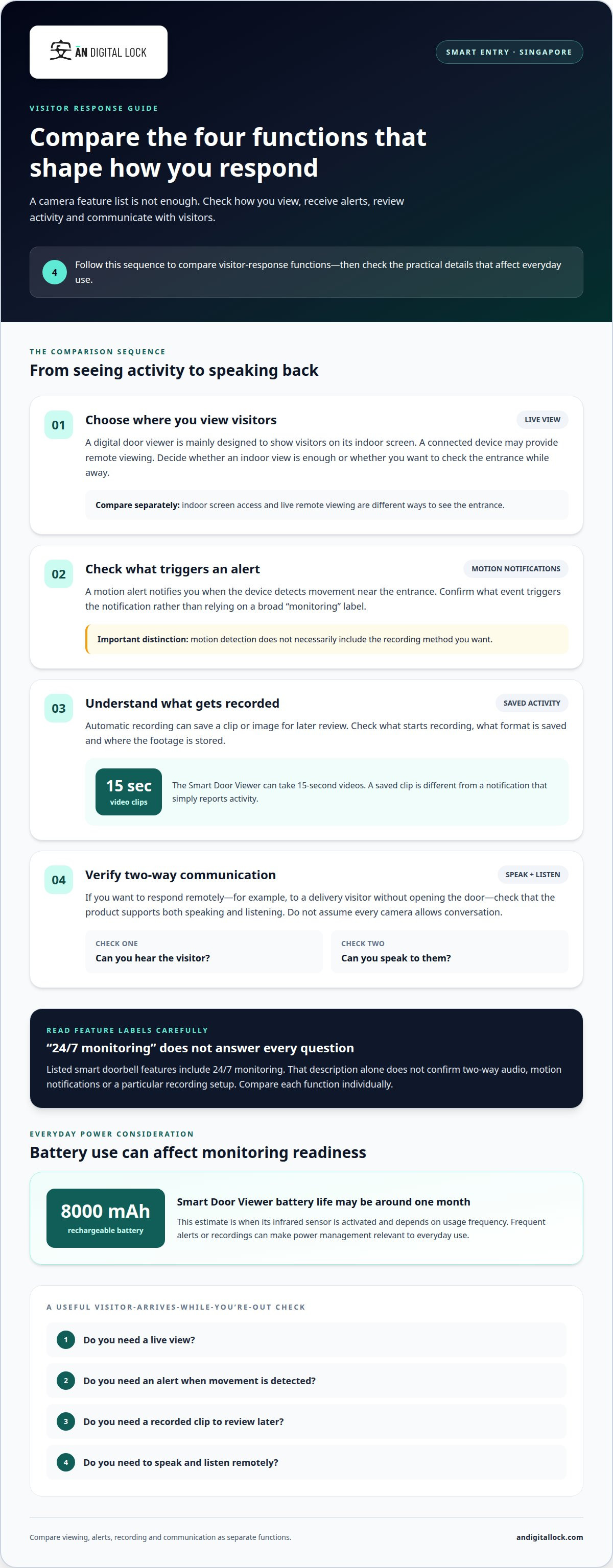
A motion alert notifies you when a device detects movement near the entrance. Automatic recording can save a clip or image for later review. These functions can help when a visitor leaves before you reach the door, but they’re distinct: motion detection doesn’t necessarily include the recording method you want.
Compare the trigger and saved format. For example, the Smart Door Viewer can take 15-second videos. That gives you a short recorded view, while a notification tells you that activity occurred. Look for clear information about what triggers recording and where footage is stored. Those details shape whether alerts provide a useful record or simply announce movement.
Remote Visitor Monitoring
Remote monitoring means viewing entrance activity while away from home, usually through a connected device. Listed smart doorbell features include 24/7 monitoring. That description indicates ongoing monitoring, but it shouldn’t be treated as proof of two-way audio, motion notifications, or a particular recording setup. Compare each function separately.
Use this sequence to compare visitor-response functions:
- Identify whether the device offers live viewing or an indoor screen.
- Check for movement notifications and the event that triggers them.
- Compare automatic recording with the available clip format.
- Confirm whether remote communication includes both speaking and listening.
Battery use can also affect how consistently a viewer is ready to monitor the entrance. The Smart Door Viewer uses an 8000 mAh rechargeable battery, which may last around one month when its infrared sensor is activated, depending on usage frequency. Frequent alerts or recordings can make power management relevant to everyday use. Compare this practical consideration alongside visitor alerts and communication, not just camera functions.
Digital door viewer versus video doorbell functions
In Singapore, a digital door viewer may suit residents who mainly want to see visitors indoors, while a video doorbell may suit those who prioritise entrance monitoring. Choose based on the functions your household needs and the installation conditions at your home.
Condo rules can vary by development, so check the relevant requirements for device placement and changes to the entrance. Don’t assume the same installation approach applies to every condo.
A digital door viewer is designed primarily to show visitors on an indoor screen. A video doorbell centres on an entrance camera and may include monitoring functions. They’re different setups, not interchangeable names for the same device. If you want to see visitors without relying on a phone, an indoor screen may suit your routine. If you want to monitor the entrance remotely, compare the doorbell’s specific connected functions.
Field of view is another useful comparison. Digital door viewers can offer fields of view ranging from 160 to 360 degrees, depending on the device. A wider angle can show more of the area around the doorway, but the stated angle alone doesn’t tell you how the view appears from your actual entrance. Consider what you need to see, such as a visitor standing close to the door or activity across a broader area.
Consider how each device fits the way you answer the door. If you prefer checking an indoor screen, prioritise the viewer’s display and camera view. If you want connected monitoring, compare a video doorbell’s remote functions. Decide where you want to view visitors, whether remote monitoring matters, then compare the camera’s field of view and installation requirements.
The door itself also matters in Singapore flats and condos. Digital door viewers generally fit the standard peephole position on many main doors, but compatibility depends on the door type, peephole size, and installation setup. A video doorbell mounts differently, so suitability depends on where it can be installed and how well that position captures the entrance. These practical differences can narrow your options before you compare extra features.
Choose by function, not by the word “smart.” A digital viewer focuses on showing visitors indoors, while a video doorbell may better suit remote monitoring. For either option, compare the actual viewing angle, display or monitoring method, and fit with your entrance. These criteria offer Singapore households a more useful basis for deciding than a feature label alone.
Door viewer and video doorbell product prices
Compare the complete setup, not just the device price. For a digital door viewer or video doorbell in Singapore, installation, door compatibility, and recording requirements all matter. One advertised price may cover only the device, while another offer may include fitting. Separate these costs before judging value.
Use the Smart Door Viewer’s listed specifications to assess what its price represents. It has a 4.3-inch indoor screen, 1080P HD view resolution, and a 130° camera view. It also supports a micro SD card with a maximum capacity of 32Gb. These details help you compare screen, image quality, viewing angle, and local storage against another device’s specifications.
Installation is another point to compare. A viewer must fit the door’s thickness and peephole opening, while a video doorbell uses a different mounting setup. Compatibility affects the work involved. An existing peephole may suit a viewer, while a doorbell needs a suitable mounting surface near the entrance. Check what installation includes when comparing options.
Recording can also change the total setup. The Smart Door Viewer can take 15-second videos, and a 32 GB micro SD card can store around 1,000 such videos. A card can also store around 8,000 images. If you want to save footage, compare whether storage is included, the supported capacity, and the recording format before deciding.
Battery design is another value factor. The Smart Door Viewer uses an 8000 mAh rechargeable battery. Its battery may last around one month when the infrared sensor is activated, depending on usage frequency. For a battery-powered device, consider how often it may need charging alongside its screen and recording functions. For a wired or differently powered doorbell, compare its stated power setup instead.
Use this simple comparison before choosing:
- Separate the device from installation in each offer.
- Match the screen, camera resolution, and viewing angle to your needs.
- Include storage media if you plan to save images or video.
- Compare the power arrangement and the door’s fitting requirements.
Compare like with like. A viewer with an indoor screen and local storage isn’t directly equivalent to a doorbell focused on remote monitoring. List the functions you’ll use, then compare only devices that meet those needs. This keeps your Singapore price comparison focused on the complete setup, including installation and storage.
Best smart door viewers and video doorbells available in Singapore
There isn’t one best device for every Singapore home. Compare the Smart Door Viewer’s indoor-screen format with a video doorbell’s entrance-camera functions, then match the specifications to your door and routine. Shortlist products that suit the installation and offer the viewing and storage features you’ll actually use.
The Smart Door Viewer combines a 4.3-inch TFT screen with a 1080P HD view and a 130° camera angle. Its camera is also specified as 2 megapixel high definition. These details help you assess the screen and image specifications together, rather than treating “HD” as the only useful measure. A listed smart doorbell feature set includes 1080p video and a 135° wide-angle view, giving you comparable figures to review.
Storage is another practical difference. The Smart Door Viewer supports a micro SD card up to 32Gb, while the listed smart doorbell features include 7 days of cloud storage. One approach uses a memory card; the other specifies cloud retention. Consider where you want footage stored and how you prefer to access it. For the viewer, the recommended card is Class 10, with a writing speed of 10Mbs.
Fit matters before you select a device. The Smart Door Viewer is specified for doors 40-110 mm thick and peephole diameters of 14-30 mm. Its indoor screen measures 140 mm by 82 mm by 20 mm. These dimensions help indicate whether the device suits the door and the space available indoors. Compatibility depends on the door and installation setup, so compare the stated measurements against the entrance.
Use this shortlist to identify the better match:
- Choose by viewing setup: prioritise an indoor screen or the video doorbell’s listed camera functions.
- Compare footage storage: weigh a supported micro SD card against the listed 7 days of cloud storage.
- Match the door: consider thickness, peephole diameter, and the required mounting arrangement.
- Review product support: the Smart Door Viewer has a 1-year product warranty.
If your household wants an indoor screen and local recording, compare those specifications in a Smart Door Viewer. If you prioritise cloud storage or a wider stated camera angle, the listed video doorbell features may better match your preferences. Neither specification alone determines which device will suit every entrance. Compare fit, viewing method, and storage before deciding.
Singapore HDB rules for installing smart doorbells and door viewers
For an HDB flat, distinguish device fit from installation requirements. A product’s dimensions indicate whether it may suit a door, but don’t establish the rules for every flat or installation. Consider applicable HDB guidance before making changes to the existing entrance.
A digital door viewer is designed to use the peephole position, while a video doorbell has a separate mounting arrangement. In Singapore HDB flats, a standard 14 mm door-hole diameter is a common compatibility reference for digital viewers. The actual door, peephole, and product measurements still determine whether a particular model fits.
Installation height is another practical consideration. The standard door viewer height is approximately 147-152 cm from the floor. That reference can help residents assess the view from indoors, especially if household members differ in height. The door’s existing peephole position may affect where the viewer can be installed.
Before choosing, compare the device’s physical requirements with your entrance:
- Measure the door thickness and peephole diameter against the product specifications.
- Consider whether the device uses the existing peephole or requires a different mounting arrangement.
- Review how the installation affects the entrance and the view from inside the flat.
- Separate product compatibility from any applicable HDB installation guidance.
For example, a viewer specified for doors 40-110 mm thick and peepholes 14-30 mm wide has defined fitting limits. A 14 mm opening falls within that stated diameter range, but door thickness and the installation setup remain relevant. Don’t treat one matching measurement as proof that every part of the installation will fit.
Keep installation requirements in view. Replacing an existing peephole with a digital viewer may involve different work from attaching a video doorbell elsewhere on the entrance. Don’t assume a mounting method suitable for one HDB flat will work in another. Door material, existing hardware, and the selected device all affect the setup.
For smart doorbell placement, consider the camera’s position and the area it captures. Mounting it away from the peephole can change the view of visitors. Check that the chosen location meets your needs and applicable property requirements. Product features alone don’t determine whether a particular installation is suitable.
Use the measurements and installation method to narrow your options, then follow the relevant HDB guidance for the work. To explore digital door viewer options for an HDB entrance, compare the product’s fit requirements with your door’s existing peephole setup.
AN Digital Lock: Digital Door Locks
AN Digital Lock helps Singapore homeowners consider entrance products that complement a smart door viewer or doorbell. For a wider entrance upgrade, explore its Digital Door Locks, Wooden Doors, and Metal Gates. These products let you plan visitor viewing alongside access and the physical entrance.
Start with the function you need most. A viewer or doorbell helps you see visitors; a Digital Door Lock manages access. If you’re also furnishing a home or organising valuables, AN Digital Lock offers Wooden Doors and Safe Boxes. Choose products that fit your project instead of adding features you won’t use.
For guidance on entrance products, contact AN Digital Lock.
Plan your entrance around everyday use
Choosing between a smart door viewer and smart doorbell in Singapore is one part of planning a comfortable, secure-feeling entrance. Consider how you want to see visitors, manage access, and whether your entrance suits the device you prefer. A coordinated setup can make the space feel more considered without adding unnecessary functions.
For a broader entrance project, AN Digital Lock offers Digital Door Locks, Wooden Doors, and Metal Gates. These products are relevant if you’re planning more than visitor viewing, such as updating access or changing the door and gate together. Choose your next step based on the part of your entrance you want to improve.
Share your plans with AN Digital Lock and explore suitable options for your home. Contact AN Digital Lock for advice, and take the next step towards an entrance that works for you.
Frequently Asked Questions
What is a digital door viewer?
A digital door viewer uses a camera and indoor display to show who’s outside, rather than relying on a conventional peephole. It’s useful when you want to check the entrance from inside without standing directly at the door. Compare the screen’s size and position with where household members can comfortably view it, then check whether the device fits the existing door opening.
Can I see my door from my phone when I'm not home?
Remote viewing requires a device designed for app access and a suitable network connection. An indoor-screen viewer doesn’t necessarily provide phone viewing. Before choosing a model, distinguish live phone access from saved footage or notifications. A recording you can review later, for instance, doesn’t necessarily provide a live view while you’re away.
How long can the batteries last?
The Smart Door Viewer’s 8000 mAh rechargeable battery may last around one month when its infrared sensor is activated, depending on usage frequency. Frequent sensor activity can affect how often you need to recharge it. For example, an entrance with regular visitor movement may use the sensor more often than a quieter doorway. Keep the charging routine in mind when deciding where the indoor screen will sit.
What is the difference between a smart door viewer and a smart doorbell?
A smart door viewer centres on checking visitors from indoors, usually through an indoor screen. A smart doorbell is built around an entrance-mounted camera and may offer connected monitoring. Consider whether you mainly want a convenient indoor view or app-based access while away. Compare each device’s actual functions, since its label alone doesn’t confirm which features it includes.
Do smart doorbells need Wi-Fi, a subscription, or cloud storage?
Wi-Fi is needed for network-dependent features such as app-based remote viewing. Cloud storage is a separate feature from local recording, and the listed smart doorbell features include 7 days of cloud storage. Subscription requirements depend on the specific product and service terms. Before deciding, separate three questions: whether the device connects to Wi-Fi, where recordings are stored, and whether continued cloud access carries a subscription.
Smart doorbell and door viewer privacy risks and data security
For Wi-Fi-enabled digital door viewers, reduce security risks with end-to-end encryption, regular firmware updates, strong passwords, and two-factor authentication.