


Did you know that a standard sliding door latch can often be bypassed with less than 150kg of prying force? It's a sobering thought for many Singaporean homeowners who rely on basic manual hooks to secure their balconies. You've probably felt that nagging worry about the "Track-Pop" method, where intruders simply lift the door off its rails to gain entry. You likely want the convenience of keyless access but fear that installing a sliding glass door digital lock might shatter your expensive tempered glass or void your door's warranty.
We understand that your home's security shouldn't come at the cost of its aesthetics or structural integrity. This ultimate 2026 buying guide promises to simplify your decision by highlighting locks that utilize advanced vertical-clamp technology and slim profiles designed specifically for HDB and condo layouts. You'll discover how to achieve a secure, smart-home integrated entrance that meets the latest safety standards and provides 0.5-second biometric recognition. We will walk you through the top-rated models from brands like Solity and Philips, explain the benefits of Matter compatibility, and show you exactly how to choose a drill-free solution that keeps your family safe.
Key Takeaways
- Learn why standard sliding door latches are vulnerable to the "Track-Pop" method and how to eliminate this security gap effectively.
- Discover how a sliding glass door digital lock with vertical clamp technology provides superior resistance against prying forces compared to traditional hook latches.
- Identify the best slim-profile digital locks from brands like Solity and Philips that fit narrow aluminium frames common in Singaporean condos and HDBs.
- Explore professional "No-Drill" installation methods that secure your balcony glass without risking cracks or voiding your door's warranty.
- Master the latest 2026 smart home trends, including Matter compatibility and biometric access, for a frictionless and modern home entry experience.
The Vulnerability of Standard Sliding Glass Door Locks
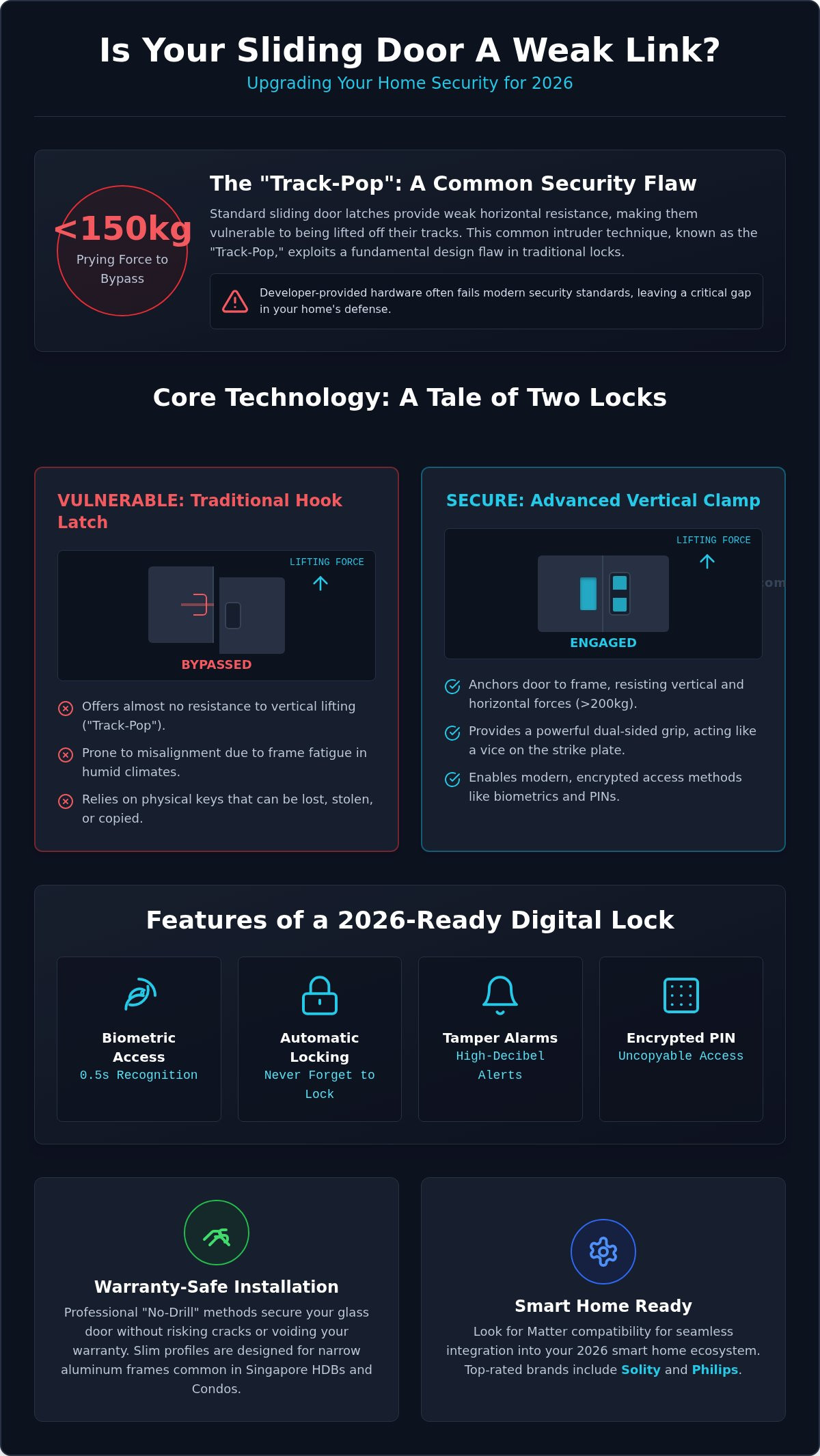
Many homeowners believe their balcony is a private sanctuary. The reality is often different. Standard sliding doors are statistically easier to bypass than traditional swing doors because of their track-based design. Most intruders don't bother picking locks; they exploit mechanical gaps instead. The most common technique is the "Track-Pop" method. By using a simple lever or crowbar, an intruder can lift the entire door panel upward. Since standard hook latches only provide horizontal resistance, the door clears the track and swings open even while locked. Research indicates these basic latches can fail under just 150kg of prying force, making them a minor hurdle for a determined intruder.
Why Your Balcony is a Security Weak Point
Singapore's high-rise living doesn't grant automatic immunity. Condo balconies are often accessible via adjacent units or maintenance ledges. For HDB ground units, the risk is even more direct. A visible, flimsy latch sends a message of vulnerability. It's vital to upgrade developer-provided hardware to something more robust. A modern sliding glass door digital lock acts as both a physical barrier and a psychological deterrent. It signals that your home is protected by 2026-standard technology rather than outdated mechanical hooks. Upgrading is about moving from a "visible" lock to a "verifiable" security system.
The Limitations of Mechanical Sliding Door Latches
Traditional locks suffer from physical degradation that many people ignore. Singapore's humid climate can cause aluminium frames to experience fatigue after about seven years, leading to subtle misalignments. When a door doesn't sit perfectly on its rail, a mechanical hook latch loses its grip. Additionally, traditional keys are a constant security liability. They're easily picked or duplicated at local locksmiths without your consent. Transitioning to a sliding glass door digital lock provides essential electronic features that mechanical hardware simply cannot match:
- Automatic deadlocking: The system engages the moment the door is closed, ensuring you never forget to lock up.
- Tamper alarms: Integrated sensors trigger high-decibel alerts if the door is shaken or pried.
- Encrypted access: Use biometrics or PIN codes that can't be "picked" or physically duplicated like a metal key.
Relying on a basic latch in 2026 is a gamble. By understanding these mechanical flaws, you can take the necessary steps to secure your home's most accessible entry points with technology built for modern Singaporean residential needs.
Decoding Digital Lock Mechanisms for Sliding Doors
Choosing the right hardware requires a deep dive into the engineering that keeps your home safe. While traditional locks rely on a simple hook, a high-quality sliding glass door digital lock utilizes more sophisticated engagement methods. The most significant advancement for 2026 is the shift toward vertical clamp technology. Vertical clamp technology serves as the primary defense against track-lifting by physically anchoring the door panel to the frame, making it nearly impossible to pry the door upward and off its rails.
The strike plate plays a crucial role in this setup. It's the reinforced metal component mounted on the door frame that the lock's bolt or clamp interacts with. In a sliding door configuration, the strike plate must be perfectly aligned to ensure the vertical clamps can "bite" securely. Without a precision-engineered strike plate, even the most advanced digital lock loses its effectiveness.
Vertical Clamp vs. Hook Latch
Understanding the difference between these two mechanisms is critical for your home security. Traditional hook latches are designed to prevent the door from sliding horizontally. However, they offer almost no resistance to vertical movement. An intruder can lift the door panel just a few centimeters, causing the hook to slip out of its housing. In contrast, vertical clamps act like a powerful vice. They grip the strike plate from both the top and bottom simultaneously. This dual-sided grip ensures that even if someone tries to lift the door, the lock remains firmly engaged with the frame.
- Horizontal Pull Strength: Modern digital locks are tested to withstand over 200kg of lateral force, significantly higher than mechanical latches.
- Frame Engagement: The clamp is specifically engineered for the narrow aluminium profiles common in Singaporean condos and HDBs.
- Anti-Pry Design: The vertical orientation of the locking bolt means that prying tools have no leverage to force the mechanism open.
Auto-Locking Benefits for Sliding Doors
Human error is the leading cause of security breaches in Singaporean households. It's easy to slide a balcony door shut without fully engaging the manual latch, leaving your home exposed. A smart sliding glass door digital lock removes this risk entirely through sensor-based auto-locking. These sensors detect exactly when the door panel meets the frame and engage the deadlocking mechanism within seconds. If you're looking for the most secure options for your home, you can browse the latest vertical clamp models at our showrooms to see these mechanisms in action.
For a truly seamless experience, many homeowners integrate these locks with pneumatic door closers. This setup ensures the door always returns to the closed position, where the digital sensor then takes over to secure the latch. This combination is especially useful for families with children or pets who frequently move between the living room and the balcony. By automating the physical act of locking, you ensure that your secondary entry points are just as secure as your main entrance.
Key Considerations for Singapore Balcony and Kitchen Doors
Selecting a sliding glass door digital lock isn't just about security; it's about survivability in Singapore's tropical climate. High humidity levels often exceeding 80% can wreak havoc on sensitive electronics if the hardware isn't properly rated. Whether you're securing a breezy condo balcony or a kitchen door prone to steam and grease, you need a device built for these specific conditions. For a broader look at home security, check our Digital Lock Singapore guide to understand how different technologies fit into your overall home ecosystem.
Weather Resistance and IP Ratings
For most sheltered balconies in Singapore, an IP54 or IP55 rating is the industry standard for 2026. This ensures the internal circuits are protected from dust and occasional rain splashes during a sudden monsoon downpour. If your balcony is prone to direct sun exposure, look for locks with UV-resistant tempered glass panels to prevent the interface from fading or cracking over time. Zinc alloy bodies are highly recommended because they resist corrosion in our salty, humid air much better than cheaper plastic alternatives. Always confirm the IP rating with your installer if the lock will be exposed to driving rain.
Slim Profile Design for Narrow Frames
The biggest hurdle for Singaporean homeowners is the narrow width of aluminium sliding frames. Standard digital mortise locks are designed for thick wooden doors and simply won't fit these slim profiles. You must measure your "backset", which is the distance from the edge of the door to the center of the lock, very carefully. Most sliding glass doors require a slim-profile sliding glass door digital lock with a backset of 35mm or less. Choosing a bulky model will lead to a messy installation that might interfere with the glass or prevent the door from sliding fully into its pocket. Many 2026 models now feature "ultra-slim" chassis specifically engineered for HDB and condo aluminium frames.
Consider your daily habits when choosing access methods for different areas of the home. In the kitchen, where hands are often wet or oily from food preparation, a biometric fingerprint sensor might struggle to read your print accurately. In these specific scenarios, RFID cards or mobile app unlocking provide a more reliable, frictionless experience. For balconies, where hands are typically dry, the high-speed biometric sensors found in modern models offer the ultimate convenience. Balancing these practical needs ensures your smart home remains helpful rather than frustrating.
- Kitchen Doors: Prioritize RFID or PIN access for reliability with wet hands.
- Balcony Doors: Focus on IP ratings and biometric speed for quick entry.
- Narrow Frames: Verify the lock's width against your aluminium frame's surface area.
Best Sliding Glass Door Digital Locks for 2026
Selecting the right hardware is the final step in securing your balcony or kitchen entrance. In 2026, the market offers specialized solutions that go beyond basic keyless entry, focusing instead on mechanical strength and high-speed processing. While many generic options exist, only a few brands have perfected the slim-profile sliding glass door digital lock required for Singaporean aluminium frames. You need a device that balances aesthetic refinement with the ruggedness to withstand our local environment.
Solity GG 33B: The Specialist Choice
The Solity GG 33B is widely considered the powerhouse for sliding door installations. It's specifically engineered with a dual-action vertical clamp mechanism that physically anchors the door panel to the strike plate. This design provides the vertical resistance needed to stop "Track-Pop" intrusions. Beyond its physical strength, it includes a high-temperature alarm that triggers in fire scenarios, ensuring the lock releases for a safe exit. For those living in high-traffic HDB blocks, the "Fake PIN" feature is a standout. It allows you to enter random digits before or after your actual code, making it impossible for curious neighbors to memorize your sequence.
- Biometric Speed: Philips Glass Door Lock models lead the industry with a 0.5-second fingerprint recognition time.
- Rental Management: The Igloohome Glass Door Lock is the best for rental properties, allowing owners to generate time-sensitive PINs remotely.
- Battery Life: Most 2026 models operate on AA batteries with an expected lifespan of 10 to 14 months.
- Emergency Power: If you miss the low-battery alerts, these locks feature a 9V battery terminal or a USB-C port for instant emergency power via a power bank.
Smart Home Integration: Zigbee and Wi-Fi
Modern security is about more than just locking a door; it's about ecosystem connectivity. Many of the latest 2026 models are Matter-compatible, meaning they integrate seamlessly with Apple Home, Google Home, and Alexa. This allows you to create automation routines, such as having your balcony lights turn on the moment the door is unlocked. Remote unlocking is also a game-changer for social gatherings. You can let guests onto the balcony while you're busy in the kitchen without ever touching the door. If you want to see how these specialized devices differ from standard front door hardware, you can read our Mortise Lock guide for a full comparison.
Choosing a lock is a long-term investment in your family's safety and convenience. We recommend visiting our showrooms to feel the mechanical quality of these devices in person. You can explore our full range of 2026 digital locks and speak with our specialists to find the perfect fit for your specific sliding door profile. Our team ensures that your chosen lock provides a frictionless experience from the very first day of installation.
Seamless Installation and Professional Integration in Singapore
Finding the perfect hardware is only half the battle. The success of your sliding glass door digital lock depends entirely on the precision of its installation. Unlike standard wooden doors, glass and aluminium frames leave zero room for error. A slight misalignment of just 2mm can prevent sensors from triggering the auto-lock mechanism, leaving your balcony unsecured despite the high-tech investment. Professional integration ensures that the physical lock and the digital sensors work in perfect harmony with your door's specific track system.
Frameless vs. Framed Glass Door Requirements
Frameless glass doors require a specialized "No-Drill" approach. Since tempered glass cannot be drilled without shattering, we utilize vertical-clamp technology that securely "clips" onto the edge of the glass panel. This method avoids industrial adhesives that often degrade or peel in Singapore's intense heat and humidity. You must also consider the clearance gap between your sliding panels. If the gap is too narrow, the lock body might strike the adjacent glass pane during operation. For framed aluminium doors, we typically employ a bracket-mount system. This provides a stable foundation for the lock without compromising the structural integrity of the slim frame. If you're also looking to upgrade your primary entrance, our HDB Main Door guide offers excellent insights into matching your home's overall security aesthetic.
- Clearance Check: Ensure there's at least 5mm of space between sliding panels for a frictionless fit.
- Strike Plate Alignment: Our installers adjust the strike plate to account for doors that don't sit perfectly flush against the frame.
- Sensor Calibration: We test the magnetic sensors multiple times to guarantee the auto-lock engages every single time the door closes.
Choosing Your Security Partner in Singapore
Selecting a reliable partner is essential for long-term peace of mind. AN Digital Lock has been a trusted expert in the Singapore market since 2013, serving thousands of HDB and condo residents. As an authorized dealer for global leaders like Philips, Solity, and Zigbang, we provide authentic hardware backed by genuine local warranties. Our professional installation team brings over 10 years of experience to every home, ensuring your sliding glass door digital lock is fitted with surgical precision. We don't just install a product; we provide a comprehensive service that includes onsite technical support and long-term maintenance advice.
Don't leave your balcony security to chance with a DIY attempt or an unverified contractor. Seeing is believing, so we invite you to experience the latest 2026 technology for yourself. Visit our showrooms at Paya Lebar or Sembawang for a live demonstration of our vertical clamp locks. Our specialists are ready to help you find a secure, drill-free solution that protects your home without voiding your door's warranty.
Secure Your Future with Advanced Home Protection
Upgrading to a modern sliding glass door digital lock is the most effective way to eliminate the mechanical vulnerabilities of standard balcony latches. You now understand that vertical clamp technology and slim-profile designs are the essential standards for protecting Singaporean homes in 2026. These specialized innovations don't just provide keyless convenience; they offer a robust physical barrier that traditional hooks simply can't match. By choosing hardware designed for our local climate and narrow aluminium frames, you ensure your security remains reliable for years to come.
As an official distributor for Solity, Philips, and Zigbang, AN Digital Lock has helped over 10,000 happy Singaporean homeowners transition to smarter security. Our expert installation team has been featured in major Singapore home and decor publications, reflecting our commitment to quality since 2013. We provide the technical support and onsite warranties you need for a frictionless experience. Secure your balcony today with AN Digital Lock’s glass door solutions and enjoy the peace of mind that comes with professional, drill-free integration. Your home's safety is a long-term investment. It's time to embrace the contemporary refinement your family deserves.
Frequently Asked Questions
Can a digital lock be installed on a frameless sliding glass door?
Yes, a sliding glass door digital lock can be installed on frameless doors using vertical-clamp technology. These units clip securely onto the glass edge without the need for drilling or permanent adhesives. This method is ideal for HDB and condo balconies because it leaves the tempered glass intact. Our team has performed these specialized installations since 2013, ensuring a firm grip that doesn't slip or vibrate over time.
Will a sliding glass door digital lock prevent the door from being lifted?
Yes, choosing a model with vertical clamp technology effectively prevents the door from being lifted off its tracks. While standard hook latches offer no vertical resistance, these digital clamps anchor the door panel directly to the strike plate. This mechanism is specifically designed to stop the "Track-Pop" method used by intruders. It provides significantly higher resistance than developer-provided hardware, making your balcony a much harder target for criminals to bypass.
What happens if the battery of my glass door lock dies?
You won't be stranded if the batteries fail. Most 2026 digital locks operate on AA batteries that last 10 to 14 months, but they also include emergency power options for your convenience. You can use a 9V battery or a USB-C power bank at the external terminal to jump-start the system. This provides enough temporary power to unlock the door via fingerprint or PIN so you can replace the internal batteries immediately.
Are digital locks for glass doors waterproof for balcony use?
Most high-quality locks for balcony use are weather-resistant rather than fully waterproof. For a sheltered Singaporean balcony, you should look for an IP54 or IP55 rating. This protects the internal electronics from dust and the occasional rain splashes during a heavy monsoon downpour. If your lock will face direct rain, it's best to consult our specialists about adding a protective cover or choosing a model with higher sealing standards for longevity.
Do I need to drill holes in my glass door to install a digital lock?
You don't need to drill holes into the glass itself. For frameless doors, the lock utilizes a bracket that clamps onto the panel. For aluminium-framed sliding doors, the installation involves securing the lock to the metal frame rather than the glass. This no-drill philosophy is essential for maintaining the structural integrity of your door. It also ensures you don't void any existing manufacturer warranties or HDB regulations during the upgrade process.
Can I use a fingerprint to unlock my balcony sliding door?
Absolutely. Biometric access is one of the most popular features for balcony doors. Modern sensors from brands like Philips and Solity offer an unlock time of approximately 0.5 seconds. It's a frictionless way to move between your living room and balcony without fumbling for keys. Just ensure your hands aren't excessively wet, as moisture can sometimes interfere with the capacitive sensors found in older or lower-end models on the market.
How much clearance is needed between two sliding glass panels for a lock?
Professional installers typically look for a clearance gap of at least 5mm between the two sliding panels. This space is necessary to ensure the sliding glass door digital lock doesn't rub against or strike the inner glass pane when you open the door. If your panels are too close together, a specialized slim-profile lock is required. We recommend an onsite assessment to verify these dimensions before you finalize your purchase to avoid fitment issues.
Which brands are best for sliding glass door digital locks in Singapore?
Solity, Philips, and Zigbang, formerly Samsung, are the leading brands for sliding door security in 2026. Solity is highly regarded for its dual-action vertical clamps, while Philips is preferred for its superior biometric processing speed. Zigbang offers excellent smart home integration for those using Matter-compatible systems. As an authorized dealer for these global manufacturers, we can help you compare their specific features at our Paya Lebar or Sembawang showrooms today.