


Cylindrical lock? Deadbolt? If you're upgrading the security for your HDB or condo in Singapore, the technical terms can quickly become confusing. You've likely heard that a mortise lock is the premium choice for ultimate protection, but what exactly makes it different? And is the higher price tag truly worth the investment for your family's peace of mind?
This guide is designed to give you clear, straightforward answers. We will cut through the jargon to show you exactly how these robust locks operate, compare them directly against other common types, and explain why they are considered the gold standard for home security across the island.
By the end of this article, you will have the confidence to decide if a mortise lock is the right choice for your home. You'll understand its powerful features and be fully prepared to discuss your security needs with a professional installer, ensuring a seamless and secure experience from start to finish.
Key Takeaways
- Learn how a mortise lock’s unique design, concealed within your door, provides a superior level of security for your HDB or condo.
- Quickly identify the key differences between this lock type and the common cylindrical locks found on most interior doors.
- Discover why the most trusted digital locks in Singapore are built upon the strength of a traditional mortise body.
- Determine if this high-security lock is the right choice for your main door to achieve ultimate peace of mind.
The Anatomy of a Mortise Lock: Unpacking the Components
Imagine a strong metal case hidden inside a pocket carved into the edge of your door. That’s the basic principle behind a mortise lock. This "pocket"-or mortise-is precisely what gives the lock its renowned strength and durability. Unlike simpler locks that are just drilled through the door, a mortise lock becomes an integral part of the door itself. To understand its superior design, it helps to first know exactly what a mortise lock is and how its core components work together to provide ultimate peace of mind.
The Lock Body (The 'Mortise')
The heart of the system is the lock body: a large, rectangular metal cassette that fits snugly inside the mortise. This robust case houses the entire complex mechanism, protecting it from tampering and force. Compared to a standard cylindrical lock found on many HDB bedroom doors, the lock body of a mortise lock is significantly larger and more intricate, integrating all functions into one secure unit for maximum resilience.
Latchbolt and Deadbolt
A key feature providing layered security is the presence of two distinct bolts working in tandem:
- The Latchbolt: This is the angled, spring-loaded bolt that clicks into place when you close the door. It is operated by turning the handle or lever, allowing for quick and convenient passage.
- The Deadbolt: This is the solid, rectangular bolt that provides the real security. It doesn't rely on a spring and can only be extended or retracted by a turn of the key or an internal thumbturn, locking the door firmly in place.
The Trim: Handles, Knobs, and Levers
The "trim" refers to all the visible hardware on the surface of your door-the parts you see and touch every day. This includes the handles, levers, or knobs, as well as the plates they are mounted on (escutcheons). The trim is what you use to operate the latchbolt for everyday entry and exit. It comes in a vast array of styles, allowing you to match your lock's appearance to your home's aesthetic without compromising on security.
Strike Plate and Cylinder
Two final pieces complete the security puzzle. The strike plate is the metal plate installed on your door frame that receives the bolts. It does more than just prevent scratches; it reinforces the frame at its weakest point, bracing it against forced entry. The lock cylinder is the part where you insert your key. It contains the pin-tumbler mechanism that, when the correct key is used, allows you to engage or retract the deadbolt, securing your home.
Mortise Lock vs. Cylindrical Lock: A Head-to-Head Comparison
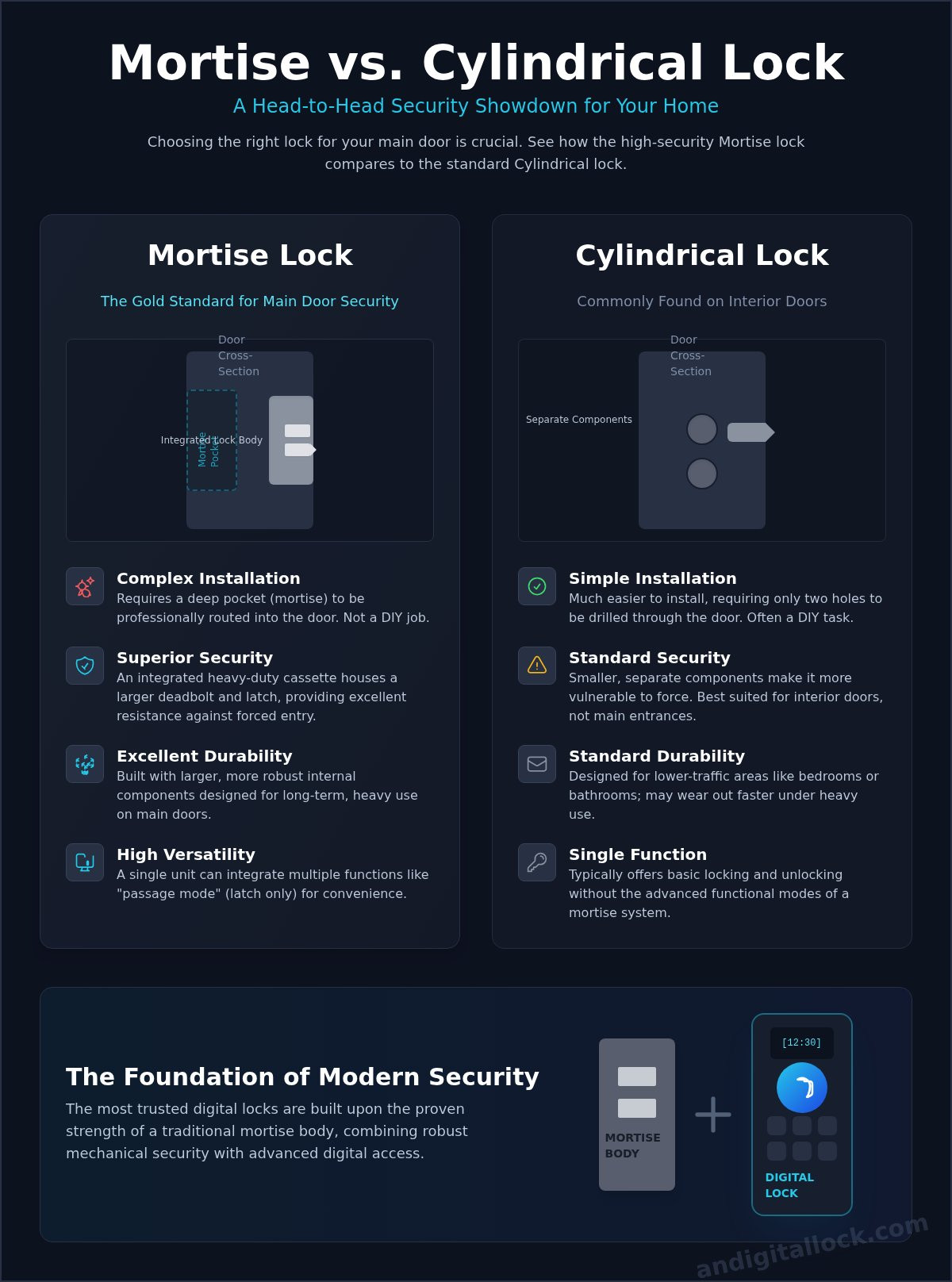
When choosing a lock for your home, you'll likely encounter two main types: mortise and cylindrical. While the cylindrical lock (also called a bored lock) is common for interior doors in many Singapore homes, the mortise lock offers a significant upgrade in security and functionality, especially for main entrance doors. Understanding the core differences is key to making the right choice for your family's safety and achieving ultimate peace of mind.
Installation and Door Preparation
The most immediate difference lies in how they are installed. A cylindrical lock is simple to fit, requiring just two holes drilled into the door. In contrast, a mortise lock requires a deep, rectangular pocket-the mortise-to be expertly routed into the edge of the door. This complex process is not a DIY job and demands a professional installer to ensure a perfect, secure fit for your HDB or condo door.
Security and Durability
This is where the mortise lock truly excels. Its lock body is a heavy-duty cassette containing larger, more robust internal components. The latch and deadbolt are integrated into this single, solid unit, providing superior resistance against forced entry attempts like kicking or prying. Cylindrical locks, with their smaller, separate components, are generally easier to bypass, offering less protection for critical entry points.
Functionality and Versatility
A mortise lock is more than just a lock; it's a versatile locking system. A single unit can combine multiple functions, such as 'passage mode' (latch only, no locking) or 'classroom function' (key locks/unlocks the outside lever). This adaptability makes them ideal for various applications. Cylindrical locks are typically single-function, offering basic locking and unlocking without these advanced, convenient features.
Mortise Lock
- Installation: Complex; requires a deep pocket (mortise) routed into the door. Professional installation is essential.
- Security: High; integrated heavy-duty deadbolt and latch in a strong cassette. Excellent resistance to forced entry.
- Durability: Excellent; built with larger, more robust internal parts for long-term, heavy use.
- Versatility: High; can integrate multiple functions like passage, privacy, and classroom modes in one unit.
Cylindrical Lock
- Installation: Simple; requires two drilled holes. Suitable for DIY.
- Security: Standard; separate latch and deadbolt components. More vulnerable to bypass.
- Durability: Good; designed for standard residential use but less durable under stress.
- Versatility: Low; typically single-function (e.g., locking or passage).
The Evolution: How Mortise Locks Power Modern Digital Security
The classic mortise lock has a long history of providing reliable security. But its story doesn't end with a traditional key. Today, this time-tested mechanism forms the powerful core of the most advanced digital locks, blending centuries of mechanical strength with cutting-edge convenience. It’s not about replacing the mortise; it's about upgrading how you control it for a seamless, modern lifestyle.
The Best Foundation: Why Digital Locks Use a Mortise Body
When you invest in a premium digital lock, you're investing in security first. That's why top brands build their best models around a strong mortise body. This robust metal case doesn't just house a formidable deadbolt; it also shields the sophisticated electronic components from tampering and impact. This fusion of strength and technology ensures your smart lock is not just smart, but also incredibly tough against forced entry.
Replacing the Key: Modern Access Methods
A digital mortise lock keeps the reliable internal deadbolt but replaces the physical key with faster, more secure access methods. You gain the freedom to unlock your door in a way that suits your lifestyle, all while controlling the same powerful locking mechanism. Common access methods include:
- Biometric Fingerprint: Secure, one-touch access that is unique to you.
- PIN Codes: Grant permanent or temporary access to family and guests.
- RFID Cards: A simple tap-and-go solution, perfect for children or elderly family members.
- Smartphone Apps: Lock or unlock your door remotely from anywhere via Wi-Fi, or grant access via Bluetooth when you're nearby.
Why Digital Mortise is Perfect for Singapore Homes
For securing the main doors of HDB flats and condos across Singapore, a digital mortise lock offers the perfect balance. It provides the keyless convenience modern families need-no more worrying about lost keys or fumbling for them with full hands. Features like auto-locking provide ultimate peace of mind, ensuring your door is always secure. Plus, with activity logs, you can always know who has accessed your home and when. This combination of robust security and seamless convenience is the new standard for home protection.
See how mortise security powers our range of digital locks and find the perfect fit for your home today.
Is a Mortise Lock Right for Your Home? Key Considerations
Choosing the right lock is the most critical decision for your home's security. A mortise lock represents a significant upgrade in strength and durability, but it's not a one-size-fits-all solution. To help you make a confident choice, here are the key factors to consider before investing in this premium security hardware for your Singapore home.
Best Applications: Main Doors and High-Security Areas
Due to their robust, integrated design, these locks offer superior protection against forced entry. This makes them the ideal choice for any primary entry point to your property. Think of your HDB or condo main door, back doors, or any entrance that requires maximum security. However, they are generally considered overkill for interior doors like bedrooms or bathrooms, where a simple latch is sufficient for privacy.
Door Compatibility: Thickness and Material
This is the most important technical check. Because the lock body is installed inside a deep pocket (the mortise) cut into the door's edge, not all doors are suitable.
- Door Thickness: Your door must be sufficiently thick, typically at least 40mm, to accommodate the lock body without weakening its structure.
- Door Material: Solid wood, metal, or heavy-duty laminate doors are perfect candidates. Hollow-core doors, often found inside older flats, are completely unsuitable as they lack the internal structure to hold the lock securely.
Why Professional Installation is Non-Negotiable
Unlike a standard cylindrical lock, installing a mortise lock is a highly precise task best left to trained professionals. The mortise pocket must be cut to exact specifications with specialist tools. An improper cut can permanently damage your door, leading to costly replacements.
More importantly, the lock's security and smooth operation are entirely dependent on a perfect fit. A poorly installed lock can fail, completely compromising your home’s safety. To ensure you get the ultimate peace of mind and a hassle-free experience, always rely on an expert installation service. Our team at AN Digital Lock provides seamless and professional fitting for all our security solutions.
Upgrade Your Security: The Final Word on Mortise Locks
From understanding their intricate components to comparing them against standard cylindrical locks, it's clear why the mortise lock remains a superior choice for security-conscious homeowners in Singapore. This time-tested mechanism has not only proven its strength over decades but has also seamlessly evolved to power the most advanced digital and smart lock systems available today, offering a perfect blend of robust protection and modern, keyless convenience for your HDB or condo.
When you're ready to make that upgrade, trust the experts. AN Digital Lock is your trusted supplier for premium digital security solutions. We are dedicated to providing a seamless, hassle-free experience, backed by professional installation from our experienced technicians and the praise of over 3,700 5-star reviews from satisfied customers across the island.
Give your family the ultimate peace of mind they deserve. Explore our range of high-security digital mortise locks and discover the perfect fit for your home today!
Frequently Asked Questions About Mortise Locks
Can I replace my current doorknob with a mortise lock?
Yes, it is possible to upgrade your standard doorknob to a mortise lock, but it requires professional installation. Unlike a simple knob replacement, this process involves cutting a precise pocket, or 'mortise,' into the door's edge to house the lock body securely. Our expert technicians handle this for you, ensuring a seamless and secure fit for your HDB or condo door, providing ultimate peace of mind without any hassle.
Are mortise locks more expensive than other types of locks?
Generally, mortise locks represent a premium investment in your home's security and are priced higher than standard cylindrical locks. This cost reflects their robust construction, complex internal mechanisms, and superior durability. Prices can range from S$300 to over S$1,000 for high-end digital models. We see this as an investment in long-term safety, offering trusted brands and 0% interest plans to make top-tier security accessible for every Singapore home.
What is the difference between a mortise lock and a deadbolt?
The key difference is in their design. A deadbolt is a standalone lock providing a single locking point. A mortise lock, however, is a complete system housed in one cassette that is fitted inside the door. This cassette typically includes both a latch (operated by the handle) and a deadbolt. This all-in-one construction offers enhanced strength and a more streamlined, sophisticated appearance compared to having two separate lock components on your door.
How do I know if my door is thick enough for a mortise lock?
Most mortise locks require a door thickness between 40mm and 60mm to properly accommodate the lock body. The best way to check is to simply measure the edge of your door. For Singapore homes, most modern HDB and condo doors meet this requirement. If you are unsure, our team will verify your door's compatibility during our free consultation, guaranteeing a perfect and secure installation for a seamless experience.
Do digital mortise locks work if the power goes out?
Yes, they do. Digital mortise locks operate on batteries and are not connected to your home's main power supply, so a power outage will not affect their function. Premium models provide low-battery alerts well in advance. For complete peace of mind, most digital locks also include a mechanical key override and an external emergency power contact point, allowing you to use a 9V battery to temporarily power the lock if needed.
How long does a high-quality mortise lock typically last?
A high-quality mechanical mortise lock, when properly installed, can easily last for decades. For premium digital models, you can expect a reliable lifespan of 10 to 20 years or more, thanks to their durable construction and advanced engineering. Choosing a trusted brand like Philips or Samsung and ensuring professional installation are key to maximising longevity. This makes a quality mortise lock a sound investment for securing your home for many years to come.