


Ground-floor access changes the security equation. Effective security solutions for ground floor HDB units focus on the entrance and any openings that face shared or outdoor spaces. The goal is to balance protection with convenient access.
Direct access can simplify daily routines, especially when lifts are busy or getting in and out is difficult. At the same time, fewer barriers between home and outdoors can make privacy, secure entry and keeping pets safely inside more important. This guide covers the concerns to consider, how ground-floor living affects accessibility, and which entrance and boundary features can support a secure, practical home.
Key Takeaways
- Assess foot traffic, privacy and activity around the unit at different times before deciding whether its surroundings suit your household.
- Weigh easier step-free access against the need to secure doors, gates and any direct openings to outdoor areas.
- Consider how the layout affects pets and everyday routines, especially where there is no lobby or other buffer between the home and the outdoors.
- Match entrance security measures to the unit’s access points, including the door, gate and windows.
- Understand that rules for window grilles and other modifications can vary, and that HIP includes an optional choice of a new entrance door and grille gate.
Ground-floor security concerns
A ground-floor HDB flat is more exposed to nearby paths and outdoor activity. A practical plan for security solutions for ground floor HDB units should address privacy, entry points and pests together.
Privacy and pest concerns
Windows facing pedestrian routes or shared spaces can raise privacy and pest concerns. Passers-by may be able to see indoors, while open windows can let insects in. Mosquito screens can help limit pests while allowing ventilation. If you spot a rat, contact building management promptly. Check the view through each window and consider how curtains or furniture can improve privacy without getting in the way.
Choosing security measures
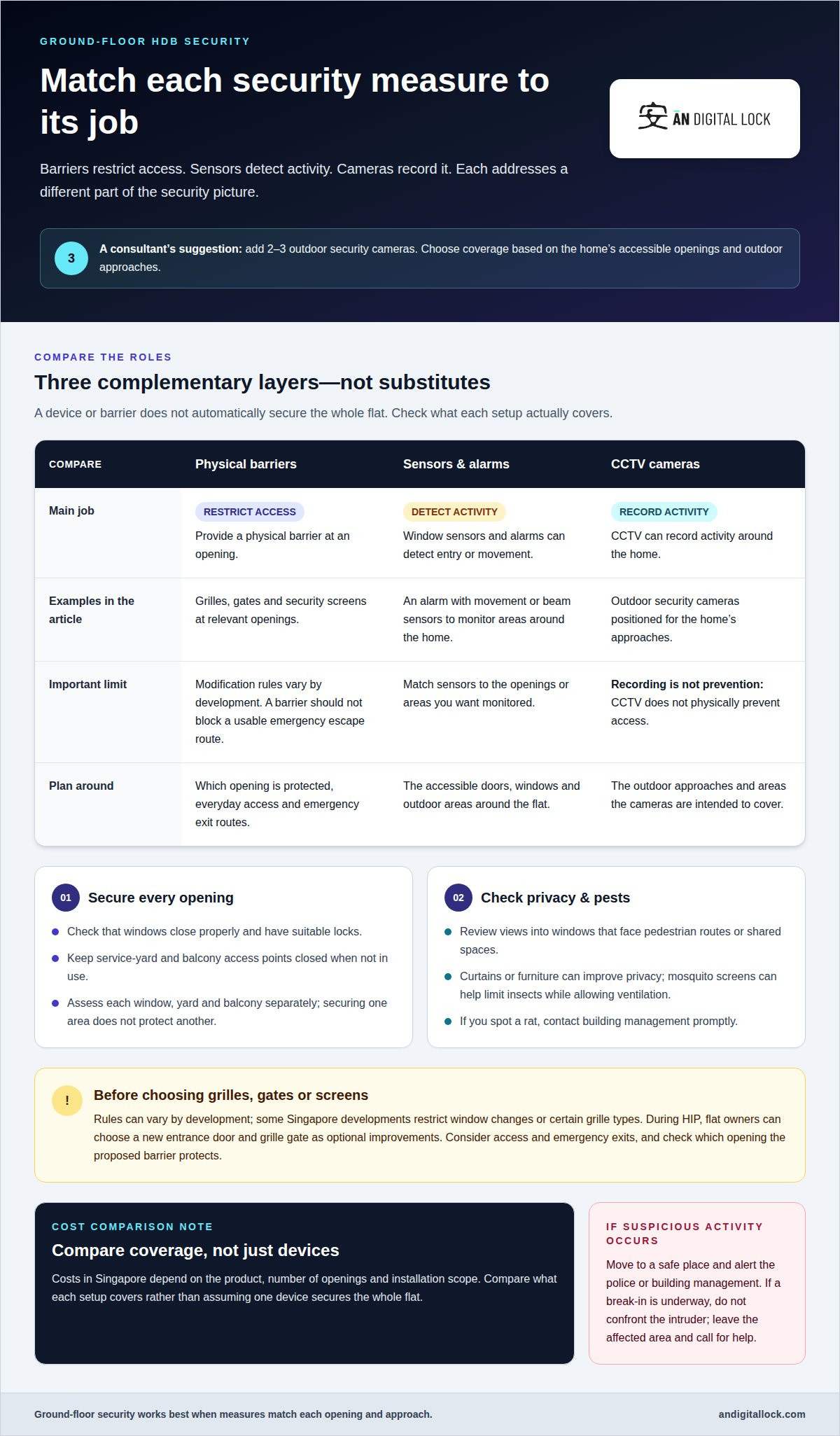
Security measures work in different ways: barriers restrict access, sensors detect activity, and cameras record it. For a ground-floor flat, an alarm with movement or beam sensors can monitor areas around the home. A security consultant also suggests adding 2-3 outdoor security cameras. The most useful security solutions for ground floor HDB units match the home’s accessible openings and outdoor approaches.
Grilles provide a physical barrier, while window sensors and alarms can detect entry or movement. CCTV can record activity, but it does not physically prevent access. These options serve different purposes, so treat them as complementary measures rather than substitutes. Costs in Singapore depend on the product, number of openings and installation scope. Compare what each setup covers, rather than assuming one device secures the whole flat.
Grilles, gates, and installation rules
Grilles, gates and security screens create barriers at different openings, but modification rules can vary by development. Some Singapore developments do not allow window changes or certain grille types. During HIP, flat owners can choose a new entrance door and grille gate as optional improvements, according to gov.sg. Consider how a proposed barrier affects everyday access and emergency exit routes, as well as which opening it protects.
Securing windows, service yards, and balconies
Secure every opening, not just the main entrance. Check that windows close properly and have suitable locks; quality frames and locks can support window security. Keep service-yard and balcony access points closed when they are not in use. Where permitted, grilles can add a physical barrier. Assess sightlines and access at each window, yard and balcony separately, since securing one area does not protect another.
If you notice suspicious activity, move to a safe place and alert the police or building management. If a break-in is underway, do not confront the intruder. Leave the affected area and call for help.
Accessibility and convenience
A ground-floor HDB flat offers direct access without relying on a lift. This can make everyday movement easier for residents, caregivers and families carrying groceries, prams or mobility aids.
In Singapore, this convenience matters when a lift is out of service or crowded. Residents can reach their home from the ground-level common areas without waiting for lift access. For someone over 70, avoiding stairs during a lift breakdown can make a real difference to daily routines. Families with young children may also find it easier to move between home and shared spaces.
Ground-floor living can also simplify short trips. Carrying a sleeping child, bringing in shopping or taking a bicycle out may involve fewer steps. A nearby garden or open space can make outdoor access feel immediate. That access also means households should consider the transition between shared areas and the flat, particularly when children or pets move in and out.
Convenience depends on the unit’s exact position, not just its storey. A flat beside a quiet garden may feel different from one facing a busy path or active void deck. Foot traffic and noise can vary by time and day. Viewing the property at different times can show how its access route and surroundings fit your household’s routine.
Accessibility can also shape decisions for people who visit regularly. A ground-floor home may make it easier to bring in groceries or assist an older family member. Consider the route from the block entrance, nearby drop-off points and the path to the unit. These practical details determine whether easy access works well beyond the front door.
HDB and SCDF requirements should inform grille choices and emergency access. Some Singapore developments restrict window modifications or certain grille types, so a barrier should not block a usable escape route.
Use a simple household check: walk from the block entrance to the flat, then consider how the route works with bags, a pram or mobility equipment. Note whether a garden, walkway or void deck is directly outside. This helps balance the convenience of ground-level access with privacy and activity around the home.
For households weighing accessibility against security, aim for a layout that supports easy movement while keeping entry points manageable. A ground-floor unit can remove reliance on lifts, but the path outside, the unit’s outlook and household routines still matter. These details help determine whether convenient access feels practical throughout the day.
That independence can matter most when lift access fails outside ordinary hours. A lift breakdown at midnight left a family member of the author stranded downstairs until four in the morning. The experience shows that ground-level access can be more than a daily convenience: it can preserve a direct route home when a lift is unavailable.
For older residents and families with young children, not relying on lifts can make arrivals and departures simpler. This benefit relates to access, though; the surrounding path and shared spaces still shape how comfortable the entrance feels in daily use.
Ground-floor units may lack a lobby or other barrier to the outdoors
Some ground-floor HDB units open directly onto an outdoor area, with no lobby or secondary door between the home and shared spaces. This can make entering and leaving straightforward, but it also shortens the route from the living area to a walkway, car park or road. A pet that slips through an open entrance could quickly reach these shared areas. Household routines and the exact route outside therefore matter.
Think through a typical arrival home with groceries, a pram or a child in tow. If the main door stays open while someone carries items inside, a dog or cat may have a chance to run out. Create a simple arrival routine: keep pets in a separate room before opening the entrance, bring the bags inside, then let them move through the home. This adds a pause when the doorway is most exposed.
A ground-floor unit may also have outdoor-facing windows or a service area close to shared paths. An open window creates a direct connection between indoors and outdoors, while an entrance without a buffer offers fewer layers between the household and passing activity. Assess each route separately: the main entrance, any back or service access, and openings beside a yard or balcony. A single measure at the front door will not address every opening.
Pet safety calls for practical routines. Decide which household member will hold the pet while someone else opens the door. Keep a leash near the entrance for departures, and avoid leaving the main door ajar while unloading groceries. These habits can reduce the chance of an animal dashing outside, especially when the doorway opens towards a car park, common path or road.
Shared access affects privacy as well as movement. Depending on the unit’s position and window coverings, someone walking close to a ground-floor window may have a direct view into the room. Consider where the sofa, dining table or pet bed sits in relation to the entrance and outdoor route. Understanding sightlines helps households arrange daily activities without blocking their usual paths.
Walk through the entry routine with everyone in the household. Note where shoes, bags and pet supplies collect, then keep the doorway clear. Decide who manages the door when several people arrive together. If the layout has no lobby, this routine marks the transition between home and shared space. It also helps residents decide whether outdoor access feels convenient or too exposed for their household.
What are the best security measures for a ground-floor HDB flat in Singapore?
Effective protection combines secure entry habits, physical barriers and tools that detect activity. For a ground-floor HDB flat, prioritise the entrance and every window or outdoor-facing opening accessible from shared areas.
Start with the front door. A sturdy lock matters, but so does using it consistently: lock the door whenever you enter or leave, even for a brief trip. An electronic deadbolt with auto-lock can help secure the entrance through its locking function. It should complement, not replace, the habit of confirming that the door is locked when you leave.
Next, consider how each measure works:
- Door locks: A security consultant recommends a strong door-lock cylinder and suggests an electronic deadbolt with auto-lock. Select a setup that suits the entrance and supports consistent locking.
- Window frames and locks: Quality frames and locks help secure windows. Examine each accessible opening, including those beside a service yard or balcony, rather than focusing only on the front door.
- Outdoor cameras: A consultant suggests adding 2-3 outdoor security cameras. Positioning depends on the areas you need to observe, such as an approach to the entrance or an outdoor-facing side of the flat.
- Movement or beam sensors: An alarm with sensors around the perimeter can detect movement near monitored areas. The sensor arrangement should reflect the unit’s accessible approaches and openings.
- Alarm response: One recommendation is to connect the alarm directly to a security firm or the police. An alarm’s usefulness depends on what it detects and how its alert is handled.
Each measure addresses a different part of the problem. A grille or secure window frame creates a physical barrier, while a sensor detects activity and a camera records what happens. A stronger door lock protects the entrance, but it cannot secure an open window. Choose a combination that suits the unit’s layout and outdoor access.
Keep the setup easy to use. Make sure everyone in the household knows how to lock the entrance and operate the alarm. When leaving, close accessible windows and confirm the door is locked. At home, avoid leaving the entrance open unattended, especially when it faces a common path or car park.
Review the setup after changes to the household or flat. A new pet, a different daily routine or a change in how an outdoor area is used may shift which openings need attention. Treat the door, windows and perimeter as connected parts of one security plan, rather than separate fixes.
A security consultant advises residents to lock the apartment door whenever they enter or leave. Making this part of both arrival and departure routines ties the recommendation to everyday use instead of an occasional check. Residents can make locking the door a deliberate, consistent step, even when they will be away only briefly.
A security consultant recommends an alarm system with movement or beam sensors around the apartment’s perimeter. Consider the whole perimeter when planning sensor coverage, so monitoring reflects the areas that need attention. Together, the door-locking habit and perimeter sensors address different parts of the security plan: one secures the entrance, while the other detects activity around the apartment.
Can HDB residents install window grilles, gates, or security screens, and what rules apply?
Window grilles, entrance gates and security screens provide different kinds of barriers. In an HDB flat, options for modifying windows can depend on the development. Some Singapore developments do not allow window modifications or certain grille types, so a design that works in one block may not suit another.
Start by considering each opening separately. A window grille addresses that window, while an entrance gate adds a barrier outside the main door. A security screen may provide another boundary, depending on its design and location. None replaces a lock or secures a different opening. For example, an entrance gate will not protect an accessible service-yard window.
Consider these factors before choosing a barrier:
- Location: Identify whether the opening faces a corridor, void deck, garden or other shared area. A ground-floor window beside a public path has a different exposure from one facing a private enclosed space.
- Purpose: Decide whether the priority is limiting access, controlling visibility or creating a separate entrance boundary. A grille and a gate serve different positions in the home.
- Everyday use: Consider how residents open windows for ventilation and reach each area during normal routines. A barrier that makes a regularly used opening difficult to operate may be impractical.
- Emergency access: Think about how household members would use doors and windows in an emergency. A barrier should not leave residents unable to use an intended exit.
Rules can vary by development, so do not assume you can add a grille or screen simply because a neighbouring flat has one. Some developments restrict window changes or particular grille types. Design and location matter, especially if they affect the exterior appearance or use of an opening. Consider the entrance gate separately from window modifications.
HDB’s Home Improvement Programme offers an optional choice of a new entrance door and grille gate, according to gov.sg. This is an optional improvement during HIP, not a requirement for every flat. It gives owners a specific opportunity to consider the entrance door and gate together.
For practical planning, list each opening and its purpose. Note which openings face a shared route, which residents use often and which barriers are already in place. Then consider how a proposed grille, screen or gate would affect access and movement. This keeps the decision grounded in the flat’s layout rather than another unit’s setup.
If an entrance gate is part of your security plan, explore metal gate options for your HDB entryway.
HDB rules vary by development, and some developments restrict window modifications or particular grille types. Find out what applies to the flat before installing a grille. Any barrier should still allow residents to use an intended exit in an emergency.
AN Digital Lock
AN Digital Lock helps homeowners choose entrance products that suit their home’s layout and security priorities. For a ground-floor HDB flat, that may mean considering how the main door and gate work together or whether the setup suits daily access. Options include Digital Door Locks, Wooden Doors, Metal Gates, Safe Boxes, Digital Doorbells and Digital Door Viewers. Each serves a different purpose, from securing the entrance to seeing who is outside. Contact AN Digital Lock to discuss entrance options for your flat.
Make your next security decision with confidence
A practical plan for security solutions for ground floor HDB units should suit your household’s entrance routine. Before choosing an upgrade, decide what you want to improve: entry control, the door itself or the boundary between your home and shared spaces. A clear priority makes the next decision more focused.
AN Digital Lock offers Digital Door Locks, Wooden Doors and Metal Gates for entrance planning. These products let you consider the door and gate as parts of one entry, rather than as isolated choices. The right combination depends on your flat’s layout and daily routine.
Take the next step by discussing the entrance products that suit your home. Contact AN Digital Lock to explore your options and move towards a setup that feels secure and convenient.
Frequently Asked Questions
Which door locks and digital locks are suitable for HDB main doors?
Digital door locks made for main doors can suit an HDB entrance when the door and gate measurements are compatible. Choose an access method, such as fingerprint, PIN or RFID, based on how your household prefers to enter. Lock features vary by model. Before choosing, measure door thickness and door-to-gate and gate-handle clearance. Compatible door thickness is approximately 35 mm to 60 mm, so these measurements help determine fit.
How much do window grilles, digital locks, CCTV, and alarm systems cost in Singapore?
Costs depend on the product, number of openings and installation scope.