


Imagine your elderly mother standing outside your HDB flat, repeatedly pressing her thumb against a scanner that refuses to recognize her. It's a common frustration for many Singaporean families where worn fingerprints or small children's hands lead to repeated entry failures. While biometrics feel futuristic, the debate of rfid card vs fingerprint lock often comes down to one simple question: which one actually works every single time? You shouldn't have to choose between cutting-edge tech and basic reliability for your front door.
We understand that you want a secure home that doesn't feel like a tech hurdle for your loved ones. This guide promises to clear the confusion by comparing these two popular access methods across durability, ease of management, and security. We'll preview how leading brands like Philips and Solity integrate both technologies into seamless BTO bundles. By the end, you'll know exactly how to achieve 100% first-time entry success for your gate and door. It's time to ensure your family stays safe without the constant stress of lost cards or failing sensors.
Key Takeaways
- Understand why RFID tags offer a more consistent entry experience for elderly parents and children compared to traditional biometric scanners.
- Evaluate the performance of an rfid card vs fingerprint lock when dealing with Singapore's high humidity and common hand sanitiser use.
- Learn how to streamline your home security by syncing your HDB metal gate and wooden door locks to a single RFID device.
- Explore the different formats of RFID access, including compact fobs and stickers, to find the best fit for your family's lifestyle.
- Discover the essential steps for programming new access tags to maintain full control over your home's digital security.
What is an RFID Tag and How Does it Work with Digital Locks?
An RFID tag is a smart, passive device consisting of a tiny microchip and an antenna. It uses Radio-frequency identification technology to communicate with your digital lock without any physical contact. When you tap the tag against the reader, the lock emits a small electromagnetic field that powers the tag. This allows the tag to send a unique, encrypted ID back to the lock for instant verification. In the ongoing debate of rfid card vs fingerprint lock, many Singaporeans prefer RFID because it doesn't rely on sensitive scanners that might struggle with wet or elderly hands.
One major benefit of RFID is its passive nature. These tags don't require internal batteries to function. They can last for years without any maintenance, making them a reliable solution for busy households. For Singaporean homes, the 13.56MHz Mifare standard is the preferred security benchmark. Most high-quality locks from brands like Solity and Philips use this frequency because it supports advanced encryption protocols. This encryption effectively prevents unauthorized cloning or skimming, ensuring that only your registered tags can grant access to your HDB flat.
RFID vs. Traditional Physical Keys
Moving away from a traditional mortise lock significantly boosts your home's security profile. RFID systems are much harder to pick than mechanical cylinders because there's no physical keyhole to manipulate. If you lose a physical key, you usually have to replace the entire lock set for peace of mind. With RFID, you simply enter the system's management mode and delete the lost tag immediately. This renders the lost card useless instantly. Modern digital locks also provide helpful audit trails, allowing you to see exactly when each family member returned home through a synced mobile app.
The Difference Between RFID and NFC
You might notice your smartphone has NFC (Near Field Communication), which is a specialized subset of RFID technology. However, your phone's NFC might not always work with every digital lock. Digital locks often require specific frequency matches and security handshakes that consumer phones cannot always replicate. While using a phone is convenient, dedicated RFID hardware like cards or fobs remains more reliable for daily entry. When weighing an rfid card vs fingerprint lock, remember that a dedicated tag provides a consistent 100% success rate that isn't dependent on your phone's battery life or software updates. It's a simple, foolproof backup that every family member can carry easily.
RFID Card vs Fingerprint Lock: The Head-to-Head Comparison
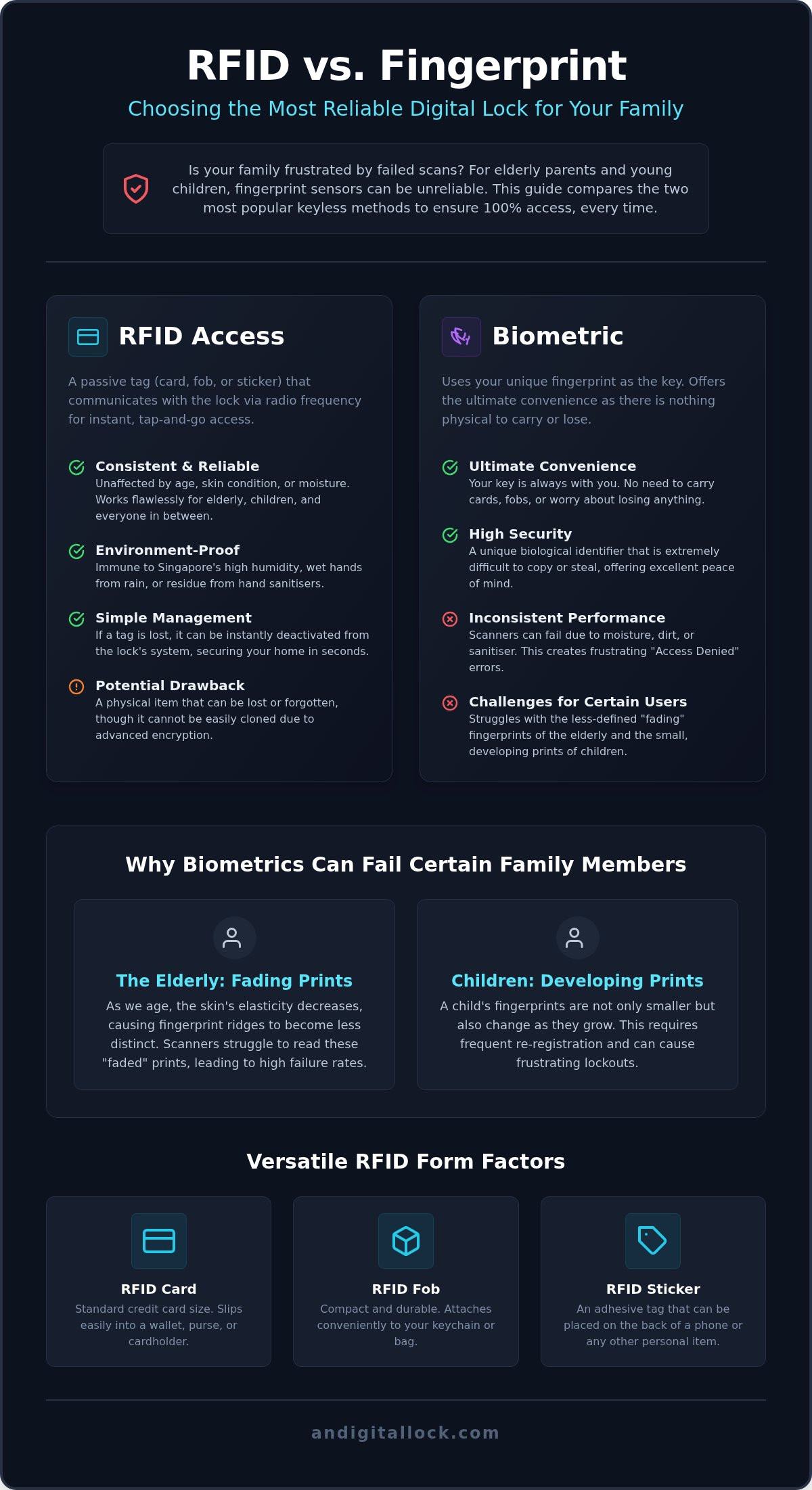
Choosing between an rfid card vs fingerprint lock depends on your family's daily habits and the specific environment of your HDB flat. Fingerprint scanners offer the ultimate keyless convenience because you never have to worry about carrying a physical item. However, RFID technology provides a "tap-and-go" speed that is often more consistent for certain users. While modern scanners are incredibly fast, they require precise finger placement. RFID readers are more forgiving, allowing you to simply swipe a card or fob near the sensor for instant, frictionless access.
Singapore's tropical humidity plays a massive role in lock performance. Moisture on the skin or the frequent use of hand sanitiser can leave residue that confuses optical and even some capacitive sensors. RFID is immune to these environmental factors. It works perfectly whether your hands are wet from a sudden downpour or dry from office air conditioning. Most premium locks from brands like Solity or Philips can store up to 100 fingerprints and 100 RFID tags. This high capacity ensures you'll never run out of space for family members, domestic helpers, or trusted guests.
From a security standpoint, biometric technologies offer a unique identifier that cannot be stolen or duplicated easily. A physical tag, however, can be misplaced. The trade-off is that an RFID tag is easily replaceable. If a card goes missing, you can deactivate it in seconds through your lock's interface, maintaining your home's integrity without needing to reset the entire system.
Why Biometrics Often Fail the Elderly and Children
Seniors often face a biological challenge known as "fading fingerprints." As we age, the ridges on our skin become less distinct, making it difficult for even high-end scanners to register a clear image. Similarly, children have smaller, developing prints that change as they grow, which can lead to frequent "Access Denied" errors. Many HDB families find that RFID stickers are the perfect solution here. You can stick a small RFID tag onto the back of a child's phone or a senior's EZ-Link card. This ensures a 100% success rate for every generation in your home.
The Hybrid Approach: Getting the Best of Both Worlds
The best digital lock Singapore homeowners can choose usually combines both methods into one unit. You don't have to pick just one technology. Adults can enjoy the biometric speed of a Zigbang or Philips lock, while kids and grandparents use RFID fobs for guaranteed entry. Managing these different users is simple through a single mobile app. You can assign names to each tag and fingerprint to track who enters the home in real-time. If you're looking to upgrade your home security, you can explore our latest BTO lock bundles to find a system that supports every family member's needs.
Types of RFID Access: Cards, Stickers, and Fobs
While the debate of rfid card vs fingerprint lock often focuses on the scanner, the real versatility of RFID technology lies in its various form factors. You aren't restricted to a single plastic card. Modern digital locks allow you to register multiple types of access devices to suit different family members. These passive devices are incredibly durable and require zero battery power, making them a "set and forget" solution for HDB households. Choosing the right shape ensures that every family member has a frictionless entry experience.
- Standard RFID Cards: These are the classic, wallet-sized options. They fit perfectly behind a clear ID slot or inside a purse, making them ideal for adults who already carry a wallet.
- RFID Key Fobs: These compact, teardrop-shaped devices are built from rugged plastic. They're designed to survive being dropped on concrete and easily attach to your existing HDB gate key set.
- RFID Stickers: This is the "invisible" solution many homeowners overlook. You can stick these small, adhesive tags onto the back of your smartphone or an EZ-Link card. It turns any everyday object into a high-tech key.
- Custom Wearables: For active lifestyles or young children, RFID wristbands are a great choice. They're waterproof and stay securely on the wrist, perfect for kids playing at the void deck.
When looking to complement your security setup with other household gadgets, نادی مارکت (Nadi Market) offers a wide variety of products that cater to a modern lifestyle.
Choosing the Right Form Factor for Your Lifestyle
Teenagers are notorious for losing keys, but they rarely leave home without their smartphones. Applying an RFID sticker to their phone case is the number one choice for HDB families. It eliminates the "I forgot my card" phone call entirely. When considering durability, key fobs are the clear winner. They survive the daily wear and tear of a pocket much better than a thin card. You should also consider aesthetic harmony. When you browse for a digital lock Singapore showrooms offer, look for fobs or cards that match the sleek finish of your Zigbang or Solity hardware.
Sourcing Reliable Replacements in Singapore
Don't be tempted by cheap, unencrypted tags found on generic marketplace apps. These low-cost alternatives often lack the proper 13.56MHz Mifare encryption required by premium brands like Philips or Solity. Using a non-genuine tag can lead to intermittent reading errors or even security vulnerabilities. It's best to source your replacement tags from authorized dealers like AN Digital Lock. We ensure every card, fob, or sticker is fully compatible with your specific model's frequency. This guarantees a secure handshake between the tag and the lock every time you tap to enter. When comparing an rfid card vs fingerprint lock, the reliability of a genuine, encrypted tag is what truly provides peace of mind.
Step-by-Step: Programming and Syncing Your RFID Tags
Programming your digital lock doesn't have to be a tech nightmare. Most major brands like Zigbang, Philips, and Solity follow a similar logic to keep your home secure. You'll always start by entering Master Mode using your master PIN or a registered master card. This critical step prevents unauthorized users from tampering with your access list. Once the lock is in programming mode, you can tap multiple cards, fobs, or stickers one after another to register them in a single session. This bulk registration is much faster than the individual scanning required for biometrics. When you look at the setup for an rfid card vs fingerprint lock, RFID is the clear winner for large households needing to issue many keys at once.
If a tag is ever lost, don't panic. You can instantly delete that specific tag's ID from the internal memory. This keeps your flat secure without having to reset every other family member's access. It's a straightforward process that ensures your home remains a sanctuary even if a physical card goes missing.
Syncing Your HDB Gate and Main Door
The "One-Tag-Two-Locks" trick is a massive convenience for Singaporean homeowners. You can program a single RFID device to unlock both your metal gate and your HDB main door with just two taps. It eliminates the need to carry separate fobs or remember which finger is registered for which lock. While the rfid card vs fingerprint lock choice often comes down to personal preference, the ability to bridge two different lock types with one tag is a major functional win. If you find your tag works on the door but fails on the gate, it's often due to signal interference from the metal mesh. Our technicians at AN Digital Lock specialize in calibrating these readers to ensure a 100% success rate on both units.
RFID Maintenance and Safety Tips
Keep your tags in top shape by following a few simple rules. First, avoid "Card Clash." Stacking your RFID entry card directly against an EZ-Link card in your phone case can confuse the reader. It's best to keep them slightly separated to ensure the correct signal is picked up. Second, clean your tags with a dry microfiber cloth. Avoid using wet wipes or alcohol; moisture can eventually seep into the edges and damage the internal antenna. Finally, if you're moving into a pre-owned home, always perform a "Master Reset." This wipes all previous data and ensures that no old tags from previous owners can still open your door.
Ready to upgrade to a seamless entry system? Check out our latest digital lock bundles designed specifically for HDB flats.
Why Choose AN Digital Lock for Your Keyless Journey?
Since 2013, AN Digital Lock has established itself as Singapore's leading expert in keyless home security. We've completed thousands of successful installations across HDB flats and condos. This extensive experience gives us deep insight into the specific environmental challenges of local homes, such as high humidity and signal interference from metal gates. Our curated selection only includes the most reliable hardware from global leaders like Zigbang, Philips, and Solity. We don't just sell locks; we provide comprehensive security solutions. Our exclusive BTO bundles are specifically designed to bridge the gap between your metal gate and wooden door. This ensures a unified entry experience that simplifies your daily routine. Whether you're deciding between an rfid card vs fingerprint lock or looking for a hybrid setup, our team ensures your home stays protected with the latest technology.
Our relationship with you doesn't end when the last screw is tightened. We believe in lifetime support for every client. This means you have a direct line to experts who can help with programming questions or managing lost tags long after the initial setup. We understand that family needs change over time. You might need to add a new domestic helper to the system or update access for growing children. Our team is always available to guide you through these transitions. This commitment to service is why thousands of Singaporean homeowners trust us to secure their most valuable assets.
Expert Installation and On-Site Training
Professional mounting is critical for maintaining high reader sensitivity. A poorly aligned lock on an HDB gate can lead to frustrating signal drops or mechanical strain. Our technicians calibrate every unit on-site to guarantee a 100% success rate. We also provide hands-on training for your entire household. We make sure your kids and seniors feel completely confident using their RFID stickers or biometric scanners before we leave. If you ever have a programming question or need to replace a lost tag, our fast-response support team is ready to assist. We take the guesswork out of digital security so you can enjoy peace of mind from day one. If you're also looking for similar professional expertise for your vehicle, you can check out Locksmith & Car Pros for specialized automotive locksmith services.
Experience Keyless Living at Our Showrooms
The best way to resolve the rfid card vs fingerprint lock debate is to try them yourself. Visit our Singapore showrooms to test the response speed and tactile feel of different models in person. You can see the difference between optical and capacitive sensors while testing our range of RFID fobs and stickers. Consult with our specialists to find the perfect lock bundle for your specific HDB layout. We'll help you sync your gate and door locks for the ultimate "one-tap" convenience. Stop by today and discover how easy home security can be when you have the right experts by your side.
Browse our latest BTO Digital Lock Bundles here!
Secure Your HDB Flat with Confidence
Deciding on the right rfid card vs fingerprint lock setup is the final step toward a truly frictionless home. You now understand how the reliability of RFID tags supports every family member; from young children with developing prints to seniors with fading fingerprints. By choosing a hybrid solution, you get the high-tech convenience of biometrics paired with the guaranteed success of a tap-and-go card. It's the most effective way to eliminate entry frustration for good.
At AN Digital Lock, we specialize in making this transition effortless for Singaporean families. We are the region's leading stockist of premium brands like Zigbang and Philips, backed by over 10 years of dedicated home security expertise. Every installation includes professional mounting and comprehensive on-site training for your whole family. We don't just install hardware; we ensure your metal gate and wooden door are perfectly synced for a stress-free entry every single time.
Upgrade to Seamless Keyless Access with AN Digital Lock Today!
Your smarter, safer home is just one click away. Let us help you find the perfect fit for your lifestyle today.
Frequently Asked Questions
Can I use my EZ-Link card or office pass as an RFID tag for my home lock?
Yes, you can often use an EZ-Link card if your digital lock supports the 13.56MHz Mifare standard. Most modern models from Solity and Zigbang are compatible with this frequency. However, some office passes use specialized encryption or a different 125kHz frequency that won't sync with residential locks. It's best to test your specific card at our showroom before relying on it for daily entry.
What happens if I lose my RFID tag? Do I need to replace the entire lock?
You don't need to replace the lock at all. Simply enter the lock's Master Mode using your PIN and delete the lost tag's ID from the system memory. This is a significant benefit in the rfid card vs fingerprint lock debate; losing a physical tag is a simple software fix rather than a costly hardware replacement. Once deleted, the old tag will no longer grant access even if someone finds it.
Are RFID tags waterproof? Can I use them on my outdoor metal gate?
Most RFID fobs and cards are highly water-resistant and designed to withstand Singapore's humidity. They are perfectly suitable for use on HDB metal gates located in sheltered corridors. While they shouldn't be submerged in water, they'll continue to function reliably through rain splashes and damp weather without any internal damage to the antenna.
Can someone 'clone' my RFID tag just by walking past me in public?
It's extremely unlikely with the modern encrypted tags used by brands like Philips and Solity. When comparing an rfid card vs fingerprint lock, some worry about "skimming," but high-frequency 13.56MHz Mifare tags use secure handshakes that prevent simple cloning. This is a much higher security grade than the unencrypted cards often used in older office buildings or hotels.
How many RFID tags can I register to a single digital lock?
Most premium digital locks can store between 40 to 100 different RFID tags. This high capacity is ideal for large multi-generational families or households with multiple domestic helpers and part-time cleaners. You can easily assign a unique fob to every person and track their entry times through your lock's mobile app for better home management.
Do RFID tags work during a power outage or if the lock's battery dies?
The RFID tag itself is passive and doesn't need power, but the lock reader requires electricity to scan it. If your lock's AA batteries die, the reader won't respond to your tag. In this scenario, you can use a 9V battery at the external jump-start points to provide temporary power. This allows the reader to scan your tag so you can enter and replace the internal batteries immediately.
Can I use an RFID sticker on the back of a metal phone case?
No, you shouldn't place an RFID sticker on a metal surface as it will block the radio signal. Metal interferes with the communication between the tag's antenna and the lock's reader. For the best results, apply your RFID sticker to a plastic, silicone, or leather phone case. This ensures a clear signal path and a 100% success rate every time you tap your phone to the lock.
Is there a limit to the distance the tag can be from the reader to work?
Yes, the effective range is typically within 1 to 3 centimeters. This short range is a deliberate security feature designed to prevent accidental unlocking. You must physically "tap" or bring the tag very close to the designated sensing area on your door or gate lock. This ensures the door only opens when you intend to enter, providing better protection against unauthorized access.