


What if the safest way to stop a teenager sharing the door code isn’t tighter secrecy, but a clearer conversation? The worry is understandable: an unauthorised person could get into your home, yet changing the code without explanation may create more conflict than confidence. Preventing teenagers from sharing the door access code starts with a rule your family can understand and follow.
Your teenager is also learning to manage independence and friendships. A calm, specific boundary can protect home security without turning access into a test of trust. Explain who may use the code, why it mustn’t be shared, and what to do when a friend needs to enter.
This guide shows you how to agree on a household rule, respond if the code has already been shared, and choose access arrangements that fit your routines. Digital locks can offer PIN, fingerprint, RFID, or Wi-Fi access, but the controls vary by model. Compare a lock’s documented capabilities with your family’s plan, and use technology to support clear communication rather than replace it.
Key Takeaways
- Preventing teenagers from sharing the door access code begins with a calm, clear household rule that respects growing independence.
- Use a family discussion to explain the security concern, hear your teenager’s perspective, and agree on when access can be shared.
- Compare shared PINs with separate access options by convenience and oversight, remembering that controls vary by lock model.
- If the code has already been shared, establish who received it and whether they still need access before deciding what to change.
- Match PIN, fingerprint, RFID, or Wi-Fi access to your household routines and the specific functions of your digital lock.
Why preventing teenagers from sharing the door access code starts with trust
Parents need to protect the household, and teenagers need room to make responsible choices. These aims can work together. Preventing teenagers from sharing the door access code is easier when the rule is presented as a practical safety boundary, not as proof that a teenager can’t be trusted.
A household access boundary is an agreed rule about who may enter the home, which credentials they may use, and when permission is needed. Door-code sharing means giving an entry credential to someone outside that agreed plan. A code opens a door; it is not a measure of your teen’s character. It can also be copied, remembered, or passed on, extending access beyond the person your teenager intended to help.
Home security involves both physical measures and everyday choices. The overview of Home security practices provides broader context for thinking about locks alongside personal security habits. In a family, clear expectations are one of those habits: everyone should understand who is allowed to enter and how to handle exceptions.
Why teenagers may share a door access code
Start by asking what happened rather than deciding what it means. A teen might share a code because a friend arrived before they did, because it seemed easier than interrupting a parent, or because they wanted to help someone avoid waiting outside. A one-off choice made for convenience calls for a conversation and a clearer plan. Repeated sharing after the boundary has been explained calls for a firmer response. Focus on the behaviour and its impact, not a label such as “irresponsible.”
How to explain the household boundary without shaming
Keep the explanation specific and calm. For example: “This code opens our home, so it’s for household members only. Please don’t pass it to friends or anyone else unless we’ve agreed first.” This connects the rule to access without suggesting your teen has bad intentions.
Then offer a practical alternative. Ask what situations make sharing feel useful, and invite your teenager to suggest a better way to handle them. Agree on what to do if a friend arrives unexpectedly, needs to collect something, or can’t reach the family member who’s home. A workable plan makes the boundary easier to follow and gives your teen a clear next step.
How to agree on a door-code rule your teenager can follow
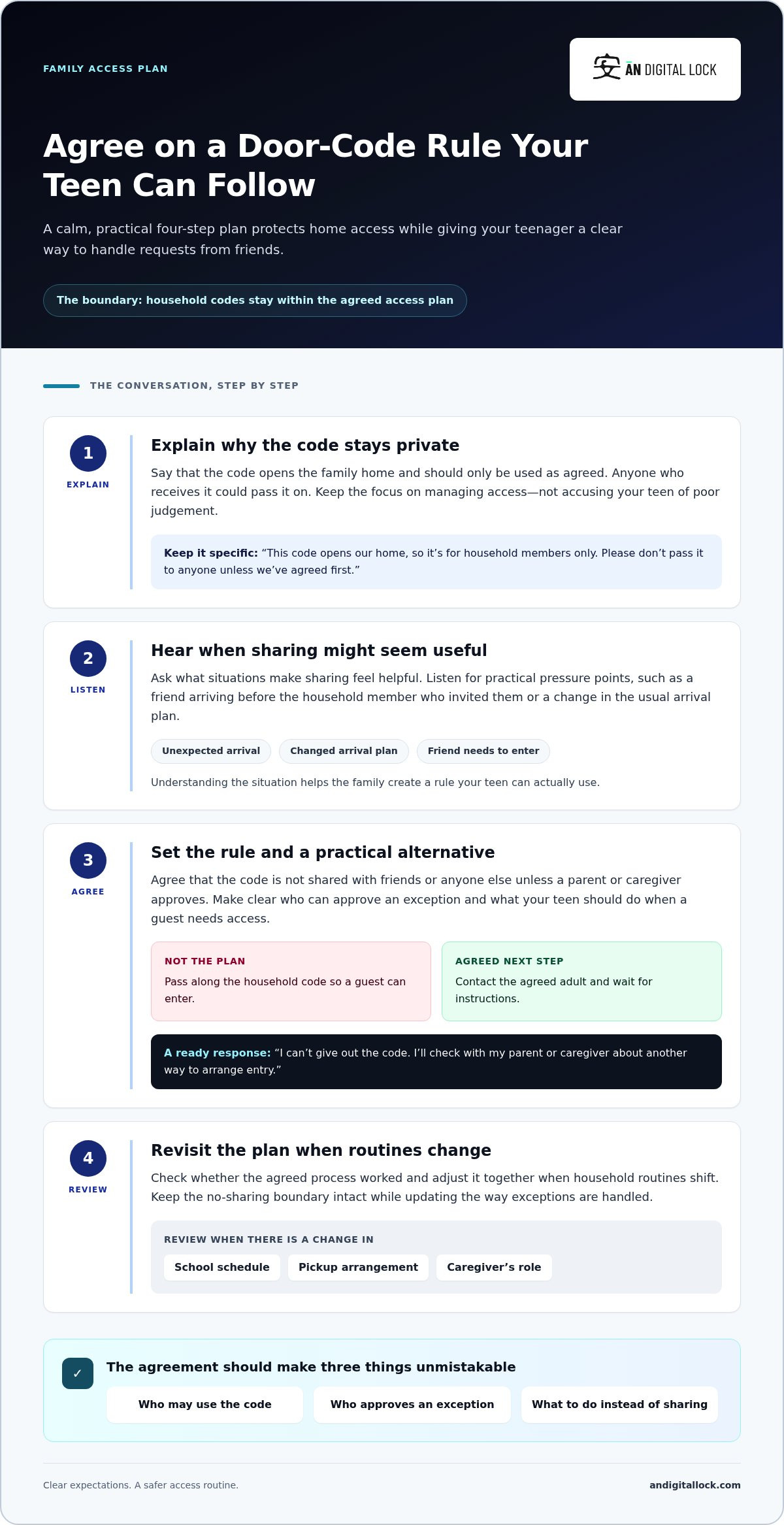
A rule is easier to follow when everyone understands both the boundary and what to do instead. Set aside a calm moment, not the middle of an argument or a rushed departure. Make a shared plan for everyday access, planned visitors, and unexpected changes. Preventing teenagers from sharing the door access code works best when expectations are clear before a friend asks to come in.
- Explain the concern. Say that the code opens the family home and should stay within the agreed household access plan. Anyone who receives it could pass it on, so it should not be shared without permission. Keep the focus on managing access, not accusing your teen of poor judgement.
- Hear your teenager. Ask when sharing might seem helpful. Listen for practical pressure points, such as a friend arriving before the household member who invited them or a change in the usual arrival plan. Understanding the situation helps you create a rule your teen can actually use.
- Agree on the rule and an alternative. Make the boundary direct: don’t pass the code to friends or anyone else unless a parent or caregiver has approved it. If a guest needs access, your teen should contact the agreed adult and wait for instructions rather than sharing the household code.
- Review the agreement. Revisit the plan when routines change, such as a new school schedule, a different pickup arrangement, or hiring a dedicated caregiver through Housekeeping Co. Ask whether the approved route worked and adjust the process together, while keeping the no-sharing boundary intact.
Set a clear rule and explain its purpose
Decide who may use the code, who can approve an exception, and what your teenager should say if someone asks for it. For example: “I can’t give out the code. I’ll check with my parent or caregiver about another way to arrange entry.” This gives your teen a ready response instead of requiring them to invent an explanation under social pressure. A useful agreement makes the boundary, the approver, and the next step unmistakable.
Agree on reasonable exceptions and consequences
Discuss legitimate needs in advance. A planned friend visit or a change in arrival time can be handled by contacting a parent or caregiver, who can decide how to arrange access. Also agree on a proportionate response: an accidental share may call for promptly telling an adult and reviewing the plan; repeated sharing may require a firmer household response. If the code is deliberately misused, prioritise restoring safe access arrangements and explain what must change before normal routines resume. Keep consequences predictable and connected to the behaviour, not to embarrassment or blame.
A digital lock can be one part of this agreement, but its access controls vary by model. The National Institute of Standards and Technology’s research on smart home security and privacy offers context for considering how households use connected devices. If you’re reviewing entry options alongside the family rule, explore digital door lock options and compare their documented access methods with your household’s needs.
Compare shared codes, separate access, and other entry options
The right arrangement depends on who needs regular entry, how much flexibility your household needs, and what the specific digital lock supports. A single PIN may be simple to manage, while separate credentials or non-code options can reduce reliance on passing around one number. Neither technology nor a more complex setup replaces a clear household rule.
| Access arrangement | Convenience | Oversight | Limitations |
|---|---|---|---|
| Shared household PIN | Easy for regular household members to remember and use. | Provides little distinction between people using the same code. | Any recipient may share or pass on the PIN. A shared code doesn’t identify which person entered it. |
| Separate PINs, if supported | Each authorised user can use their own credential instead of one shared number. | May make access management more specific, depending on the lock’s documented controls. | Not every lock supports separate user codes or the same management options. |
| Fingerprint access, if supported | Can provide an alternative to remembering and entering a PIN. | May reduce the need to disclose a code, depending on who is enrolled and how the model manages access. | Availability and enrolment controls vary by lock. It won’t arrange guest access by itself. |
| RFID access, if supported | An authorised user can use a registered card or tag instead of sharing a PIN. | Access depends on the credential and the lock’s documented controls. | A card or tag still needs to be kept secure; features differ by model. |
When a shared PIN is practical, and where it falls short
A shared PIN can be straightforward for a household where several people need regular entry and simplicity matters. The trade-off is that anyone who knows it may pass it along. Because several people use the same PIN, it should not be treated as a record of who unlocked the door. If a household member moves out or a guest no longer needs access, consider how to handle the shared credential based on the lock’s actual controls.
When separate or non-code access may suit the family
If a lock supports separate credentials, individual PINs can help households assign access more distinctly than one shared code. Fingerprint or RFID access may also reduce reliance on sharing a PIN, but suitability depends on the family’s routines and the model’s documented functions. Don’t assume a lock offers temporary codes, schedules, user-specific permissions, or access logs; these capabilities aren’t universal. Compare the available options with your household’s agreed access plan, and use the digital lock buying guide for broader selection considerations.
For preventing teenagers from sharing the door access code, choose an arrangement that makes the approved action easy to follow. If friends need entry, keep that process separate from a teenager handing out a household credential. A digital lock can support the plan only through features the specific model actually provides.
What to do if your teenager has already shared the door code
Respond promptly, but keep the first conversation private and steady. The immediate aim is to understand who may now have access and make a practical plan for the household. A calm response also makes it easier for your teenager to explain what happened, including details they may be reluctant to share if they expect an instant punishment.
- Find out exactly what was shared. Ask whether your teenager gave someone the code, showed it while entering it, or sent it in a message. Clarify when it happened and who received it. If they know whether the recipient passed it on, note that too, but don’t assume they can know for certain.
- Establish whether access is still needed. Ask what the person needed to enter the home for and whether that reason still applies. A past visit doesn’t automatically mean ongoing permission. If someone still needs access, agree on an approved arrangement rather than leaving the shared code in circulation without discussion.
- Address the immediate access concern. Decide whether the disclosure warrants changing the PIN or updating another credential. Use the lock’s own instructions, since the available controls and steps differ by model. A code change may address that credential, but it can’t establish whether someone copied or shared it further.
- Reset the household plan together. Review who currently needs access and whether existing arrangements still make sense. Explain what will change and why, then involve your teen in agreeing on a workable way to handle future requests.
Quick check: Treat an accidental, limited disclosure as a chance to clarify the rule. Treat repeated sharing, onward sharing, or continued access by someone who no longer needs it as an ongoing access concern that calls for a firmer review.
Assess the situation before changing access
Ask questions to understand the scope, not to build a case against your teenager. For example: “Who has the code now, and what did they need it for?” Then check whether the person had a legitimate reason to enter and whether that reason has ended. If the answers are incomplete, make a cautious decision based on what the household needs now. Don’t assume a new PIN alone resolves every concern; consider who else may have received the old one and what other credentials are in use.
Restore the agreement and review household access
Once immediate needs are clear, explain any access changes and invite your teen to help make the revised plan workable. Go through the people who need regular entry, planned visitors, and any arrangements that are no longer appropriate. If the lock supports separate credentials or other access updates, use only the functions described in its instructions. Clear, model-specific steps help the family act consistently without assuming every digital lock has the same controls.
For a digital door lock that fits your household’s access needs, explore digital door lock options and compare their documented functions with your family’s plan.
Choose a digital door lock that supports your family access plan
Choose the access arrangement first, then look for a digital door lock with documented features that fit it. Start with the family agreement: who needs to enter, which access methods each person can use, and who approves exceptions. This keeps the decision practical. A digital lock can support a household plan, but no access method by itself prevents someone from sharing a credential or guarantees home security.
Match access methods to the household routine
List the household members who need independent access and how often they use the door. Then compare the options offered by each model:
- PIN: A familiar option for people who regularly enter. Consider whether the lock supports separate user PINs if you want each household member to have a distinct code.
- Fingerprint: May suit family members who prefer not to enter a PIN. Enrolment and user-management controls differ by lock.
- RFID: A card or tag can provide another way to enter. Include how the household will keep track of each credential in its access plan.
- Wi-Fi: Connectivity may suit a household that wants connected access functions, but those functions vary by model. Read the documented controls instead of assuming Wi-Fi means temporary codes, schedules, or access logs.
Prioritise the methods and controls that solve a real household need. If teenagers use a PIN while other family members prefer fingerprints or RFID, consider whether that mix is supported by the specific lock. Keep a simple backup plan for ordinary access problems: decide whom household members should contact and where they can wait safely if their usual entry method isn’t available. Don’t rely on an assumed backup feature.
Make a confident lock choice
Use product documentation to compare the access methods, user controls, and any model-specific functions against your agreement. The digital lock buying guide offers broader selection considerations. Focus on documented capabilities, not features you hope a lock might have.
Before deciding, check that everyone understands the agreed access method, what to do if a guest needs entry, and how to handle a lost or exposed credential. Preventing teenagers from sharing the door access code is a family practice supported by suitable tools, not a result any lock can promise.
Explore AN Digital Lock’s digital door locks and compare their documented access methods with your family’s needs.
Make your family’s access plan work for the long term
Set aside a few minutes to decide what a workable door-access routine looks like for your household. Consider how your teenager’s schedule may change, who else needs to enter, and what everyone should do if a guest needs access. Keep the agreement clear enough to follow without constant reminders, then revisit it when family routines shift.
A digital door lock can support that plan when its documented access options fit your needs. AN Digital Lock has specialised in digital door locks since 2013, with options that include PIN, fingerprint, RFID, and Wi-Fi access. Features vary by model, so focus on the controls that match your family’s agreed routine. Preventing teenagers from sharing the door access code is grounded in communication and sensible access choices, not suspicion.
Compare access methods for your household with AN Digital Lock’s digital door locks and choose an option that supports clear boundaries as your teenager grows more independent.
Frequently Asked Questions
Can a teenager copy or memorise a door access code without sharing it?
Yes. A teenager could remember a code after seeing someone enter it, even if they never deliberately share it. To reduce casual exposure, avoid saying the PIN aloud in front of visitors and shield the keypad while entering it. If the code is written down or stored digitally, consider who can access that note. These steps limit unnecessary exposure, but they can’t prevent someone from remembering a code they’ve seen.
What should I do if my teenager says sharing the code was an emergency?
First, understand what made the situation feel urgent and whether anyone still needs help or entry. If there’s an immediate safety concern, focus on getting appropriate assistance rather than debating the rule. Once everyone is safe, ask who received the code and whether it may have been passed on. Then discuss a reliable alternative for future urgent situations, such as calling a parent or caregiver before arranging access.
Should parents tell teenagers when a door access code has been changed?
Usually, yes. Tell authorised household members promptly so they aren’t unexpectedly locked out or left unsure which credential to use. Explain the practical reason for the change, such as an exposed code or a change in who needs access. Share the new code only with people who are meant to use it, and do so discreetly. If circumstances require an immediate change, communicate it as soon as practical.
Can a digital lock show which person used the door code?
It depends on the specific lock and how it’s configured. A lock may record an entry event, but a shared PIN alone doesn’t show which household member entered because everyone uses the same credential. Some models may offer user-specific controls or access records; don’t assume these functions are available across all digital locks. Check the model’s documented features and consider privacy expectations before using records to discuss household entry.
Is a fingerprint or RFID entry method better than a shared PIN for teenagers?
There isn’t one best method for every family. Fingerprint entry or an RFID credential may reduce the need to disclose a shared PIN, but each has different practical considerations, such as whether the teen is comfortable using it or can keep a card or tag secure. Compare only the controls the particular lock documents. Agree on how to handle access if a credential is unavailable, and keep the household rule clear.
How can I set a no-sharing rule without damaging trust?
Explain the rule as a household access decision, not a judgement about your teenager’s honesty. Invite them to describe situations where a friend might ask for entry, then agree on a simple response, such as contacting an adult in the household. Preventing teenagers from sharing the door access code is more workable when your teen knows the reason for the boundary and has a practical alternative to offer friends.
What happens if a friend has already received the door access code?
Ask your teenager when the friend received it, whether they used it, and whether they might have passed it on. Find out if the friend still has a legitimate reason to enter. If the disclosure concerns you, review the lock’s instructions and decide whether changing or updating access is appropriate for that model. Tell the friend clearly that the code must not be shared, and arrange any future visits through an authorised household member.