


If you’re searching for a pet-safe gate lock my dog can't open, start by checking the whole setup, not just the lock. Look at the gate’s design, how it closes, and whether your dog can reach or manipulate the latch. A suitable lock may help control access, but no lock can make every gate or situation dog-proof.
The right setup should help keep your dog safely inside while still making everyday access straightforward for the people at home. Your choice depends on the gate, your dog’s behaviour, and how often household members use the entrance.
This guide covers lock characteristics to consider, how gate fit and closing habits affect security, and how to balance pet safety with convenient human access. For a metal gate, digital gate locks are one option to compare. AN Digital Lock specialises in digital door locks and sells a range of metal gate lock models. Use the practical checks below to narrow down what may suit your entry point.
Key Takeaways
- A pet-safe setup depends on the gate as well as the lock. Check that the gate closes fully and aligns consistently before choosing hardware.
- Find a pet-safe gate lock my dog can't open by considering your dog’s behaviour, the gate’s fit, and the latch position, rather than relying on lock type alone.
- Compare keyed, combination, and digital access against your household’s routine. Keep human access simple enough that everyone can secure the gate consistently.
- Use a step-by-step checklist to assess your dog’s habits, inspect the gate, and identify who needs access and how often.
- Compare metal gate lock options with your gate and access needs in mind, without assuming any lock is dog-proof.
Why a Pet-Safe Gate Lock Starts With the Whole Gate
A pet-safe setup is more than a lock. It combines hardware suited to the gate with a gate that closes fully, sits in the right position, and engages consistently. If you’re looking for a pet-safe gate lock my dog can't open, first consider how your dog interacts with the entrance and whether the gate is working as intended.
A lock controls access, but it cannot guarantee that a dog will never get out. The gate may be left ajar, fail to meet its frame, or have openings a pet can squeeze through. The practical goal is to reduce likely ways the gate could be opened or bypassed while keeping access manageable for the household.
How dogs may find a way through a gate
Different behaviours create different challenges. A dog that nudges the gate tests whether it closes securely. One that paws near the latch may interact with reachable hardware. A dog that jumps may get over the gate, while one that watches people use the entrance may learn a repeated opening routine. Observe what your dog actually does, then focus on the risks that apply. No one lock style is universally dog-proof.
Look for the moment the gate becomes accessible. Does your dog push it while someone enters, investigate the latch when alone, or follow closely behind a person passing through? The answer can shape your priorities. A release that is difficult for your dog to reach may matter if it paws at the latch. Reliable closure may be more urgent if the dog nudges the gate or people often leave it partly open.
Why the gate matters as much as the lock
Check the entire entry point before comparing hardware. Does the gate swing freely, sit unevenly, or leave openings around its edges? A secure lock cannot correct a gate that does not close properly. If the gate shifts away from the frame, the latch may not meet its strike point as intended, so the lock may not secure it consistently.
It also helps to distinguish the latch from the lock. The latch physically holds the gate closed; the lock restricts or controls how it can be released. They may be combined in one assembly, but each has a role. For a general overview of types of latches, consider how the closing mechanism works before choosing access hardware.
Make a quick inspection with the gate closed, then open and close it as household members normally would. Check whether it reaches the frame, whether the latch engages every time, and whether a nearby gap gives your dog another way through. Notice whether anything shifts when the gate is gently pushed or released. These observations make it easier to compare options based on the whole gate, not the lock alone.
Check Gate Fit, Gaps, and Latch Position Before Choosing
Before comparing locks, inspect how the gate behaves in everyday use. A lock can secure the entry point only if the gate reaches its intended closing position and the latch can engage. Note any sticking, sagging, loose fittings, or movement that changes where the gate meets its frame. These are gate-condition issues that a different lock may not solve.
Look at the full opening, too. A dog may find a route through a gap or reach hardware from an unexpected angle. This inspection gives you a clearer basis for choosing a pet-safe gate lock my dog can't open, without assuming the lock alone will prevent every escape.
Inspect the gate's movement and closing point
Open and close the gate as household members normally would. Notice whether it swings freely, catches, bounces back, or needs to be lifted or pushed into place. When closed, it should meet the frame in a consistent position. If the gate sits unevenly, the latch may miss or engage only intermittently, even if the lock itself is suitable.
Separate these observations from your lock preferences. First record whether the gate moves smoothly and closes predictably. Then check whether the latch lines up each time. A loose hinge, shifting panel, or worn closing point can affect alignment. Choosing a lock before identifying the cause may leave the underlying problem untouched.
Look for reachable hardware and escape openings
Observe your dog near the closed gate while keeping the entry safely controlled. Can it nose or paw the release? Can it press a lever, reach through a gap, or push a part that moves? The AKC guide to choosing dog gates also highlights the importance of selecting a gate suited to the dog and its intended use.
Check openings around the sides, bottom, and any panels. A lock controls access through the gate; it cannot block a gap or stop a dog squeezing through an opening. Look for loose or damaged components as well. If something shifts when touched, record it as a gate issue to address before assessing new hardware.
Use this quick inspection sequence:
- Close the gate normally and note whether it reaches the same position each time.
- Observe the latch and identify whether it engages consistently.
- Look for gaps or movable parts your dog can reach, nose, paw, or push.
- Write down your dog’s actions, such as nudging the panel or investigating the release.
Keep your notes specific. “Latch misses when the gate swings shut” is more useful than “gate feels unreliable.” The details help distinguish a fit problem from an access concern and make later comparisons relevant to your household. If you’re reviewing options for a metal entrance, compare metal gate lock options with your inspection notes.
Compare Gate Lock Options by Access, Fit, and Everyday Use
Once you understand the gate’s condition and your dog’s behaviour, compare access methods against the household’s routine. Keyed, combination, and digital locks work differently for people, but none is automatically dog-proof. If your dog can reach the release, it may still interact with it. Consider the mechanism’s placement along with how household members will use it.
Keyed, combination, and digital access compared
A keyed lock relies on a physical key, which users need to carry and manage. A combination lock avoids carrying a key but requires users to remember and share a code. Digital access uses an electronic method, which varies by lock. Think about who needs entry, how often people use the gate, and how access is shared. Your dog’s reach and behaviour remain relevant with every category.
Use the table to narrow your priorities, not to assume that a particular category will solve every escape risk:
| Gate or access situation | Human access needs | Potential limitation | Checks before selection |
|---|---|---|---|
| Metal gate used regularly | Consider whether users prefer carrying a key or using another access method. | A lock may not suit the gate’s structure or available fitting position. | Compare the gate’s construction, closing position, and space around the lock area. |
| Gate shared by household members | Choose an approach everyone can use consistently, including during routine comings and goings. | Keys can be misplaced; codes may need to be shared and remembered. | Consider how access is handed over and whether the release is easy for users to reach. |
| Gate with a reachable release area | Keep everyday operation manageable for people who use the entrance. | Any accessible mechanism may attract a dog that paws, noses, or presses it. | Assess release placement and your dog’s observed behaviour around the gate. |
Matching a digital lock to a metal gate
Digital gate locks are one category to consider for a metal gate, but suitability depends on the specific gate and how the lock fits. AN Digital Lock’s metal gate lock range includes models such as SOLITY GD-60BK, HAFELE GL5700, and Zigbang A21. The model names alone do not establish compatibility or pet resistance. Compare the gate’s structure, installation position, and access to the release before deciding.
Fit matters as much as the access method. A lock positioned awkwardly can make daily use difficult, while a reachable release may not address your dog’s behaviour. For broader principles that apply beyond gates, the guide to choosing the right door lock can help you frame the decision around your entrance and household needs. A suitable match should fit the gate, work for the people using it, and account for how your dog interacts with the entry point.
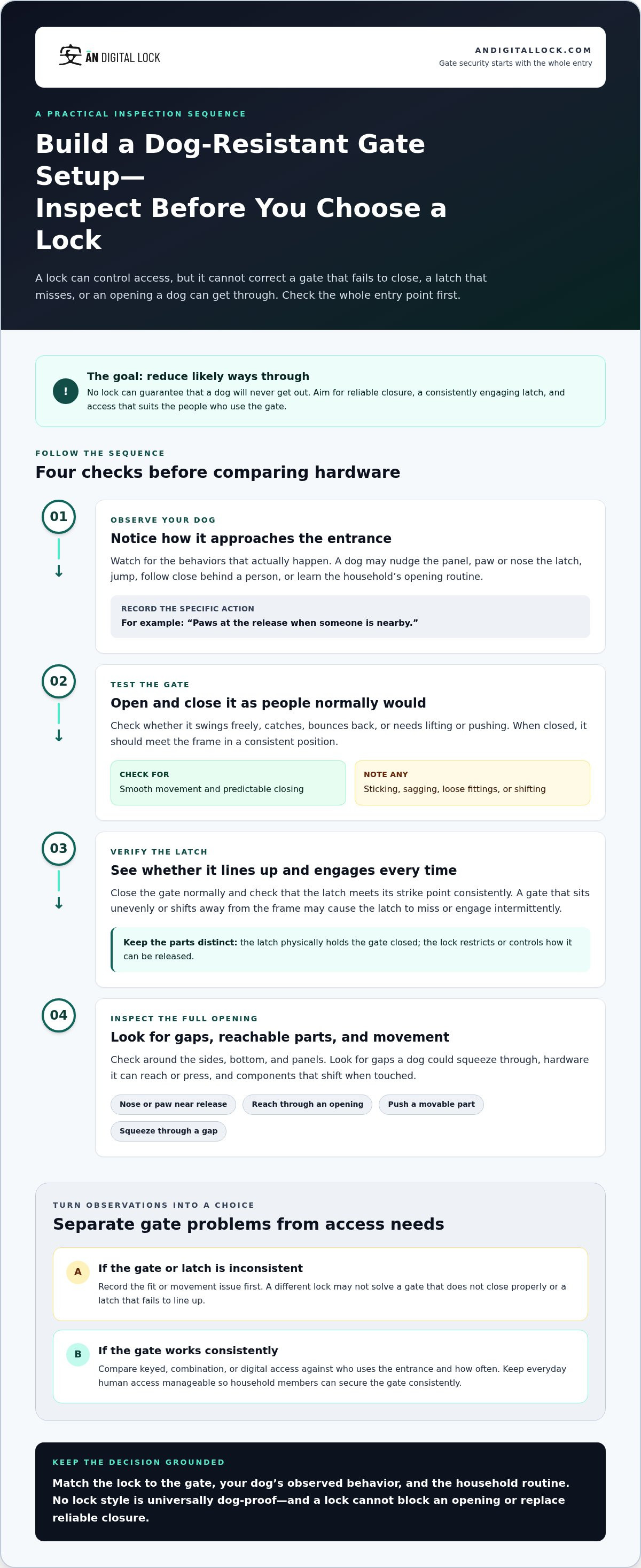
Use This Checklist to Choose a Dog-Resistant Gate Setup
A clear assessment makes it easier to compare gate locks without relying on a promise that no lock can make. Work through these steps in order. The goal is to match the hardware to your dog’s behaviour, the gate’s condition, and the way people in your home use the entrance.
A practical pre-purchase assessment
Start with what you can observe. Note whether your dog nudges the gate, paws at the release, watches people open it, or tries to get through a gap. Record which areas and parts it can reach. Then inspect the gate itself: how it closes, whether the latch engages, and whether there are openings, loose fittings, or visible wear.
- Observe your dog’s behaviour. Note the actions you’ve actually seen instead of guessing which lock might deter your pet. Include when the behaviour happens, such as during household comings and goings.
- Inspect the gate. Check its movement, closing position, latch engagement, openings, and visible wear. Keep gate-condition problems separate from the features you want in a lock.
- Assess household access. List who uses the gate, how often it is opened, and how access is shared. Include regular users and anyone who enters only occasionally.
- Compare suitable options. Use your notes to weigh access methods, gate fit, and release position. Do not treat any access type as a guarantee against escape.
Plan for safe, consistent daily use
Even suitable hardware depends on a consistent routine. Agree on the same closing steps with everyone who uses the gate: close it fully, operate the lock as intended, and check that it is secured before moving away. A rushed entry or a gate left partly open can undermine a careful hardware choice.
After any gate or hardware adjustment, test normal human operation. Open and close the gate as household members typically would, then check that the latch engages and the lock works as expected. Keep your dog safely away during the test if there is any chance the gate could open unexpectedly. If the gate or release behaves inconsistently, note the issue before relying on the setup.
When considering digital hardware, weigh the gate’s fit and the household’s access needs together. The guide to choosing the right door lock offers broader points to consider alongside this pet-safety checklist.
Ready to compare hardware for a metal gate? Explore metal gate lock options and use your observations to guide your choice. A well-considered setup can reduce likely opportunities for a dog to open or get through the gate, but it cannot guarantee that every escape scenario is prevented.
Explore Metal Gate Lock Options for Your Home
Choosing a suitable metal gate lock starts with the full entry point, not a promise that one lock will stop every dog. First consider the gate’s condition and closing position. Then factor in your dog’s behaviour, who needs access, and how often the gate is used. Finally, compare hardware based on how it fits the gate and the household routine. This practical sequence is more useful than searching for a pet-safe gate lock my dog can't open as though one model could guarantee the outcome.
What to consider in AN Digital Lock's metal gate range
AN Digital Lock sells digital locks for metal gates, including models such as SOLITY GA-60BK and Kaadas R8GD. The company specialises in digital door locks. Assess each model against your particular gate and access requirements rather than treating it as a pet-proof solution.
Before deciding, keep these factors in view:
- Gate condition: A gate that closes and aligns reliably gives the hardware a sound starting point.
- Dog behaviour: Consider whether your dog pushes the panel, reaches toward the release, or takes advantage of openings.
- Household access: Think about regular users and how access fits into your daily routine.
- Hardware fit: Consider the lock in relation to the gate’s structure and the available fitting position.
Next steps for a confident choice
Use your inspection notes to guide the final comparison. Record whether the gate closes consistently, whether the latch engages, and whether there are gaps or movable parts your dog can reach. Then match those findings to the access needs of everyone who uses the entrance. This makes it easier to compare metal gate lock options on relevant factors instead of relying on a broad label such as “dog-proof.”
After choosing or adjusting hardware, test the gate through normal human use. Check that household members can operate it comfortably and that it closes and secures as intended. Keep the same closing routine across the household, and remember that a lock alone cannot eliminate every route or situation that could lead to an escape.
For a pet-conscious setup, weigh the gate, your dog’s habits, and convenient access together. Explore AN Digital Lock's products to compare available metal gate lock options for your home.
Make Your Next Gate-Lock Choice With Confidence
Choosing a pet-safe gate lock my dog can't open starts with a realistic goal: make the entrance harder for your dog to open while keeping it straightforward for people to use. No lock can guarantee that a dog will never escape, so treat your choice as one part of a considered home-safety setup.
Before deciding, write down what the gate needs to do during an ordinary day. Who opens it, and how often? What does your dog tend to investigate? These questions can help you prioritise convenient access, suitable hardware fit, and a consistent closing routine instead of choosing by appearance or access method alone.
Then compare gate-lock options with those needs in mind. AN Digital Lock’s metal gate range includes models from SOLITY, HAFELE, Philips, Zigbang, and Kaadas. The company specialises in digital door locks, giving you a focused place to explore options for a metal gate without treating any model as dog-proof.
Take the next step with your gate and household needs in mind. Explore AN Digital Lock's gate lock options and move towards a more considered, convenient setup for your home.
Frequently Asked Questions
Can a dog open a digital gate lock?
Yes, it’s possible, depending on the dog, the gate, and how the lock is positioned. A digital lock should not be assumed dog-proof: a dog may push an unsecured gate, reach a control, or follow a routine it has watched people use. If you’re looking for a pet-safe gate lock my dog can't open, assess your dog’s actual behaviour and secure the gate consistently rather than relying on the access method alone.
What is the best type of gate lock if my dog pushes the gate?
No single lock type is best for every dog that pushes a gate. Focus on whether the gate closes and stays in position, and whether its latch engages reliably. For example, if a push makes the panel shift away from its frame, changing the access method alone may not solve the problem. Compare options after considering how the gate handles pressure and how household members will secure it.
Can a gate lock stop a dog from escaping through gaps?
No. A gate lock controls how the gate opens, but it cannot close an opening in the gate or frame. Check the spaces around the sides, bottom, and panels from your dog’s perspective. A small dog may fit through an opening that a larger dog cannot, so consider your own pet’s size and movement. If structural gaps in the perimeter are an issue, looking into custom barrier designs from specialists like outlookfencing.com.au can provide secure, gap-free fencing options. Keep your dog supervised until the entry point is secure for its needs.
Should a gate latch be placed out of a dog's reach?
Where the gate design allows, keeping the release beyond your dog’s reach can reduce the chance of pawing or nosing it. Do not make it so awkward that household members leave the gate unsecured because it is inconvenient. Consider how your dog stands or jumps near the gate, then choose a practical position that people can use consistently. Reach is not the only concern: a dog may also push the gate or exploit an opening.
Can I use a digital lock on a metal gate?
Yes. AN Digital Lock sells digital locks for metal gates, including models such as SOLITY GA-60BK, HAFELE GL5700, and Kaadas R8GD. The suitable option depends on the particular gate and its hardware arrangement. A model name alone does not establish fit, so consider the gate’s structure and the intended lock position. Digital access is one category to compare, not a guarantee that a dog cannot open the gate.
What should I check if my dog keeps opening the gate?
First, observe what happens just before the gate opens. Your dog may be pushing the panel, touching the release, or getting through while someone enters. Then check whether the gate closes fully, the latch misses, components are loose, or an opening gives your dog a way through. Note when the incident occurs and whether the gate was secured. Until you identify the cause, supervise access and follow a consistent closing routine.