


A pet-friendly HDB gate with built-in cat flap needs to fit both your entrance and your cat’s access needs. There is no single price for every gate: dimensions, materials and design features affect the final cost.
It makes sense to compare more than the flap alone. A gate that fits the opening properly and has a practical layout can help you balance everyday convenience with a secure entrance for your home.
This guide explains what can affect the cost of cat-friendly gates in Singapore and what to consider when comparing dimensions and features. Use these details to decide which specifications suit your space.
Key Takeaways
- Compare the gate’s dimensions and layout with your entrance before focusing on individual features.
- Learn how material, ventilation and a customised pet opening can shape a practical cat-safe design.
- Understand why a wider gate may cost more and which specifications can affect the overall price.
- Review the HDB-specific considerations that matter when choosing a pet safety gate in Singapore.
- See how AN Digital Lock’s metal gates may fit your plans for a more secure home entrance.
Factors to consider when choosing a cat-proof gate
Start with the entrance, not the catalogue picture. Measure its width and height, then note the frame, nearby walls and floor level. A gate that suits one HDB flat may not fit another. Check its swing and whether it could obstruct a shoe rack, door or walkway.
Consider your cat’s size, behaviour and access needs. A cautious cat may need time to get used to a flap, while an agile cat may test openings or climbable bars. Observe how your pet approaches the entrance to help assess flap placement, access direction and footholds on the grille.
Grille design affects visibility, airflow and how easily a cat can reach through the gate. Vertical bars create a different climbing surface from mesh or horizontal details. Inspect the spacing and edges, especially around joints and the flap, for places where a paw, collar or tail could get caught.
Built-in and removable options suit different needs. A built-in flap is integrated into the gate as a fixed access point. A removable cat door or mesh barrier can offer more flexibility, but its fit and stability depend on how it attaches to the existing gate or opening.
Consider security and pet safety together. A flap creates an opening, so check whether its position could give your cat access to the HDB corridor or another area beyond your control. Inspect the latch, frame edges, flap movement and hinges for escape routes or pinch points. Poor placement may also leave less secure space around the grille.
- Fit: Match the gate dimensions and frame to the entrance.
- Access: Consider the cat’s size, habits, and preferred route.
- Grille: Compare bar or mesh layouts, edges, and footholds.
- Opening: Review flap placement, movement, and access direction.
- Daily use: Account for people passing through and nearby furniture.
For a pet-friendly HDB gate with built-in cat flap, assess the opening as part of the gate’s overall design, not in isolation. Check how the flap, grille, frame and latch work together. Comparing these details helps you find a style suited to your entrance and your cat’s routine.
Why Choose a Pet Safe Gate?
A pet-safe gate combines a secure entrance with a dedicated route for a cat. In Singapore homes, a gate made with mild steel can provide a sturdy frame, while narrow gaps help limit spaces a pet could squeeze through. The grille design also affects airflow, so consider how the gate balances pet containment with ventilation.
A built-in cat flap suits households that want their cat to move between spaces without leaving the main gate open. It creates a fixed passage in the gate rather than relying on a separate barrier across the entrance. Position it where the cat can approach comfortably, making the route easier to use.
A built-in flap can suit different cat sizes and multi-cat households if its opening accommodates the largest cat using it. Consider each cat’s size and confidence, as a timid cat may need time to learn the route.
Customisation can match the opening to your pet and gate layout. A pet opening can be incorporated into a mesh gate while the frame and grille remain part of the overall design. Consider the opening’s height, width and position together. For example, a flap too close to the frame edge may leave little room for a comfortable approach.
- Material: Mild steel offers a sturdy gate structure.
- Gap layout: Narrow gaps help reduce escape routes while allowing ventilation.
- Pet opening: A customised flap gives cats a dedicated passage.
- Placement: Keep the opening clear of nearby frames and obstructions.
Maintain the gate with regular visual checks. Inspect the flap’s movement, the edges around its opening, the hinges and the latch. Remove dust or debris that could obstruct the flap. If the gate has mesh, check its perimeter and attachment points for looseness or damage. These checks can help you spot wear before it affects everyday use.
Consider your household routine, too. The flap should not obstruct the main gate when people pass through frequently. In a multi-cat home, observe whether cats can pass without crowding one another. A well-planned opening can improve access while narrow gaps and a sturdy mild-steel frame support containment and ventilation.
To compare options, consider how a custom gate design could accommodate the entrance layout, grille, and pet opening as one coordinated arrangement.
Gate dimensions and pricing
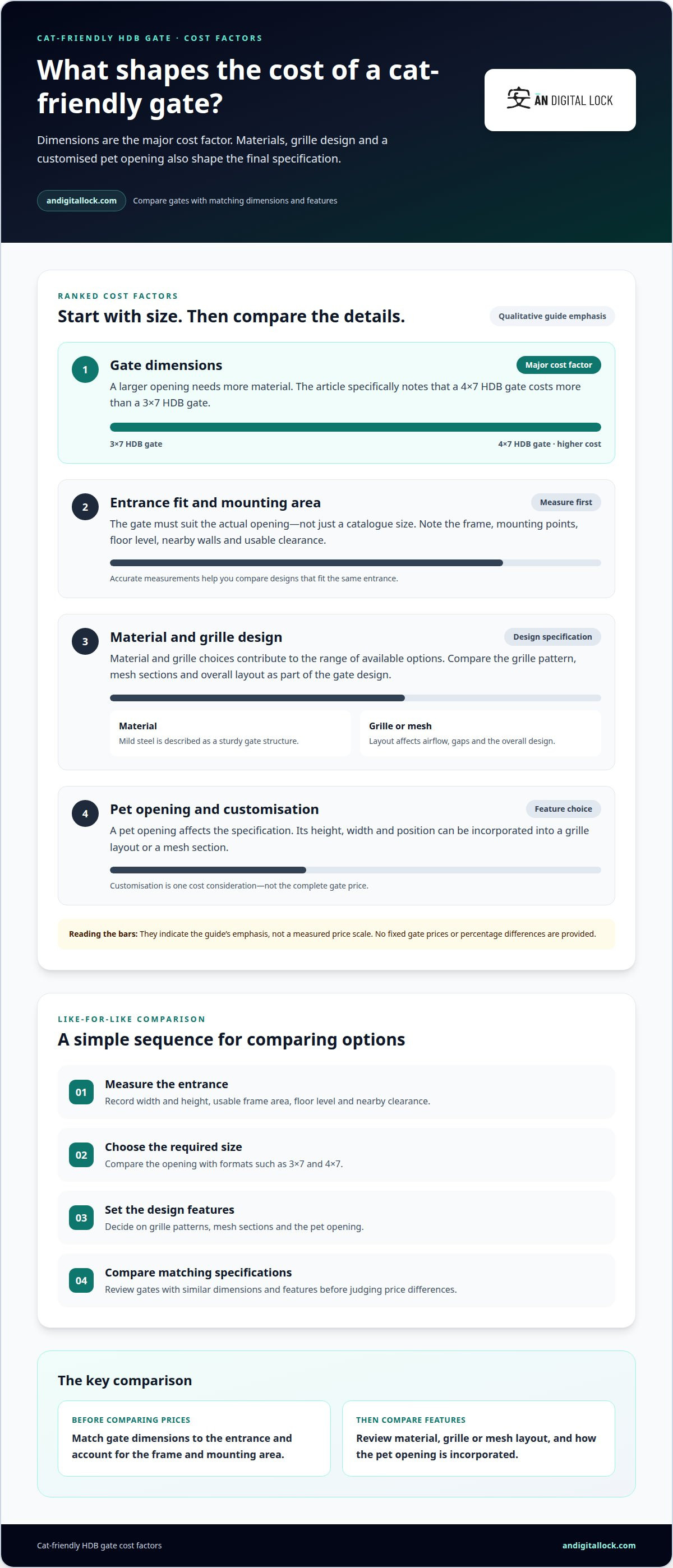
Gate size is a major factor in the overall cost. A 4×7 HDB gate costs more than a 3×7 HDB gate because the larger opening needs more material. The difference is not just height or width on paper. The gate must fit the actual entrance, including its frame and mounting points.
Measure the opening’s width and height before comparing designs. Record the clearance around the frame, floor level and nearby walls. For example, a gate beside a wall return may need a different layout from one fitted between flat surfaces. Accurate measurements help match the design to the entrance and compare like with like.
The wide range of options reflects differences in dimensions, materials, grille design and custom features. A pet opening also affects the specification. Compare gates with similar sizes and features so the price difference reflects a meaningful design comparison.
Customisation is another cost consideration. This is a customisation value, not the complete gate price. The final comparison still depends on gate size and the selected design. Consider whether the opening is built into the grille layout or added to a mesh section.
Use this sequence to assess options:
- Measure: Record the entrance width and height, including the usable frame area.
- Choose the size: Compare the required opening with common formats such as 3×7 and 4×7.
- Set the design: Decide between grille patterns, mesh sections, and a pet opening.
- Compare like for like: Review gates with matching dimensions and features before judging price.
Gate dimensions can affect how the cat flap fits into the design. A larger gate may offer more room to position an opening, while a smaller layout can limit placement. Consider the flap alongside the grille and frame, not as a separate feature. It should suit the cat’s route without compromising the gate’s usable structure.
For a practical comparison, keep the measurements and feature choices together. A 3×7 gate and a 4×7 gate are not directly equivalent, even if their grille styles look similar. Likewise, a standard layout and one with a customized pet opening have different specifications. Comparing those details helps explain why costs vary and which design better fits the HDB entrance.
HDB pet safety gates in Singapore
Choosing a gate for an HDB flat means treating the entrance as a working part of the home. The gate separates the interior from the shared corridor, so its opening, latch and pet access point should work together. A cat flap should not stop the main gate from opening or closing smoothly.
Pet safety gates marketed for HDB homes in Singapore are described as complying with HDB regulations. Treat this as a design consideration, not a substitute for checking how a particular gate fits your entrance. Dimensions, frame position and flap location all affect how the finished installation suits the home’s layout.
Look at the whole entrance, not only the gate panel. Note the door frame, the gate’s swing and any nearby shoe cabinet or furniture. A flap close to a wall, for example, may leave little room for a cat to approach. Placing it on the other side could provide a clearer route.
Material and grille layout matter in an HDB setting. Pet-friendly gate designs use narrow gaps and strong mild steel to help prevent pets escaping while allowing ventilation. Consider the gap pattern alongside the cat opening. A small opening in a mesh section, for example, changes the panel layout and needs to fit the surrounding frame.
Use this practical review before settling on a design:
- Entrance fit: Compare the gate width and height with the HDB opening.
- Movement: Consider the swing path and nearby furniture or doorways.
- Pet access: Place the flap where the cat can approach without obstruction.
- Gate structure: Review the relationship between the opening, grille, and frame.
- Daily use: Consider household traffic through the entrance and corridor.
A customised pet opening can make the gate more useful, but its position affects the overall design. Consider how the cat reaches the flap, whether people can use the gate comfortably and how much grille remains around the opening. For a nervous cat, a clear, familiar route may make the transition easier.
Assess the HDB entrance, gate movement, grille and pet access point as one arrangement. A gate that fits the opening but blocks the everyday route may be inconvenient. A well-planned layout connects the flat’s dimensions with the cat’s access needs and the gate’s intended use.
Which Singapore gate contractors offer pet-friendly HDB gates with built-in cat flaps?
In Singapore, look for gate designs that can incorporate a pet opening into the gate itself. A standard gate layout may not provide the integrated access you want. The key distinction is whether the cat flap forms part of the gate design rather than being a separate barrier beside it.
Designing an HDB gate involves more than cutting an opening. The gate frame, grille pattern, flap position and entrance dimensions all matter. An opening near a vertical frame, for example, may leave less usable space for the cat. Considering the whole panel helps make the opening feel naturally integrated.
Look at the scope of the gate work. A suitable project may involve:
- Gate layout: Matching the proposed design to the entrance and its frame.
- Pet access: Incorporating a cat opening into the chosen gate configuration.
- Grille coordination: Positioning the opening in relation to bars or mesh.
- Fit and movement: Accounting for how the gate opens and how people pass through.
Use these details to understand what “pet-friendly” means in a gate design. A cat flap shown as an add-on may differ from an opening designed into the gate layout. A clear drawing or specification shows the opening’s position relative to the frame, hinges and grille. It also makes proposals with different panel designs easier to compare.
Consider the HDB entrance as part of the design brief. The gate must fit the opening, and the pet access point should work with the household’s daily route. A flap behind a shoe cabinet, for instance, may be hard for a cat to reach. A clear approach may suit the home better.
Before deciding, organize the project details in one brief: entrance dimensions, preferred gate style, flap location, cat size and nearby obstructions. These details define the design more clearly than a vague label like “cat-proof” and make it easier to compare scope, layout and integrated pet access.
For a gate design that suits your entrance and pet-access needs, explore gate options.
AN Digital Lock: Metal Gates
AN Digital Lock sells metal gates for homeowners planning a more secure HDB entrance. When comparing a gate with your cat’s access needs, consider its dimensions, grille layout and how an opening would fit the overall design. These details help clarify what matters for your home.
A metal gate can be part of a wider entrance update alongside a wooden door or digital door lock. Keep the gate’s role clear: it provides the physical barrier, while its layout should suit how people and pets use the entrance.
Contact AN Digital Lock to discuss your metal gate requirements and preferred entrance design.
Plan an entrance that works for your home
Choose a gate design around how your household uses the entrance, not just how it looks. For a pet-friendly HDB gate with built-in cat flap, consider the cat’s route, everyday use and how the entrance elements fit together. A clear plan makes the next decision easier.
AN Digital Lock sells metal gates, wooden doors and digital door locks for home entrance projects. If you are planning a wider update, consider how the gate and door will work together as one practical setup.
Contact AN Digital Lock for advice about your gate and entrance requirements. Take the next step toward a design that suits your home and daily routine.
Frequently Asked Questions
Why should I cat-proof my gate?
Cat-proofing can help keep your cat inside the flat while the entrance gate is open. A dedicated opening can also give your pet a controlled route. For example, a cat that darts toward the corridor when someone enters may benefit from a gate layout that limits escape gaps. Consider your cat’s habits, the entrance and how household members use the gate.
Are built-in cat flaps allowed on HDB gates in Singapore?
Pet-gate descriptions for Singapore state that these gates comply with HDB regulations, but this does not establish blanket approval for every design or alteration. A built-in flap changes the gate panel, so consider the complete configuration, including the gate’s placement, frame and opening, and how it functions at the flat entrance.
What HDB rules apply to replacing or modifying a flat entrance gate?
Distinguish between replacing a gate and modifying an existing one. A new gate and a cut-out in an existing panel are different types of work, so do not assume the same considerations apply to both. For either option, focus on the entrance layout, secure closure and the effect of any change on the frame and shared corridor access.
Do HDB gate modifications need approval or comply with fire safety requirements?
HDB pet-gate descriptions state that these gates comply with HDB regulations, but this alone does not settle approval or fire-safety requirements for every modification. A flap cut into an existing panel may differ from a gate designed with an opening from the outset. Assess the whole assembly, including its frame, closure and altered panel structure.
What cat flap sizes and locking options are available for HDB gates?
Flap dimensions and locking features depend on the gate design. Choose an opening that accommodates the largest cat expected to use it, then consider the cat’s approach and movement through the passage. A flap that is too restrictive may be awkward for a larger pet, while an unnecessarily broad opening can affect the panel layout. Treat the opening and any access control as connected design choices.
How is a pet-friendly HDB gate measured, ordered and installed?
Measure the entrance width and height, then note the frame, hinges, nearby walls and gate swing. Decide where the pet opening should sit in relation to the grille and the cat’s usual route. Keep these measurements and preferences together when specifying the gate. Before installation, compare the finished design with the entrance layout to ensure the gate opens and closes without obstruction.
Can a cat flap be added to an existing HDB gate, and what does retrofitting cost?
A cat flap may be considered for an existing gate, but the panel’s construction determines whether it can accommodate the opening suitably. Retrofitting cost depends on the gate material, frame and grille layout, and the work needed to create and finish the opening. A different gate design may be more practical if the existing panel cannot accommodate a flap without affecting its structure.