


A traditional key is often the simpler choice for long-term mechanical reliability. When comparing keyless entry with a traditional key, the key difference is that a mechanical lock doesn’t depend on batteries or electronics, while a keyless system needs power and may require maintenance. That doesn’t make digital access unreliable, but it does mean there are more components to consider.
Keyless entry has clear appeal: it can make access more convenient, and you don’t need to carry a physical key for everyday use. The right choice depends on what matters most in your Singapore home, from dependable entry to flexible access and the upkeep you’re comfortable with.
This comparison explains how both options perform over time, including security, convenience, battery or key issues, and factors that can affect reliability. You’ll also find a practical guide to choosing an entry system that suits your household and daily routine.
Key Takeaways
- Traditional keys have fewer electronic parts to maintain, while keyless systems trade that simplicity for easier access.
- Security depends on more than the entry method: consider how keys or credentials can be lost, copied, or misused.
- Replacement can involve different steps for a physical key and an electronic fob, especially when programming is required.
- Review the backup entry method and upkeep needs before choosing a keyless system for long-term use.
- Digital credentials can make it easier to change access for residents or temporary users than managing physical keys.
Keyless Entry vs Traditional Keys: Which Is Actually Safer?
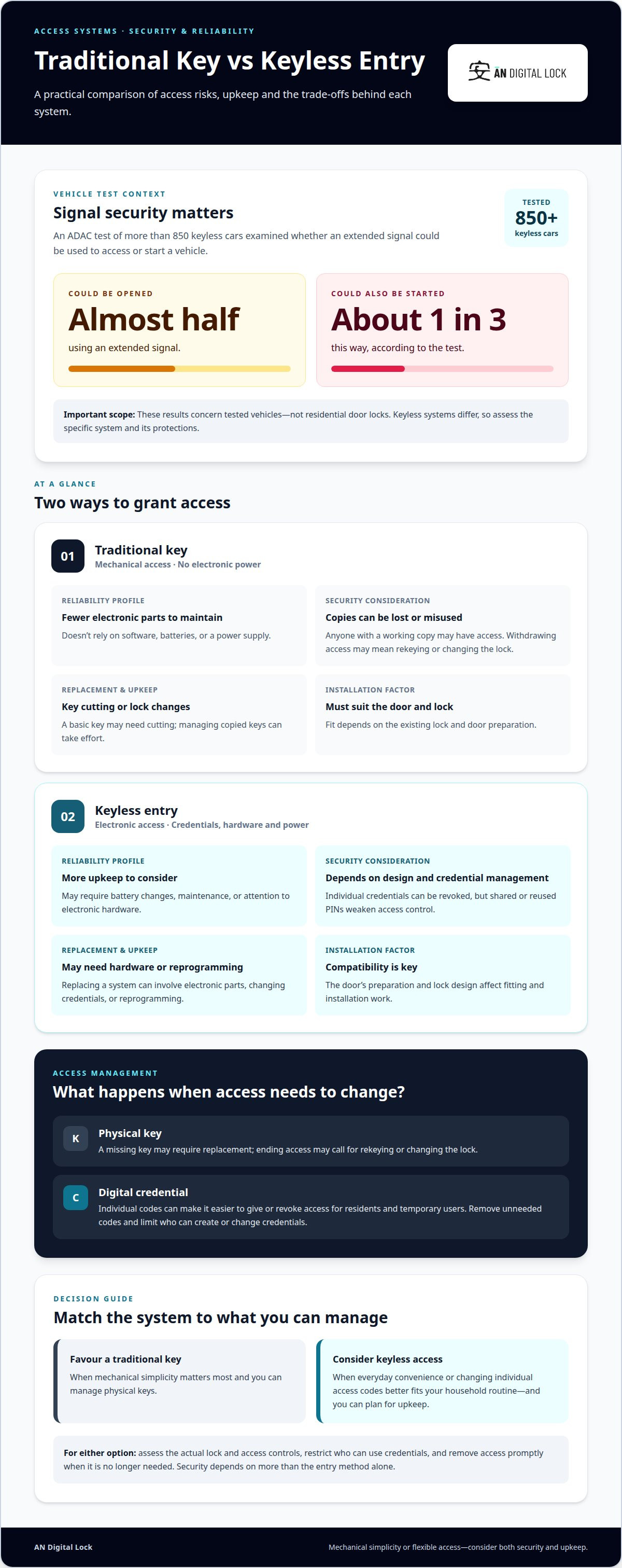
Neither access method is automatically safer. A traditional key can be copied or stolen, while keyless entry can face electronic risks. For vehicles, an ADAC test of more than 850 keyless cars found almost half could be opened using an extended signal. About one in three could also be started this way. These results concern tested vehicles, not residential door locks, but they show why signal security matters. The question of whether keyless entry or a traditional key is more reliable over the long term also depends on upkeep and access control.
For a home, compare the lock and its access controls. A traditional key gives access to anyone with a working copy. A digital lock can use individual credentials, but security depends on the device and how access is managed. If a physical key goes missing, the household may need to replace it or change the lock. If a keyless vehicle fob is lost or stolen, resetting its programming can help prevent continued use. These risks differ, so compare the actual access system rather than treating every keyless lock alike.
Replacement costs depend on what needs replacing. A basic physical key may need cutting, while a vehicle fob can require a replacement unit and programming. A lost fob may also need a programming reset. For a door lock, replacing a key and replacing the entire lock are separate jobs. Keyless entry and traditional keys involve different replacement steps: a digital system may require replacing electronic hardware, changing credentials, or reprogramming. The model and work required determine the expense.
Upfront and ongoing costs also differ. A traditional lock needs no electronic power, but managing copied keys can take effort. Keyless entry adds electronic hardware and may need battery changes or maintenance. Compatibility matters too: the door’s preparation and the lock’s design affect installation. Replacing an existing lock, for example, may require different work from fitting a digital unit to a new door. Factor installation and upkeep into your decision about long-term reliability.
| Option | Security consideration | Replacement and upkeep | Installation factor |
|---|---|---|---|
| Traditional key | Can be copied or stolen | Key cutting; lock changes if access must be withdrawn | Must suit the existing lock and door |
| Keyless entry | Depends on system design and credential management | May involve batteries, hardware, or reprogramming | Must suit the door and lock preparation |
Choose based on the access risks and upkeep you can manage. For mechanical simplicity, favour a traditional key; for greater convenience, consider keyless access and plan for maintenance.
Traditional deadbolt security compared with smart locks
A traditional deadbolt uses a physical key and mechanical components, so it doesn’t rely on software or a power supply. That simplicity limits electronic failure points, and mechanical locks are generally resistant to electronic hacking attempts. However, a key can be copied or passed to someone else. When access needs to end, the lock may need rekeying or replacement rather than simply removing a user from a list.
A smart lock changes how access is managed. Personalized access codes make it easier to give each household member a separate credential and revoke a code when a tenant or temporary user no longer needs entry. A study attributed to the National Institute of Standards and Technology links personalized access codes with a lower risk of unauthorized access than traditional keys. That advantage depends on careful code management. Shared or reused PINs weaken it.
Digital security also depends on the lock’s software and user accounts. Choose a unique PIN, restrict who can create or change credentials, and remove codes that are no longer needed. If the system provides firmware updates, install them according to its instructions. These steps help address digital risks, but they don’t replace sound physical installation. Both the electronic features and mechanical components matter.
Relay attacks are a separate concern for proximity-based vehicle entry. An attacker can extend communication between a vehicle and its key fob, making the vehicle detect the signal as if the key were nearby. This differs from guessing a smart-lock PIN or electronically attacking a traditional deadbolt. Don’t assume every keyless entry system works the same way: assess its specific access method and protections.
- Choose a deadbolt if you value a mechanical system with fewer electronic components and can manage physical keys.
- Choose a smart lock if changing or revoking individual access codes suits your household routine.
- Strengthen either choice by limiting who can access credentials and removing access promptly when it’s no longer required.
For Singapore homes where code-based access fits the household, Digital Door Locks offer a keyless alternative to a traditional deadbolt. Consider how residents will manage credentials alongside the lock’s physical security. The right system is the one whose access controls and upkeep match your daily use.
Remote keyless entry systems
Remote keyless entry uses a fob to communicate with a vehicle or electronic lock. In a car, the system detects the fob’s radio signal and may unlock the doors when the driver touches a handle. Some systems also support push-button starting or remote controls. A traditional mechanical lock works differently: a physical key moves internal parts directly, without radio communication or electronic power.
That distinction affects reliability. A mechanical door lock can still function during a power or connectivity failure because it depends on neither. Keyless entry systems rely on electronic components and batteries, so a depleted battery or system fault can interrupt normal access. Many vehicles retain a conventional keyhole as a backup, while some push-button cars can read a fob held against a marked spot. The backup method depends on the vehicle or lock.
For a key fob, battery condition is a practical maintenance factor. A weakening battery can make communication less reliable, while a fully depleted one may prevent ordinary remote use. Keep the backup entry method usable and follow the device’s battery guidance. If you rely on a digital door lock, learn how to recognise its low-battery warning and understand any supported emergency power or mechanical override before you need it.
Keyless entry can also simplify access when household needs change. A property manager may issue individual PIN codes, then update or remove a code when a resident’s access ends. Traditional keys usually require collecting copies or changing the lock to withdraw access. For multiple doors or shared spaces, keypad entry can be paired with a broader access-control system when the equipment supports that integration. The practical benefit depends on how the system manages credentials across those entry points.
Remote features vary by system. Some vehicle systems use a smartphone connection for remote control, while a basic keyless entry system may only lock or unlock doors. Don’t assume a residential door lock offers vehicle-style remote functions. Identify the actions you need, such as PIN access or remote operation, then match them to the system’s actual functions.
Use this simple decision sequence:
- Choose mechanical access if you want a door lock that works without batteries or connectivity.
- Choose electronic access if changing individual credentials matters more than avoiding electronic upkeep.
- Before relying on keyless entry, learn its backup method and how to respond to a low battery or malfunction.
For long-term reliability, assess the complete access system, not just its convenience. A clear backup method can reduce disruption from an electronic fault, while a mechanical lock avoids battery dependence altogether.
How physical keys and digital credentials grant access
A traditional key grants access through a physical match. On a conventional car lock, grooves and ridges align with internal tumblers, allowing the cylinder to turn. A door key works through its matching lock mechanism. This method needs no account, network connection, or battery. Its practical weakness is that anyone with a working key may be able to use it, and changing access can require collecting copies or changing the lock.
Digital credentials work differently. A keypad checks an entered PIN, while a compatible remote system may recognise a fob or app. In a household, separate codes can help distinguish residents’ access and make it easier to remove a former user’s credential. Traditional keys offer fewer options for temporary access or changing permissions. The convenience depends on the lock’s actual functions, not the word “smart” on its packaging.
Remote access adds another layer. Some smartphone-connected systems let users control entry from a distance, while other keyless systems only unlock locally. A remote command depends on the system’s communication method and supporting components. If the internet connection fails, an app-based remote action may be unavailable; a keypad or physical key may still work if it operates independently. Find out which entry methods remain usable without connectivity.
A dead battery can also change how access works. Many battery-powered keypad and smart locks provide a low-battery warning weeks before failure, and keypad locks typically need battery replacement every 6 to 12 months. Follow the lock’s instructions and keep its backup method practical. For vehicles, many push-button models can read a fob with a dead battery when held against the start button or another marked spot. The exact emergency method varies by system.
Power or technical faults make the backup method important. Many keyless vehicle systems include a conventional keyhole for a dead battery or electrical malfunction. For a home door lock, determine whether access depends on a physical override, external power, or another mechanism. A purely mechanical key avoids electronic and connectivity failures, but it cannot offer remote permissions. The best fit depends on which failure mode your household can manage.
- For offline access: keep a physical key or independent keypad method available.
- For remote convenience: distinguish app control from local fob or PIN entry.
- For changing access: use individual credentials where the system supports them, then remove obsolete codes.
Before choosing an advanced locking system, map how each household member enters in normal conditions and during a power, battery, or connection failure. This simple exercise shows whether convenience outweighs the value of mechanical independence.
Convenience for residents and property managers
For residents, convenience often means fewer steps at the entrance. A key fob can unlock a vehicle when its system detects the fob nearby, while a traditional key must be inserted and turned. At home, a keypad can let someone enter without carrying a metal key. The difference matters in daily routines, such as arriving with groceries or sharing access with another household member.
Property managers may value flexible permissions more than hands-free entry. With a key system, a resident’s access depends on physical copies being distributed and returned. With a keypad system that supports separate PINs, a manager can issue an individual code and remove it when access ends. For example, a temporary resident can use a personal code instead of receiving a key that must later be collected.
Some remote keyless systems also connect to a smartphone and support control from a distance. This can help a manager respond to a planned delivery or let an authorised visitor enter without handing over a key. Remote functions vary: one system may only unlock doors, while another may offer additional controls. Don’t assume a home door lock includes the same features as a vehicle fob or app.
Key fobs reduce the need to handle a key for every vehicle entry, but the fob still needs to be carried and kept in working condition. If it is lost or stolen, managing access becomes urgent. For a car, resetting the fob programming can help secure the vehicle. At home, a keypad with individual codes can make it easier to remove one person’s access without changing every resident’s routine.
A backup conventional key remains useful when an electronic system or fob fails. Many keyless vehicles have a keyhole for electrical problems or a dead fob battery. For a residential lock, the backup method depends on its design. Before choosing, map the usual entry method and the fallback: who can use it, where the backup is kept, and how access will be managed if the main method stops working.
- For shared homes: choose access management that makes it practical to add or remove each resident.
- For property managers: consider whether individual credentials reduce key handovers and collection tasks.
- For reliability: keep a usable backup for situations involving a missing fob, battery issue, or technical fault.
Match the entry method to the daily needs of residents and the access tasks a property manager handles. Explore entry options to find an approach that suits your household’s routine.
AN Digital Lock
AN Digital Lock helps Singapore homeowners weigh everyday access needs against long-term reliability. If you prefer code-based entry, Digital Door Locks provide an alternative to relying only on physical keys. Your choice should account for the household’s routines, who needs access, and how you’ll manage a backup method.
The door and entrance setup matter too. Wooden Doors and Metal Gates form part of the overall entry point, so consider how your lock choice fits the existing arrangement. AN Digital Lock offers these alongside Digital Door Locks, helping you plan the entrance as a complete setup rather than choosing a locking method in isolation.
Share your priorities, such as simpler access for residents or mechanical simplicity, and discuss which option suits your home. Contact AN Digital Lock to talk through your entry needs.
Choose the Entry System That Fits Your Home
Choosing between keyless entry and a traditional key for long-term reliability comes down to the balance you want between mechanical simplicity and flexible access. Before deciding, consider who uses the entrance, how access may change, and which backup method your household can manage confidently.
For a Singapore home, the lock is only one part of the entrance. The door and gate also shape how the complete setup fits your daily routine. AN Digital Lock offers Digital Door Locks, Wooden Doors, and Metal Gates, giving you options to consider together as you plan a secure, practical entry.
Take the next step with your household’s access needs in mind. Contact AN Digital Lock to discuss an entry setup that suits your home. A clear choice can make everyday access feel simpler and more secure.
Frequently Asked Questions
Final Thoughts: Which is Safer?
Neither option is automatically safer; security depends on the lock, the entrance, and how access is managed. A lost physical key may remain usable until the lock is changed, while a digital credential can be removed if the system supports that function. For a Singapore home, consider the door and gate together, and decide who needs access and how you’ll withdraw it if circumstances change.
What are the disadvantages of keypad locks?
Keypad locks depend on electronic components and batteries, so they need ongoing attention. Users may forget a PIN, share it too widely, or choose an easy code. Frequently used buttons can also show wear over time. Set individual codes when the lock allows it, remove codes that are no longer needed, and follow the model’s battery guidance. Keep the backup entry method accessible to the household.
What is the difference between a smart key and a traditional key?
A traditional key is a physical object cut to operate a matching mechanical lock. “Smart key” can mean an electronic vehicle fob or another credential that communicates with a compatible system. For example, a car fob may unlock doors electronically, while a house key turns a door cylinder directly. The exact features depend on the device, so the term alone doesn’t establish remote access or smartphone control.
Which one should you get?
Choose a traditional key if you want straightforward mechanical access and don’t need to change permissions often. Choose a keyless system if separate credentials suit your household or managing access is more convenient than handling key copies. Before deciding, consider who will use the entrance, how access changes will be handled, and what happens if the main method fails. The best fit is the one your household can manage consistently.
How often do keyless entry door handles, sensors, receivers, or immobilisers fail?
There isn’t one dependable failure interval for every keyless system. A handle, sensor, receiver, and immobiliser are different components, and their performance depends on the system design, installation, use, and power supply. If a fob works inconsistently, note whether the issue affects one entry point or several. That can help identify whether the problem involves the fob, a particular sensor, or the wider system.
Are keyless entry systems more vulnerable to theft or relay attacks than traditional keys?
Some proximity-based vehicle systems can be exposed to relay attacks, which extend communication between a car and its fob. ADAC testing has reported this risk in tested keyless cars. Traditional keys don’t transmit a signal, but they can still be copied, lost, or stolen. For a vehicle fob, a signal-blocking pouch can help limit relay exposure; with either method, respond promptly when access credentials go missing.