


Your renovation protection strategy needs to be more than just a few plastic sheets and a prayer. With over 60% of new BTO owners now opting for smart security upgrades, the standard for site safety has shifted. You likely feel the same anxiety every Singaporean homeowner does: the fear of fine dust ruining your non-renovated rooms or contractors accidentally scratching your expensive new flooring. Learning how to protect home during renovation is no longer just about cleaning up. It's about establishing a professional security and maintenance framework before the first hammer swings.
We understand that your home is your biggest investment. You shouldn't have to choose between a beautiful upgrade and total peace of mind while you're away from the site. This guide promises to equip you with essential physical and digital strategies to keep your space safe, clean, and secure throughout the process. We'll preview the best ways to manage contractor access without handing out physical keys, explore HDB-compliant protective materials, and show you how to maintain a damage-free environment from start to finish.
Key Takeaways
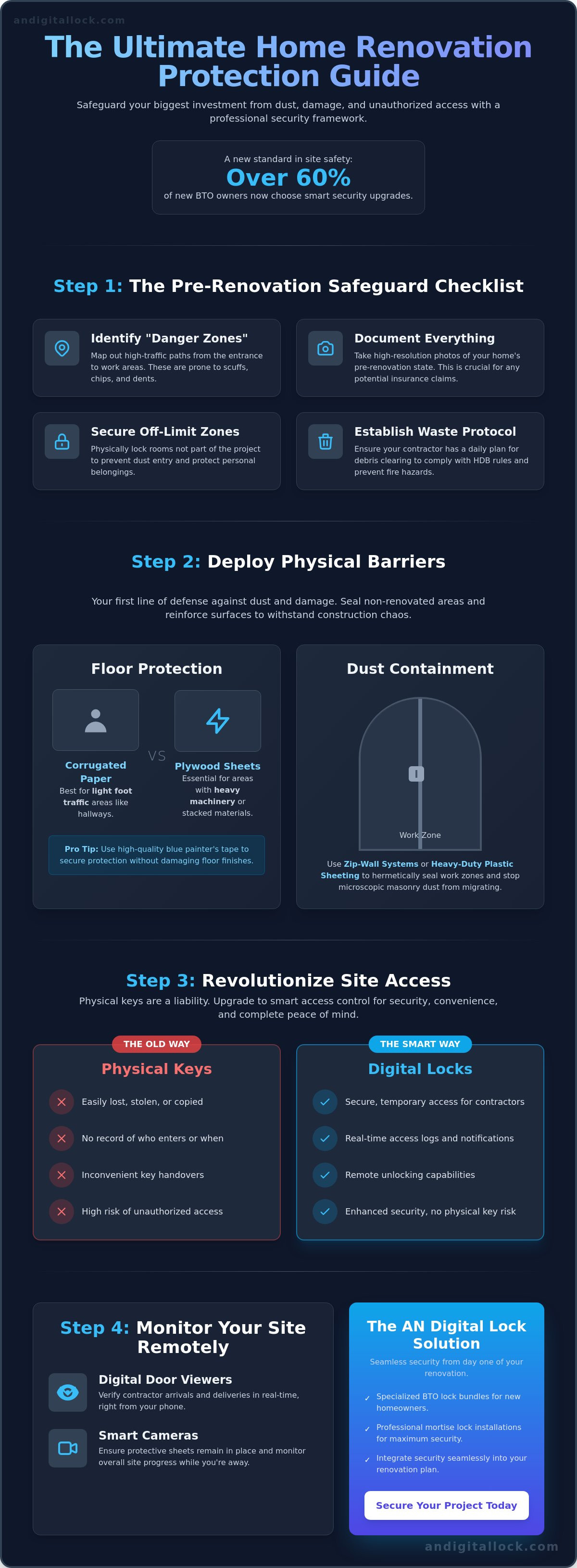
- Identify high-traffic "danger zones" and document your home’s pre-renovation state with detailed photos to prevent insurance disputes.
- Deploy professional-grade physical barriers like zip-wall systems and corrugated paper to stop fine masonry dust from migrating to clean areas.
- Discover how to protect home during renovation by replacing risky physical keys with digital locks that provide secure, temporary access for contractors.
- Monitor your site in real-time using digital door viewers and smart cameras to verify that protective sheets remain in place while you are away.
- Explore specialized BTO lock bundles and professional mortise lock installations designed to provide seamless security from the very start of your project.
The Pre-Renovation Checklist: Safeguarding Your Singapore Home
Protection starts before the first hammer swings. If you want to know how to protect home during renovation, you must begin with a comprehensive site assessment. Start by identifying high-traffic "danger zones." This is the direct path workers will take from the lift lobby through your front entrance to the specific rooms being overhauled. These transit areas are the most prone to floor chips, wall scuffs, and door frame dents. Mark these areas clearly on your floor plan.
Document everything. Take high-resolution photos of every corner of your home, including existing cracks or floor blemishes. This visual evidence serves as your best defense for insurance claims or dispute resolution if damage occurs in non-renovated areas. While following general home improvement safety principles, you should also define "off-limit" zones. Physically lock bedrooms or study areas that aren't part of the project. This prevents accidental dust entry and keeps your personal belongings secure from unauthorized access.
Establish a waste management protocol with your Interior Designer (ID) immediately. Debris shouldn't pile up in common corridors. This violates HDB regulations and creates a significant fire hazard for your neighbors. Ensure your ID has a scheduled plan for daily clearing and disposal. A clean site is a safe site. It reduces the risk of accidents and ensures that protective materials stay in place rather than being buried under rubble.
Assessing Vulnerable Surfaces and Fixed Assets
Evaluate your current hdb main door condition before work begins. If you aren't replacing it, it needs heavy-duty protection from constant door-to-door traffic and equipment transport. Check built-in wardrobes and kitchen cabinets. Even if they aren't in the "splash zone," fine masonry dust can settle into hinges and sliders, causing long-term mechanical issues. Use industrial-grade protective wrapping to seal these assets completely. Don't forget the windows. Verify that all window tracks are clean and the latches work perfectly to keep out sudden tropical rain during the hacking phase.
Communicating Security Expectations with Your Contractor
Clear communication prevents costly mistakes. Set strict working hours in accordance with HDB rules, which generally allow work from 9:00 AM to 6:00 PM on weekdays. This ensures you know exactly when people should be in your home. Discuss daily site lock-up procedures. You must clarify who is responsible for the final security check each evening. Clarify the penalties for damage to non-renovation areas in your signed contract. When workers know there's a clear accountability framework, they handle your property with much more care. This proactive approach is the most effective way to understand how to protect home during renovation without needing to be on-site 24/7.
Physical Barriers: Mitigating Dust, Debris, and Damage
Physical barriers are your property's first line of defense against the chaos of construction. In Singapore's high-density HDB and BTO environments, hacking and masonry work create immense amounts of fine dust and heavy debris. Knowing how to protect home during renovation starts with selecting the right materials to shield your surfaces. You must ensure that every non-renovated area is hermetically sealed and every floor surface is reinforced to withstand heavy foot traffic and equipment movement. Taking these steps prevents permanent damage that a simple post-renovation cleaning won't fix.
Floor Protection: From Corrugated Paper to Plywood
Use corrugated paper for light traffic areas like hallways where workers simply walk through. However, if your contractor is moving heavy machinery or stacking crates of tiles, you must insist on plywood sheets. These provide the structural rigidity needed to prevent impact damage to your underlying parquet or marble. Be extremely careful with the adhesive used. Standard duct tape can leave a sticky residue or even peel off floor finishes. Use high-quality blue painter's tape to secure your protection instead. Additionally, HDB regulations require you to protect the lift lobby and common corridor. Failure to keep these shared areas clean can lead to complaints from neighbors or fines from the Town Council.
Dust Containment Strategies
Masonry dust is microscopic and travels through the smallest gaps. Install zip-wall systems or heavy-duty plastic sheeting to isolate the work zone completely. To manage the air quality, employ the "negative pressure" technique. Place a high-velocity fan in a window within the renovation zone, blowing air outward. This creates a vacuum effect that pulls dust toward the window rather than letting it seep into the rest of your home. Seal the door gaps of non-renovated rooms with masking tape and plastic for an extra layer of security. During the hacking phase, don't wait for a weekly cleanup. Ensure your contractor performs a thorough vacuuming daily to prevent dust accumulation from becoming unmanageable.
Protect your new bathroom fixtures with padded covers immediately after installation. Scratches on a new vanity or toilet are nearly impossible to buff out and often occur when tools are placed on unprotected surfaces. Finally, seal your air conditioning vents. If dust enters the internal cooling system, you'll face expensive chemical washes or mechanical failures shortly after moving in. If you're planning to upgrade your home’s security alongside these physical protections, consider exploring the latest digital security solutions to keep your site safe and secure.
Smart Access Management: Securing Your Home During the Works
Managing the physical site is only half the battle. Controlling who enters your property, and at what time, is an essential part of how to protect home during renovation. Traditional renovations often involve handing over a "master key" to an Interior Designer or a main contractor. This creates a massive security hole. You lose control the moment that key leaves your sight. Between sub-contractors, delivery personnel, and various tradespeople, your house keys might pass through dozens of hands before the project ends. This makes your home vulnerable to unauthorized entry long after the workers have left the site.
The most effective strategy for 2026 is transitioning to a digital lock singapore homeowners trust before the heavy work begins. Modern smart locks eliminate the need for physical keys entirely. Instead of worrying about duplicates being made at a local hardware shop, you can issue unique, trackable digital credentials. This shift not only secures your assets during the construction phase but also sets the foundation for your long-term smart home security.
Why Physical Keys are a Renovation Liability
Physical keys are a liability in a high-traffic construction environment. If a worker loses a key, you're faced with an immediate crisis. You either leave the site unsecured or pay for an expensive emergency lock replacement. Many homeowners rely on external lockboxes, but these are often flimsy and easily compromised by anyone with basic tools. They also provide no audit trail. You won't know if the electrician arrived on time or if someone stayed in your home past the approved 6:00 PM HDB working hours. Changing manual locks after a renovation is a hidden cost that adds unnecessary hassle to your move-in schedule. Digital systems solve this by making access purely software-based.
The Advantage of Temporary Access Codes
Smart access management allows you to be a virtual gatekeeper. You can set specific, recurring PIN codes for different sub-contractors. For instance, the plumber's code might only work on Tuesday and Wednesday mornings. If a delivery of expensive appliances arrives while you're at work, you can issue a "One-Time Password" (OTP) that expires immediately after use. This is a critical step in how to protect home during renovation because it ensures no one has permanent access to your property.
- Real-time Notifications: Receive smartphone alerts the moment a worker enters or leaves the site.
- Instant Revocation: Delete a contractor's access code the second their task is completed.
- Entry Logs: Review a digital history of every entry attempt to ensure site rules are being followed.
By using 2026 technology like 3D facial recognition or synchronized gate and door unlocking, you create a frictionless experience for legitimate workers while maintaining absolute authority over your home's perimeter. You don't have to be physically present to ensure your home remains a restricted, secure zone.
Monitoring and Asset Protection: Keeping an Eye on the Site
Visual oversight is the final piece of the security puzzle. While digital locks manage who enters your home, active monitoring—often utilizing high-quality systems from specialized retailers like CCTV Shop—ensures that the rules you've set are actually being followed. You can't be at the construction site 24/7, but your technology can. Integrating smart monitoring tools into your strategy for how to protect home during renovation allows you to verify that protective barriers remain intact and that workers are treating your property with respect. This level of transparency reduces the risk of disputes and keeps your project on track without requiring constant physical presence.
Implementing a strict "no-overnight" policy for workers is a critical liability reducer. Unless your renovation is a specialized 24-hour commercial project, there is rarely a reason for personnel to stay past HDB's approved 6:00 PM cutoff. Use your entry logs and camera feeds to ensure the site is vacated every evening. This prevents your home from being used as temporary lodging, which can lead to increased wear and tear or accidental damage to new installations.
Using Digital Door Viewers for Real-Time Monitoring
A digital door viewer is a significant upgrade over the traditional glass peephole. These devices feature wide-angle lenses and motion-activated recording that captures every interaction at your front door. If an unauthorized person attempts to enter or if a delivery is left unattended in the corridor, you'll receive an instant alert on your smartphone. This is especially useful for verifying the identity of sub-contractors before you grant them remote access via your smart lock. You can also use the recorded footage as evidence if materials are mishandled at the entrance, ensuring accountability for every person who steps onto your property.
Securing Valuables with Digital Safe Boxes
Renovations are inherently chaotic, and small valuables are easily misplaced or damaged by dust and debris. If you are living through a renovation or visiting the site frequently, a portable digital safe box is essential. Use it to secure jewelry, spare cash, and important renovation contracts that need to stay on-site but out of harm's way. Choosing a safe with biometric access ensures you can retrieve your items quickly without fumbling for keys in a dusty environment. It provides a dedicated "safe zone" for your most sensitive assets amidst the construction turmoil.
Beyond physical security, smart home cameras allow you to check the status of your dust containment systems remotely. If a zip-wall falls down or floor protection starts to peel, you can notify your Interior Designer immediately before dust ruins your furniture. To ensure your home is fully equipped with the latest monitoring and security technology, shop our full range of digital locks and security accessories today.
The AN Digital Lock Solution: Seamless Security for Your 2026 Renovation
Successfully managing a Singapore renovation requires a partner that understands the local residential landscape. AN Digital Lock offers specialized BTO Lock Bundles designed to integrate seamlessly into your new home from day one. These bundles address the primary concern of how to protect home during renovation by providing advanced security hardware before the heavy work begins. Our professional installation services ensure that your mortise lock is fitted with precision. This prevents mechanical issues often caused by door misalignment during the construction phase.
We believe security should be frictionless and reliable. By choosing a comprehensive bundle, you secure both your main wooden door and your metal gate with synchronized technology. This allows you to manage the entire entry point through a single interface, reducing the complexity of site management while you focus on your interior design choices.
Why Install Your Digital Lock Before Renovation?
Many homeowners wait until the final handover to install smart locks. This is a mistake. Installing your lock early solves the "Access Nightmare" of coordinating key handovers for dozens of sub-contractors. You won't need to worry about unauthorized duplicates or lost physical keys. Use the "Scramble Code" feature, which allows you to enter random digits before or after your actual PIN. This keeps your primary code private even if workers are standing nearby. Our 2026 lineup of Philips and Zigbang locks is engineered for durability. They feature reinforced housings and sealed sensors that are specifically designed to withstand the dusty, high-impact environment of a typical Singapore renovation site.
Professional Support and Expert Guidance
Choosing the right hardware is only half the journey. You need expert guidance to match the lock to your specific door material, whether it's a fire-rated main door or an ultra-slim aluminium frame. Consulting with our team helps you identify the best digital lock singapore has to offer for your unique setup. We provide a tailored experience that considers your aesthetic preferences and security needs.
Once the renovation is complete, perform a "Cleanup and Reset" procedure. Wipe down all sensors with a microfiber cloth to remove microscopic masonry dust. Immediately revoke all temporary contractor PINs and reset your master code. Re-register your family's biometrics to ensure a fresh, secure start in your new space. Our team provides ongoing maintenance and technical support to ensure your security remains robust long after the contractors leave. Secure your renovation project with AN Digital Lock today!
Step Into Your New Home With Absolute Confidence
Protecting your investment requires a proactive blend of physical shielding and smart technology. By combining heavy-duty barriers with real-time digital access management, you eliminate the stress of site chaos. You've learned that documenting your site, sealing air vents, and using temporary PIN codes are non-negotiable steps for a successful project. Mastering how to protect home during renovation ensures your dream space stays pristine from the first hacking session to the final handover.
Since 2013, AN Digital Lock has helped thousands of Singapore homeowners secure their properties with over 10 years of industry expertise. As an authorized dealer for global leaders like Philips, Zigbang, and Solity, we back our technology with thousands of 5-star reviews from satisfied clients. Don't leave your site security to chance or rely on outdated manual locks. View our 2026 BTO Digital Lock Bundles and Save! Your journey to a beautiful and secure home starts with the right protection. We're ready to help you safeguard your space so you can focus on the joy of moving in.
Frequently Asked Questions
Is it safe to install a digital lock before my renovation is finished?
Yes, installing your lock early is the most effective way to manage site access. It eliminates the need for physical keys and prevents unauthorized duplication. Modern locks from brands like Philips and Zigbang are built to be durable; however, you must ensure they are properly wrapped to stay shielded from heavy construction debris.
How do I prevent dust from damaging my new digital door lock?
Cover both the internal and external units with plastic cling wrap or a dedicated protective sleeve during the hacking phase. Microscopic masonry dust can settle into fingerprint sensors and touchpads. Wipe the scanner daily with a dry microfiber cloth to prevent grit from causing permanent scratches on the glass surface.
Can I track which workers entered my home using a smart lock?
Most smart locks allow you to monitor entry logs directly through a mobile app. By assigning a unique PIN to each trade, such as your plumber or electrician, you can see exactly what time they arrived and left. This transparency is a key benefit of learning how to protect home during renovation with digital tools.
What should I do if a contractor loses the temporary access code?
You don't need to worry about security breaches if a code is forgotten. Simply log into your smartphone app, delete the old credential, and generate a new one instantly. This is much safer and cheaper than replacing a traditional lock cylinder if a physical key goes missing on a busy site.
How do I protect my HDB main door from scratches during heavy hacking?
Wrap your entire door and the door frame in corrugated paper or thick bubble wrap. Secure the edges with blue painter's tape to avoid leaving a sticky residue on the finish. This physical barrier is essential for how to protect home during renovation, as it prevents chips from moving equipment and flying debris.
Should I change my digital lock PIN once the renovation is complete?
Absolutely. You should delete all temporary contractor codes and perform a master PIN reset as soon as you receive the final handover. It's also the best time to register your family's fingerprints and facial recognition data to ensure your home's perimeter is completely refreshed for your move-in.
Is a digital door viewer necessary if I already have a smart lock?
A digital door viewer adds a vital layer of visual security that a lock alone cannot provide. While the lock manages the door, the viewer records motion in the corridor and identifies who is standing outside. It serves as a 24/7 witness to material deliveries and any unauthorized loitering near your entrance.
What is the best way to secure my valuables if I stay in the house during renovation?
Invest in a biometric digital safe box to store your jewelry, cash, and renovation contracts. Even if you are at home, the high volume of workers moving through different rooms creates opportunities for items to be misplaced. A safe provides a dust-proof, secure zone for your most sensitive assets throughout the project.