


A home safe can protect valuables from theft while still leaving them exposed to fire. For an HDB storeroom, look for a fire-resistant safe rated for at least one hour, and check that its size and mounting position suit the space. The best home safe box to install in an HDB storeroom should also match what you plan to protect, from important documents to small valuables.
Fire protection matters, but it isn’t the only consideration. Water damage, misplacement and a safe that’s difficult to secure can also undermine your plans. This guide explains how to weigh these risks, choose a practical size, avoid common selection mistakes and assess whether the storeroom wall can support mounting. You’ll have a clearer basis for choosing a safe that suits your home and the valuables you want to protect.
Key Takeaways
- Prioritise a fire-resistant safe with at least one hour of fire protection, and weigh fire exposure alongside theft, water damage and misplacement risks.
- Choose a safe around what you plan to protect and how often you need to access it.
- Avoid common selection mistakes by considering the safe’s size, intended use and protection needs together.
- Assess the storeroom wall before mounting; anchoring a safe to concrete through its anchor holes can make it harder to move.
- Use the guide’s practical checks to narrow down a safe that suits your HDB storeroom and valuables.
1. Theft, fire, water damage, and misplacement risks at home
A safe addresses several risks, but each calls for different protection. Theft concerns include someone carrying away an unsecured box or accessing valuables inside. Fire protection focuses on limiting heat around the contents. Water exposure can damage paper and electronics, while poor storage habits can leave belongings misplaced. For HDB homeowners, start by identifying which risk matters most for each item.
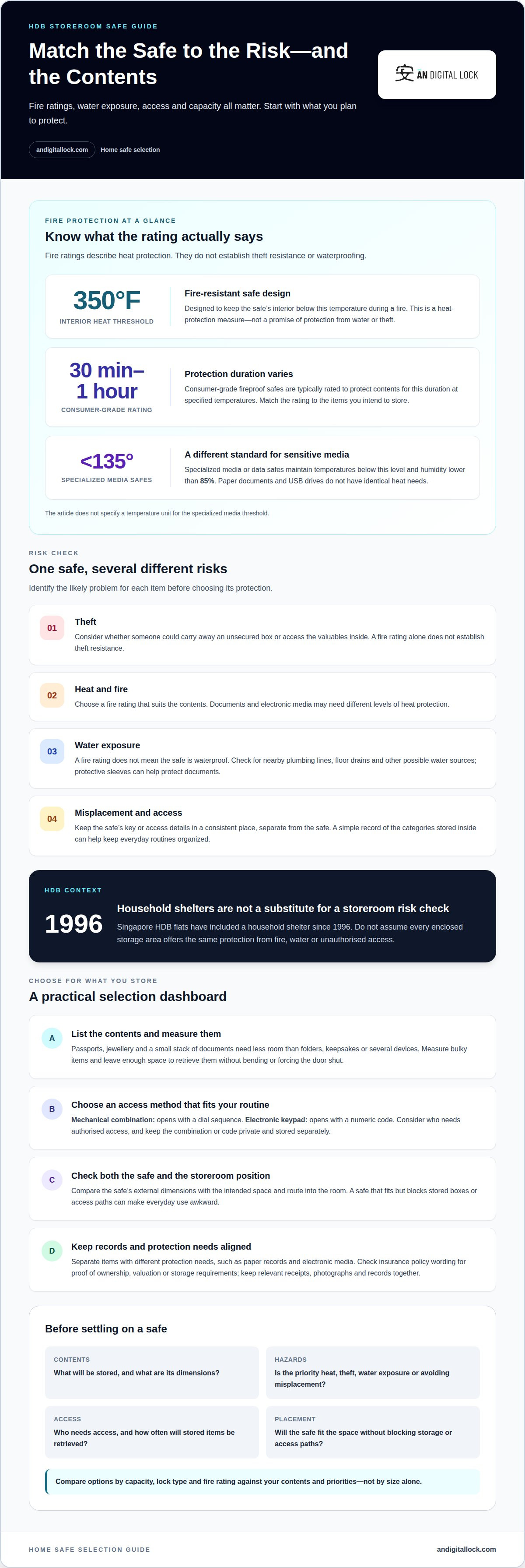
Consider a passport, jewellery and a USB drive. A locked safe can keep them together and out of casual view, but heat and moisture may still threaten sensitive contents. Fire-resistant safes are designed to keep their interiors below 350 °F during a fire. That rating describes heat protection, not theft resistance or waterproofing, so assess those risks separately.
Fire ratings also differ by contents and duration. Consumer-grade fireproof safes are typically rated to protect contents for thirty minutes to one hour at specified temperatures. A paper document and a USB drive don’t have identical heat needs. Specialized media or data safes maintain temperatures below 135° and humidity lower than 85%. Match the protection to the items you’ll store, not just the safe’s label.
Water deserves a separate check. A fire rating doesn’t establish protection against leaks or water used during firefighting. Important papers, for example, can be damaged if water enters the safe or reaches its contents. Keep documents in protective sleeves, and consider whether the proposed location is near a plumbing line, floor drain or other possible water source.
Misplacement may be less dramatic than theft or fire, but it can disrupt everyday routines. A spare key kept in an obvious drawer may be hard to find when needed, while a frequently used document can disappear among seasonal storage. Choose a consistent place for the safe’s access method, and keep a simple record of the categories of belongings inside.
Singapore HDB flats have included a household shelter since 1996, but it serves as a designated shelter, not a substitute for assessing storeroom risks. Don’t assume every enclosed storage area offers the same protection from fire, water or unauthorised access. For a sensible first pass, list what you intend to protect, note the likely hazards in its proposed location, then decide which protection deserves priority.
This assessment helps prevent a common mismatch: choosing a safe for theft when your priority is protecting documents from heat, or focusing on fire while overlooking water exposure. A suitable choice balances the contents, risks at home and the way you’ll use the storage space. Next, match the safe’s capacity and access features to each item’s value and purpose.
2. Choosing a safe based on value and use
Start with the items you plan to protect, then choose capacity based on their dimensions and use. A passport, jewellery and a small stack of documents need less interior space than folders, keepsakes or several devices. Measure bulky items, including document envelopes, so they fit without bending or forcing the door shut. Leave enough room to retrieve items easily, not just store them.
Lock type affects how you access the contents. A mechanical combination lock uses a dial sequence, while an electronic keypad opens with a numeric code; digital safe locks can refer to electronic access systems. Choose the method that suits your routine, and consider who needs authorised access. Keep the combination or code private and stored separately from the safe.
You can store important documents, jewellery, small valuables and essential records together when you want them secured in one place. A passport or property document is useful only if you can retrieve it when needed, so keep frequently used items accessible. Separate items with different protection needs, such as paper records and electronic media.
Insurance requirements depend on the policy wording and the type of item. Look for instructions about proof of ownership, valuation or storage, and keep relevant receipts, photographs and records together. A jewellery purchase receipt, for example, can help document ownership. A safe supports home security but doesn’t replace the terms of an insurance policy.
Match the safe’s capacity to your current needs and likely use. A compact box may suit a few passports and small valuables, while folders or belongings for several family members call for more interior room. Check the external dimensions against the intended storeroom position, too. A safe that fits but blocks stored boxes or access paths can make everyday use awkward.
How much do home safes in Singapore cost? Prices vary with size, lock type and fire rating, so compare those specifications against your contents and priorities rather than choosing by size alone. A larger safe or different lock configuration changes what you’re comparing. Identify the protection and capacity you need, then assess options on a like-for-like basis.
Build a simple selection checklist: list the contents, note their dimensions, decide who needs access and prioritise the protection each item needs. A household storing mainly paper records, for example, may weigh fire protection differently from one storing jewellery and small valuables. Keep access details separate, and make sure the safe’s capacity suits your planned storage.
A safe is one part of home security. For the entrance, digital door locks address a different need: controlling access through the door. Consider each product according to what it protects, rather than expecting one solution to cover every risk.
3. Common mistakes when selecting a home safe
One mistake is choosing a safe by its exterior size alone. Storeroom shelves, doorways and access routes can limit where it fits. Measure the intended position and the route into the room, then compare those dimensions with the safe. A box that fits on a shelf may still be awkward to move through a narrow storeroom entrance.
Another mistake is treating every security rating as interchangeable. A TL rating is one part of assessing a safe’s resistance, not a guarantee against every threat. TRTL indicates protection against cutting torches, while TXTL-rated safes resist explosives, tools, tactics and torches. Treat each rating as a description of a specific resistance test, not a promise against every threat.
Construction labels also need careful reading. B-rated safes have walls less than ½ inch thick and doors less than 1 inch thick. C-rated safes have the same wall and door thicknesses as B-rated safes, but are made of steel. These descriptions help distinguish construction, but they don’t replace checking whether the safe suits the contents and intended use.
Sometimes buyers focus on lock convenience and overlook upkeep. A mechanical lock may suit a household comfortable with a dial combination, but its moving parts need attention over time. Have a mechanical safe lock serviced by a qualified safe box technician every five years. Keep the combination accessible to authorised household members, but don’t store it beside the safe.
Another mistake is assuming that documents and electronic media need identical fire protection. Paper and digital storage have different sensitivities to heat and humidity. Choose protection for the most sensitive contents, and avoid mixing items if the safe’s conditions don’t suit them all. An important paper file and a USB drive, for example, may call for different protection priorities.
Installation and warranty terms deserve as much attention as the safe itself. In Singapore, assess retailers and brands by the written terms for the specific model, including whether installation is covered and what the warranty applies to. A brand name alone doesn’t explain those terms. Keep purchase and installation documents together so you can readily find the coverage details.
Finally, don’t choose a safe based on one feature, such as a thick door or digital lock. Compare its construction, lock, capacity and stated resistance against your intended use. Before deciding, list the contents, measure the available space and review the safe’s rating and written terms. This helps you focus on specifications that address your main concerns.
4. Concrete walls versus hollow partitions for mounting
The mounting surface affects how securely a safe can be anchored. Concrete offers a solid base for suitable fixings, while a hollow partition has a cavity behind its surface. Before choosing a position in an HDB storeroom, identify the wall type and note where the safe’s anchor holes are. Even a strong safe may be easier to move if its fixing point is unsuitable.
For a concrete wall or floor, align the safe’s anchor holes with the intended fixing points. Anchoring through these holes can make the safe harder for a burglar to move. The safe must sit close enough to the surface for the fixings to engage correctly. A skirting board or uneven floor, for example, may prevent close contact and complicate installation.
A hollow partition needs a different assessment. Its visible surface may not provide the same support as solid concrete, especially if the fixings engage only with the board. Consider the exact fixing location and whether solid backing is present. Don’t assume a wall can hold a valuable safe just because it supports a lightweight cabinet or shelf.
In Singapore, HDB household shelter rules are separate from the rules for an ordinary storeroom wall. Removable screws may be used to mount cabinets, shelves, fans and lights in a household shelter without a permit. That allowance names those items; it doesn’t establish a rule for bolting a safe. Keep the distinction clear before planning any mounting inside a household shelter.
Plan the location before drilling. First, check the safe’s anchor-hole positions against the intended concrete surface. Next, consider whether the door can open fully and whether stored items will block access. Finally, make sure the fixing points don’t conflict with pipes, cables or other concealed services. A spot near a storeroom corner may feel discreet, but access and fixing conditions still matter.
Wall mounting isn’t the only option. If the floor provides a suitable concrete fixing point, the safe’s anchor holes may allow floor anchoring instead. For example, a hollow wall beside a concrete floor may make the floor a more practical option. The right choice depends on the safe’s design, the available solid surface and the intended position.
For an HDB storeroom, assess the surface, the safe’s anchor-hole layout and the room’s usable space together. A concrete surface can support anchoring; a hollow partition calls for particular care about what lies behind its facing. If the proposed location is a household shelter, distinguish removable screws for named fixtures from safe bolting. This check helps avoid a mounting position that undermines the safe’s purpose.
5. What are the best home safes available in Singapore for an HDB storeroom?
The right safe fits your HDB storeroom, protects the contents you intend to store and can be secured appropriately. As a starting point, choose a fire-resistant safe rated for at least one hour. Then compare its capacity, lock type, fire rating and mounting options with the way you’ll use it.
Start with fit. Measure the proposed location, door opening and route into the storeroom before choosing a size. A safe that fits on paper may still block access to a cabinet or be difficult to position. Leave room to open the door and retrieve documents without moving stored boxes each time.
Next, match protection to contents. A household storing paper records may prioritise fire protection, while one keeping jewellery may also focus on resistance to unauthorised access. Fire-resistant safes are designed to keep their interiors below 350 °F during a fire. That figure doesn’t describe every safe’s rating or prove protection against water, so compare the stated protection for the model.
Check the fire-protection duration as well as the label. Consumer-grade fireproof safes are typically rated to protect contents for thirty minutes to one hour at specified temperatures. For an HDB storeroom, the recommended baseline is at least one hour of fire protection. This gives you a clear comparison point instead of relying on the word “fireproof” alone.
Choose a lock to suit your household’s access needs. An electronic keypad may suit people who prefer code entry, while a mechanical combination lock uses a dial. A safe with redundant locks combines mechanical and electronic locks. Consider who needs access, how the safe will be used and how you’ll keep its combination or code secure.
Installation should also inform your shortlist. A safe with anchor holes can be secured to a suitable concrete surface. Compare the holes with the proposed position before making a choice. In a storeroom with a hollow partition, don’t assume the wall alone provides a suitable mounting point.
Finally, compare models using the same criteria: dimensions, usable interior space, lock type, stated fire duration and mounting design. Two safes described as fire-resistant, for example, may differ in protection time and capacity. The best home safe box to install in an HDB storeroom isn’t necessarily the biggest or most feature-rich option. It’s the one whose documented specifications match your contents, available space and installation plan.
Keep the decision practical: write down what you’ll store, measure the location and identify your priority protection. These steps make it easier to shortlist a safe for a Singapore home without letting one feature dominate your choice.
Look for a fire-resistant safe rated for at least one hour, with dimensions and capacity that suit the storeroom and a lock that fits your household’s access needs. If you plan to mount it, make sure its anchor holes align with a suitable concrete surface.
AN Digital Lock: Safe Boxes
AN Digital Lock offers Safe Boxes for homeowners looking for a secure place to keep valuables and important documents. Assess your storeroom space, contents and mounting surface to narrow your choice. A safe should suit the items you plan to store and fit the intended location. These checks can help you make an informed selection without treating one feature as the whole answer.
If you’re ready to explore safe boxes for your HDB home, contact AN Digital Lock to discuss your needs.
Make a Confident Choice for Your Home
Choose the best home safe box to install in an HDB storeroom by thinking beyond the belongings you have today. Consider how your household’s storage needs may change, who will need access and whether the safe’s position will remain practical as the storeroom fills. A safe that fits your everyday routine is easier to use over time.
Home protection can involve more than the storeroom. AN Digital Lock offers Digital Door Locks, Wooden Doors and Metal Gates, giving homeowners options for other parts of their home setup.
If you’re ready to take the next step, contact AN Digital Lock about home safes and share what you plan to protect. A clear sense of your needs can help you move forward with confidence.
Frequently Asked Questions
How Fire Affects the Safe Box?
Fire exposes a safe and its contents to heat, which can reach sensitive items even if the exterior remains intact. A safe’s fire rating describes its performance under stated test conditions, not every possible fire scenario. Paper records and electronic storage media, for example, have different heat tolerances. Keep essential digital files backed up separately: a home safe protects physical items but can’t replace another copy.
How a Safe Box is Rated?
A safe’s rating helps explain the specific resistance or protection it has been tested to provide. Read it alongside the test conditions, such as the type of attack or fire exposure. A label alone doesn’t show whether the safe suits your contents or location. A rating focused on burglary resistance, for example, doesn’t automatically establish fire or water protection, so assess each need separately.
How to Select a Safe?
Choose a safe by matching its intended use to its contents, access routine and installation location. Start with a short inventory, such as passports, jewellery and backup drives, and note which items need frequent access. Consider who in the household needs entry and how you’ll protect access details. Then compare the safe’s stated protections and dimensions with those needs, rather than relying on its appearance or one feature.
Which Size of a Safe Box is Better?
The right size holds your belongings and fits the planned position. Measure the largest item, such as a document folder or small device, and allow room to place and retrieve it. Compare usable interior space, not just exterior measurements. A safe that’s too small can force documents to bend; an oversized model can take up useful storeroom space or obstruct other storage.
Which safe sizes and capacities fit typical HDB storeroom spaces?
There’s no single safe size that fits every HDB storeroom, so measure the available floor area, door opening and access path. Standard built-in wardrobes in Singapore HDB BTO flats are about 60 cm deep, but that measurement isn’t a guide to every storeroom. A safe measuring 45 cm or more belongs on the floor or a bottom shelf, not a middle wardrobe shelf.
What fire and water resistance ratings should I look for in a home safe?
For fire protection, look for a fire-resistant safe rated for at least one hour, and compare its stated test conditions with the items you intend to protect. Treat water protection as a separate specification: a fire rating doesn’t establish resistance to leaks or water exposure. If you’re storing paper records, consider a protective sleeve inside the safe and avoid placing it near a likely source of leaks.
How should a safe be anchored to a concrete floor or wall in an HDB flat?
Use the safe’s anchor holes to secure it to a suitable concrete surface, aligning the fixing points with those holes. First, choose a position that allows the door to open and doesn’t obstruct storeroom access. Household shelter rules are different: removable screws may be used there for cabinets, shelves, fans and lights without a permit. That allowance doesn’t name safes, so don’t treat it as approval for safe mounting.
What are the security risks of installing a safe in an HDB storeroom?
An unsecured safe may be easier to move, while a visible location can make it easier for visitors to notice. A storeroom crowded with boxes can also make access inconvenient, encouraging household members to leave valuables elsewhere. Choose a discreet, practical position and keep the safe’s access details separate. Don’t place it where stored items block the door or make it difficult to notice moisture or other changes nearby.