


Imagine standing outside your HDB flat at midnight, only to realize your heavy bunch of keys is still sitting on the dining table. It's a sinking feeling that usually ends with a S$200 emergency locksmith bill and hours of cold sweat in the corridor. If you've ever wondered how to avoid getting locked out of your house, you know that fumbling with separate keys for the metal gate and wooden door is an outdated routine. This daily hassle is a security gap that modern technology can easily close.
You deserve a more reliable, professional way to manage your home entry. This guide explores the most effective habits and smart technologies designed specifically for Singaporean homeowners. We'll cover everything from the latest 2024 fire-safety regulations for digital locks to building a "set and forget" setup that guarantees keyless freedom. Discover how to replace anxiety with contemporary refinement and ensure you never face a home lockout again. It's time to transition to a biometrically-secured lifestyle that puts you back in control.
Key Takeaways
- Identify common HDB "automatic lock" traps and the daily routines that lead to being stranded outside your flat.
- Discover how to avoid getting locked out of your house by transitioning to a permanent, keyless lifestyle using biometric and PIN access.
- Overcome battery anxiety with professional maintenance tips and low-battery alert systems from world-class brands like Zigbang and Philips.
- Understand Singapore’s mandatory fire-safety certifications to ensure your digital lock setup is fully compliant for your main entrance.
- Establish a "set and forget" security routine for your main door and metal gate to achieve total convenience and peace of mind.
The Psychology of Lockouts: Why We Forget Our Keys
Getting locked out isn't just about being forgetful; it's a byproduct of a high-speed Singaporean lifestyle. Think about your typical morning. You're rushing to catch the MRT or beat the peak-hour traffic. Your mind is already on your first meeting or your child's school schedule. You grab your phone and wallet but leave the heavy bunch of keys sitting on the shoe rack. By the time the door clicks shut, it's too late. Handling heavy groceries after a trip to the supermarket is another prime scenario. Your hands are full, you're struggling with the gate, and the main door swings shut behind you. This is why learning how to avoid getting locked out of your house is about more than just "remembering better."
The mental load of managing separate keys for your mild steel gate and your main door adds another layer of complexity. It's a legacy system that demands constant vigilance every time you leave or enter. Relying on your memory is a flawed strategy because human attention is a finite resource. Eventually, the "memory-based" prevention system will fail. It happens to everyone at some point, usually at the most inconvenient time possible.
The HDB Automatic Slam-Lock Risk
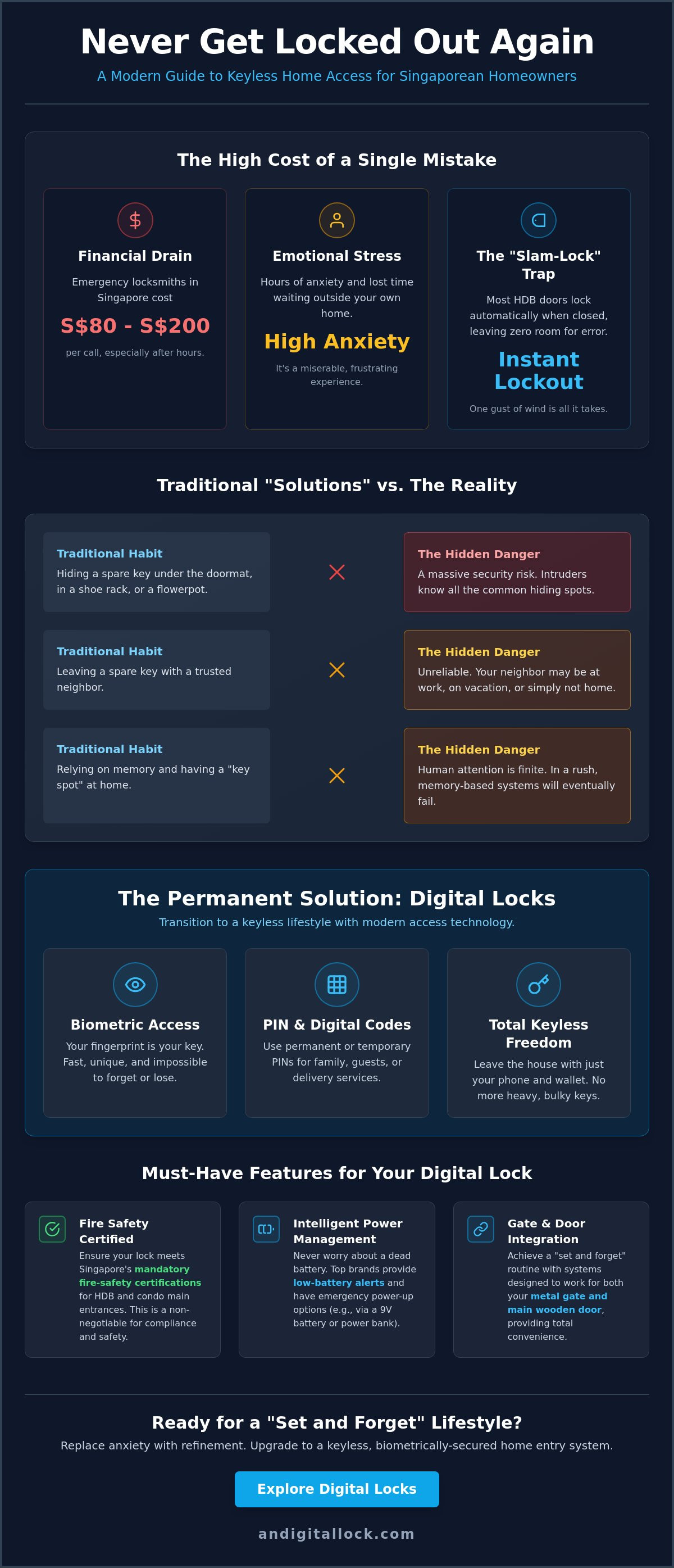
Most HDB flats use mortise locks that engage the moment the door closes. This "slam-lock" feature provides instant security, but it's also the primary cause of accidental lockouts. If your lock doesn't require a key to secure it from the outside, you're at risk. You can check this easily. Open your door and look at the latch. If it's spring-loaded and angled to retract when it hits the strike plate, you have a slam-lock. These systems leave zero room for error. One gust of wind or a momentary lapse in focus is all it takes to strand you in the corridor.
The Cost of a Single Mistake
A single lockout event carries a heavy price tag. Emergency locksmith services in Singapore typically charge between S$80 and S$200 for a standard opening. If you're locked out after midnight or on a public holiday, expect to pay on the higher end of that scale. The financial cost is only the beginning. Forced entry often leads to significant structural damage to your wooden doors, requiring expensive repairs or even a total replacement. Beyond the money, the emotional stress of being stranded and the hours of lost time create a miserable experience. Understanding these risks is the first step toward finding a permanent solution for how to avoid getting locked out of your house.
Traditional Prevention Habits and Their Hidden Risks
Many homeowners rely on manual habits as their primary defense against lockouts. While these routines are better than nothing, they often create a false sense of security. If you want to know how to avoid getting locked out of your house using traditional methods, start with a rigorous "Key Audit." Ensure every family member has a reliable, tested set of keys. This process should extend to your vehicle as well; utilizing a professional car key replacement Singapore service ensures that your backup sets are always functional. A missing or damaged spare is a lockout waiting to happen. You don't want to discover a key doesn't work when you're already stranded in the corridor.
The Danger of Hiding Keys in Singapore
Hiding a spare key under a doormat, inside a shoe rack, or within a fire hose riser is a massive security risk. HDB corridors and condo lift lobbies are high-visibility areas. Potential intruders are well aware of the "Flowerpot Strategy" and actively look for these common hiding spots. Some even use "key-fishing" tools to retrieve spares without ever being seen on a neighbor's doorbell camera. If you must keep a physical backup outside, use a high-quality, secure keybox rather than a vulnerable hiding spot. This provides a much higher level of protection for your home and prevents opportunistic theft.
The Neighbour Safety Net
Entrusting a spare key to a neighbor is a classic Singaporean solution. It builds community trust, but it isn't a foolproof plan. You must choose a neighbor who is frequently at home and whom you trust implicitly with your home's security. Even with the best intentions, this method is prone to human error. Your neighbor might be out for dinner, at work, or on vacation exactly when you find yourself locked out. This reliance on others can lead to long wait times and social awkwardness during late-night emergencies. For a more independent approach, many homeowners are now upgrading their digital door locks to remove the need for physical spares entirely.
Relying on these traditional habits requires constant mental effort. You have to remember to check the launchpad, remember where the neighbor is, and remember to audit your keys. In a fast-paced environment, your memory will eventually hit a limit. Transitioning to a tech-driven setup is the only way to achieve true "set and forget" peace of mind.
The Permanent Solution: Switching to Digital Door Locks
The most effective way to eliminate the risk of being stranded is to remove the variable that causes the problem: the physical key. While traditional habits rely on your memory, technology relies on automation and biometric data. Switching to digital door locks transforms your entry experience from a manual chore into a seamless, automated process. If you want to know how to avoid getting locked out of your house permanently, keyless living is the only 100% reliable method available today. You can finally stop carrying a heavy bunch of keys that scratch your phone screen and clutter your pockets.
Modern systems offer multiple access methods to suit every family member. You can choose from fingerprint recognition, PIN codes, RFID tags, or mobile app control. For many Singaporean households, the ultimate convenience comes from integrating the metal gate and wooden main door locks. Through synchronization, a single touch on your gate lock can automatically unlock your main door. This creates a frictionless entry path that is especially helpful when you are carrying heavy groceries or managing young children. It turns a multi-step process into a single, effortless motion.
Biometric vs. PIN Access
Fingerprint access is widely considered the gold standard for lockout prevention. It's impossible to "forget" your finger at the office or leave it inside the house. You simply touch the sensor and enter in under a second. PIN codes offer a different kind of flexibility. They are perfect for providing temporary access to guests, part-time cleaners, or delivery personnel without handing over a physical key. To maintain high security, premium locks now feature "fake PIN" technology. This allows you to enter random digits before or after your actual code to prevent onlookers from memorizing your sequence or identifying smudge patterns on the keypad.
Smart Features That Save the Day
Remote unlocking via Wi-Fi is a life-saving feature for busy professionals. If a family member arrives early while you are stuck in a meeting, you can let them in instantly using your smartphone. This eliminates the need for anyone to wait in the corridor. Additionally, auto-lock features ensure your home is always secure. The system automatically bolts the door the moment sensors detect it has closed, solving the "did I lock the door?" anxiety forever. Real-time notifications provide an extra layer of reassurance by sending alerts to your phone whenever someone enters or leaves. This level of connectivity is a core part of how to avoid getting locked out of your house while maintaining total control over your home's security.
Maintenance Mastery: Ensuring Your Smart Lock Never Fails
The most common concern for homeowners transitioning to keyless entry is electronic failure. Many ask, "What happens if the battery dies while I am outside?" This fear is understandable, but modern technology has built-in redundancies to prevent this scenario. Premium brands like Philips and Zigbang include multi-stage low-battery alert systems. These locks will beep or flash a red light for several weeks before the power actually runs out. If you pay attention to these signals, you'll find that learning how to avoid getting locked out of your house is simply a matter of responding to your hardware's requests.
Even if you miss every warning, you're still not stuck. Most professional-grade locks come with physical emergency keys. Do not keep these keys inside your house; that defeats their purpose. Instead, store one in your car's glove box or at your office desk. This provides a final, mechanical fail-safe that works even if the electronics are completely unresponsive. Reliable maintenance combined with these backup strategies ensures you stay in control of your home access at all times.
Battery Care and Management
In the humid Singaporean climate, battery health is a top priority. Most digital locks in Singapore have a battery life of 8 to 12 months depending on usage frequency. To keep your system running smoothly, follow these strict guidelines:
- Use Alkaline Only: Always use high-quality alkaline batteries like Energizer or Duracell. Never use rechargeable batteries because their voltage drops too quickly, which can cause the lock to malfunction.
- Avoid Mixing Brands: Never mix old and new batteries or different brands in the same lock. This can lead to battery leakage and permanent damage to the circuit board.
- Biannual Checks: Set a recurring calendar reminder for June and December. Check for any signs of corrosion or swelling, even if the low-battery light hasn't appeared yet.
The 9V Battery Jump-Start Trick
If your lock loses power completely, you can jump-start it from the outside. Almost every digital lock features two small metal contact points on the bottom or front of the external panel. You can find a 9V battery at any 7-Eleven or Cheers outlet across Singapore. Simply hold the 9V battery terminals firmly against the lock's external contact points to power the keypad and sensor instantly. While holding the battery in place, enter your PIN or scan your fingerprint to gain entry. Once you are inside, replace the internal batteries immediately to restore normal function. This simple trick is a vital part of knowing how to avoid getting locked out of your house due to power loss. Contact our experts today if you need help choosing a lock with the most reliable emergency power features.
Securing Your HDB or Condo with AN Digital Lock
AN Digital Lock has been a trusted expert in Singapore's home security scene since 2013. We don't just sell hardware; we provide the definitive answer for how to avoid getting locked out of your house through professional, tech-driven upgrades. Our curated selection features world-class brands like Zigbang, Philips, Solity, and Hafele, ensuring your home benefits from contemporary refinement and elite engineering. We understand that your home's safety is tied to your emotional well-being, which is why we only offer products that prioritize ease of use and reliability.
New homeowners find immense value in our BTO lock bundles. These packages are designed to sync your gate and door locks, creating a frictionless entry experience from the moment you collect your keys. Our service goes far beyond the initial transaction. We provide expert installation by trained technicians and dedicated after-sales support to ensure your system remains responsive for years to come. This commitment to service is a core reason why we remain a top choice for residential security in the region.
Tailored Solutions for Singapore Entrances
Every entrance has unique requirements, and we specialize in matching the right technology to your specific HDB main door and metal gate. Our inventory includes certified fire-rated doors and ultra-slim profile gates that meet the strict 2024 Certificate of Conformity (CoC) standards. For those seeking a high-security digital upgrade, a mortise lock is the professional choice. It offers a robust, integrated mechanism that provides superior protection compared to basic bolt-on alternatives. We ensure every lock we install is fully compliant with Singapore's fire safety regulations, giving you total peace of mind.
The AN Digital Lock Experience
Choosing a security partner requires trust and social validation. Our authoritative reputation is built on a massive foundation of social proof, including a high volume of positive user testimonials and media recognition. We don't just sell locks; we guide you through a logical progression to find the best fit for your lifestyle. Whether you need a system that tracks helper entry times or a simple one-touch fingerprint sensor for elderly family members, we help you finalize your transaction with confidence. You can stop worrying about how to avoid getting locked out of your house and start enjoying the freedom of a keyless life. Visit our showrooms to experience our hardware firsthand or browse our digital lock collections today to secure your home.
Step Into a Worry-Free Keyless Future
Living with the constant fear of a lockout is a burden you don't have to carry. By understanding the risks of traditional "slam-locks" and the limitations of manual habits, you've already taken the first step toward a more secure home. The ultimate secret for how to avoid getting locked out of your house is embracing a biometrically-secured, keyless setup that works for you every single day. Modern technology has made fumbling for keys a thing of the past.
AN Digital Lock has been Singapore's trusted specialist since 2013. As an authorized dealer for global leaders like Zigbang, Philips, and Solity, we've helped over 10,000+ happy homeowners secure their properties with contemporary refinement. Don't let a single forgotten key disrupt your peace of mind or lead to expensive emergency fees. We're committed to providing the safety and simplicity your family deserves.
Upgrade to a keyless life with AN Digital Lock’s premium bundles and experience the simplicity of a "set and forget" security system. Your journey to total convenience starts with a single touch. We look forward to helping you secure your home with ease.
Frequently Asked Questions
What is the fastest way to get back into my house if I am locked out?
Use your emergency backup methods like a physical mechanical key or a 9V battery jump-start to gain entry immediately. If you've already upgraded to a digital lock, these built-in fail-safes are designed for instant access without the need to wait for an expensive locksmith. Keeping a spare physical key in a secure location like your car or office remains the most reliable strategy for how to avoid getting locked out of your house permanently.
Can I install a digital lock on an existing HDB door and gate?
Yes, most existing HDB wooden doors and metal gates are compatible with modern digital locking systems. Our professional technicians assess the thickness and material of your current entrance to ensure a secure and seamless fit. Whether you have a standard mild steel gate or a solid timber door, there is a keyless solution that can be retrofitted easily without compromising your home's structural integrity or security.
How much does a digital door lock cost in Singapore for a standard BTO?
Pricing for digital locks in Singapore depends on the specific brand and the advanced features you choose, such as 3D facial recognition or Wi-Fi integration. For a standard BTO flat, many homeowners find that investing in a door and gate bundle is the most cost-effective approach. Since prices fluctuate based on technology and installation requirements, it's best to consult with a specialist to find a professional setup that fits your specific budget.
Will a digital lock still work if the Wi-Fi goes down?
Yes, your digital lock will continue to function perfectly using local access methods like fingerprints, PIN codes, or RFID tags. Wi-Fi is primarily used for secondary features like real-time app notifications and remote unlocking from your smartphone. The core locking mechanism is completely independent of your internet connection. You won't be stranded outside just because your home router is offline or facing a temporary service disruption.
What happens if the fingerprint scanner fails to recognize my thumb?
You can immediately use your backup PIN code or RFID tag to gain entry if the scanner fails. Scanners might occasionally struggle with wet or very dry skin, but having multiple registration points, like scanning both thumbs, usually solves this minor issue. This built-in redundancy is a vital part of how to avoid getting locked out of your house when technology faces environmental hurdles or physical changes to your skin.
Is it possible to hack a digital door lock?
While no system is 100% impenetrable, premium digital locks use advanced encryption and anti-hacking features that make them significantly more secure than traditional mechanical locks. Features like random "fake" PIN codes and dual-verification modes add extra layers of protection against unauthorized access. We recommend brands like Zigbang and Philips that undergo rigorous security testing to withstand modern tampering attempts and provide contemporary refinement to your home security.
Do I need to change my entire door to upgrade to a smart lock?
You don't need to replace your entire door to upgrade to a smart lock in most cases. Most digital systems are designed to fit onto existing wooden doors or metal gates with professional installation. However, if your current door is old or doesn't meet the latest fire-safety standards, upgrading to a new fire-rated door alongside your lock is a smart move. This ensures your home remains fully compliant with Singapore's mandatory safety regulations.
How often do I need to change the batteries in my digital lock?
You should typically change your batteries every 8 to 12 months depending on how often you use the door. Premium locks provide low-battery alerts several weeks in advance to give you plenty of time for a replacement. Always use high-quality alkaline batteries and avoid mixing different brands to prevent leakage. Regular maintenance ensures your lock remains responsive and helps you maintain a "set and forget" security routine for your home.