


Imagine returning to your HDB flat after a long day, only to find your digital lock unresponsive because the power finally gave out. It's a stressful scenario that many Singapore homeowners fear, leading many to ask: how long do digital lock batteries last? You deserve the convenience of keyless entry without the constant anxiety of a sudden lockout.
We understand that reliability is your top priority for home security. In this guide, you'll discover the real lifespan of your device and learn the expert tips needed to push that battery life to 12 months or more. Whether you're using a high-drain Wi-Fi model or a standard biometric lock, proactive management ensures your home remains both safe and accessible.
We'll break down the impact of Singapore's humidity on battery performance and explain why choosing the right brand, like Panasonic Evolta or Duracell, is critical to preventing internal damage. You'll also learn about the latest 2026 HDB regulations regarding Certificates of Conformity and the mandatory emergency override methods that keep you from ever being stranded outside.
Key Takeaways
- Learn exactly how long do digital lock batteries last based on your specific model, from efficient offline locks to power-intensive Wi-Fi versions.
- Identify the top-performing battery brands recommended by experts to prevent leakage and protect your lock's internal circuitry.
- Establish a proactive 6-8 month replacement schedule to ensure your home remains accessible without relying on low-battery alerts.
- Discover how to use 9V batteries and USB-C power banks as emergency jumpstart methods for your door lock singapore.
- Understand the critical 2026 HDB regulations regarding Certificates of Conformity and why every digital lock must have a manual override key.
The Reality of Digital Lock Battery Life in Singapore
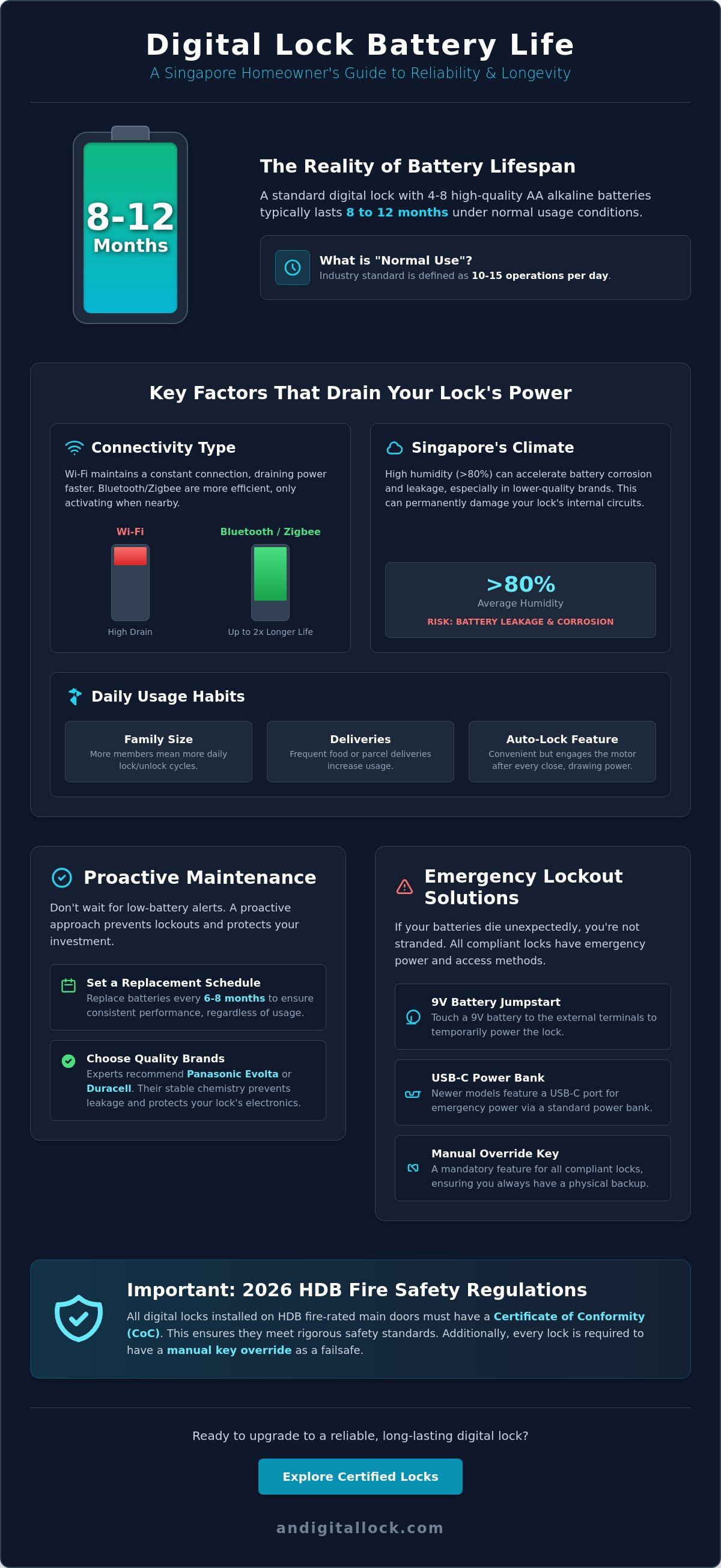
Homeowners often ask how long do digital lock batteries last before they actually commit to an upgrade. In most cases, a standard digital lock powered by four to eight AA alkaline batteries will function reliably for 8 to 12 months. This timeframe assumes "normal use" and the use of high quality batteries. Modern 2026 models have integrated smarter power management chips that reduce energy drain during idle periods, helping to push these limits toward the one year mark.
To understand these power requirements, it helps to look at what a smart lock is and how its components interact. These devices rely on internal motors to move the deadbolt or latch, and these mechanical movements consume the most energy. When you add features like backlit keypads or biometric sensors, the demand on your batteries increases. Understanding these basics helps you manage expectations for your specific home setup.
Defining "Normal Use" for Singaporean Households
Industry standards define normal use as roughly 10 to 15 operations per day. For a typical Singaporean family in an HDB or Condo, this number can fluctuate based on lifestyle. Consider these factors that impact your daily cycle count:
- Family Size: A household of five will naturally cycle the lock more often than a couple living alone.
- Delivery Culture: High frequency of food and parcel deliveries means your door opens and closes more than you might realize.
- Auto-Lock Features: While convenient, the motor engaging every time the door closes draws consistent power.
Main door locks generally see much higher traffic than bedroom digital locks. Because of this, you'll find that interior locks often last significantly longer than the primary entrance unit.
Why Battery Life Varies Between Models
The technology inside your door lock singapore model determines its efficiency. Basic keypad locks are the most energy efficient because they stay dormant until touched. In contrast, advanced facial recognition models require more power to process visual data instantly. If you prioritize battery longevity, choosing a model with an efficient standby mode is essential.
Connectivity is the biggest variable. Wi-Fi enabled locks are often more power hungry because they maintain a frequent connection to your home network. Bluetooth or Zigbee models are much more efficient, often lasting twice as long as their Wi-Fi counterparts. Premium 2026 models now utilize a "Deep Sleep" mode. This feature cuts power to non-essential sensors until the lock detects physical touch or a registered mobile device nearby, effectively extending the answer to how long do digital lock batteries last for even the most advanced units.
Factors Draining Your Smart Lock’s Power
While standard usage defines the baseline, several hidden factors dictate how long do digital lock batteries last in a real-world setting. It isn't just about how many times you press the buttons. The environment and the technical configuration of your home play massive roles in power consumption. Identifying these drains early helps you avoid the frustration of a dead lock during a busy week.
The Wi-Fi vs. Bluetooth Power Trade-off
Wi-Fi locks offer incredible remote access, but they require a constant "heartbeat" connection to your router. This background activity drains power much faster than Bluetooth models, which only wake up when you're nearby. If the signal strength at your hdb main door is weak, the lock works harder to maintain a connection. To save energy, consider using a Wi-Fi bridge to offload communication tasks from the lock hardware itself. This setup allows the lock to remain in a low-power state for longer periods.
Singapore Humidity and Battery Corrosion
Singapore's tropical climate is particularly tough on digital electronics. High humidity levels, often exceeding 80 percent, accelerate the internal chemical breakdown of lower-quality alkaline batteries. This process frequently leads to leakage, creating a white powdery residue that can ruin your lock's terminals. Inspect your battery compartment every few months for these signs. It's also wise to avoid placing locks in direct afternoon sun, as excessive heat further reduces battery efficiency and chemistry stability.
Mechanical Friction: The Silent Battery Killer
The most overlooked drain is physical resistance. If your mortise lock is misaligned even by a few millimeters, the motor must exert extra force to throw the bolt. A door that requires a push or pull to lock can reduce battery life by 50%. Check your door closer to ensure it isn't hindering the latch. A smooth, effortless click is what you want for maximum power savings. If you notice any resistance, a professional adjustment can save you significant battery costs over time.
Modern features like live video feeds or frequent remote unlocking requests will also cause a drop in longevity. While some premium models are rated to stay powered for several months of use, these active features pull significant current. If you're planning a new home setup, our curated BTO lock bundles are specifically selected for their balanced power efficiency and robust performance in Singaporean conditions.
Comparing Brand Performance: Zigbang, Philips, and Solity
Choosing a reputable manufacturer is the most reliable way to predict how long do digital lock batteries last in your home. While generic models might fail unexpectedly, premium brands engineer their hardware for maximum efficiency and predictable discharge. Your choice of brand directly impacts whether you'll be changing batteries twice a year or once every twelve months.
Zigbang, formerly known as Samsung, remains a market leader due to its ultra-efficient standby modes. Their locks are designed to consume negligible power when idle, ensuring that a standard set of four batteries often reaches the 10-month mark under typical conditions. Philips takes a different approach by offering high-capacity lithium battery packs in their top-tier models. These rechargeable units provide consistent voltage until they are nearly depleted, offering a more modern alternative to traditional disposable cells.
Solity and Hafele provide an excellent performance-to-price ratio. These brands are the "workhorses" of Singaporean HDB flats, typically utilizing standard alkaline setups that offer reliable service for 8 to 10 months. For homeowners managing short-term rentals or guest rooms, Igloohome is a standout. Their unique offline access technology means the lock doesn't need to stay connected to Wi-Fi to receive new codes, which significantly reduces the power drain compared to other connected devices.
Alkaline vs. Rechargeable Lithium Systems
The 2026 market shows a clear divide between traditional AA setups and modern built-in lithium-ion packs. Traditional alkaline batteries are easy to find at any local supermarket, but they carry a risk of leakage if left too long. Lithium-ion systems, often found in premium digital lock singapore models, offer the convenience of USB-C charging. However, you must remember to charge them before they hit zero percent. If you stick with alkaline, never mix old and new batteries. Mixing brands or capacities creates an uneven discharge that can lead to terminal corrosion.
Brand-Specific Low Battery Alert Systems
Every brand handles the low battery warning differently. Zigbang locks are famous for their melodic alerts; they play a distinct tune every time you unlock the door once power drops below a certain threshold. Philips models often utilize voice prompts and direct push notifications to your smartphone. Most reputable locks provide a grace period of approximately 50 to 100 entries after the first warning. This gives you plenty of time to purchase replacements before the motor stops functioning entirely. Understanding how long do digital lock batteries last after the first alert is key to avoiding a lockout.
Proactive Maintenance: How to Extend Battery Life
Extending the lifespan of your security system requires more than just a good initial purchase. By following a structured maintenance routine, you can significantly influence how long do digital lock batteries last and prevent unexpected failures. These simple steps ensure your lock operates at peak efficiency year after year while protecting the delicate internal electronics from common issues like corrosion.
- Step 1: Use only premium Alkaline batteries. We recommend Energizer or Duracell for their consistent voltage output and reliability.
- Step 2: Set a calendar reminder to replace your batteries every 6 to 8 months. Don't wait for the low-power melody or app alert to trigger before taking action.
- Step 3: Inspect the battery compartment during every change. Keep it clean and dry to prevent terminal oxidation, which can block power flow and lead to hardware failure.
- Step 4: Check for firmware updates in your lock's mobile app. Manufacturers often release patches that optimize power consumption for Wi-Fi and Bluetooth modules.
- Step 5: Verify your door alignment. If the door has sagged even slightly, the motor works harder to engage the bolt, draining power unnecessarily with every cycle.
Choosing the Right Battery Brand
The type of battery you choose is non-negotiable for long-term lock health. You must avoid "Heavy Duty" or Zinc-Carbon batteries at all costs. These older technologies lack the capacity for motorized locks and are prone to rapid voltage drops that can cause your lock to glitch. Instead, look for Energizer Max with PowerSeal technology. This specific design helps prevent damaging leaks for up to 10 years in storage, providing an extra layer of safety for your hardware. Always use a single brand of batteries; mixing brands causes uneven discharge and potential leaks.
Software and Connectivity Optimization
Your lock's digital settings offer several ways to save power without sacrificing security. If your household doesn't require immediate locking, try increasing the "Auto-Lock" timer by a few seconds. This small adjustment can prevent the motor from cycling during quick transitions, such as when you're just grabbing the mail or a food delivery. You can also disable non-essential features like high-volume voice prompts or elaborate LED animations. These aesthetic touches draw small amounts of current that add up over several months. Finally, ensure your mobile app is configured to send "Critical Battery" push notifications. This serves as a final fail-safe for your home security system.
Maintaining your home's entry points shouldn't be a chore. If you're looking for a complete security overhaul with the latest energy-efficient tech, explore our high-performance digital door locks designed for modern Singaporean living.
Emergency Solutions: Never Get Locked Out
Even if you understand exactly how long do digital lock batteries last and follow a strict maintenance schedule, unexpected situations can still occur. Perhaps a long overseas holiday drained the remaining power, or a family member ignored the low-battery melody. Don't panic. Modern smart locks are engineered with multiple fail-safes to ensure you're never truly stranded outside your home. Knowing these backup methods provides the ultimate peace of mind for any Singapore homeowner.
How to Use a 9V Battery to Power Your Lock
Most established brands include emergency power contact points on the external assembly. These are typically two small metal nodes located at the very bottom or hidden behind a small sliding cover on the front panel. If your lock is completely dead, follow these steps:
- Purchase a standard 9V alkaline battery from the nearest convenience store.
- Firmly press the battery terminals against the two metal nodes on the lock.
- Maintain constant contact while you scan your fingerprint, enter your PIN, or tap your RFID card.
- Once the door unlocks, keep the 9V battery in place until the motor fully retracts the bolt.
It's vital to replace the internal AA batteries immediately after gaining entry. The 9V jumpstart is a temporary power bypass, not a permanent fix. For newer 2026 models, you might even find a USB-C port instead of 9V nodes. This allows you to use a standard portable power bank to wake up the system instantly.
The Mechanical Key Safety Net
Every HDB-compliant door lock singapore model must include a mechanical override. This is a physical key that works regardless of battery life or electronic failure. While the convenience of keyless entry is the main draw, the physical key is your most reliable safety net. You should never store this emergency key inside the house it's meant to unlock. Instead, keep one in your car, at your office, or with a trusted relative living nearby.
AN Digital Lock provides a wide range of models featuring discreetly hidden keyholes that maintain a sleek, modern aesthetic without compromising on safety. If you've tried these emergency methods and your lock still won't respond, it's time to seek professional assistance. We're here to help our customers with technical support and troubleshooting to ensure your home remains secure. Understanding how long do digital lock batteries last is the first step, but having a solid backup plan is what makes you a truly savvy smart home owner.
Ready to upgrade to a more reliable entry system? Explore our latest BTO lock bundles and discover the perfect balance of technology and dependable backup solutions for your home.
Secure Your Home with Confidence and Ease
Managing your home's entry shouldn't be a source of constant stress. You now know that while the answer to how long do digital lock batteries last typically ranges from 8 to 12 months, your specific lifestyle and lock features play a major role. By choosing high quality alkaline batteries and sticking to a proactive 6 month replacement schedule, you can enjoy the full benefits of keyless living without the fear of a lockout. Remember that even the best tech requires a simple maintenance routine to stay at peak performance in Singapore's humid climate.
If you're ready to modernize your entrance with a compliant 2026 model, AN Digital Lock is your trusted partner. We are an authorized dealer for leading global brands like Zigbang, Philips, and Solity, bringing over 10 years of home security expertise to every installation. Our team ensures your new lock meets all current HDB standards, providing free professional installation and a solid local warranty for your total peace of mind. Our extensive portfolio of institutional partners and positive user ratings reflects our commitment to high quality service.
Upgrade to a reliable smart lock with AN Digital Lock today! Take the first step toward a simpler, safer, and more refined home experience for you and your family.
Frequently Asked Questions
How long do batteries last in a digital lock on average?
On average, digital lock batteries last between 8 to 12 months with standard daily use. Factors such as the number of users and the type of connectivity will determine exactly how long do digital lock batteries last in your specific household. High-traffic homes or locks with active Wi-Fi features may require more frequent replacements every 4 to 6 months.
Can I use rechargeable AA batteries in my digital lock?
You should avoid using standard rechargeable AA batteries in most digital locks. These cells typically provide only 1.2V of power compared to the 1.5V required by alkaline batteries. This lower voltage can cause the motor to struggle or trigger false low-battery warnings. Always stick to high-quality alkaline brands for consistent performance.
What happens if my digital lock battery dies completely while I am out?
If your batteries die completely, you can provide emergency power using a 9V battery or a USB-C power bank at the external contact points. These nodes allow you to wake the system and authenticate your entry. Additionally, all HDB-compliant 2026 models feature a mechanical key override so you can always enter manually during a total power failure.
Why is my digital lock battery draining so fast?
Rapid battery drain is usually caused by a weak Wi-Fi signal or mechanical friction in the door latch. If your lock constantly struggles to stay connected to your router or has to push against a misaligned door frame, the power consumption spikes. Ensuring your door is perfectly aligned can often double your battery's lifespan.
How do I know when it is time to change the batteries?
Your lock will provide several warnings, including distinct melodic alerts, flashing red LED lights, or direct push notifications to your smartphone app. Most reputable brands trigger these alerts when there is still enough power for approximately 50 to 100 more entries. We recommend replacing them immediately when you hear the first warning.
Is it safe to use a 9V battery to jumpstart my lock?
It is perfectly safe to use a 9V battery to jumpstart your lock. The external terminals are specifically designed for this purpose, allowing the lock to bypass dead internal cells without damaging the circuitry. Simply hold the battery against the nodes while you scan your fingerprint or enter your PIN to gain access.
Does cold weather or air conditioning affect digital lock battery life?
Standard indoor air conditioning in Singapore won't noticeably impact your battery life. However, extreme humidity is a much larger threat than temperature. High moisture levels can lead to terminal oxidation and battery leakage, which is why using leak-proof alkaline batteries is essential for protecting your investment.
Should I remove the batteries if I am going on a long holiday?
You should remove the batteries if you plan to be away from home for more than one month. This prevents the risk of battery leakage damaging the internal electronics while the lock is idle. Just make sure you have your mechanical override key with you so you can re-enter your home easily upon your return.