


Imagine your elderly mother standing at her HDB gate, her hands trembling slightly from arthritis as she fumbles with a heavy bunch of keys. It's a daily struggle that turns a simple trip to the market into a source of stress and exhaustion. You want your parents to remain independent, but you worry about them forgetting a complex PIN or losing their keys. Finding an easy to use digital lock for seniors is about more than just high-tech hardware; it's about restoring their confidence and your peace of mind.
We agree that home security should never feel like a test of memory or physical strength. You need a system that works every time with a single, simple movement. This 2026 guide introduces the most intuitive, senior-friendly digital locks designed for Singaporean households. We will preview advanced palm recognition, dependable RFID cards, and dual-sync technology that unlocks both the gate and door simultaneously. Discover how to eliminate lockout anxiety and provide your loved ones with the effortless access they deserve.
Key Takeaways
- Learn why upgrading to an easy to use digital lock for seniors eliminates the physical strain of turning keys and the anxiety of misplaced belongings.
- Identify essential senior-friendly features such as high-contrast buttons and multilingual voice prompts that guide users through every step.
- Compare biometric, PIN, and RFID access methods to find the most reliable solution for aging skin and memory-free entry.
- Understand the technical requirements for HDB gate and door synchronization to ensure a seamless, one-touch experience for elderly residents.
- Discover top-rated brand recommendations and professional installation tips that guarantee long-term safety and home independence.
Why Traditional Keys Pose a Risk to Seniors in 2026
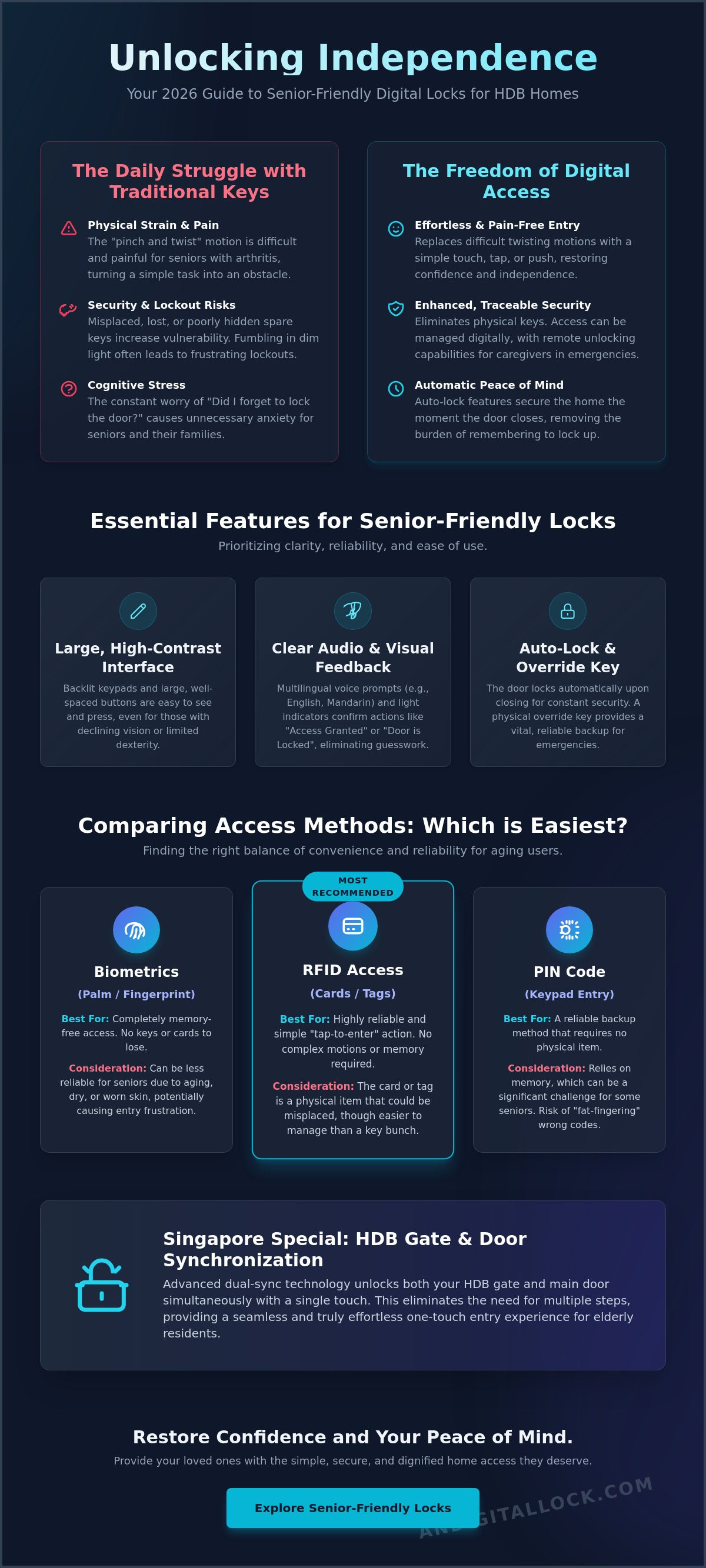
For many Singaporean seniors, the simple act of entering their home has become a daily obstacle. Traditional keys require precise fine motor skills that often decline with age. Conditions like osteoarthritis or rheumatoid arthritis make the "pinch and twist" motion of a small metal key painful and difficult. An easy to use digital lock for seniors removes this physical barrier entirely. By switching to a modern digital lock singapore homeowners can ensure their elderly parents enter the home without straining their joints.
Beyond physical pain, manual keys create security vulnerabilities. Seniors often hide spare keys under floor mats or leave them with multiple neighbors "just in case." This practice increases the risk of unauthorized entry or lost keys. A digital system provides a traceable, secure alternative where access can be managed digitally without physical duplicates. It's about combining safety with a frictionless user experience.
The Challenge of Fine Motor Skills
Traditional locks are unforgiving. Fumbling with a tiny key in a dimly lit HDB corridor is a recipe for frustration. It often leads to dropped keys or accidental lockouts. Understanding what is a smart lock helps families see the shift from fine motor "pinching" to gross motor "touching." These devices offer several physical advantages:
- They eliminate the need for precise alignment of the key into the keyhole.
- They replace complex small movements with simple palm or fingerprint recognition.
- Backlit keypads provide better visibility in dark hallways for those with declining eyesight.
- One-touch handles allow residents to enter with a single push or pull movement.
Cognitive Load and Security
Memory loss is a significant concern for aging residents. The nagging question of "did I lock the door?" causes unnecessary stress throughout the day. Modern digital locks solve this with auto-lock features that engage the moment the door closes. This provides immediate peace of mind and ensures the home is always protected.
For families, the ability to grant remote access is a game-changer. If a senior forgets their PIN or struggles with a sensor, a caregiver can unlock the door via a smartphone app from anywhere in Singapore. This ensures that help is always available, even in an emergency, without needing to break down a door or wait for a locksmith. Using an easy to use digital lock for seniors isn't just about tech; it's about preserving dignity and ensuring safety in an increasingly complex world.
Defining "Easy to Use": Essential Features for Senior-Friendly Locks
An easy to use digital lock for seniors must prioritize clarity over complexity. Many modern designs focus on sleek, minimalist aesthetics that can be confusing for elderly users. True accessibility starts with large, high-contrast buttons. These tactile inputs are easier to press for those with limited dexterity and provide clear visibility for residents with declining vision or cataracts. When buttons are large and well-spaced, the risk of "fat-fingering" a PIN code decreases significantly, reducing frustration during entry.
Security is only effective if it is used consistently. Automatic locking mechanisms are a critical feature for senior-friendly homes. These systems ensure the door bolts engage the moment it closes, removing the cognitive burden of remembering to lock up. To support this, long battery life is essential. Most premium models provide clear low-battery warnings weeks in advance. If the batteries do fail, an external 9V battery jumpstart port allows for emergency power, ensuring no one is ever left stranded outside.
Visual and Auditory Feedback
Backlit keypads are a non-negotiable safety feature for Singaporean homes. They ensure the interface is bright and readable in the dim lighting of an HDB corridor. Voice guidance adds a necessary layer of reassurance by providing verbal confirmation in languages like English or Mandarin. Senior-Friendly UI is a design framework that utilizes two distinct sensory signals, such as a visual light change and an auditory voice prompt, for every successful action. Hearing a clear voice say "Door is locked" or "Access granted" eliminates the guesswork and anxiety often associated with adopting new technology.
Reliability and Emergency Access
Reliability is the cornerstone of trust for senior users. While digital methods are the primary way to enter, a mechanical override key remains a vital safety net. It provides comfort to tech-sceptics who worry about electronic failures. Furthermore, following established door lock singapore standards ensures that your installation complies with fire safety regulations. These rules require that the lock allows for a "one-motion" emergency exit from the inside, which is crucial for elderly residents during a crisis.
This focus on safety aligns with government initiatives like the Enhancement for Active Seniors (EASE) programme, which subsidizes home modifications to support aging in place. Choosing the right hardware is the first step toward a safer, more independent lifestyle. If you are ready to upgrade, you can explore a wide selection of digital door locks designed to make home access effortless for every generation.
Comparing Access Methods: Which is Truly Easiest for Seniors?
Choosing the right entry method is the most important decision for a senior-friendly home. It's the difference between a smooth, confident entry and a stressful lockout. An easy to use digital lock for seniors should offer multiple ways to unlock. This ensures that if one method becomes difficult, a reliable backup is always ready. While PIN codes are a standard feature, they aren't always the best primary choice for everyone.
Fingerprint scanning is popular because it's keyless and convenient. You can't forget your finger at home. However, it isn't always perfect for every elderly resident. Cognitive ease must be balanced with physical reliability. We need to look at how different technologies handle the specific needs of aging users in the Singaporean environment.
Biometrics and Aging Skin
Aging skin often becomes thinner and drier over time. In Singapore's humid climate, moisture levels fluctuate constantly. This can make it difficult for basic sensors to read fingerprint ridges clearly. It often leads to "failed" readings that cause panic. We recommend high-sensitivity semiconductor sensors found in premium brands like Philips or Zigbang. These sensors are designed to capture more detail than older optical versions. To increase success, register at least three different fingers during setup. This gives the system more data points to recognize the user on the first try, even if one finger is particularly dry that day.
The RFID Advantage for Seniors
RFID technology is often the most underrated solution for elderly residents. Tapping an RFID card is a motion seniors already know from using their EZ-Link cards on the MRT. It requires very little precision compared to typing a 6-digit code on a keypad. RFID stickers are even more effective. You can stick them on the back of a mobile phone or a wallet. This turns an object they already carry into a "smart key."
- Simple Motion: Tapping requires less dexterity than typing or precise finger placement.
- Always Ready: Stickers on phones ensure the "key" is never left behind.
- Accessibility: RFID fobs can be attached to a lanyard for easy reach without digging through bags.
In 2026, facial recognition has emerged as the gold standard for "hands-free" living. It's perfect for seniors carrying groceries or those with severe arthritis who find any physical contact difficult. Models like the Xeno Alexi Pro Max or Yew F11 use 3D scanning to recognize faces instantly. It removes all physical interaction, making it the ultimate easy to use digital lock for seniors who want a zero-friction experience. This technology provides independence while maintaining the highest levels of home security.
Singapore Specifics: HDB Gates and Professional Installation
Living in an HDB flat presents a unique security challenge for elderly residents. The traditional setup requires seniors to manage two separate locks: one for the metal gate and another for the wooden door. For an easy to use digital lock for seniors, this double-entry process must be simplified. Managing multiple keys or remembering two different PINs is exhausting and increases the risk of being locked out. Modern technology now allows these two barriers to work as one.
Professional installation is about more than just hardware placement. It's about ensuring the lock meets strict HDB fire-rating requirements. Since March 1, 2024, digital locks on HDB main entrance doors within 3 meters of a lift lobby or staircase must be fire-rated and certified. Our team ensures every installation is compliant, protecting your home and your insurance coverage. We prioritize local, Singapore-based support to provide on-site warranties that give families immediate peace of mind.
Synchronized Gate and Door Access
In 2026, "Dual-Sync" technology has become the standard for senior-friendly Singaporean homes. This innovation allows a single fingerprint scan or RFID tap on the gate to unlock the main door simultaneously. It removes the need for seniors to stand in the corridor fumbling with a second lock. This speed is vital for safety and physical comfort. Most high-quality HDB setups utilize a mortise lock for the main door. These heavy-duty systems provide superior physical strength for solid hdb main door units while remaining easy to operate with a simple push-pull handle.
The AN Digital Lock Installation Standard
We believe the installation process isn't finished until the user feels confident. Our "On-Site Training" is a core part of our service. We spend time with elderly residents to ensure they can operate the easy to use digital lock for seniors without help. We register their fingerprints, show them how to use RFID stickers, and explain the voice prompts in their preferred language.
Our commitment to service continues long after the technician leaves. We provide 24/7 emergency support to handle any unexpected issues. If a parent ever feels confused or encounters a technical glitch, our local experts are available to assist immediately. This eliminates the "technology failure" anxiety that many seniors feel when switching from traditional keys. Ready to simplify your home security? Browse our BTO lock bundles to find the perfect synchronized system for your HDB flat.
Top Easy-to-Use Digital Lock Recommendations for 2026
Selecting the right brand is the final step in securing a parent's home. In 2026, several manufacturers have distinguished themselves by creating hardware specifically for elderly needs. These brands move beyond basic security to offer an easy to use digital lock for seniors that actually improves daily life. We recommend focusing on models that prioritize tactile feedback and clear communication.
The Philips EasyKey Series is a standout choice for visual clarity. These locks feature large, brightly backlit displays and exceptionally loud voice prompts. Zigbang, formerly known as Samsung, remains a leader in ergonomic design. Their push-pull handles are ideal for those who struggle with traditional door knobs. For families seeking a budget-friendly option, Solity offers reliable RFID access without unnecessary complexity. If your main concern is meeting strict HDB fire-rating standards for a heavy door, Hafele provides robust German engineering that is built to last.
Why These Brands Excel for Seniors
These manufacturers have integrated "Senior Mode" settings into their latest software. This feature simplifies the interface by disabling complex menu options and focusing on primary access methods. The physical build quality is equally important. The handles on Zigbang and Philips models are designed for a "gross motor" grip. This means a senior can push the door open with their palm or forearm if their fingers are feeling stiff. For those moving into new estates, our BTO Lock Bundles offer these premium brands in synchronized sets that cover both the metal gate and the main wooden door.
Final Selection Checklist
Before making a final decision, we recommend a physical test. Technology that looks simple on a screen can feel different in person. Use this three-step checklist to evaluate an easy to use digital lock for seniors:
- Test fingerprint sensitivity: Ensure the sensor can read thinner or drier skin on the first attempt.
- Check button size: Verify that the numbers are large enough to read without squinting and spaced far enough apart to prevent accidental presses.
- Verify voice prompt volume: Make sure the auditory feedback is loud enough to be heard clearly in a noisy corridor.
Don't rely on specifications alone. We encourage you to bring your parents down to see the technology in action. Seeing their confidence grow as they unlock a door for the first time is the best way to ensure long-term satisfaction. Visit our showroom for a hands-on senior-friendly demonstration and let our experts help you find the perfect fit for your family.
Empower Your Loved Ones with Effortless Security
Choosing an easy to use digital lock for seniors is the most practical way to support aging in place while enhancing home safety. You've learned that the right technology removes the physical strain of manual keys and replaces it with intuitive, one-touch access. From synchronized HDB gate and door systems to high-contrast interfaces with voice guidance, modern security is designed to serve the elderly, not confuse them. Professional installation and patient on-site training are the final pieces that turn a technical upgrade into a life-changing convenience.
With over 10 years of experience in Singapore, our 5-star rated professional installation team is dedicated to your family's comfort. We are an authorized dealer for leading brands like Zigbang, Philips, and Solity, ensuring you receive genuine hardware and reliable long-term support. Take the first step toward a stress-free home entry today. Browse our Senior-Friendly Digital Lock Collection and discover how simple home security can be. Give your parents the independence they deserve and the peace of mind you need.
Frequently Asked Questions
Is a fingerprint lock or a PIN lock better for an elderly person?
Fingerprint locks are generally better for physical ease, but RFID cards are the most dependable option for seniors with very dry or thin skin. While an easy to use digital lock for seniors should offer both, RFID requires the least precision. It removes the need to remember a complex PIN or perfectly align a finger on a sensor, making it a reliable choice for daily use.
What happens if the digital lock battery dies while my parent is alone?
If the battery dies, your parent can use an external 9V battery to jumpstart the lock from the outside. Every premium model we install features these emergency contact points. This allows them to power the keypad temporarily to enter their PIN or scan their fingerprint. Most locks also include a mechanical override key as a secondary backup for complete peace of mind.
Can my parent still use a physical key if they are uncomfortable with the technology?
Yes, your parent can absolutely use a physical key if they feel uncomfortable with the electronic interface. Most senior-friendly models come with high-security mechanical keys that work just like a traditional lock. This serves as a vital safety net. It ensures they never feel locked out by technology they don't yet trust while they transition to keyless living at their own pace.
Are digital locks safe for HDB fire-rated doors in Singapore?
Digital locks are perfectly safe and often mandatory for HDB fire-rated doors, provided they are certified. Since March 1, 2024, HDB main doors within 3 meters of lift lobbies or staircases must use fire-rated locks. We ensure all our fire-rated installations comply with these strict safety regulations. This protects your home and ensures your insurance remains valid in the event of an emergency.
How long does it take for a senior to learn how to use a smart lock?
Most seniors learn to use a smart lock in under 10 minutes when guided by a professional. Our installation team provides dedicated on-site training to ensure every resident feels confident. We focus on the simplest access method, such as a single fingerprint or an RFID tap. This hands-on approach makes the transition smooth and eliminates any anxiety about using an easy to use digital lock for seniors.
Can I unlock the door for my parents remotely using my phone?
Will the digital lock still work if the home Wi-Fi goes down?
Your digital lock will continue to work perfectly even if your home Wi-Fi goes down. Local access methods like fingerprints, PIN codes, and RFID cards don't require an internet connection to function. Only remote features, such as app-based unlocking or real-time notifications, will be temporarily unavailable. Once your connection is restored, these smart features will automatically resume their normal operation.
How often do the batteries need to be changed in a senior-friendly lock?
Batteries in a senior-friendly lock typically need to be changed once every 10 to 12 months. The lock will provide audible and visual warnings weeks before the power actually runs out. We recommend using high-quality alkaline batteries to ensure consistent performance. This prevents leakage that could damage the internal electronics and keeps the easy to use digital lock for seniors running reliably year-round.