


What if the very device you installed to protect your family is actually the most vulnerable entry point in your home? It is natural to feel a mix of excitement and anxiety when upgrading to a smart home. You want the modern refinement of a keyless entry, but the fear of high-tech burglars or a sudden electronic failure is real. You have likely noticed the massive price gaps between marketplace bargains and professional brands, leaving you confused about what truly keeps you safe.
In this guide, you'll discover the reality of digital lock security vulnerabilities and why they're often a result of poor engineering rather than the technology itself. We'll show you how to distinguish between vulnerable, unrated hardware and professional-grade security that meets strict 2026 standards like UL 10C. You will learn how to identify locks with bank-level AES 256-bit encryption and why ANSI/BHMA Grade 1 ratings are non-negotiable for physical strength.
We'll examine current risks like the wolfSSL vulnerability disclosed in May 2026 and explain how high-security features, such as 3D facial recognition, provide the protection you deserve for your wooden doors and metal gates. By the end, you'll feel confident choosing a secure solution that offers both safety and simplicity.
Key Takeaways
- Learn the critical difference between hardware flaws and software exploits to identify real-world digital lock security vulnerabilities in 2026.
- Discover how professional-grade locks shield your home against high-voltage EMP attacks and common solenoid bypass techniques used by intruders.
- Understand the risks of "Cloud-Only" systems and learn how to protect your network from signal sniffing and replay attacks.
- Identify why unbranded marketplace locks lack the essential R&D and physical reinforcement found in trusted brands like Philips, Zigbang, and Solity.
- Master the technical specifications to look for, including mortise bodies and anti-drill plates, to ensure maximum protection for your wooden doors and metal gates.
Understanding Digital Lock Security Vulnerabilities in 2026
A security vulnerability is not the same as a product malfunction. When your digital lock fails to read a fingerprint because of a dirty sensor, that's a performance issue. A true vulnerability is a specific flaw in the hardware design or software code that an intruder can exploit to gain unauthorized access. As digital door locks become the standard for Singaporean homes, understanding these digital lock security vulnerabilities is the first step toward a safer household. You need to know if your lock has a physical "backdoor" or a digital one.
The Singapore market has evolved rapidly. A decade ago, digital locks were luxury items. Today, they're essential for modern BTO flats and landed properties. This shift has changed how we view home protection. We've moved away from the heavy weight of physical keys toward the refined ease of biometric and PIN access. However, news headlines often confuse readers by grouping simple mechanical failures with sophisticated security breaches. A breach is intentional; a failure is often just poor maintenance or low-quality components.
Digital vs. Mechanical: Which is Truly More Vulnerable?
Traditional mechanical locks aren't as secure as you might think. They're susceptible to "bumping," picking, and unauthorized key duplication. These are "hidden" vulnerabilities because you can't see them until they're exploited. Modern Electronic lock technology addresses these legacy issues by removing the physical keyhole entirely in many models. This eliminates traditional picking methods. Additionally, digital systems provide an audit trail. You can check your smartphone to see exactly when your wooden doors or metal gates were opened. This level of transparency is something a standard deadbolt simply cannot offer.
The Reality of Hacking in 2026
Is your lock likely to be hacked? Statistically, a physical break-in via a window or a forced door remains far more common than a sophisticated digital exploit. Most "hacking" videos you see on social media feature unbranded, cheap hardware that lacks basic shielding. Professional brands have spent years perfecting their defenses against these attacks. In 2026, the best way to verify a lock's resilience is through local standards. Always check for the IMDA's Cybersecurity Labeling Scheme (CLS) rating. This label tells you that the device has undergone testing to ensure it meets specific security requirements, giving you the peace of mind you need for your family's safety.
Physical Vulnerabilities: Can Your Lock Be Forced or Tricked?
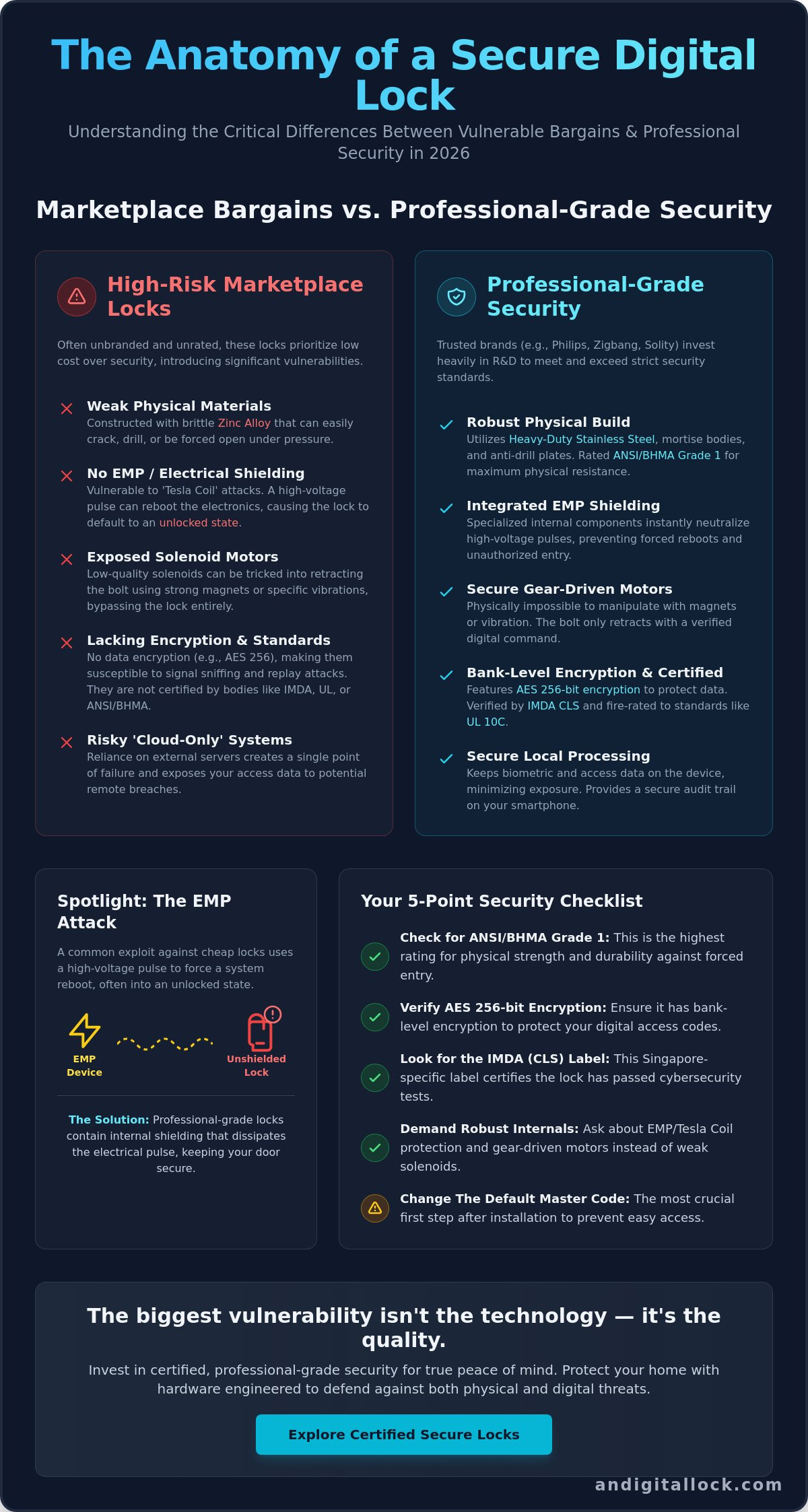
Burglars don't always need a laptop to bypass your door. Physical digital lock security vulnerabilities often stem from cost-cutting in the manufacturing process. One well-known exploit is the 'Tesla Coil' or EMP attack. This involves using a handheld device to deliver a high-voltage pulse, which can cause some electronic circuits to reboot into an 'open' state. Professional brands now include specialized internal shielding to neutralize these pulses instantly. If your lock lacks this protection, it's essentially an open invitation for anyone with a cheap electronic device.
Poorly designed internal motors, known as solenoids, represent another significant risk. A strong magnet or a specific type of vibration can sometimes trick a low-quality solenoid into retracting the locking bolt. In contrast, professional models use robust gear-driven motors that are physically impossible to move without the correct digital authorization. Material choice is equally vital. While many marketplace locks use brittle zinc alloy that can crack under pressure, premium security relies on heavy-duty stainless steel casings. These materials provide the structural integrity needed to withstand forced entry attempts and drilling.
Perhaps the most common physical vulnerability is the 'Master Code' risk. Many homeowners forget to change the factory default PIN after installation. This oversight leaves your front door unlocked for anyone who knows the brand's default settings. It's a procedural flaw that can undo even the best hardware. You should update all codes immediately upon installation to ensure your home remains a private sanctuary. Check out our BTO lock bundles to find a system that combines physical strength with smart, user-friendly security features.
Hardware Bypasses and How Professional Brands Block Them
Professional locks must balance fire safety with external security. Anti-panic egress handles allow you to exit quickly during an emergency, but they're designed to prevent external manipulation through letterboxes or gaps. You should also look for 'Fake PIN' features. This technology allows you to enter random digits before or after your actual code. It prevents 'shoulder surfing' by neighbors and stops intruders from analyzing fingerprint smudges on the keypad to guess your PIN. For maximum reinforcement, ensure your unit uses a mortise lock body. This design sits deep inside the door, making it significantly harder to pry open than surface-mounted alternatives.
Environmental and Power Failures
Singapore's high humidity is a silent enemy of electronics. It can cause condensation inside cheap locks or degrade fingerprint sensor accuracy over time. High-quality models are sealed against moisture to maintain performance in our tropical climate. If your battery dies while you're out, don't panic. Most reputable models feature external 9V battery contact points for an emergency jumpstart. They also include mechanical key overrides as a final fail-safe. For added safety, professional digital locks include heat sensors. These sensors detect extreme temperatures and trigger an automatic unlock if a fire is detected inside the home, ensuring your family can exit safely without fumbling for codes.
Cyber Vulnerabilities: Hacking, WiFi, and Bluetooth Risks
While physical attacks require proximity and specialized tools, cyber threats can sometimes be initiated from a distance. One of the most discussed digital lock security vulnerabilities involves signal sniffing. This occurs when an attacker uses a radio device to capture the Bluetooth or WiFi data packets sent between your smartphone and your lock. If the device uses outdated protocols, a hacker can perform a replay attack to mimic your "unlock" command later. Professional-grade hardware prevents this by using sophisticated handshakes that change with every interaction.
Relying exclusively on "Cloud-Only" locks presents another layer of risk. If a manufacturer's central server is breached, every lock connected to that ecosystem could potentially be compromised simultaneously. This is why security experts often recommend local mesh networks like Zigbee or Z-Wave. These protocols create a private, low-power network within your home. They don't rely on a constant direct connection to the open internet, making them significantly harder to target from the outside compared to standard WiFi-only models.
The "set and forget" mentality is perhaps the greatest digital risk for homeowners. Security is a moving target, and new flaws are discovered every year. For example, the May 2026 wolfSSL disclosure highlighted how even trusted libraries can contain digital lock security vulnerabilities if they aren't patched. If your lock doesn't support automatic firmware updates, it remains frozen in time with all its original bugs. Choosing a professional brand ensures you receive regular, automatic patches that harden your defenses against these evolving threats.
Encryption Standards: AES-128 vs. AES-256
When selecting a digital lock in Singapore, bank-grade encryption is the absolute minimum requirement. While AES-128 is strong, AES-256 offers a significantly higher level of mathematical complexity that is virtually impossible to crack with current computing power. You should also prioritize apps that offer two-factor authentication (2FA). This adds a second layer of verification, ensuring that even if someone steals your password, they cannot access your home. Rolling codes prevent replay attacks by ensuring that every digital 'handshake' between your phone and the lock uses a unique, one-time signal that cannot be reused by an eavesdropper.
The Vulnerability of 'Smart' Features
Convenience shouldn't come at the cost of safety. Voice assistant integration is popular, but it can be a weakness if not configured correctly. An intruder could potentially shout an "unlock" command through a window or letterbox. Always set a voice PIN for these actions. Similarly, geofencing—which unlocks the door as you approach—must be precise. You don't want your door to unlock while you're still in the lift or parking your car. Remote unlocking is a powerful tool for letting in guests, but it should be used sparingly and only through secure, encrypted channels to maintain total control over your entry points.
The Marketplace Trap: Why Cheap Locks are Vulnerable
E-commerce platforms like Shopee and Lazada are flooded with unbranded OEM locks that look identical to premium models. These "budget" options often hide significant digital lock security vulnerabilities beneath a shiny exterior. A lock retailing for $50 simply cannot afford the research and development required for bank-grade encryption or electromagnetic shielding. While a professional brand invests millions in securing its software ecosystem, these generic alternatives often use "off-the-shelf" components that are easily bypassed by anyone with basic technical knowledge.
One of the most alarming issues with low-end hardware is the 'Ghost Fingerprint' phenomenon. Cheap semiconductor sensors often degrade after just a few months of use in Singapore's humid climate. As the sensor wears down, its ability to distinguish between unique ridges diminishes. In some cases, the lock begins to accept almost any fingerprint or even a simple smudge as a valid entry. This isn't just a malfunction; it's a total failure of your home's primary defense. When you choose a professional system, you're paying for a sensor that remains precise for years, not months.
Lack of local support is another hidden danger. If a marketplace lock fails at midnight, there's no official service center to call. You're left stranded outside your own home. Worse yet, many of these sellers disappear from the platform once they've offloaded their stock. This leaves you with no warranty and no path for repairs. For a reliable solution that includes professional installation and local support, explore our digital door locks today.
Identifying 'Vulnerable' Locks Before You Buy
Spotting a high-risk lock is easier than you think. Watch out for red flags like a lack of an official manufacturer website or a suspiciously low price point. Be particularly wary of "International Version" locks. These units are often designed for other markets and lack the specific security patches or frequency regulations required for Singapore. Furthermore, installing a non-fire-rated lock on HDB main doors is a serious safety violation. Always verify that your lock meets local fire safety standards to ensure it won't seize up during an emergency.
The Cost of Cheap Security
Calculate the total cost of ownership before you buy. A cheap lock often requires replacement within a year, doubling your initial investment. There's also the risk of uncertified installers. These "freelance" workers may not have the training to handle sensitive hardware, and in some cases, they could even duplicate your master access data. The most terrifying risk is a 'lock-in' scenario. We've seen numerous cases where residents are trapped inside their homes because a low-quality internal motor failed. Investing in professional-grade hardware isn't just about keeping people out; it's about ensuring you can always get out when it matters most.
Hardening Your Home: How to Choose a Vulnerability-Resistant Lock
Choosing the right hardware is your primary defense against digital lock security vulnerabilities. You should prioritize global brands with a proven track record of engineering excellence. Manufacturers like Philips, Zigbang, and Solity invest heavily in both physical durability and software encryption. These brands don't just sell a product; they provide a comprehensive security ecosystem that is constantly tested against modern exploits. When you select a recognized brand, you're benefiting from years of rigorous research and development that unbranded marketplace alternatives simply cannot match.
Physical construction remains the foundation of home safety. Always look for locks with a heavy-duty mortise body that sits securely within the door frame. You should also verify if the model includes anti-drill plates made of hardened steel to prevent forced entry. For an added layer of protection, enable dual-verification modes. This setting requires two forms of identity, such as a fingerprint and a PIN, before the door opens. It's a simple step that effectively neutralizes the risk of someone stealing your code or spoofing your biometric data. Ensure your purchase is handled by a reputable Singapore supplier to guarantee you're receiving genuine, local-market hardware.
The Security Checklist for 2026
Use this checklist to evaluate any potential purchase. It's designed to filter out hardware with known digital lock security vulnerabilities:
- Mechanical Override: Does the lock include a physical key? Ensure it uses a high-security cylinder that is resistant to picking and bumping.
- Firmware Support: Does the manufacturer push regular updates? Check if the mobile app provides notifications for security patches.
- Local Support: Is there a dedicated service center in Singapore? You need to know that expert help is available if you encounter a technical glitch or a lockout.
Professional Installation vs. DIY
Proper installation is just as important as the lock itself. Correct alignment is everything. If the strike plate is even a few millimeters off, the internal motor will strain every time it tries to lock. This leads to 'bolt jam' vulnerabilities and eventually causes the hardware to fail prematurely. Professional installers understand these nuances. They ensure that the mortise sits perfectly within your wooden doors or metal gates for a frictionless experience. They also play a vital role in setting up your administrative access. A professional will guide you through the process of changing master codes and securing your mobile app, ensuring no "backdoors" are left open. Secure your home with a vulnerability-tested digital lock from AN Digital Lock to enjoy true peace of mind and contemporary refinement.
Secure Your Future Home Today
Protecting your home in 2026 requires a proactive approach to security. You've learned that digital lock security vulnerabilities are often the result of poor engineering in low-end models rather than a flaw in the technology itself. By prioritizing physical strength like mortise bodies and digital safeguards like AES-256 encryption, you can effectively neutralize both physical and cyber threats. Don't let the marketplace trap of cheap, unbranded hardware compromise your family's safety. Instead, choose professional-grade solutions that offer long-term reliability and local support.
At AN Digital Lock, we bring over 10 years of experience in Singapore home security to your doorstep. We are an authorized distributor for global leaders like Philips, Zigbang, and Solity, ensuring you receive only genuine, tested hardware. Our commitment to your safety includes 24/7 technical support for all our digital lock customers, so you're never left without assistance. It's time to upgrade your wooden doors and metal gates with confidence.
Browse our curated range of exploit-resistant digital locks and take the first step toward a more secure, refined lifestyle. Your peace of mind is our priority, and we're here to help you every step of the way.
Frequently Asked Questions
Can someone open my digital lock using a high-powered magnet?
Only low-quality or unbranded locks are susceptible to magnetic interference. Professional brands use gear-driven motors or shielded solenoids that are specifically designed to resist external magnetic fields. This engineering ensures that a magnet cannot physically pull the locking bolt into an open position. If you invest in a reputable model, this particular bypass method is not a realistic threat to your home.
Are fingerprint digital locks vulnerable to being tricked by a photo or fake print?
Modern semiconductor sensors are highly resistant to these tricks because they detect live tissue and 3D ridge patterns. Older optical sensors, which essentially take a 2D picture of your finger, were sometimes vulnerable to high-resolution photos. However, the latest 2026 standards prioritize semiconductor technology that measures electrical conductivity, making it nearly impossible for a photo or a silicone mold to gain access.
What is the most secure type of digital lock for an HDB flat?
A fire-rated mortise lock is the most secure choice for HDB main doors. These units are installed deep within the door's structure, providing much higher resistance to forced entry than surface-mounted "rim" locks. For maximum safety, ensure the lock is certified by local authorities for fire-rated doors. This ensures the hardware won't seize up during extreme heat, allowing your family to exit safely in an emergency.
Can a digital lock be hacked if it is not connected to the internet?
Yes, but the risk profile changes significantly. While an offline lock is immune to remote cloud breaches or server-side attacks, it still faces digital lock security vulnerabilities related to local signal sniffing. A hacker would need to be physically near your door to intercept Bluetooth or RFID signals. Professional models mitigate this risk by using rolling codes and bank-grade encryption that changes with every interaction.
What should I do if I suspect my digital lock's security has been compromised?
Perform a full factory reset and update your master PIN immediately. A reset clears all existing access data and removes any unauthorized smartphones or fobs paired with the device. You should also check the manufacturer's app for any pending firmware updates that may patch known vulnerabilities. If you remain concerned, contact your authorized supplier for a professional diagnostic to ensure the hardware is functioning correctly.
Are there any digital locks that are completely unhackable?
No security device is 100% unhackable, but professional models make the effort required impractical for intruders. High-end locks use AES-256 encryption, which would take current computers an astronomical amount of time to crack. The goal of professional security is to make a breach so difficult and time-consuming that a burglar will simply move on to an easier, less protected target.
How often should I change my digital lock's PIN or access codes for maximum security?
You should update your access codes every six months to minimize digital lock security vulnerabilities. Regular rotation prevents long-term exposure of your PIN and reduces the risk of someone guessing the code by looking at smudge patterns on the keypad. It is also wise to change your codes immediately after any home renovations or whenever a temporary guest or tenant moves out.
Do digital locks have a 'backdoor' for manufacturers or emergency services?
Reputable manufacturers do not include hidden digital backdoors in their software. Instead, they provide physical fail-safes for emergency situations. These typically include a mechanical override key or external battery contact points for a 9V jumpstart. These features ensure you can always enter your home during a power failure without creating a permanent digital vulnerability that a hacker could exploit.