


Did you know that even the most expensive smart lock is useless if your installer makes one common drilling error on your HDB fire-rated door? Many Singapore homeowners believe that buying a premium brand guarantees security, but in our high-humidity environment, technical precision matters more than the price tag. Understanding the digital lock installation mistakes to avoid is the only way to prevent technical failures that lead to stressful lockouts. You deserve a seamless entry experience that doesn't compromise your home's safety or your door's structural integrity.
We're here to help you secure a perfectly functioning keyless system that stands the test of time. This guide reveals how to protect your warranty and ensure your lock meets the latest 2026 HDB safety standards. We'll examine the importance of the Certificate of Conformity (CoC), the necessity of mechanical overrides for fire safety, and how to choose the right hardware for both wooden doors and metal gates. Following these steps will ensure your digital hardware remains reliable and fully compliant with local regulations.
Key Takeaways
- Learn how a tiny 2mm misalignment causes motor burnout and how to shield your electronics from Singapore's high humidity.
- Stop the "Swiss Cheese" effect on your HDB door by mastering proper drilling and strike plate alignment.
- Discover the most common digital lock installation mistakes to avoid, such as using the wrong lock type for metal gates or thin wooden doors.
- Extend your lock's lifespan by using the correct battery chemistry and updating factory default settings immediately.
- Ensure long-term reliability by choosing professional in-house installers who follow a strict precision testing protocol.
Why Correct Installation is the Foundation of Home Security
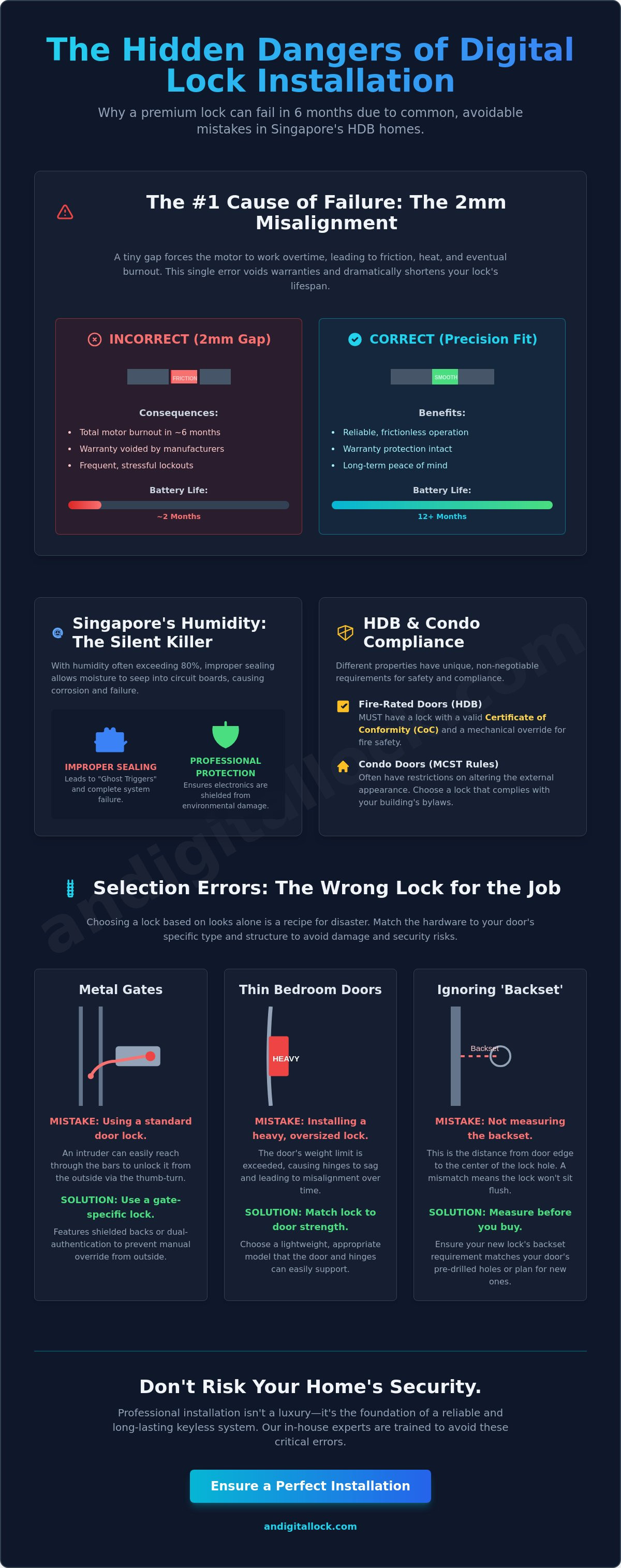
A digital lock is far more than a fancy piece of hardware. It's a high-precision security system that relies on absolute technical accuracy to function. Many homeowners focus solely on the brand name, but even a top-tier Philips or Zigbang lock will fail if the setup is flawed. One of the most common digital lock installation mistakes to avoid is overlooking the "Precision Gap." A tiny 2mm misalignment between the bolt and the strike plate forces the motor to work overtime. Over six months, this constant friction leads to total motor burnout. To understand what smart locks are and how their internal components interact, you must view them as integrated electronic systems rather than simple mechanical latches.
Singapore’s environmental factors also play a massive role in long-term reliability. With humidity levels often exceeding 80%, exposed internal electronics are at high risk. If an installer leaves gaps or fails to seal the mounting points correctly, moisture seeps into the circuit boards. This causes "ghost" triggers or complete system failure. By 2026, smart home security standards in Singapore have evolved to prioritize durability. Homeowners now expect a frictionless entry experience, but that requires a foundation of professional installation that accounts for both mechanical alignment and environmental protection.
The Hidden Costs of a Bad Installation
Poor installation creates a domino effect of expenses. When a deadbolt latch experiences friction, it drains your batteries at double the normal rate. You'll find yourself replacing expensive alkaline batteries every two months instead of once a year. Worse, many global manufacturers will void your warranty if they find evidence of "unauthorized modification" or improper drilling. The biggest cost, however, is emotional. Imagine the stress of a lockout at 11 PM with young children or elderly parents because a poorly aligned bolt finally jammed.
HDB vs. Condo: Different Doors, Different Stakes
Your property type dictates your installation requirements. For HDB units in 2026, strict regulations require fire-rated locks for all fire-rated main doors. These locks must carry a valid Certificate of Conformity (CoC) to pass resale inspections and ensure safety during emergencies. Condo owners face different challenges; MCST rules often restrict changes to the external appearance of doors. Choosing the right digital lock Singapore residents trust means matching the hardware to these specific legal and structural constraints. Failing to check these details is one of the major digital lock installation mistakes to avoid if you want to keep your home safe and compliant.
Selection Errors: Choosing the Wrong Lock for Your Door Type
Selecting a lock based solely on aesthetics is a recipe for long-term frustration. One of the most overlooked digital lock installation mistakes to avoid is the "Weight Mistake." Installing a heavy, premium biometric lock on a thin plywood bedroom door causes the hinges to sag over time. This misalignment eventually prevents the bolt from retracting smoothly. You must match the physical footprint and weight of the hardware to the structural integrity of your door. If the door isn't sturdy enough to support the mortise, you risk permanent damage to the wood grain.
Technical measurements are equally vital. The "Backset" measurement is the distance from the door edge to the center of the pre-drilled hole. Ignoring this is the primary reason many DIY installations fail; the lock simply won't sit flush against the frame. Additionally, homeowners often confuse door locks with gate locks. A standard door lock often has a simple button or thumb-turn on the interior. If you install this on a metal gate, an intruder could easily reach through the bars to unlock it from the outside. Gate-specific locks feature shielded backs or dual-authentication to prevent this vulnerability.
Before you commit to a purchase, consider how the hardware interacts with your existing setup. For HDB owners, handle clearance is a frequent pain point. If your new gate lock handle protrudes too far, it may strike your main door lock, preventing the gate from closing. You can avoid these headaches by browsing our specialized BTO lock bundles, which are curated specifically for Singapore's unique residential layouts.
The HDB Gate and Main Door Synchronization
Many homeowners dream of a "One-Card" system. A common error is buying a gate lock and a door lock from different brands that use incompatible RFID frequencies. This forces you to carry multiple tags, defeating the purpose of a keyless lifestyle. You should also verify your HDB main door thickness before ordering. Standard HDB doors are usually 35mm to 45mm thick; if your door is thinner, a standard mortise lock may be too deep to fit securely. Avoid cheap, unbranded bundles that lack local technical support, as these often fail to address common security threats like signal jamming or firmware exploits.
Sliding and Glass Door Pitfalls
Sliding balcony doors require a specific "hook-style" latch. A standard straight bolt will not secure a sliding mechanism because the door can simply be lifted or pulled away from the frame. For glass doors where drilling is impossible, rim locks are the best solution. These surface-mounted locks provide security without risking a shattered glass panel. Finally, if you live in a landed property, ensure your gate lock has a verified weatherproof rating. Singapore's intense rain can quickly short-circuit a lock that isn't specifically designed for outdoor exposure.
Technical Installation Pitfalls: Mortise Alignment and Drill Errors
The most destructive digital lock installation mistakes to avoid often involve the physical modification of your door. One of the most common issues is the "Swiss Cheese" effect. This happens when an installer drills multiple incorrect holes because they didn't align the hardware properly the first time. For HDB residents, this is a major safety risk. Fire-rated doors are designed to resist flames for at least 30 minutes; however, excess drilling compromises the door's internal core and structural integrity. If your door is riddled with unnecessary holes, it may no longer meet the strict fire-safety standards required for HDB resale or insurance compliance.
Precision is also required for the strike plate alignment. The strike plate is the metal component on the door frame where the bolt rests. If the bolt touches the edges of this plate even slightly, it creates friction. This friction prevents the auto-lock feature from engaging and puts immense strain on the motor. You should also pay close attention to the spindle length. If the spindle is too long, the handle will feel stiff; if it's too short, the handle will feel loose or "spongy." Professional installers always use the specific template provided by the manufacturer to avoid these DIY disasters. Relying on "gut feeling" instead of a template is a guaranteed way to ruin a premium door.
Mastering the Mortise Cut
The pocket that houses the mortise lock must be perfectly vertical. If the cut is slightly slanted, the entire lock assembly will sit at an angle, causing the internal gears to grind. Poor chiseling often leaves visible gaps around the lock faceplate, which isn't just an eyesore; it's a security vulnerability that intruders can exploit. Always check if your installer uses a professional jig. A jig is a specialized tool that clamps onto the door to guide the drill and chisel with mathematical precision, ensuring a clean and secure fit every time.
Wiring and Sensor Placement
Electronic failure often stems from the "Pinched Wire" mistake. During the final assembly, wires can easily get trapped between the lock body and the door. The lock might work perfectly on the first day, but as the door vibrates from daily use, the insulation wears down and causes a short circuit. Equally important is the auto-lock sensor positioning. If the sensor is misaligned, the bolt may fire before the door is fully closed, damaging your door frame. Never allow an installer to tape over sensors during the testing phase, as this prevents you from seeing if the system actually functions in a real-world scenario.
Post-Installation Failures: Battery, Connectivity, and Maintenance
Completing the physical setup is only half the battle. One of the most critical digital lock installation mistakes to avoid is neglecting the operational configuration once the hardware is on the door. Many homeowners forget to change the factory default Master PIN immediately. Leaving your lock on "0000" or "1234" makes your high-tech investment an easy target for anyone familiar with the manufacturer's default settings. You must also locate your 9V emergency jumpstart terminal. Knowing exactly where to touch a 9V battery to the exterior port is your only lifeline if you ignore low-battery warnings and get locked out.
Battery choice is a non-negotiable factor for long-term reliability. Always use high-quality Alkaline batteries. Many users mistakenly use rechargeable batteries, but these often provide a lower voltage that causes erratic behavior in smart sensors. Even worse, low-grade batteries are prone to leaking acid, which can permanently corrode the internal circuit boards of your door lock Singapore system. Before the installer leaves, verify your Wi-Fi signal strength at the door. Thick HDB concrete walls frequently create "dead zones" that prevent remote unlocking features from working when you need them most.
Connectivity and App Setup Blunders
Managing access is a key part of smart home security. Never share your primary "Admin" credentials with renovators or temporary visitors. Instead, issue "Guest" keys or one-time PINs that expire automatically. This keeps your master settings secure. In 2026, cyber security is just as important as physical strength. Ensure you update your lock's firmware immediately after installation. These patches fix digital lock installation mistakes to avoid related to software vulnerabilities. Whether you use Bluetooth, Zigbee, or Wi-Fi, ensure your home hub is compatible with the lock’s specific protocol to avoid laggy performance.
Maintenance Myths that Ruin Locks
Common household cleaning habits can actually destroy your lock's sensors. Never use WD-40 or other oil-based lubricants on the digital components. These oils attract dust and grime, creating a sticky residue that ruins fingerprint recognition. Similarly, stop over-cleaning with high-concentration alcohol. Harsh chemicals degrade the protective coatings on fingerprint scanners over time. Use a dry, lint-free microfiber cloth instead. Finally, remember that weather protection isn't a "set and forget" feature. Periodically check the rubber gaskets to ensure Singapore's intense heat hasn't caused them to warp or lose their seal.
Ready to upgrade your home security without the hassle of technical errors? Browse our collection of professional smart locks and enjoy expert installation today.
The AN Digital Lock Advantage: Professional Installation for Peace of Mind
Choosing a professional team is the final step in securing your home. While many retailers rely on third-party freelancers, our "In-House" installers are dedicated experts trained specifically on our product range. This distinction is vital because freelancers often prioritize speed over precision. Our team understands the nuances of every Philips, Solity, and Zigbang model we carry. By choosing experts who live and breathe these systems, you effectively eliminate the digital lock installation mistakes to avoid that lead to motor failure and jammed bolts. We don't just sell locks; we secure homes with a commitment to long-term reliability.
The AN Digital Lock 2026 Installation Protocol is our blueprint for success. Every session includes a rigorous multi-point check to ensure the mortise is perfectly vertical and the strike plate is aligned to the millimeter. We conclude every installation with a comprehensive user tutorial. We'll show you how to set your Master PIN, register biometrics, and use the emergency jumpstart ports. Our 24/7 support promise means you're never left stranded. If you encounter a technical glitch at midnight, our team is ready to assist. It's this level of dedication that has earned us the trust of homeowners across the island.
Why Professionalism Matters in Singapore
Singapore's residential landscape requires specialized knowledge. With over 10,000 HDB and Condo installations completed, we've seen every door type and gate configuration. We specialize in handling complex fire-rated door certifications. We ensure your new lock doesn't just look good but also maintains the legal safety standards of your property. Our "Clean Install" guarantee means we use professional jigs to prevent the "Swiss Cheese" effect. You won't find messy holes or damaged wood grain when we're finished; only a sleek, perfectly integrated security system.
Book Your Free Site Survey Today
We've simplified the journey to a smarter home into three easy steps:
- Step 1: Consultation. Visit our showrooms to experience the latest tech from global leaders like Philips and Solity.
- Step 2: On-Site Assessment. Our experts conduct a site survey to measure your backset and handle clearance, ensuring a 100% fit.
- Step 3: Precision Installation. We handle the heavy lifting and provide full training so you're confident using your new system.
Don't leave your home security to chance or untrained contractors. We offer exclusive BTO and Resale bundles that combine high-performance hardware with our gold-standard installation service. Secure your home with AN Digital Lock today and experience the difference that professional precision makes.
Secure Your Future with Professional Precision
Your home security is only as strong as the quality of its setup. We've explored the critical digital lock installation mistakes to avoid, from the structural dangers of "Swiss Cheese" drilling to the necessity of using high-quality alkaline batteries. By prioritizing technical alignment and choosing the right hardware for your property type, you ensure your keyless system remains reliable for years to come. Precision isn't just about functionality; it's about the peace of mind that comes from knowing your family is safe.
Since 2013, AN Digital Lock has provided over 10 years of expertise to Singapore homeowners. As an authorized dealer for global leaders like Zigbang, Philips, and Solity, we guarantee authentic hardware backed by professional in-house installation. Our reputation is built on trust, with over 1,000+ 5-star Google reviews from satisfied customers. Don't leave your safety to chance with freelance contractors or DIY guesswork. Upgrade to a Secure Digital Lock with Professional Installation today. You're just one step away from a smarter, safer, and more convenient home experience.
Frequently Asked Questions
Can I install a digital lock on my existing HDB door myself?
You can technically perform a DIY installation, but it's highly discouraged for fire-rated doors. Improper drilling is one of the most common digital lock installation mistakes to avoid, as it can compromise the door's structural integrity. Most homeowners prefer professional services to ensure the lock functions correctly and remains eligible for full warranty coverage.
What happens if the battery of my digital lock dies while I'm outside?
You can use a 9V battery to provide emergency power via the external jumpstart terminals found on most models. Simply hold the battery against the contact points to power the screen and enter your PIN. Many premium locks also include a physical mechanical override key that functions even when the electronics are completely dead.
Why is my digital lock beeping even though the door is closed?
Beeping usually indicates a misalignment where the bolt is hitting the strike plate instead of sliding in smoothly. This friction triggers an alarm because the motor cannot complete its locking cycle. It could also be a low-battery warning; most locks start alerting you several weeks before the power actually runs out.
Does installing a digital lock void my fire-rated door certification in Singapore?
It won't void the certification if you use a fire-rated lock with a valid Certificate of Conformity (CoC). Since March 1, 2024, HDB regulations strictly require that any digital lock on a fire-rated door must be certified to SS 332 or EN 1634-1 standards. Professional installation ensures you don't damage the door's internal fire-stopping core.
Why should I avoid using rechargeable batteries in my smart lock?
Rechargeable batteries typically provide 1.2V, which is lower than the 1.5V required by most digital lock sensors. This lower voltage causes the lock to behave erratically or report "low battery" even when fully charged. High-quality alkaline batteries are the industry standard because they provide consistent power and are less likely to leak.
How often should I change the access codes for my digital lock?
You should update your primary access codes every 3 to 6 months for optimal security. It's also vital to change or delete temporary codes immediately after renovators, cleaners, or guests have finished their stay. Frequent updates help prevent digital lock installation mistakes to avoid related to long-term PIN exposure or "fingerprint smudges" on common numbers.
Can one digital lock work for both my main door and my metal gate?
No, the physical hardware for a wooden door is different from the slim-profile locks required for metal gates. However, you can choose a synchronized bundle where both locks use the same RFID tags or mobile app. This allows you to unlock both the gate and the door with a single action for a seamless entry experience.
What is the average lifespan of a digital lock in Singapore's climate?
A well-maintained digital lock typically lasts between 5 to 7 years in Singapore. Our high humidity can affect electronic components, so regular cleaning with a dry cloth is essential. Choosing a model with a high IP rating for weather resistance will help extend its lifespan, especially if your door is exposed to wind-driven rain.