


Last Tuesday, you might have found yourself standing at your front door, repeatedly pressing your thumb against a cold scanner while your groceries grew heavy. It is a frustrating reality for many homeowners in Singapore, where high humidity often interferes with older scanning technology. You need to know that your digital lock fingerprint sensor reliability isn't just a luxury; it's a fundamental requirement for a stress-free, keyless lifestyle.
We understand the anxiety of being locked out due to a slow or unresponsive sensor. You deserve a home security solution that works instantly, every single time. This 2026 guide explores the transition to semiconductor technology and the latest ANSI/BHMA Grade 1 durability standards that mandate locks withstand 250,000 uses. We will show you how to identify high-performance hardware and which brands offer the lowest failure rates for your wooden doors and metal gates, ensuring your smart home remains a sanctuary of convenience and contemporary refinement.
Key Takeaways
- Learn the difference between False Rejection Rate and False Acceptance Rate to understand how modern biometric algorithms ensure your home stays secure.
- Discover why semiconductor sensors are superior to optical versions for mapping electrical currents in your skin for faster access.
- Identify why Singapore’s humidity causes sensor failure and how to select hardware that remains responsive even with wet or sweaty fingers.
- Follow our two-step selection process to maximize your digital lock fingerprint sensor reliability by insisting on AI-adaptive technology for your wooden door or metal gate.
- Understand our rigorous testing process at AN Digital Lock that ensures every brand we stock can handle the unique challenges of the tropical climate.
Understanding Digital Lock Fingerprint Sensor Reliability in 2026
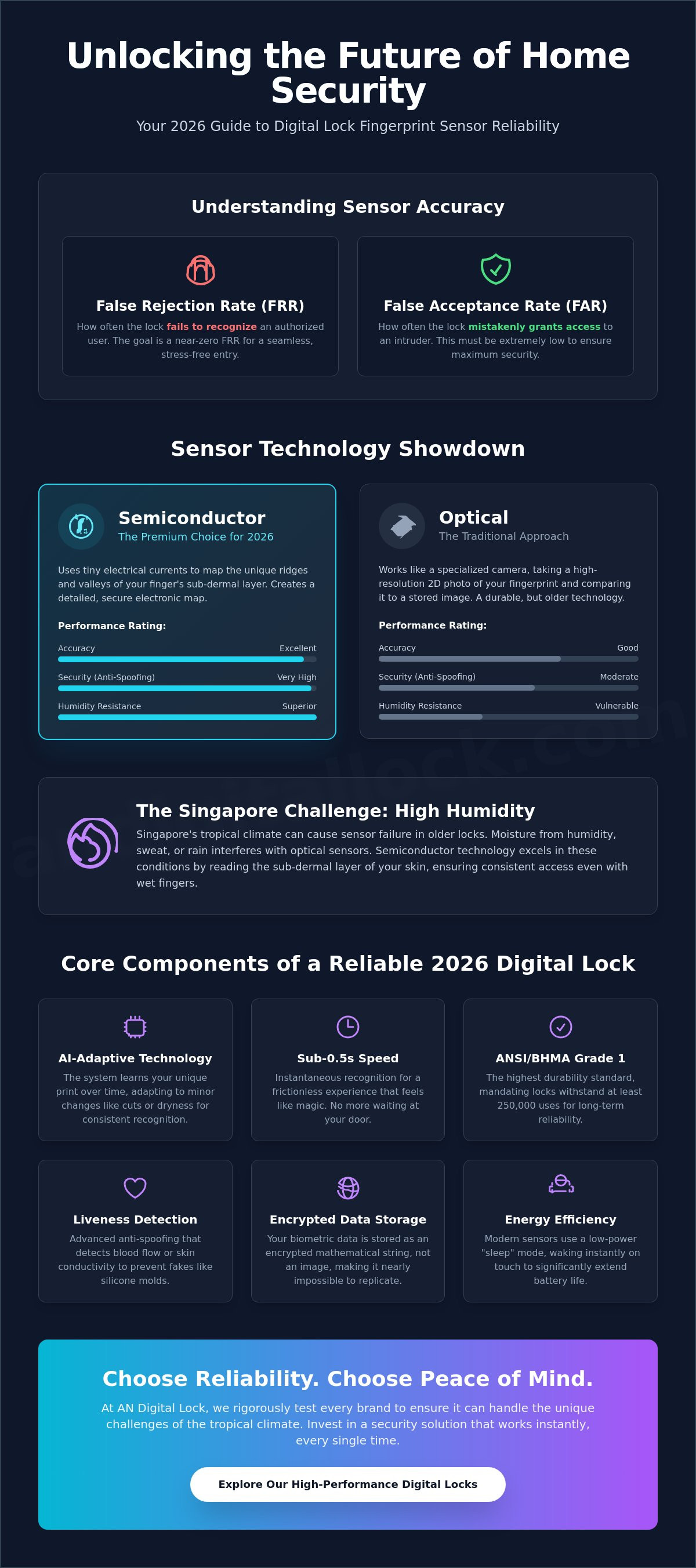
When you invest in home security, reliability isn't just a buzzword; it's the difference between a seamless entry and a frustrating night spent on your doorstep. In technical terms, digital lock fingerprint sensor reliability is measured by two critical metrics: the False Rejection Rate (FRR) and the False Acceptance Rate (FAR). FRR represents how often the lock fails to recognize an authorized user, while FAR measures how often it mistakenly grants access to an intruder. By 2026, the industry has shifted its focus toward minimizing FRR to near-zero levels without compromising the strict security of a low FAR.
Biometric algorithms have evolved significantly over the last few years. Early 2020 models often relied on simple 2D pattern matching, which could be easily fooled or hindered by a slight change in finger positioning. Today, AI-driven recognition systems learn your unique print over time. These systems adapt to minor skin changes, such as small cuts or dryness, ensuring that your access remains consistent. This technological leap has triggered a massive psychological shift among homeowners in Singapore. We've moved from a "key-first" mentality to a "biometric-first" lifestyle, where the physical key is viewed as a dusty relic for emergencies only.
The Core Components of a Reliable Sensor
The hardware housing the algorithm is just as vital as the software itself. High-end sensors now utilize sapphire glass coatings instead of standard hardened plastic. Sapphire glass is virtually scratch-proof and maintains its clarity after years of use, which is essential for accurate readings. Industry leaders now aim for a processing speed of sub-0.5 seconds. This instantaneous recognition creates a frictionless experience that feels like magic. Additionally, modern sensors are incredibly energy-efficient. They remain in a low-power "sleep" mode and wake up instantly upon touch, significantly extending the battery life of your digital lock singapore setup.
Why Biometrics Are Now Safer Than Physical Keys
Physical keys are inherently risky. They can be lost, stolen, or duplicated in minutes at any hardware store. Biometric data, however, is stored as an encrypted mathematical string rather than a literal image of your finger. This makes it nearly impossible to replicate. Modern fingerprint sensor technologies also include advanced anti-spoofing measures. These sensors detect "liveness" by checking for blood flow or skin conductivity, ensuring that silicone molds or high-resolution photos cannot bypass your security. When you choose a high-quality biometric lock for your wooden door or metal gate, you're choosing a system that prioritizes your emotional well-being and physical safety above all else.
Comparing Fingerprint Sensor Technologies: Semiconductor vs. Optical
Your choice of hardware directly dictates your digital lock fingerprint sensor reliability. In 2026, the market is primarily split between semiconductor (capacitive) and optical sensors. While both aim to grant you quick access, they function in fundamentally different ways. Understanding these differences helps you avoid the frustration of a lock that fails when your hands are dry or the weather is humid.
Semiconductor sensors are the premium choice for modern homes. Instead of taking a photo, they use tiny electrical currents to map the ridges and valleys of your finger. This creates a detailed electronic map that is nearly impossible to spoof with a simple 2D image. Research by the National Institute of Standards and Technology (NIST) highlights the performance accuracy of fingerprint scanning when utilizing advanced capacitive methods. Because these sensors measure actual skin properties, they offer a higher level of security that banks and high-security facilities prefer.
Optical sensors represent the traditional approach. They work like a specialized camera, illuminating your finger and capturing a high-resolution image to compare against the stored version. While they've improved significantly, they can still struggle with oils, dirt, or "ghost" prints left behind on the glass. However, they remain a durable option for certain environments due to their thick protective layers. If you're looking to upgrade your home security, you can explore our latest Digital Door Locks to see these technologies in action.
Semiconductor Sensors: The Gold Standard for HDBs
For HDB owners, semiconductor sensors are the ideal solution. They excel at reading dry or slightly worn fingerprints. This is a common issue for elderly residents or those with manual jobs. Their compact nature allows manufacturers to integrate them directly into the handle for a more ergonomic, one-motion entry. Most importantly, they offer superior resistance to "dummy" fingerprint attacks by detecting the electrical charge of a living finger.
Optical Sensors: When Are They Still Relevant?
Optical sensors still have a place in the 2026 market. They are often more cost-effective. This makes them a great choice for budget-friendly secondary door locks or internal rooms. They also perform remarkably well in extreme lighting conditions, such as areas with heavy direct sunlight that might interfere with other sensor types. Because the sensor surface is usually made of hardened glass, it's easy to clean and maintain in high-traffic commercial areas.
Common Reliability Challenges for Digital Locks in Singapore
Singapore’s tropical climate presents a unique set of challenges for smart home technology. High humidity levels often exceed 80%, which can significantly impact digital lock fingerprint sensor reliability. When moisture sits on the sensor surface or your skin, it can distort the electrical signals needed for a successful scan. This leads to the "False Rejection" frustration that many homeowners fear.
Wet and sweaty fingers are the primary cause of recognition failure in the tropics. Whether you've just come in from a sudden afternoon downpour or finished a morning jog, moisture acts as a physical barrier. This is why adherence to NIST biometric standards is so important. These benchmarks ensure that the hardware is tested against environmental stressors to maintain high accuracy even in less-than-ideal conditions.
Physical wear also plays a role over time. After five or more years of daily use, the protective coating on a sensor can begin to thin. This reduces sensitivity and increases the time it takes for the lock to grant access. Additionally, intermittent sensor lag is often a direct result of battery fluctuations. As power levels drop, the sensor might not receive enough voltage to wake up instantly, leading to a sluggish response that feels like a hardware failure but is actually just a maintenance issue.
Dealing with "Difficult" Fingerprints
Elderly users often have faded fingerprint ridges, which makes it harder for traditional scanners to find a match. Children also present a challenge because their fingerprints are still developing and changing in size. To solve this, register multiple fingers for every family member. We recommend registering both thumbs and index fingers. This simple strategy provides you with immediate backup options if one finger is too dry or slightly injured, ensuring you're never stuck outside.
Environmental Protection Measures
Gate locks are especially vulnerable to the elements. You should prioritize models with high IP (Ingress Protection) ratings to guard against dust and water splashes. A robust mortise lock housing is essential here. This design encloses the internal biometric circuitry, shielding it from the corrosive effects of Singapore's salt-heavy air and humidity. For routine maintenance, simply wipe the sensor with a dry microfiber cloth. Don't use harsh chemical cleaners; they can strip away the specialized coating that keeps the sensor accurate.
How to Choose a Fingerprint Lock That Never Fails You
Selecting a device that guarantees entry requires a systematic approach. You shouldn't settle for the first model you see in a showroom. Instead, focus on the specific hardware features that drive digital lock fingerprint sensor reliability. Start by confirming the sensor type. As established in previous sections, semiconductor sensors are non-negotiable for main entry points. They provide the precision needed to handle the daily wear and tear of a busy household while offering the highest level of security against spoofing.
Next, look for "self-learning" capabilities. This AI-driven technology is a game-changer for multi-generational families in Singapore. It allows the system to update its stored template every time you successfully unlock the door. This is particularly helpful for elderly residents whose fingerprint ridges may have faded with age. It also accommodates children as their fingerprints grow and change. Without this adaptive learning, you might find yourself re-registering prints every few months to maintain accuracy. This feature ensures your keyless lifestyle remains frictionless and dependable.
Don't overlook the importance of natural ergonomics. If the sensor is placed awkwardly, you'll struggle to get a consistent read. The best designs allow your thumb to fall naturally onto the scanner as you grip the handle. This one-motion entry is the hallmark of contemporary refinement and ease of use. Finally, always verify the backup options. Even the most reliable biometric system should be paired with a mechanical key and RFID card access for total peace of mind. If you're ready to secure your home, browse our premium collection of Digital Door Locks to find the perfect fit for your lifestyle.
Top Brands Known for Biometric Precision
Zigbang, formerly known as Samsung, continues to lead the industry in recognition speed. Their sensors are optimized for rapid-fire entry, making them a favorite for busy professionals. Philips offers advanced multi-layered security with robust sensor coatings that resist scratches and oils. This durability is essential for long-term performance. Solity excels with specialized algorithms designed for diverse skin types. Their tech is specifically tuned to recognize fingerprints across all age groups, from young children to seniors, ensuring no one in your family is left waiting at the door.
The Role of Multi-Factor Authentication
For those who prioritize maximum protection, multi-factor authentication (MFA) is the ultimate solution. This involves combining your fingerprint scan with a PIN code or an RFID card. Dual-verification modes are perfect for high-security scenarios, such as when you are away on vacation. While the fingerprint sensor provides the convenience, the second layer adds an impenetrable barrier against unauthorized access. You can find more detailed advice on these configurations in our comprehensive door lock singapore guide.
Why AN Digital Lock Prioritizes Sensor Precision and Longevity
At AN Digital Lock, we don't just sell hardware; we provide peace of mind. We understand that digital lock fingerprint sensor reliability is the most critical factor for Singaporean homeowners who want to leave their physical keys behind. To ensure every product meets our high standards, we implement a rigorous selection process. We only stock global brands like Kaadas, Philips, and Solity that have demonstrated consistent performance in our local climate. Our team conducts "Real-World" tests on every new model we carry. We verify that the sensor wakes up in under 0.5 seconds and recognizes prints even when the air is thick with humidity.
Our commitment to longevity extends to our exclusive HDB and BTO lock bundles. These packages are specifically designed to offer high-reliability biometric technology for both your wooden door and metal gate. By choosing a bundle, you ensure that your entire entry system uses synchronized, high-performance sensors. This unified approach eliminates the frustration of carrying a physical key for one lock while using biometrics for the other. It’s about creating a frictionless, contemporary lifestyle for every member of your family. We prioritize your emotional well-being by ensuring your home remains secure and easy to access.
Expert Installation and Sensor Calibration
Professional installation is the backbone of digital lock fingerprint sensor reliability. If a lock is misaligned by even a few millimeters, it can cause mechanical strain that eventually affects the electronic components. Our technicians ensure that the sensor and mortise are perfectly calibrated for smooth operation. During the installation, we provide on-site user training. We'll teach your family the correct way to register prints to minimize future false rejections. We also offer long-term maintenance advice to keep your sensor at peak performance for years to come.
Visit Our Showrooms for a Hands-On Test
Reading about technology is useful, but feeling it for yourself is better. We invite you to visit our showrooms to try different brands before you commit to a purchase. You can test the recognition speed and ergonomic feel of our top picks in person. Our staff provides personalized consultations to help you secure your hdb main door with the most reliable tech available. We are dedicated to maintaining the best digital lock singapore standards, ensuring your home remains a safe and stylish sanctuary.
Secure Your Future with Precision Biometrics
Choosing a home security solution is about more than just picking a brand. It's about ensuring your family enjoys a frictionless, keyless lifestyle that never leaves you waiting at the door. You've now seen how digital lock fingerprint sensor reliability depends on selecting semiconductor hardware and AI-driven algorithms that adapt to your unique needs. Whether you're managing the challenges of Singapore's high humidity or helping elderly parents with faded prints, the right technology makes all the difference in your daily routine.
At AN Digital Lock, we bring over 10 years of experience in Singapore home security to every installation. As an authorized dealer for Zigbang, Philips, and Solity, we curate only the most dependable hardware for our customers. Our 5-star rated installation and support team ensures your sensors are perfectly calibrated for long-term performance. Upgrade to a reliable biometric lock at AN Digital Lock today! Experience the contemporary refinement and safety you deserve. We're here to help you transition to a smarter, more secure home with total confidence.
Frequently Asked Questions
Do fingerprint sensors work if my hands are wet or sweaty?
Yes, modern semiconductor sensors are designed to handle minor moisture, though they work best when your skin is relatively dry. If your hands are dripping wet after a heavy rain or a workout, the water can distort the electrical scan and cause a read error. Simply wipe your finger on your clothes for a second to ensure the sensor can accurately map your ridges without interference from excess liquid.
Can a digital lock fingerprint sensor be easily scratched or damaged?
Premium sensors utilize sapphire glass or high-grade hardened coatings to resist scratches from daily use. While these materials are incredibly durable, you should avoid touching the sensor with sharp metal objects or using abrasive chemicals for cleaning. Normal contact with fingers won't cause damage, but a deep scratch can eventually degrade the recognition accuracy over several years of operation.
What happens to the sensor if the digital lock runs out of battery?
The sensor will stop functioning immediately once the power is completely exhausted. However, you won't be stranded outside your home. Most locks feature an external emergency power port where you can touch a 9V battery to jumpstart the system for a quick scan. You should also keep your physical emergency key in a safe place outside the home, such as in your car or at an office, for manual entry.
Are digital lock fingerprint sensors reliable for elderly family members?
Yes, they are highly effective if you choose a model with a semiconductor sensor and AI-adaptive learning. These technologies are specifically designed to overcome digital lock fingerprint sensor reliability issues caused by faded ridges or dry skin. We recommend registering at least three different fingers for elderly users. This provides them with immediate backup options if one particular finger is difficult for the scanner to read on a cold or dry day.
Can someone use a photo or a fake fingerprint to trick the sensor?
It is nearly impossible to fool a semiconductor sensor with a photo or a silicone mold. These advanced scanners require the natural electrical conductivity of human skin to trigger an unlock. Unlike older optical technology that just takes a 2D picture, semiconductor sensors map the actual depth and "liveness" of your finger. This ensures that only a real, living person can gain access to your wooden door or metal gate.
How many fingerprints can a typical high-quality digital lock store?
Most high-quality digital locks in 2026 can store between 50 and 100 unique fingerprints in their internal memory. This high capacity allows you to register multiple fingers for every family member and even grant temporary access to trusted guests or domestic helpers. You can easily manage these enrollments through the lock's interface, allowing you to delete individual prints without resetting the entire system.
What should I do if the sensor fails to recognize my fingerprint?
Clean both the sensor surface and your finger with a dry microfiber cloth to remove any oils, dirt, or moisture. If the sensor remains unresponsive, use your backup PIN code or RFID card to enter your home. Once inside, check the battery levels in the mobile app or the lock's menu. Low voltage is a common cause of sensor lag, and a fresh set of batteries often restores the device to peak performance instantly.
Is a semiconductor sensor really worth the extra cost over an optical one?
Investing in a semiconductor sensor is definitely worth it for your main entrance. This technology offers superior digital lock fingerprint sensor reliability and much faster recognition speeds in Singapore's humid environment. While optical sensors are more budget-friendly for internal bedroom doors, the added security and ergonomic benefits of semiconductor tech make it the gold standard for your primary home security setup.