


For a home safe in Singapore, look for a fire rating of at least 1 hour to help protect important documents and valuables. Fire and water protection are separate considerations, so compare each claim alongside the safe’s usable capacity. Choosing a fire- and waterproof safe for important documents in Singapore means balancing those protections with the space you need and the amount you plan to spend.
It’s easy to focus on a safe’s price or outside dimensions, but neither tells the whole story. A compact safe may suit a few passports and certificates, while files and office records need more interior space. The right choice depends on what you’re storing, how much room it takes up, and which risks matter most to you.
This guide compares safe sizes, fire and water protection, price considerations, and suppliers in Singapore. You’ll learn how to match capacity to your documents, assess protection claims, and narrow down options for home or office use without paying for space or features you don’t need.
Key Takeaways
- For a home safe, use a fire rating of at least 1 hour as a starting point when comparing options.
- Compare fire and water protection separately, then match both to the documents and valuables you need to protect.
- Choose capacity based on the items you’ll store; filing cabinet safe drawers can accommodate vertical pocket files and arch files.
- Compare budget and premium safes by their protection claims, usable space, and suitability for your home or office, not price alone.
- Use the decision guide to narrow your options by storage needs, protection priorities, and local supplier choices.
Fire-resistant safes for homes and offices
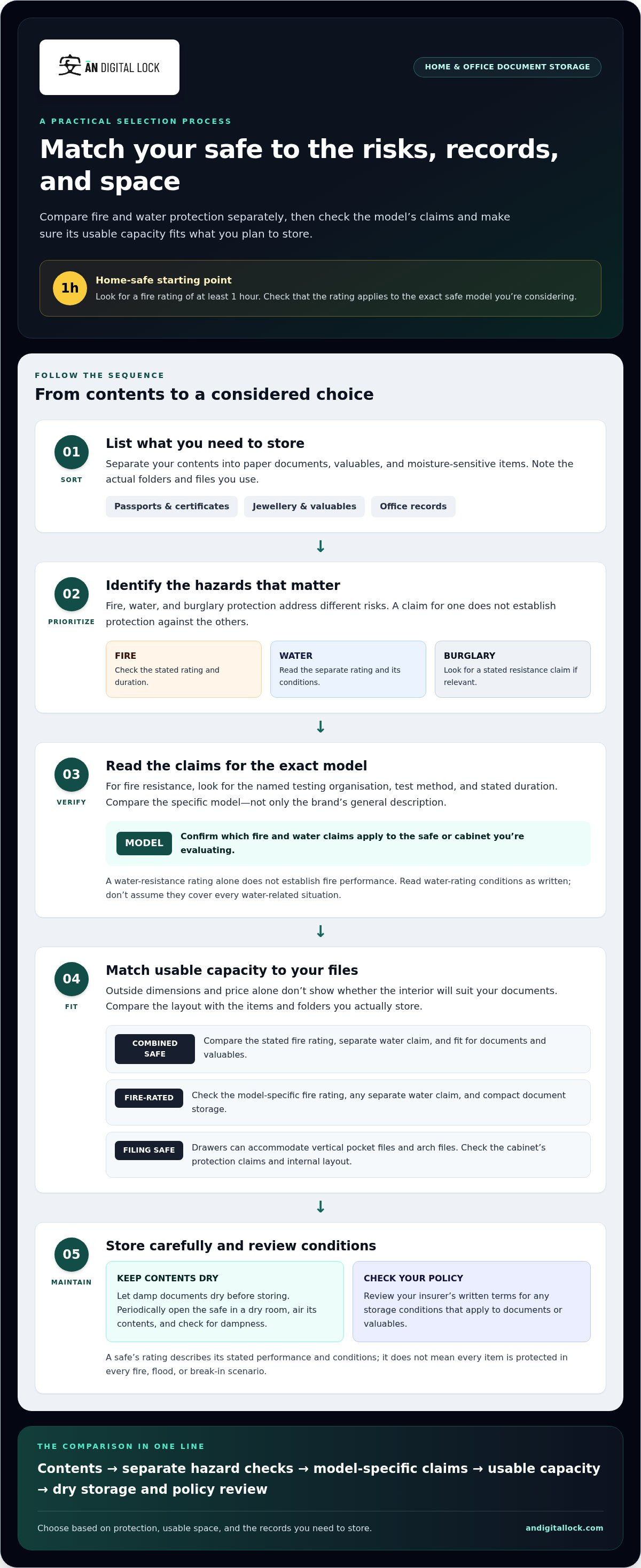
Choose protection by the documents you store and the space available. For a home safe, the recommended starting point is a fire rating of at least 1 hour. When comparing a fire and waterproof safe for important documents in Singapore, assess the fire and water claims separately.
Fire-Resistant and Waterproof Safes
A fire and waterproof safe is designed to address heat and water exposure, rather than fire alone. These protections serve different purposes: a fire claim doesn’t establish water resistance, and a water claim doesn’t establish fire performance. For a Singapore home or office, compare each stated protection separately, then match the safe’s capacity to items such as passports, certificates, or office files. This is essential when choosing a fire and waterproof safe for important documents in Singapore.
Independent Fire-Resistance Ratings
An independent fire-resistance rating gives you a basis for comparing a tested safe with a general product claim. Look for the named testing organisation, the test method, and the stated duration in the product information. Compare the exact safe model, not just a brand’s general description. A 1-hour rating is the recommended minimum starting point for a home safe, but the rating should relate to the model you’re considering.
Water-Resistance Ratings
A water-resistance rating addresses exposure to water, separately from fire resistance. Read the stated rating and conditions as written; don’t assume it means protection in every water-related situation. A water rating alone also says nothing about fire performance. For example, if a safe’s information describes water protection but gives no fire rating, compare it as a water-protection option, not as a substitute for a fire-rated model.
Filing cabinet safes offer another format for workplaces and document-heavy homes. Their drawers are wide and deep enough to store vertical pocket files and arch files. This keeps records in a familiar filing arrangement, unlike a compact safe that may require documents to be folded or stacked. Before choosing one, compare the internal layout with the folders you use and check which protection claims apply to the cabinet.
| Option | Fire protection | Water protection | Storage fit |
|---|---|---|---|
| Combined safe | Compare stated rating | Compare separate claim | Documents and valuables |
| Fire-rated safe | Check model-specific rating | Check separate claim | Compact document storage |
| Filing cabinet safe | Check cabinet’s rating | Check separate claim | Vertical pocket files and arch files |
Choose a safe that fits your files and clearly states protection against the hazards you want to address.
Protection of important documents and valuables
Protection depends on the hazard, the safe’s rating, and what you store. A passport, paper certificate, and jewellery, for example, may call for different considerations.
For home document storage in Singapore, compare the safe’s stated protection with your insurer’s written terms. Insurance requirements vary by policy, so review any storage conditions that apply to valuables or documents.
Fire Ratings and Protection Duration
A fire rating describes tested resistance to heat for a stated duration. For a home safe, the recommended minimum is a fire rating of 1 hour. That duration helps compare models, but it doesn’t mean every item inside remains unaffected in every fire. Match the rating to the contents: paper records, for example, need different consideration from items sensitive to heat.
Moisture and Burglary Protection
Moisture resistance and burglary resistance address separate risks. A water-resistance claim doesn’t establish protection against forced entry, just as a fire rating doesn’t establish water resistance. Compare the stated protections individually. For jewellery or original identity documents, check whether the product information describes resistance to both water and unauthorised access, rather than relying on a general “protected” label.
Limitations and Risks of Safe Protection
A fire-resistant or waterproof safe has limits defined by its claims and conditions. A combined label doesn’t mean the safe withstands every fire, flood, or break-in scenario. Contents can also be vulnerable if stored damp or if the safe is used beyond its stated protection. Keep a simple inventory of items such as certificates and jewellery, and store copies separately where practical.
Pay attention to moisture after storage, especially with paper and delicate materials. Don’t put damp documents inside; let them dry first. Periodically open the safe in a dry room and air its contents. For example, inspect paper certificates for dampness and check that stored fabric or photographs feel dry. This routine helps you spot moisture concerns before they affect stored items.
Use this practical sequence when preparing important records:
- Sort contents into paper documents, valuables, and moisture-sensitive items.
- Compare fire, water, and burglary claims separately against those contents.
- Keep documents dry before storage, then periodically inspect and air them.
- Review your insurance policy for any conditions on storing valuables.
These steps clarify what the safe is intended to protect and where its limits matter. A product rating describes the safe’s stated performance, while insurance wording sets conditions relevant to a claim. Neither replaces careful storage: a dry certificate in a suitably rated safe is a more considered choice than damp paperwork stored on the assumption that every hazard is covered.
Budget and premium safe comparisons
Budget and premium are useful comparison labels, not universal safe specifications. In Singapore, compare each model’s stated features and quoted price in Singapore dollars rather than assuming a higher price guarantees stronger protection. A lower-cost option may suit a small set of records, while a larger or dual-protection model may better match broader storage needs.
Start by listing what the safe needs to do. A homeowner storing a few certificates, for example, has different capacity needs from an office keeping folders and valuables together. Then compare the same criteria across models. This prevents a compact safe with limited stated protection from seeming equivalent to a larger model with separate fire and water claims.
| Comparison point | Budget option | Premium option |
|---|---|---|
| Price | Compare the quoted amount in S$ | Compare the quoted amount in S$ |
| Protection | Read each stated claim | Read each stated claim |
| Capacity | Match to listed contents | Match to listed contents |
| Value assessment | Prioritise essential requirements | Assess whether added features meet a real need |
Price alone doesn’t show whether a safe suits your documents. Read the details for the exact model, then compare its fire and water claims separately. If the description gives a fire claim but no water claim, don’t treat it as equivalent to a model that states both. Compare usable interior space too: a safe that cannot fit your folders may not solve your storage problem.
Use this short comparison process before deciding:
- Write down the items you plan to store, such as passports, certificates, or folders.
- Record each model’s stated protection and usable capacity.
- Compare like-for-like quoted prices in S$, including models with similar stated claims.
- Choose the lowest-priced option that meets your actual storage and protection priorities.
This approach helps distinguish a lower purchase price from better value. If two models fit the same documents, for instance, compare their stated protections before paying more for a premium label. If one model has more capacity than you need, that extra space may not justify the price difference. If you’re storing both papers and valuables, weigh the stated protection against that specific mix.
For home and office buyers, compare requirements, not tier names. Keep product descriptions and quoted prices side by side. Note differences in capacity and protection claims, then decide which matter for your documents. This gives you a clear basis for comparing budget and premium options without relying on price labels alone.
Safe size and storage capacity
Choose a safe by measuring the items you’ll store and comparing those measurements with usable interior space. A cabinet’s outside dimensions show its footprint, not how many folders or valuables fit inside.
Start with a simple inventory: certificates, passports, paper files, small valuables, and storage boxes. Group items that need to stay together. If a folder must remain flat, for example, measure its height, width, and thickness while closed. Compare these measurements with the safe’s interior, accounting for shelves, door fittings, and enough room to remove the folder easily.
Capacity descriptions can conceal practical differences. Two safes with similar external dimensions may have different interior layouts. A thick door, fixed shelf, or narrow opening can reduce usable space. Check product dimensions carefully and distinguish internal measurements from external ones. If a listing gives only a volume figure, it won’t tell you whether a long folder fits flat or whether stacked items block access.
For office records, a filing cabinet safe drawer can hold vertical pocket files and arch files. This format keeps files upright and accessible, unlike a compact box that may require folders to be laid down. Consider the files you actually use: a drawer that fits one folder type may not suit wider binders or bulky envelopes. Match the drawer layout to your filing system before choosing.
Use these steps to estimate the capacity you need:
- Measure the largest folder or document container you intend to store.
- List items that need separate space, such as passports or jewellery cases.
- Compare the list with the safe’s internal dimensions and shelf arrangement.
- Check that the door opening allows each item to go in and come out easily.
Placement matters too. Measure the intended spot in your Singapore home or office, including the route through doorways and around furniture. A safe that fits a study corner may be difficult to move through a narrow corridor. Leave enough room to open the door fully and retrieve a folder without shifting other contents. For a floor or cabinet location, consider the surface and surrounding storage when planning access.
Finally, allow for changes in what you store. A safe packed tightly with current files can become awkward when new certificates or records arrive. Don’t choose by volume alone: check whether your largest items fit first, then see how the remaining space accommodates smaller valuables. This practical sequence helps you compare compact safes, larger models, and filing drawers against the contents you need to protect.
Singapore safe brands and suppliers
Compare Singapore suppliers by the safe models and product details they publish, not by brand names alone. A supplier may list several models, but each needs its own capacity and protection information. Start with the exact model name, then compare its description with your document-storage needs. This prevents a broad brand reputation from standing in for the performance of a specific safe.
Use a simple comparison sheet for each listing. Record the model, internal dimensions, storage format, fire claim, water claim, and quoted price in S$. Leave fields blank when details are not stated rather than treating them as equivalent protections. For example, a listing that describes a fire rating but gives no water details differs from one that describes both. A clear comparison reveals these differences without relying on sales labels.
Supplier information also matters for practical fit. Note whether the product page shows internal and external measurements, interior photographs, and the safe’s intended storage arrangement. A filing-style model, for example, may suit office folders better than a compact box. Match the model’s details to your records, then compare those details across Singapore listings. This is more useful than comparing brand names without model-specific information.
Use these steps to narrow the options:
- Write down the documents and valuables the safe must hold.
- Identify the exact models shown by each Singapore supplier.
- Compare stated protection, internal layout, and dimensions side by side.
- Compare quoted prices in S$ only after matching similar models.
- Shortlist the models whose published details fit your needs.
Keep comparisons like for like. A compact document safe and a filing cabinet safe serve different storage needs, so their prices alone don’t show which is better value. Similarly, a supplier’s broad “fire and waterproof” description shouldn’t replace separate claims for the specific model. Use the product details to distinguish fire protection from water protection and assess whether the format suits passports, certificates, or folders.
For a final decision, rank your priorities: stated protection, usable space, and budget. Then review shortlisted models in that order. If two Singapore listings look similar, compare their exact model names and specifications before deciding. This helps you identify meaningful differences between brands and suppliers and avoid choosing a safe based only on a prominent label or low displayed price.
AN Digital Lock: Digital Door Locks
AN Digital Lock offers Safe Boxes for storing documents and valuables at home or in the office. Use the comparison criteria above to decide what size and protection claims suit your needs, then explore a Safe Box as part of your home security setup.
Digital Door Locks address another part of home security: entrance access. They can complement a safe by helping secure the home itself, while the safe provides a dedicated place for important items. Choose products according to the protection need you’re addressing.
For a safe box or digital door lock, visit AN Digital Lock.
Make your next home security choice
Choosing a fire and waterproof safe for important documents in Singapore is one part of a considered home security setup. Your next step is to decide how to secure both stored valuables and your home’s entrance, based on the risks and access needs that matter to your household.
AN Digital Lock offers Safe Boxes for document storage, alongside Digital Door Locks, Wooden Doors, and Metal Gates. These products serve different purposes, so focus on the specific area you want to address rather than expecting one item to do everything. A safe protects stored belongings; entrance products support the security and function of your home’s entry points.
If you’re ready to explore options for your home, contact AN Digital Lock. Take the next step with a clearer plan for the protection and access your household needs.
Frequently Asked Questions
What fireproof and waterproof safes for important documents are available in Singapore?
Singapore buyers can compare compact document safes, combined fire-and-water-resistant models, and filing cabinet safes. The right format depends on whether you store loose certificates, folders, or valuables alongside papers. An office keeping upright files, for example, may need a drawer-style cabinet, while a household storing passports may prefer a smaller interior. Compare each model’s stated protections and layout separately.
Which safes are independently certified for fire and water resistance, and what standards do the ratings meet?
Certification applies to a specific model and tested performance, not automatically to every safe from a brand. Look for documentation naming the independent testing organisation, standard, and protection conditions. Assess fire and water certifications separately, because one doesn’t establish the other. Compare the exact model identifiers on the safe and its documentation to ensure the certification evidence matches the product you’re considering.
How long can document safes withstand fire, and at what temperatures?
A safe’s stated fire-resistance duration applies to its test conditions, not every possible fire temperature or exposure. For home document storage, the recommended starting point is a 1-hour fire rating. Compare the duration shown for each exact model, and read what the rating covers. Paper, digital media, and heat-sensitive valuables may have different vulnerabilities, so the safe’s rating alone cannot describe every item’s outcome.
What are the water-resistance ratings and limits for fireproof safes?
Water-resistance claims describe the conditions under which a safe was assessed; they don’t establish protection against every kind of water exposure. Compare the model’s stated rating and conditions, including the type of exposure described. A water claim cannot replace a fire rating, and a fire rating cannot establish water resistance. Store dry documents inside and don’t interpret a general “waterproof” label as unlimited protection.
How much do fireproof and waterproof document safes cost in Singapore?
Safe prices in Singapore depend on the model, capacity, construction, and stated protection. Compare quoted prices in Singapore dollars only after matching models with similar interior space and protection claims. A compact document box and a filing cabinet safe serve different storage needs, so their prices aren’t directly comparable. Consider whether extra capacity or a second protection claim addresses a genuine requirement.
Where can I buy fireproof and waterproof safes in Singapore, and what are the delivery and installation costs?
Buy through Singapore safe suppliers that provide model-specific product information and itemised purchase terms. Delivery and installation charges depend on the safe, delivery access, and the work included in the quote. Compare these as separate costs rather than assuming the displayed product price covers placement. A heavy cabinet may also require different handling from a compact box, so include the intended location in your purchase planning.
What safe size and capacity are suitable for passports, certificates, and A4 documents?
Choose capacity by measuring your largest document folder and comparing it with the safe’s internal dimensions. Passports and loose certificates need less space than folders kept flat or stacked together. For A4 papers, check that the interior and door opening accommodate your actual folder or document sleeve. Also account for shelves and other items, since usable space can differ from the safe’s external size.
How should a fireproof safe be installed and maintained to protect documents in Singapore’s humid climate?
Place the safe on a stable, dry surface and keep documents dry before storage. Avoid locations where leaks or routine cleaning could wet the exterior. Periodically remove papers and inspect them for dampness, then air the safe in a dry room before returning the contents. Arrange folders to allow air to circulate, and follow the manufacturer’s care instructions for the specific model and locking mechanism.