


Blame rarely helps anyone find the keys. A shared routine does more to stop the same row from returning, which is the heart of avoiding family arguments about lost keys. When everyone is rushing out for school, work or errands, a misplaced set can disrupt the morning and leave family members pointing fingers.
It’s understandable to feel frustrated when keys go missing, especially if spares are hard to track or different people need access to the home. The fix doesn’t have to be complicated. A clear place to leave keys and an agreement about who manages spares can make access easier for everyone.
This guide shows you how to build a practical household key routine, share access more clearly and handle a missing set without turning it into a blame game. You’ll also learn when a digital door lock may suit your family. Options such as PIN, fingerprint, RFID and Wi-Fi access can reduce reliance on physical keys, but the best choice depends on how your household uses the entrance.
Key Takeaways
- Identify whether keys are misplaced, handoffs are being missed or spare-key ownership is unclear.
- Give everyday keys a consistent place and borrowed spares a clear return plan.
- For avoiding family arguments about lost keys, focus on fixing the household system rather than assigning blame.
- Compare physical-key habits with digital access to see which approach better fits your family’s daily routines.
- Agree on a simple routine to try first, then discuss whether another access method could make entry easier.
Why lost keys turn into family arguments, and what the real problem is
Someone is ready to leave, but the keys aren’t where they expected. One family member remembers using them last; another insists they put them back. A quick search becomes a tense replay of who went where and when. The frustration makes sense, especially when everyone needs the same entrance to work smoothly. But a missing key alone doesn’t explain why the disagreement keeps returning.
The underlying issue is often a mismatch between shared access needs and unclear habits. Several people may use the same keys, yet each assumes someone else has put them in the usual spot or will pass them back. Under time pressure, uncertainty fills the gaps. Different expectations can then sound like accusations: one person wants an immediate answer, while another feels unfairly held responsible.
Why the same key problem keeps happening
Keys are easy to overlook when there’s no consistent drop-off habit. They might land in a bag, on a kitchen counter or beside the door, depending on who came home and what they were carrying. Each location may seem sensible in the moment, but it makes the next search harder for everyone else. Frustration can build even when nobody is being careless on purpose.
Rushed departures add pressure. When someone is waiting at the door, a small delay can feel like a bigger failure, and a minor disagreement can sharpen quickly. One isolated mix-up doesn’t necessarily call for a household overhaul. If the same confusion happens repeatedly, treat it as a pattern to solve together. A consistent cue and place can help form a habit, as described in the process of habit formation.
How to discuss lost keys without turning it into blame
Talk about the effect of the problem, not a person’s character. “We lost time looking for the keys this morning” is more useful than “You always leave them somewhere.” The first statement describes a shared inconvenience and leaves room to find out what happened. The second invites defensiveness and can turn a practical issue into a dispute about fault.
Choose a calm moment after the search is over. Agree that the goal is to make keys easier for everyone to find, then discuss what would make the routine realistic for people arriving with shopping, bags or children. Try neutral prompts such as:
- “Where would it be easiest for all of us to put the keys when we come in?”
- “How should we let each other know if someone borrows a spare?”
- “What could we change so the next person doesn’t have to guess?”
Takeaway: The missing key is the immediate problem; the unclear routine is what deserves attention. That shift is central to avoiding family arguments about lost keys, because it turns blame into a shared, practical conversation.
Find the cause: habits, unclear handoffs or too few access options
Before changing the routine or considering a new lock, work out what’s going wrong. A key left in a different place each day calls for a different fix from a spare that’s borrowed and not returned, or a household member who has no convenient way to enter. A short, blame-free review helps everyone describe the pattern instead of guessing who caused it.
For a little while, note when the search happens, where the key turns up and who needed it. Keep the notes practical, not personal. Look for recurring conditions, such as a rushed school run, a late return or a change in who’s carrying the household keys. Identify the cause first, and the solution can fit the way your household actually shares access.
Spot the pattern behind misplaced keys
Look beyond the last place someone remembers seeing a key. Ask whether one person was using it or whether it was passed between family members, and whether the handoff was clear. A key might be back in the home but not in the place the next person expects. That’s a handoff issue, not necessarily a misplaced-key habit.
Compare different situations without turning the review into a scorecard:
- Time and place: Does the search tend to happen before work or school, after an evening outing, or when the household returns with shopping?
- Key use: Is one set shared? Does a borrowed spare go back to a known place, or does each person assume someone else has it?
- Routine changes: Do visitors, different work or school schedules, or a change in who leaves first make the usual arrangement less reliable?
If the problem appears only during a particular handoff, focus there. If keys are regularly set down in different places, create a predictable home for them. A single unusual mix-up may need no lasting change; a repeating pattern deserves a household agreement.
Decide whether the household needs a routine or another access method
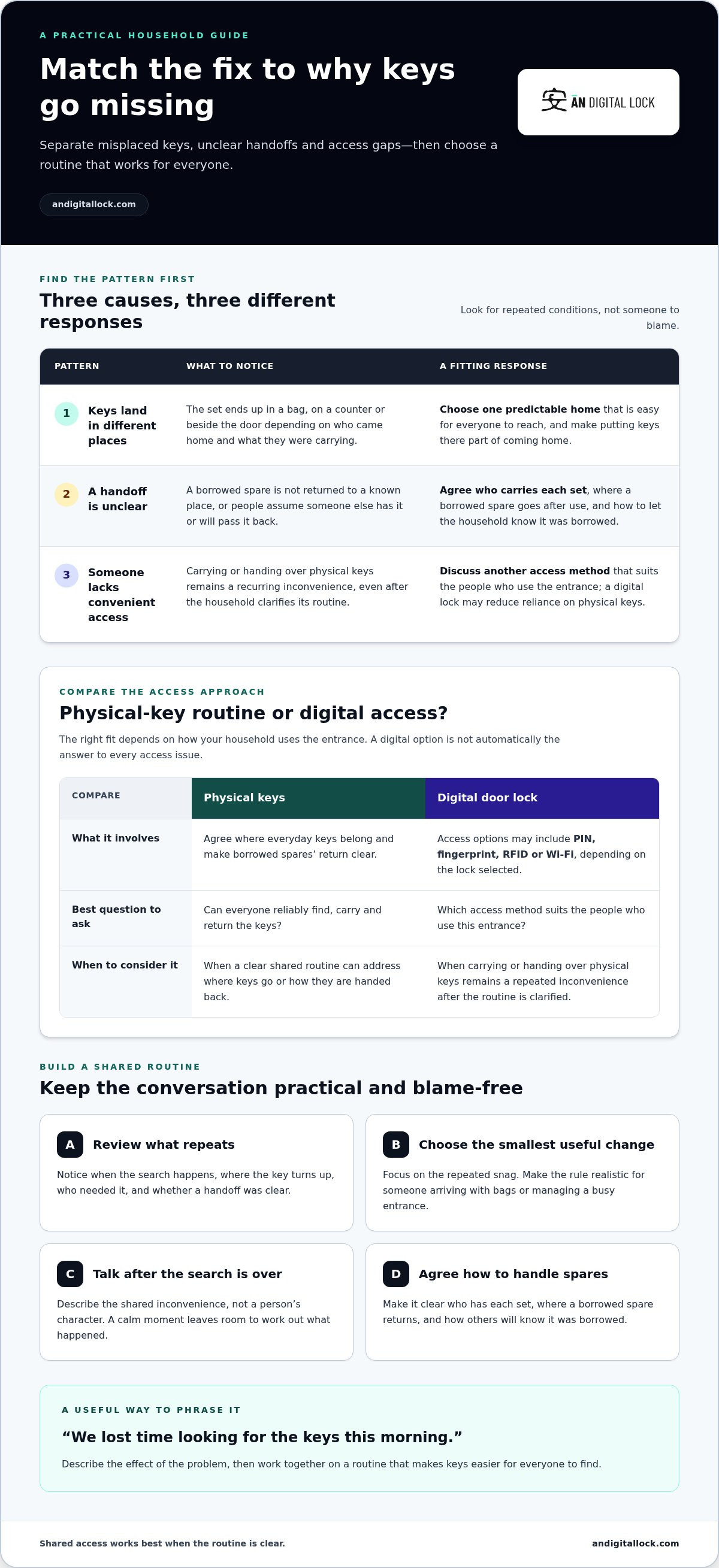
Match the response to the cause. If keys are scattered, choose one spot that’s easy for everyone to reach and make returning them part of coming home. If the difficulty is borrowing, agree who carries each set and where it goes after use. Keep the rule realistic for someone arriving with bags or managing a busy entrance, or it may be hard to maintain.
Another access method is worth discussing when carrying or handing over physical keys remains a recurring inconvenience, even after the household clarifies its routine. Digital door locks offer options such as fingerprint, PIN, RFID or Wi-Fi access, depending on the lock selected. Consider which method suits the people who use the entrance instead of assuming a digital option will resolve every access issue. Exploring digital door lock options can help families understand the alternatives.
Keep the review short and shared: describe the repeated snag, identify who it affects, then agree on the smallest useful change. That gives your family a practical next step before deciding whether a new routine or access method is the better fit.
Create a shared key routine that works for the whole family
A useful routine should be easy to follow on an ordinary day, not just when everyone has time to think about it. Agree on one place for everyday keys, make spare-key ownership clear and decide what to do when a key can’t be found. Keep the steps simple enough for every household member to remember, including children who are old enough to manage their own keys.
A reliable family key routine gives every key a home, every spare a clear owner and every search a calm first step.
Agree on one place and one handoff rule
Choose a spot that’s convenient on the way in, such as a designated hook or tray near the entrance. A place that’s awkward to reach or easy to overlook is less likely to become part of the daily habit. Then agree that borrowed keys go back to the same place immediately after use, rather than being passed on informally.
Use this short routine as a starting point, then adjust it together:
- Choose the home: Set one consistent, accessible location for everyday keys. Tell everyone in the household where it is.
- Assign the spares: Agree who keeps each spare key and when it may be borrowed. Don’t rely on assumptions about who has it.
- Return and reset: Put borrowed keys back in their agreed place as soon as they’re no longer needed. If a key must be handed to another person, let the owner know directly.
- Make it work for everyone: Talk through different schedules and arrival habits. If someone regularly comes home later or leaves first, check that the chosen spot and handoff rule still make sense.
Keep the agreement visible if that helps, such as with a brief note near the key spot. Revisit it if the household’s schedule changes. The aim isn’t to monitor one another; it’s to make the next person’s access predictable.
Use a no-blame lost-key checklist
If a key is missing, follow the same search steps before anyone starts assigning responsibility. A calm, repeatable response helps everyone focus on useful information: when the key was last confirmed, who used it and whether it may have been borrowed.
- Pause and retrace: Think back to the last confirmed use and check the places visited since then.
- Check the usual points: Look at the agreed key spot, bags or pockets used that day, and the agreed handoff location.
- Share information: Ask who has seen or borrowed the key, using neutral questions rather than accusations.
- Communicate about delays: Decide in advance who household members should contact if they’re delayed or can’t get in, and what the next agreed step is.
Could a digital door lock reduce lost-key friction? Compare the trade-offs
A digital door lock may reduce the need to carry and hand over a physical key, but it won’t automatically settle who should have access or how the household uses the entrance. Compare the day-to-day trade-offs before deciding. The best fit depends on who needs regular access and which method feels straightforward for them.
| Consideration | Physical-key routine | Digital access |
|---|---|---|
| Everyday entry | Household members carry a key or arrange a handoff. | Entry may use an available method such as fingerprint, PIN or RFID, depending on the lock. |
| Sharing access | Agree who holds each key and how borrowed keys are returned. | Agree who should use each access method and how the household will manage access. |
| Common friction | Keys can be misplaced, left behind or difficult to pass between people. | Physical-key dependence may be reduced, but family expectations and access habits still need to be clear. |
| Routine to maintain | Return keys to an agreed place and track spares. | Make sure each user understands their chosen method and the household’s backup plan. |
Compare familiar keys with fingerprint, PIN and RFID access
A physical key is familiar and doesn’t require household members to learn a new entry method. Its drawback is that it must be carried, stored and handed over reliably. Fingerprint access uses a registered fingerprint for entry, while PIN and RFID access provide alternatives to carrying a conventional key. These methods aren’t included on every digital lock, and each may feel more or less convenient depending on the user. A PIN, for instance, may suit someone comfortable entering a code, while another household member may prefer a different available method.
Digital access can change the key-sharing routine, but it doesn’t remove the need for one. Families still need shared expectations about who needs access, how access is managed and what to do if the usual method isn’t available. For a closer look at the options, explore this digital lock buying guide.
Choose a solution around your household’s habits
Start by listing who enters regularly and how each person would use the entrance. Consider comfort with sharing a PIN, using registered fingerprint access or carrying an RFID credential. Agree on a backup routine that everyone understands, without assuming every lock offers the same backup method. For broader selection considerations, see this guide to choosing the right door lock.
For avoiding family arguments about lost keys, don’t assume a digital lock will prevent disagreements. Choose an access arrangement that fits your household and establish clear expectations around it. If reducing physical-key handoffs addresses a recurring problem, explore digital door lock options as one possible next step.
Make a family access plan and choose the next step together
A useful access plan is one everyone can follow, not a rule created by the person most frustrated by the last search. Set aside a calm moment and keep the conversation focused on what happens at the entrance. Agree on one manageable change, try it in daily life and decide together whether it’s enough.
Run a short household reset
Give each person a chance to explain what makes the current arrangement inconvenient. One person may leave early, another may need to borrow a spare, and someone else may be unsure where keys belong. Listen for practical obstacles rather than debating who should have remembered. Then agree on a trial plan with one clear responsibility and a time to review it.
Use this short agenda:
- Describe the problem: Name the recurring snag, such as uncertainty about who has the spare or difficulty coordinating a handoff.
- Compare workable routines: Consider whether a consistent key location, a clearer handoff or another access method best addresses that specific problem.
- Choose one trial: Decide what each person will do and how you’ll tell whether the change is practical during a rushed morning or a late return.
- Review together: After trying the plan, discuss what worked and what still caused friction. Adjust one detail at a time.
Keep the trial simple. For example, the household might agree that a spare stays with one designated person and is returned to its usual place after borrowing. If the arrangement is too complicated to remember when everyone is busy, simplify it rather than adding more rules. Shared responsibility should make access clearer, not turn key management into another source of pressure.
Know when to explore digital door locks
Try a straightforward physical-key routine first if the main issue is scattered keys or an unclear handoff. Consider a digital door lock if physical keys continue to complicate everyday entry, even after the household has agreed how to manage them. Digital locks can reduce reliance on carrying a conventional key, but they don’t replace shared expectations about who needs access and how the chosen method will be used.
Compare access options against your household’s real needs. Fingerprint, PIN, RFID and Wi-Fi access methods are available across digital door lock options, but not every lock includes every method. Think about who enters regularly, which method each person can use comfortably, and what backup arrangement the household will follow if its usual approach isn’t available. The right choice is the one that fits how your family uses the entrance, not simply the one with the most features.
For avoiding family arguments about lost keys, agree on a routine before deciding whether you need another access method. If your family is ready to compare digital door locks, explore AN Digital Lock and consider which access options best match your household’s daily habits.
Make the next step a shared decision
A calmer way forward starts with one small agreement your household can keep. Try the routine, notice whether it makes everyday access easier, and review it together without treating a slip-up as a failure. If physical keys still create repeated friction, consider whether another access method would better suit the people who use your entrance. That shared decision is the practical heart of avoiding family arguments about lost keys.
For households exploring digital access, AN Digital Lock offers options including fingerprint, PIN, RFID and Wi-Fi access methods. Its range includes digital locks from brands such as Zigbang, Philips, Solity, Hafele and Igloohome. Compare options around your family’s needs and comfort, rather than choosing on features alone.
Explore AN Digital Lock’s digital door lock options when you’re ready to consider a keyless approach. Whatever you choose, a clear plan made together can help everyone feel more confident about getting in and out of home.
Frequently Asked Questions
Can a digital lock stop family arguments about lost keys?
It can reduce one source of friction by reducing reliance on physical keys, but it can’t guarantee a family won’t argue. A digital lock changes how people enter; it doesn’t decide who should have access or what happens if someone forgets the agreed method. Before switching, identify whether conflict stems from carrying keys, lending them or unclear responsibility. If the issue is communication, a clearer agreement may matter more than new hardware.
What should we do first when someone loses a house key?
First, confirm whether the key is truly lost or simply with another household member. Check where it was last used, then contact anyone who may have taken it, including someone who left earlier. If it may have been dropped outside and could be linked to your home, treat that as an access concern as well as a search. Keep the household updated so people don’t repeat the same checks.
How do I talk to my family about repeatedly losing keys?
Bring it up after everyone has had time to settle, not while someone is waiting at the door. Describe the pattern and its effect, then invite ideas: “We’ve spent time searching twice this week. What would make the key easier for everyone to find?” For avoiding family arguments about lost keys, focus on a shared outcome instead of naming a person as the cause. Agree on one small change and revisit it without keeping score.
Is keeping a spare key enough to prevent lost-key problems?
No. A spare helps only if people know where it is, who is responsible for it and whether it has been returned after borrowing. It can become another missing key if it moves between bags or drawers without a clear arrangement. Assign responsibility and choose a consistent place for it, then occasionally check that it’s still there. Keep the spare-key plan appropriate to your household’s access and security needs.
What if different family members prefer different ways to unlock the door?
Different preferences don’t necessarily require everyone to use the same method. Check which access methods the digital lock supports, then consider each person’s comfort: one may prefer a PIN, while another may be comfortable with fingerprint or RFID access. Discuss ease of use and what the household will do if someone’s preferred method isn’t available. Don’t assume every lock supports every option.
Can children use a digital door lock instead of carrying a key?
Children may use a digital door lock if they can understand and use its selected entry method reliably, with an adult deciding what’s appropriate for the child and household. A PIN or RFID method may suit some children better than another option, but suitability varies. Practise the agreed method together and explain what the child should do if it doesn’t work or they feel unsure.
How can we avoid arguing when someone forgets the agreed key routine?
Treat a forgotten step as a cue to reset, not proof that someone doesn’t care. Use a brief reminder such as, “Let’s put it back in the usual place now,” then carry on with the day. Later, ask whether the arrangement was easy to follow at that moment. If the same step keeps being missed, simplify the routine or clarify the responsibility so everyone can recover from a lapse without restarting the argument.