


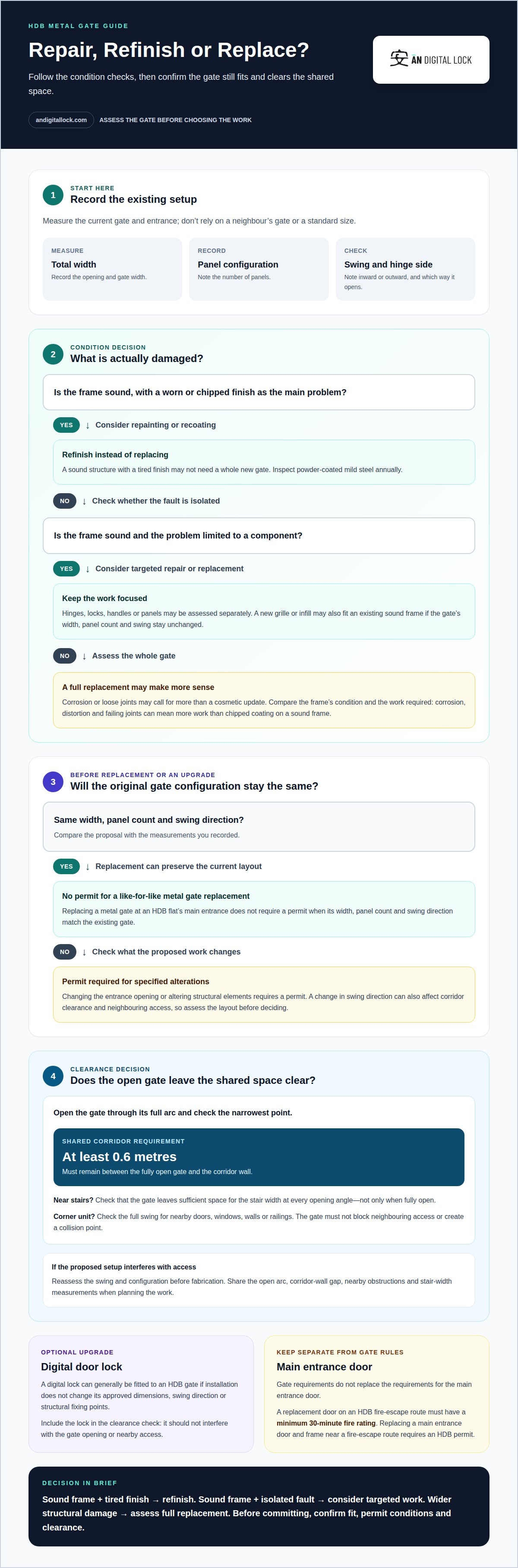
Replacing a metal gate at an HDB flat’s main entrance does not require a permit. If you install a replacement, it should match the existing gate’s width, panel count and swing direction. Changing the entrance opening or altering structural elements requires a permit, so alternatives to replacing the entire HDB gate may be worth considering first.
A worn finish or a minor fault doesn’t always mean the whole gate needs replacing. The right option depends on what’s damaged, whether the gate opens and closes properly, and how much clearance it needs in the corridor. This guide explains how to assess repainting or recoating, compare partial upgrades with replacement, and evaluate costs. You’ll also learn what to measure, how swing direction affects your options, and when a full replacement may make more sense. Start with the gate’s condition and fit, then weigh each alternative against your home’s needs.
Key Takeaways
- Before choosing a replacement or upgrade, record your gate’s width, panel count and swing direction so the new setup preserves its existing fit.
- Assess how the gate opens into the shared corridor and whether its swing affects access near a staircase or fire-escape route.
- Compare the condition of the frame and individual components with the work required, then weigh a targeted repair against replacing the whole gate.
- For a gate with a sound structure but a tired finish, consider whether repainting or recoating could address the problem; inspect powder-coated mild steel annually.
- Review upgrade choices alongside your entrance needs, including whether a digital door lock is a suitable addition to your gate setup.
1. Matching the original gate's width, panel count and swing direction
In Singapore, a replacement HDB gate should match the existing gate’s width, number of panels and swing direction. Keeping these features unchanged means replacing the gate without changing the entrance opening. A metal gate replacement at an HDB flat’s main entrance does not require a permit when those dimensions and the swing remain the same. Measure carefully before choosing a replacement or considering a smaller upgrade.
Measure the opening and current gate rather than relying on a neighbour’s gate or a standard size. Record the total width, panel configuration and hinge side. Note whether the gate swings inward or outward and which way it opens. Provide these details when planning the work so the proposed gate can be compared with the existing setup. A change in width, panel count or swing direction may affect compliance and corridor clearance.
Keep the original swing direction unless the layout makes that impossible. For example, changing an inward-swinging gate to open outward can affect the shared corridor. A corner-unit entrance needs particular care: the open gate may meet a neighbouring door, window or wall. Open it through its full arc and note any obstruction before deciding on a different direction. The gate must not block neighbouring access or create a collision point.
Can a new gate grille or infill be fitted into an existing HDB gate frame? Yes, if the frame is sound and the new grille or infill can be secured without changing the gate’s width, panel count or swing. A mild steel frame with corrosion or loose joints may need more than a cosmetic update, so assess its condition before choosing an infill.
Replacing a gate and replacing a main entrance door are separate decisions. In Singapore, a replacement door on an HDB fire escape route must have a minimum 30-minute fire rating. Don’t assume that gate changes satisfy door requirements, or that a gate itself carries the door’s fire rating.
How do I find a reliable HDB gate repair contractor in Singapore? Look for a contractor in HDB’s Directory of Renovation Contractors, then explain the existing width, panel count, swing direction and proposed work. Clear measurements help assess whether a targeted repair can retain the original configuration.
Before committing, compare the existing gate with the proposed work: width, panels, hinge side and opening direction. If those details stay unchanged, a new grille or suitable component repair may preserve the current layout without replacing the entire gate.
2. Corridor clearance and fire-escape considerations
Before fabrication, measure the gate’s open position against the shared corridor. For an HDB flat along a shared corridor, the open gate must leave at least 0.6 meters between the gate and the corridor wall. Measure with the gate fully open, not just while it is closed. A replacement that fits the entrance can still obstruct the corridor if its swing uses too much space.
Check the full arc of movement. Open the gate slowly and note where its edge travels, from fully closed to fully open. Record the narrowest clearance and any nearby obstruction, such as a wall, railing or neighbouring entrance. Share those measurements before fabrication so the proposed design can be assessed against the actual corridor layout.
A staircase needs a separate check. For an HDB flat next to stairs, the open gate must leave sufficient space for the stair width at every opening angle. Test its movement through the full arc: a position that clears the stairs when fully open may still narrow the stairway halfway through the swing. Don’t assess clearance at only one angle.
Corner layouts also call for careful measurement. A gate may clear the corridor wall but swing into a neighbouring door or window. Note the positions of those features and check whether the gate’s handle or edge could hit them. If you’re considering a different swing direction, assess its effect on the shared corridor and stair access before changing the layout.
Keep the gate’s requirements separate from those for the main door’s fire-escape route. Replacing an HDB main entrance door and frame near a fire-escape route, such as a lift lobby or staircase, requires an HDB permit. Some units along an escape route also have specific requirements for the main door and frame, separate from the gate. A compliant gate doesn’t establish that a door replacement meets those separate requirements.
A digital lock can generally be fitted to an HDB gate if installation doesn’t change its approved dimensions, swing direction or structural fixing points. Include the lock in the clearance assessment: it shouldn’t interfere with the gate’s opening or nearby access. Measure the steel gate in its installed position rather than judging its fit by appearance alone.
Use a simple record before finalising any work: note the gate’s open arc, the corridor-wall gap, nearby doors or windows, and stair width. These checks help identify whether a targeted adjustment can address the problem, or whether the gate’s configuration needs reconsideration. For a replacement option, compare designs of metal gates against your measured entrance and corridor layout.
3. Gate upgrade costs
Compare the scope of work, not just the quoted total. A repair may address a loose hinge or damaged latch, while refurbishment may involve surface preparation and a new finish. Full replacement includes a new gate and installation. For example, a gate with a sound frame but chipped coating may need less work than one with corrosion, distortion and failing joints. The frame’s condition is often the key cost factor because it determines whether smaller repairs will suffice.
Break down each option before deciding. List the materials, labour, removal of old components and installation work included in each proposal. Compare like with like: a repaint should not be compared directly with a replacement that includes a new frame. Measure the opening and record the gate’s panels and swing direction. Those details help define the work and avoid comparing costs for an unsuitable gate.
What are the pros and cons of repairing, refurbishing, or replacing an HDB gate? Repair usually targets a faulty component, while refurbishment can improve the finish of a usable gate; both retain more of the existing structure. Replacement provides a new gate but involves broader work and installation.
Homeowners should also account for compliance-related work. Changing the entrance opening’s size or shape, widening it, or altering structural elements requires a permit under the described HDB renovation guidance. That work can add steps beyond a like-for-like gate replacement. Keep gate costs separate from main-door costs: a replacement door on an HDB fire escape route must have a minimum 30-minute fire rating. A digital lock fitted to an HDB fire-rated door should have a Certificate of Conformity to SS 332/EN 1634-1.
When is repairing an HDB gate unsafe or not worth the cost? If the frame is badly corroded, warped or no longer holds its components securely, a surface repair won’t address the underlying problem. If several parts keep failing, compare the combined repair work with the scope of replacing the gate.
Before choosing, describe the fault, identify the parts that need work and note whether the frame remains sound. For each option, specify what installation includes and whether disposal or adjustments are part of the work. A repair that leaves a poor fit or unresolved structural damage can lead to further work; broader replacement may be more suitable for extensive deterioration.
Match the proposed work to the entrance. Check that the gate fits the opening and retains the required configuration. If a door, frame or fire-escape route is involved, account for its rating and certification requirements in the renovation plan. This makes cost comparisons more useful: weigh the immediate work against fit, safety and compliance rather than choosing solely by the smallest initial scope.
4. Can an HDB gate be repainted, polished, or re-coated instead of replaced?
Yes, repainting or recoating can refresh an HDB gate when its frame, joints and moving parts remain sound. These options address surface wear, such as faded paint or small chips, without requiring a new gate. Polishing may improve suitable surfaces, but it won’t repair corrosion, loose joints or a gate that no longer closes properly.
Start by inspecting the entire gate. Check the frame, panel edges, hinges and joints, and note whether damage is limited to the coating or has reached the metal. A small paint chip on an otherwise sound mild steel panel calls for a different response than rust around a joint or a frame that has begun to warp.
For powder-coated mild steel, inspect the gate annually and touch up chips to prevent rust at exposed points. Check edges and connections as well as broad, flat surfaces. A chip left untreated exposes the metal beneath the coating, so timely touch-ups can help protect those areas. Keep a simple record of inspections and treated spots.
Repainting and recoating focus on the gate’s finish, but preparation matters. Remove loose or flaking coating and address exposed areas before applying a new finish. Painting over loose material can produce an uneven result without addressing the surface underneath. If coating damage is widespread, assess the full surface rather than treating only the most visible patch.
Polishing is better suited to surface marks that don’t involve failing paint or damaged metal. Identify the gate’s material and finish, then choose a method suitable for that surface. Abrasive treatment can affect a coating, so don’t assume a method suitable for one metal gate will suit another finish. Test a discreet area before working across a visible panel.
A quality powder-coated mild steel or marine-grade stainless steel gate in Singapore can last 15-25 years without significant maintenance when properly fabricated. That figure is not a reason to ignore damage: check whether the frame remains secure and the gate still opens and closes correctly. Finish work won’t restore structural strength or correct a distorted frame.
Choose surface restoration when the problem is cosmetic and the gate’s structure and operation remain sound. If corrosion reaches important joints, panels are loose or the frame is distorted, repainting alone won’t resolve the fault. Compare the work needed to restore the gate with targeted repairs or replacement. A sound frame with isolated chips may need only careful touch-ups.
5. Can HDB gate hinges, locks, handles, or panels be repaired or replaced separately?
Yes, a single faulty component may be repairable without replacing the whole gate. First identify whether the problem is isolated or caused by another part. For example, a latch that won’t meet its catch may be caused by a loose handle, misaligned lock or gate sagging on its hinges. Fixing only the visible symptom may leave the underlying issue unresolved.
Check the hinges by opening and closing the gate slowly. Look for looseness, uneven gaps, scraping or a panel that drops as it moves. Adjusting or replacing a hinge may suit a gate with a sound frame and secure fixing points. If the surrounding metal is corroded or the hinge has pulled away from the frame, replacing the hinge alone may not restore a firm attachment.
For a lock or handle problem, note what happens during operation. Does the handle move freely while the latch stays put? Does the lock work when the gate is open but bind when closed? These details help distinguish a faulty mechanism from misalignment between the gate and frame. A digital lock can generally be fitted to an HDB gate if it doesn’t change approved dimensions, swing direction or structural fixing points.
A damaged panel may also be replaceable separately, depending on how it connects to the frame. Compare its size, attachment points and position with the existing gate. A replacement that changes the gate’s width, number of panels or swing direction may not preserve the original configuration. A new grille or infill should fit securely without weakening the frame or interfering with movement.
Before arranging component work, record the fault and inspect the entire gate. Note rust around joints, movement at the hinges, uneven panel gaps and whether the latch aligns. Then test the gate through its full opening and closing movement. This helps show whether one component is failing or several connected parts need attention.
Separate repairs make the most sense when the frame remains stable and the fault is limited. If several parts are worn, a panel is loose and the frame is distorted, compare the combined repair work with replacing the gate. Repeatedly adjusting a gate that keeps dropping may leave the underlying hinge or frame problem unresolved.
Keep changes within the existing gate configuration. Replacing a lock or handle should not alter the gate’s approved dimensions, swing, or structural fixing points. For a digital lock that fits those conditions, compare digital lock options for your entrance.
AN Digital Lock: Digital Door Locks
AN Digital Lock offers Digital Door Locks for homeowners considering an access upgrade alongside gate repairs. If the gate’s frame and panels remain usable, a digital lock may be a more focused change than replacing the entire gate. It can generally be fitted to an HDB gate if installation doesn’t change approved dimensions, swing direction or structural fixing points.
Assess the gate’s condition and opening first. If it’s stable and operates smoothly, a digital lock may suit your entrance needs. If the frame or panels are damaged, include the gate itself in your decision.
Contact AN Digital Lock or visit andigitallock.com to explore Digital Door Lock options.
Make your next entrance upgrade a considered one
Before planning work, decide what you want your entrance to do better: look refreshed, operate smoothly or support a different access routine. That priority can help you choose among alternatives to replacing the entire HDB gate without expanding the work beyond your needs. If the existing structure remains suitable, focus on the specific change that would make daily use easier.
If you’re planning a broader entrance update, AN Digital Lock offers Metal Gates, Wooden Doors and Digital Door Locks. Consider how each choice fits your home as a whole, rather than treating the gate, door and lock as unrelated purchases. A clear plan helps you move from a repair decision to an upgrade suited to your entrance and everyday routine.
Ready to discuss the right options for your home? Contact AN Digital Lock to discuss options. Take the next step with a clear idea of what you want to improve, and make your entrance work better for you.
Frequently Asked Questions
Do I need an HDB permit to replace my metal gate in Singapore?
Usually, no. Replacing an HDB main entrance metal gate doesn’t require a permit if the replacement keeps the existing width, panel count and swing direction. This doesn’t cover changes to the entrance itself: widening or reshaping the opening, or altering structural elements, requires a permit. Keep the gate’s configuration unchanged and assess its position against the corridor before ordering.
Can I install a digital lock on my new HDB metal gate?
Generally, yes, if fitting the lock doesn’t change the gate’s approved dimensions, swing direction or structural fixing points. Before choosing a lock, measure the space between the door and gate, as well as clearance around the gate handle. A lock body or handle that clashes with the main door can prevent the gate from closing properly, even if the lock itself fits.
What Are HDB Door and Gate Regulations?
HDB building-works renovation guidelines cover replacement of a flat’s main door, internal door and front gate. A replacement door on a fire escape route must have a minimum 30-minute fire rating. Keep the unit number clearly visible on the gate, including on a full-panel privacy gate. These requirements concern different parts of the entrance, so assess the gate and main door separately.
What are alternatives to replacing an entire HDB gate in Singapore?
Practical alternatives to replacing the entire HDB gate include repainting a sound gate, touching up coating chips, or repairing a faulty hinge, handle, lock or panel individually. A replacement grille or infill may also suit an existing frame that remains sound. Start by identifying the actual fault: a stiff latch, for instance, may need adjustment rather than a new gate if the frame and hinges remain secure.
How much does it cost to repair or refurbish an HDB gate in Singapore?
The cost depends on the work required, the gate’s condition and whether parts or surface treatment are involved. A small hinge adjustment differs from replacing a damaged panel or treating widespread corrosion. Compare quotes by scope, listing labour, materials, preparation and replacement components separately. This lets you compare similar work and decide whether a focused repair makes sense alongside broader refurbishment.
What HDB rules apply to repairing or modifying a flat entrance gate?
For a gate replacement, retain its existing width, panel count and swing direction to avoid changing the approved configuration. Changing the entrance opening’s size or shape, widening it or altering structural elements requires a permit under the described HDB renovation guidance. For a repair, identify whether the work affects only a component or changes the structure or opening. That distinction helps define the appropriate scope.
Do HDB gate repairs or replacements require approval from HDB or the town council?
A like-for-like replacement of the main entrance metal gate doesn’t require an HDB permit when its width, panel count and swing direction remain unchanged. Work that changes the entrance opening or structural elements requires a permit. HDB’s building-works renovation guidelines cover front-gate replacement; use those criteria to assess the work. Town-council involvement is not a substitute for an HDB permit when one is required.