


Practical security solutions for single parents in Singapore can start with easing household costs and finding direct family support. The Ministry of Social and Family Development and Community Development Councils offer assistance, and Singapore residents can call the ComCare Hotline on 1800-111-2222 daily from 7am to 12 midnight.
Managing expenses while caring for a child alone can feel like a constant balancing act. The support available depends on your circumstances, so it helps to know where to start and which costs may be covered. This guide covers two practical routes: using eligible child-related support to reduce out-of-pocket expenses, and seeking direct assistance when your household needs more help. It also explains how to make home-security decisions with safety and affordability in mind, without assuming every option suits every family. Start with support that fits your situation, then consider practical ways to secure your home.
Key Takeaways
- Explore family and counselling support that may ease pressure at home, including online counselling eligibility for adults with a Singapore family connection.
- Look into assistance from the Ministry of Social and Family Development and Community Development Councils, and consider how it may support your household needs.
- Build a simple safety plan with trusted neighbours, clear routines for children, and updated home access after a relationship ends.
- Decide which entrance-security measures fit your home and budget, then explore Digital Door Locks, Wooden Doors, Metal Gates, or Safe Boxes as relevant.
3. How can single parents in Singapore find affordable home security systems?
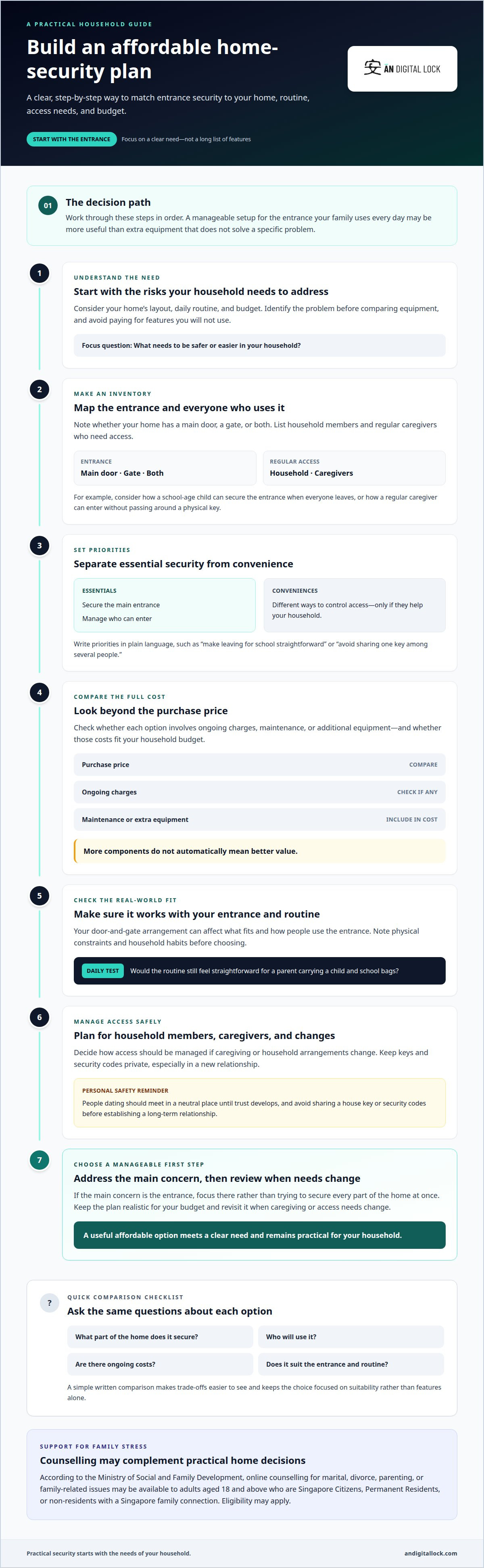
Affordable security solutions for single parents in Singapore begin with identifying the risks your household needs to address. Choose options that suit your home’s layout, daily routine, and budget, rather than paying for features you won’t use. Start with the main entrance, then consider other access points and how your household manages them.
Make a simple home-security inventory before comparing options. Note whether your home has a main door, a gate, or both, and list who needs regular access. For example, a parent with a school-age child may want a straightforward way to secure the entrance when everyone leaves. If a caregiver visits regularly, consider how to provide access without passing around a physical key.
Separate essential needs from optional conveniences. Essentials may include securing the main entrance and managing who can enter. Convenience features may offer different ways to control access. Write down your priorities in plain language, such as “make leaving for school straightforward” or “avoid sharing one key among several people.” This keeps the focus on practical value rather than a long list of features.
Compare the full cost, not just the purchase price. Consider whether an option involves ongoing charges, maintenance, or additional equipment, and whether those costs fit your household budget. More components do not automatically mean better value. A focused setup for the entrance your family uses every day may be more useful than equipment that adds expense without meeting a clear need.
Consider your existing entrance before choosing a system. A home’s door and gate arrangement can affect what fits and how residents use the entrance. For a parent carrying a child and school bags, a simple routine may matter more than extra steps at the door. Note physical constraints and household habits so your choice supports daily life rather than complicating it.
Account for everyone who needs access. List household members and regular caregivers, then decide how access should be managed if arrangements change. Keep keys and security codes private, especially in a new relationship. People dating should meet in a neutral place until trust develops and avoid sharing a house key or security codes before establishing a long-term relationship.
Support for family stress can complement practical home decisions. According to the Ministry of Social and Family Development, Singapore adults aged 18 and above who are Singapore Citizens, Permanent Residents, or non-residents with a Singapore family connection may be eligible for online counselling for marital, divorce, parenting, or family-related issues. Counselling can provide a place to discuss family concerns that affect routines and access arrangements.
Use the same questions to compare each option: What part of the home does it secure? Who will use it? Are there ongoing costs? Does it suit the existing entrance and household routine? These questions help you focus on suitability rather than features alone. A simple written comparison also makes the trade-offs easier to see.
Choose a manageable first step. If the main concern is the entrance, focus on that rather than trying to secure every part of the home at once. Keep the plan realistic for your budget and revisit it when caregiving or access needs change. An affordable option is useful when it addresses a clear need and remains practical for your household.
5. Are there Singapore government grants or subsidies for home security or caregiving support?
In Singapore, the Ministry of Social and Family Development and Community Development Councils offer assistance to single parents. Start by grouping your household’s needs into clear categories: essential expenses, caregiving support, and home safety. This makes it easier to explain what help you need and ask which forms of assistance may apply. Don’t assume that support for family needs covers security equipment.
Prepare a short summary before approaching a support channel. Explain who lives in your household, your caregiving arrangement, and the specific pressure you’re facing. For example, describe whether a change in childcare affects your work, or whether an unexpected household expense has reduced the money available for essentials. Clear examples keep the discussion focused on your circumstances rather than a general request for help.
Ask directly what the assistance covers. Find out whether it addresses caregiving, basic household expenses, or another immediate need. If you’re considering a security purchase, explain the safety concern separately and ask whether the assistance applies to it. This helps avoid assuming that a general support programme covers home-security equipment.
For urgent financial concerns, Singapore residents can call the ComCare Hotline at 1800-111-2222, which operates daily from 7am to 12 midnight. Explain the pressure point, such as childcare arrangements affecting work or a household expense disrupting the budget. Mobile callers to 1800 service lines may incur airtime charges. Keep the concern specific so the conversation can focus on the kind of assistance relevant to your situation.
Caregiving support and home security address different needs, even when both affect daily life. A caregiver may help with supervision or routines; entrance security concerns who can access the home. Write down which challenge needs attention first. For example, describe a need for after-school care separately from a concern about who can enter your home.
Before making a decision, record the next step offered by the support channel, the information it requests, and any follow-up date. Keep copies of documents that help explain your circumstances, but share personal details only through the appropriate channel. If the next step concerns caregiving, note who will care for your child and when. If it concerns finances, list the expense causing pressure.
Keep a simple record to avoid confusion. Note the support need, the organisation contacted, the guidance received, and any action you must take. For example, keep a discussion with a Community Development Council about family assistance separate from a future enquiry about entrance security. This helps you track applications without assuming one type of support covers another.
Keep the security decision within a manageable household budget while you explore assistance. Prioritise the entrance or access concern that affects everyday safety, and avoid adding expenses that don’t address that concern. If you’re weighing practical ways to secure a home entrance, review home entrance security options alongside your household priorities. That keeps the support discussion and the equipment decision distinct, while helping you plan each step clearly.
If the main concern is emotional or family support, Singapore’s NCSS Single-Parent Programme provides family casework and counselling, support groups, programmes for children, and public education to support the psycho-emotional well-being of single-parent families. These are forms of family support, so ask the relevant organisation what help is available for your circumstances rather than assuming the programme pays for security equipment. AWARE launched the #asinglelove public campaign in 2016 to bring single-parent families’ stories into public view and provide back-to-work support. Its divorce-related support group is currently closed, so check whether another suitable support option is available.
Housing support has separate eligibility rules. Singapore’s debarment rule for purchasing subsidised housing was amended after AWARE’s housing advocacy, but unmarried parents in Singapore are eligible for subsidies only for two-room flats in non-mature estates. This housing support is separate from grants for home security or caregiving. If your priority is reducing household costs, smart thermostats and lights can help manage energy use; treat them as household technology rather than assuming they qualify for a subsidy. When speaking with a support channel, distinguish caregiving or family support from the cost of security equipment, and ask whether the assistance covers the specific item or service you need.
4. How can single parents in Singapore create a home emergency and personal safety plan
Make a written plan for the home, your child, and trusted contacts. Choose a clear meeting point outside the home, such as a familiar neighbour’s door. Tell your child which adult to approach if you’re delayed. Keep the plan accessible and explain it calmly, using age-appropriate language. For example, practise how to call a trusted relative after arriving home from school.
Include home access in your safety plan. If a relationship ends on bad terms, update locks and access settings. Review who has keys or security codes, and remove access that is no longer appropriate. Don’t share new codes in group chats or leave keys in predictable places. If a caregiver needs access, agree on a private method and explain when it may be used.
Set a routine for times when the home is empty. Where practical, adjust schedules, arrange a regular babysitter when needed, or teach children to close blinds and lock doors. A child who returns before a parent can follow a simple routine: enter, secure the door, and contact the parent. Keep instructions consistent, and teach children not to open the door to unexpected visitors.
Choose two or more trusted people nearby, such as a neighbour and a close friend, who can keep an eye on the home or report suspicious activity. Share only what they need to know, such as when you expect to be away and how to reach you. Agree on a practical way to communicate concerns. A neighbour who notices someone repeatedly waiting near your entrance can alert you.
Protect your location details online. Avoid posting real-time updates that reveal when your home is empty, and review who can see location-tagged photos. Even a school-pickup picture can reveal routines without showing an address. Share family updates after leaving the location, and ask relatives not to post your child’s daily schedule publicly. These steps limit unnecessary exposure.
Prepare emergency contacts in one place. Include the child’s caregiver, a trusted relative, and a nearby friend. Make sure your child knows how to reach at least one adult without relying only on a parent’s phone. Singapore residents can contact the National Anti-Violence and Sexual Harassment Helpline at 1800-777 0000, which operates 24 hours a day. Save the number in your phone and keep it accessible to another trusted adult.
Plan for likely disruptions, not just emergencies. If you’re delayed, decide who can collect your child and how your child will know. If your child loses a key or cannot get inside, identify a safe adult to contact rather than waiting alone outside. Keep instructions brief and practise them together. Revisit the plan when caregiving arrangements, school routines, or trusted contacts change.
For a final review, walk through the entrance routine with your child and check that each step is understandable. Confirm that the trusted neighbour knows how to reach you, and remove outdated contacts from the plan. For added support in thinking through home access, review practical home access options as part of your safety plan.
Agree in advance on what your child should do if you’re delayed and which trusted adult to contact. Keep the steps simple: secure the home, contact you, and use the agreed backup contact if you cannot be reached. Make sure the adult knows what help may be needed, and keep the child’s instructions consistent with the home routine. Update the plan when caregiving arrangements or schedules change so your child is not relying on outdated instructions. Calm practice can make the steps familiar without making your child feel responsible for handling an emergency alone.
Treat privacy as part of your safety plan. Limit personal details and location sharing on social media, as posts can reveal when your home may be vulnerable. Avoid sharing routines or updates that show when your child is home without you, and ask family members to respect the same boundaries. When the home is unattended, reduce risks by adjusting schedules where practical, arranging a regular babysitter, or teaching children to close blinds and lock doors. Choose an approach suited to your child’s age and household routine, then explain it clearly. A predictable plan and careful online sharing can reduce avoidable exposure and make daily arrangements easier to follow.
AN Digital Lock
AN Digital Lock offers home entrance products to suit your household’s security priorities. If your plan identifies the main entrance as a concern, consider Digital Door Locks, Wooden Doors, or Metal Gates, depending on your home. A Safe Box can provide a dedicated place for important belongings. The right choice depends on your entrance and what you need to secure, so focus on practical fit rather than products that do not address your concerns. After mapping access needs, routines, and budget, contact AN Digital Lock to discuss the options that may suit your home.
Make your next home decision with confidence
Your home’s needs may change as your child grows, caregiving arrangements shift, or routines evolve. Revisit who needs access and whether your entrance still suits everyday use. This gives you a practical starting point when considering security solutions for single parents in Singapore, without taking on features that don’t match your priorities.
For entrance-related needs, AN Digital Lock offers Digital Door Locks, Wooden Doors, and Metal Gates. Consider how your current entrance works for your household, then focus on the change that would make daily access more manageable. A decision grounded in your routine can keep your next step clear and relevant.
When you’re ready to explore options for your home, contact AN Digital Lock. Take the time to choose what fits your household, and move forward with a plan that supports a more secure and comfortable home.