


Tired of fumbling for your house keys, especially after a long day? You’ve seen modern digital locks that open with a simple tap, but you might be wondering: is that small rfid tag really secure enough for my HDB or condo? The technology can seem complex, and questions about what happens if you lose a tag or which ones are compatible can feel overwhelming.
We're here to provide clear, straightforward answers. This guide is designed to demystify RFID technology and give you complete confidence in your home security. We'll explain in simple terms how it works, why it’s a trusted and reliable choice for thousands of Singapore homeowners, and how to easily set up and manage tags for your entire family.
Get ready to achieve a new level of keyless convenience. Learn how to unlock your door with just a tap and gain the ultimate peace of mind that comes with a secure, modern home.
What is an RFID Tag? Your Key to Effortless Entry
Think of an RFID tag like your EZ-Link card, but for your front door. It’s the simplest, most reliable way to unlock your world. This technology offers a straightforward 'tap-and-go' solution that provides instant access without the fuss of traditional keys, PIN codes, or even your smartphone.
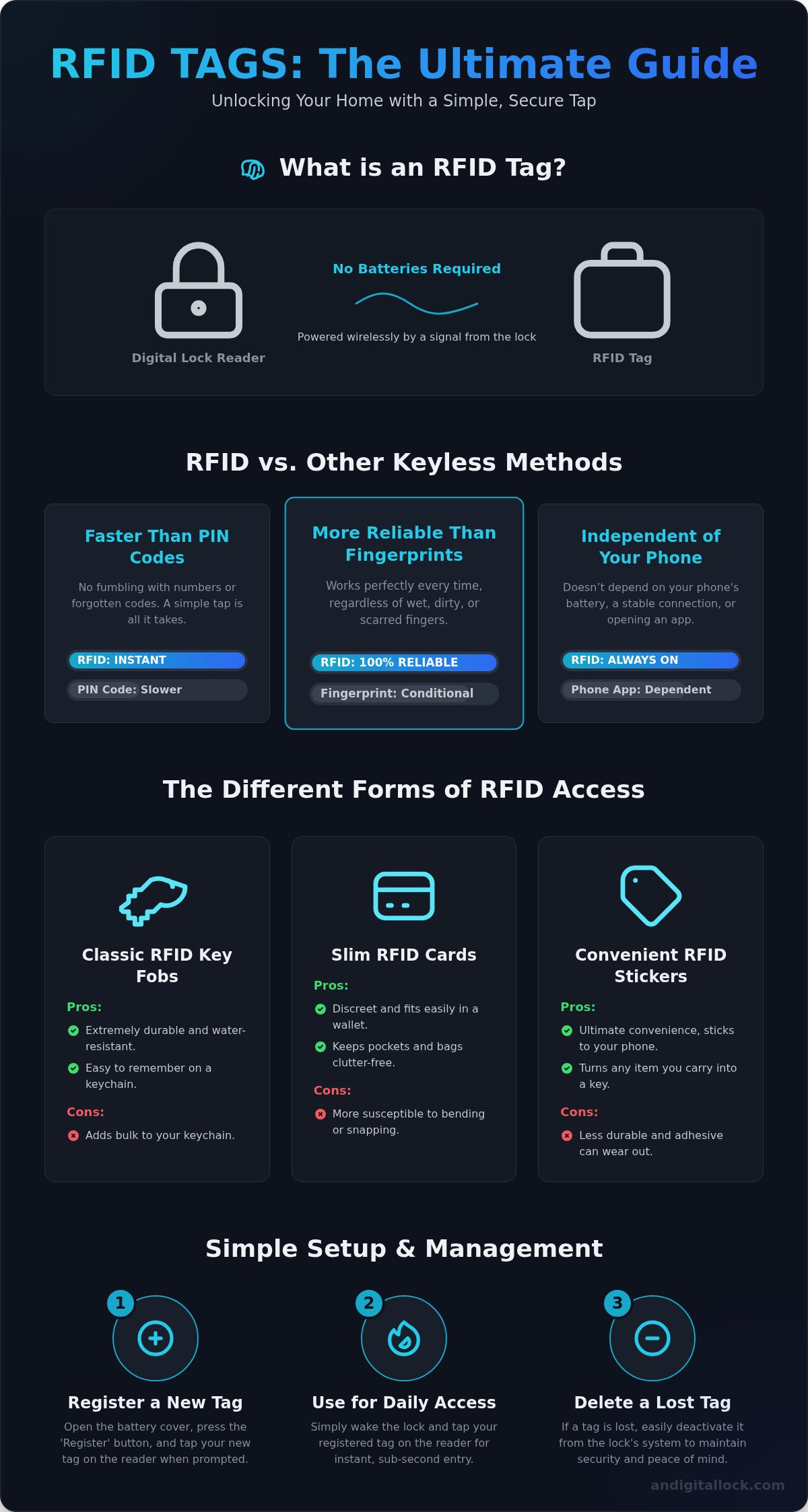
The system works with two core components: the rfid tag itself (which can be a card, sticker, or key fob) and the reader, which is seamlessly integrated into your digital lock. The most brilliant part? The tag requires no batteries. It is powered wirelessly by a signal from the lock whenever it comes close, ensuring it's always ready to grant you access. This makes it a truly hassle-free experience for securing your Singapore home.
The Technology Behind the Tap
Inside every RFID tag is a tiny microchip storing a unique digital identity and a small antenna. When you tap the tag against your digital lock, the reader emits a low-power radio wave. This wave energises the tag just long enough for it to transmit its unique ID back to the reader. This sophisticated process, known as Radio-frequency identification (RFID), completes a secure 'digital handshake' in milliseconds, granting you instant and seamless entry.
RFID vs. Other Keyless Methods
While digital locks offer multiple access methods, the RFID tag stands out for its unmatched simplicity and reliability. It’s the perfect blend of modern security and effortless convenience.
- Faster Than PIN Codes: No more fumbling with numbers or worrying about forgotten codes. A simple tap is all it takes, which is perfect when you're carrying groceries or rushing into your HDB flat.
- More Reliable Than Fingerprints: Fingerprint sensors can sometimes struggle with wet, dirty, or scarred fingers. An RFID tag works perfectly every time, regardless of the conditions.
- Independent of Your Phone: Unlike Bluetooth or app-based locks, RFID access doesn’t depend on your phone's battery, a stable connection, or opening an app. It offers pure, uncomplicated reliability for your ultimate peace of mind.
The Different Forms of RFID Access for Your Home
When you hear the term rfid tag, you might picture a specific item, but it actually refers to a versatile technology, not a single shape. This flexibility is one of its greatest strengths for modern home security in Singapore. While the U.S. Department of Homeland Security explains how RFID technology is used for large-scale tracking, its application for your HDB or condo is focused on seamless, personalised access. Understanding the different forms helps you choose the most convenient option for every member of your family.
The best part? Most premium digital locks are designed to support multiple types, giving you the freedom to mix and match.
Classic RFID Key Fobs (Tags)
These are the small, durable plastic tags designed to live on your keychain. They are the most common form of RFID access and are built for the rigours of daily life. They offer a simple, tap-and-go experience that is incredibly reliable.
- Pros: Extremely durable and water-resistant. Since they are attached to your keys, they are easy to remember and hard to lose.
- Cons: Can add a little extra bulk to an already crowded keychain.
Slim RFID Cards
Designed to be the same size and shape as a credit card, these slim tags slip discreetly into any wallet, purse, or cardholder. They are a sleek and professional alternative to a traditional key or fob, perfect for those who prefer to travel light.
- Pros: Familiar format that is easy to store and carry. Very discreet and keeps your pockets or bag free of clutter.
- Cons: Can be forgotten if you switch wallets or bags, and they are more susceptible to bending or snapping than a robust fob.
Convenient RFID Stickers
For ultimate convenience, the RFID sticker is a small adhesive tag that can be attached to almost any object you carry. This turns your everyday items into a key for your front door, offering a truly hands-free way to secure your home.
- Pros: Stick it on the back of your smartphone, your staff pass, or another item you never leave home without.
- Cons: Less durable than plastic cards or fobs. The adhesive may wear out over time, and the sticker itself can get damaged, requiring replacement.
This versatility is why AN Digital Lock ensures our premium digital locks come with a variety of access tags to suit your lifestyle.
How to Set Up and Manage RFID Tags on Your Digital Lock
One of the best features of a modern digital lock is the seamless convenience of an RFID tag. Getting your new tags set up is a simple, hassle-free process that requires no technical expertise. While the exact steps can vary slightly between brands like Philips, Samsung, or Kaadas, the core process is designed to be user-friendly. This guide provides a clear overview of the three main tasks you'll need to master: adding, using, and deleting tags for ultimate peace of mind.
Step 1: Registering a New RFID Tag
Pairing a new tag with your lock takes just a few moments. Follow these simple steps to grant access:
- Locate the Registration Button: First, open the battery cover on the interior side of your digital lock. You will typically find a small button labelled “REG,” “Register,” or “Settings.”
- Follow the Prompts: Press the registration button. Your lock will provide audio or visual prompts to guide you into pairing mode.
- Tap to Pair: When prompted, simply tap your new card, sticker, or key fob on the designated RFID reader area on the front of the lock (often marked with a card icon).
- Confirm Success: The lock will usually beep or provide a voice confirmation. Test the tag by locking the door and using the newly registered tag to unlock it.
Step 2: Using Your Tag for Daily Access
This is the easy part. Accessing your home or office has never been more convenient. Simply wake the lock by touching the keypad or sensor area, then tap your registered rfid tag on the reader. The lock instantly verifies the tag’s unique ID and unlocks the door in under a second, giving you quick and secure entry.
Step 3: Deleting a Lost or Stolen Tag
If a tag is ever lost or stolen, it is crucial to delete it from your lock’s memory immediately to secure your property. Unlike a lost physical key, a lost tag’s access can be revoked instantly. This is a major security advantage that directly addresses many common RFID security and privacy concerns by giving you full control.
For most digital locks, the safest method is to delete all registered tags at once and then re-register only the ones you still have. This single action ensures the lost tag is permanently disabled and can no longer be used, keeping your home secure.
Are RFID Tags Secure? Debunking Common Home Security Myths
For many Singaporean homeowners, the biggest question about digital locks is security. You want convenience, but not at the expense of safety. A common concern is whether an RFID tag can be "skimmed" or copied, giving intruders easy access. While this is a valid question, modern technology has made RFID access one of the most secure options for your HDB or condo.
Let's debunk the myths and show you how a premium digital lock offers superior protection and peace of mind.
Myth: 'RFID Tags Can Be Easily Copied'
While basic, low-frequency RFID cards used for simple inventory can be copied, the technology in today's digital locks is far more advanced. Trusted brands like Samsung, Philips, and Kaadas use sophisticated encryption. Your tag and lock perform a secure, dynamic "handshake," sharing a secret code that is virtually impossible for outsiders to clone. This ensures that only your authorized rfid tag can unlock your door.
Lost Tag vs. Lost Key: Which is Safer?
Misplacing your access credential is stressful, but how you resolve it makes all the difference. Consider the two scenarios:
- A Lost Traditional Key: You face an immediate security risk. The only solution is to call a locksmith to change the entire lock cylinder, a process that is both inconvenient and costly, often running into hundreds of dollars.
- A Lost RFID Tag: You remain in complete control. Simply access your digital lock's admin settings and instantly deactivate the lost tag from its memory. The tag becomes useless in seconds. You can then register a new one at minimal cost, restoring full security without any hassle.
Enhancing Security with Multi-Factor Authentication
For the ultimate peace of mind, many premium digital locks offer a 'dual verification' mode. This feature requires two forms of authentication for entry-for example, tapping your RFID tag and entering a PIN code. It’s an ideal setting for when you're away on holiday or simply want an extra layer of robust protection for your family.
Ready to upgrade to a smarter, more secure home entrance? Find a secure digital lock with advanced RFID protection today.
Embrace Smarter, Safer Access with RFID Technology
In summary, RFID technology offers a powerful blend of convenience and robust security for the modern Singaporean home. It simplifies your daily routine by providing a truly keyless solution, and with today's advanced encryption, you can confidently debunk the myth that it's insecure. Upgrading your home is no longer just about strength, but about seamless, intelligent access.
Ready to experience this for yourself? Choosing the right digital lock with a reliable rfid tag is the first step towards a smarter home. As the trusted supplier for countless HDB and condo homes, backed by over 3,700+ 5-star customer reviews, AN Digital Lock is here to ensure a hassle-free experience. We provide free installation and dedicated after-sales support to give you ultimate peace of mind.
Shop our range of secure digital locks with RFID access and unlock a new level of convenience for your family today.
Frequently Asked Questions About RFID Tags
Can I use any brand of RFID tag with my digital lock?
For optimal security and seamless performance, it is highly recommended to use the RFID tag provided by your digital lock's manufacturer, such as Philips or Samsung. Different brands often use specific frequencies and proprietary encryption. Using an incompatible or third-party tag can lead to functionality issues and may compromise your home's security. To ensure a hassle-free experience and maintain your warranty, always use genuine, brand-specific accessories for your HDB or condo.
How many RFID tags can I register to a single digital lock?
The number of RFID tags you can register depends on the specific model of your digital lock. Most premium digital locks from trusted brands like Kaadas and Philips can support anywhere from 20 to 100 registered tags, making them ideal for families and even small businesses. We advise checking your product's user manual for the exact capacity. For a personalised recommendation, our expert team is always ready to provide a free consultation.
Do RFID tags ever run out of battery?
No, the RFID tags used for digital door locks do not have batteries and will not run out of power. They are "passive" devices, meaning they are powered wirelessly by the signal from the digital lock's scanner when you tap it. This design ensures outstanding reliability and convenience, giving you one less thing to worry about. You can enjoy seamless, long-term access to your home without ever needing to charge or replace a battery.
What is the difference between RFID and NFC technology for door locks?
While both use radio waves, the key difference is their application and range. RFID (Radio-Frequency Identification) is a broader technology used with dedicated cards or fobs. NFC (Near Field Communication) is a specialised, short-range subset of RFID that allows devices like smartphones to act as secure keys. Essentially, an RFID card is a physical access tool, while NFC provides the convenience of unlocking your door with the phone already in your hand.
How much do replacement or additional RFID tags typically cost in Singapore?
In Singapore, the cost for a replacement or additional RFID tag for your digital lock typically ranges from S$10 to S$30 per piece. The price can vary depending on the brand, such as Samsung, Philips, or Kaadas, and the specific model of your lock. At AN Digital Lock, we offer genuine accessories to ensure perfect compatibility and security for your system. Contact our team for precise pricing and to ensure you get the right tag for your lock.
Can an RFID tag get damaged by water or being dropped?
Most RFID tags are designed to be durable. They are sealed in plastic, making them highly water-resistant and able to withstand rain or accidental splashes. While they are also built to survive everyday drops and impacts, a severe crack or significant physical damage to the internal chip and antenna can cause the tag to stop working. We always recommend handling them with reasonable care to ensure their longevity and your continued peace of mind.