


Imagine standing at your HDB corridor, balancing heavy groceries while digging for keys that have vanished into the bottom of your bag. It's a frustrating ritual that often leads to misplaced sets or locked-out family members. We agree that your home should be a sanctuary of ease, not a source of stress. Installing a fingerprint digital lock solves these pains by turning your unique biometric signature into the only key you'll ever need.
This guide will help you find the perfect biometric solution for your HDB or condo, ensuring your choice meets the mandatory SCDF Certificate of Conformity standards required for all Singapore installations since October 2024. We'll preview top-rated models from authorized brands like Zigbang and Philips, explain how to handle battery emergencies, and show you how to secure your entrance with a single, reliable touch. You'll learn exactly what to look for to ensure your family enjoys instant access and contemporary refinement without the fear of biometric failure.
Key Takeaways
- Understand why modern semiconductor sensors offer superior protection against 3D molds and photo spoofs compared to older optical technology.
- Learn how a fingerprint digital lock provides faster entry than keypads and allows you to monitor individual user profiles for better peace of mind.
- Navigate the complex SCDF Certificate of Conformity and fire-rating requirements to ensure your HDB or condo remains legally compliant.
- Determine whether a fingerprint or keypad system better suits your family's lifestyle by comparing speed, security, and ease of use.
- Master the basics of battery maintenance and professional installation to ensure your smart home setup remains functional and secure for years.
What is a Fingerprint Digital Lock and How Does It Work?
A fingerprint digital lock is a sophisticated biometric security device that replaces traditional metal keys with your unique biological identity. Instead of carrying a physical object that can be lost or stolen, you use the distinct patterns of ridges and valleys on your fingertip to gain entry. This technology has evolved rapidly in Singapore, moving from a niche luxury feature to a standard component of the modern smart home. Most premium models today store your encrypted biometric data locally on the device hardware. This localized storage ensures your privacy remains protected; your fingerprint information never leaves the lock to enter a vulnerable cloud network.
The evolution of this technology is driven by a need for both speed and ironclad security. In the past, biometric systems were often seen as temperamental or slow. However, the latest generation of locks has perfected the recognition process. They provide a seamless transition from the corridor to your living room. By choosing a biometric system, you're opting for a security method that ties home access directly to your person, which is far more secure than a shareable code or a physical key that anyone can use.
Semiconductor vs. Optical Sensors
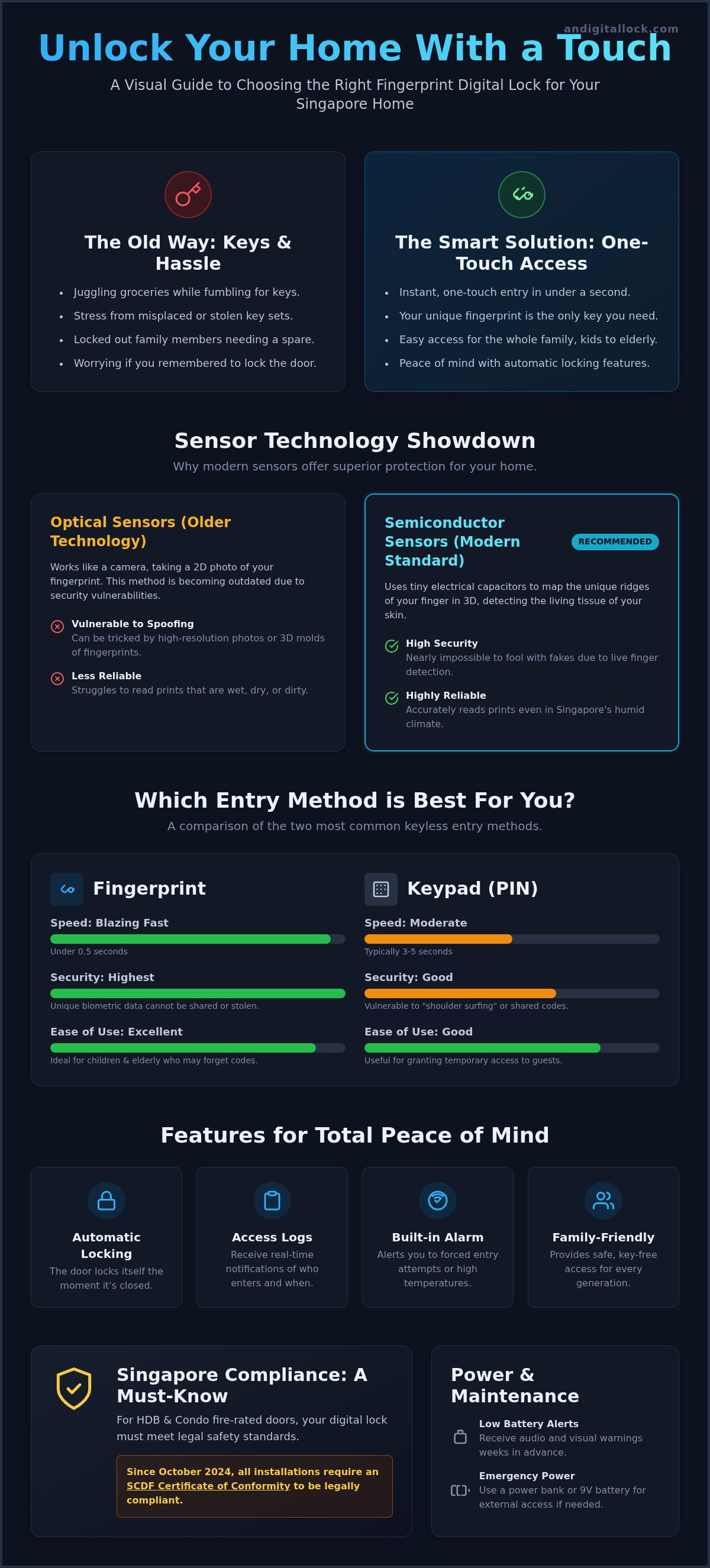
Early biometric locks relied on optical sensors. These sensors essentially take a high-resolution photograph of your finger to identify patterns. While they were revolutionary at the time, they have limitations in modern security. Optical sensors are more susceptible to spoofing with high-quality images or 3D molds. Understanding how fingerprint scanners work reveals why industry leaders like Zigbang, Philips, and Solity have shifted toward semiconductor technology.
Semiconductor sensors use tiny electrical capacitors to map your fingerprint in three dimensions. They detect the actual electrical charge of your skin, making it nearly impossible to trick the system with a fake replica. These sensors are also much more reliable in Singapore's humid climate. They can read prints accurately even if your hands are slightly damp or dry. At AN Digital Lock, we prioritize semiconductor sensors in our product range because they offer the highest level of residential safety for local families. They provide the peace of mind that only a true biological match can grant entry to your home.
The Convenience of One-Touch Entry
Traditional locks require you to find your keys, align them with the keyhole, and turn the cylinder; a process that takes several seconds and requires both hands. A fingerprint digital lock reduces this entire sequence to a single touch that typically takes less than half a second. This speed is a significant advantage for busy homeowners returning from the market with groceries or parents carrying sleeping children. The system is always ready, eliminating the stress of being locked out because you forgot a PIN or misplaced a keycard.
Biometric access is particularly beneficial for multi-generational HDB households. Elderly family members often struggle with the fine motor skills required for small keys or may find it difficult to remember complex PIN codes. Similarly, children are prone to losing physical keys or cards. Biometrics remove these hurdles entirely. When you upgrade your HDB main door with a fingerprint sensor, you're investing in a frictionless lifestyle. Everyone in the family carries their "key" with them at all times, ensuring safe and instant access for every generation.
Why Biometric Security is Superior for Home Protection
Biometric technology offers a level of security that traditional mechanical locks simply can't match. While a standard key is a static object that anyone can use, your fingerprint is dynamic and unique. Modern sensors in a high-quality fingerprint digital lock use live finger detection. This means they don't just look at the pattern; they sense blood flow and temperature. High-resolution photos or 3D molds fail these checks, rendering "spoofing" attempts useless. For added safety, these locks integrate directly with internal alarm systems. If someone tries to force the handle or if the sensor detects high temperatures from a fire, a loud siren sounds immediately to alert you and your neighbors.
One of the most reassuring features for busy Singaporean families is the automatic locking mechanism. We've all had that moment of panic halfway to the MRT station, wondering if the door is shut. These smart mortises detect when the door is closed and engage the bolts instantly. It's a simple feature that provides immense emotional relief. Beyond simple entry, these devices act as a digital concierge. They maintain a detailed access log. You can receive real-time notifications on your smartphone when your children return from school or when a visitor enters. This level of visibility transforms a simple door into an intelligent security gateway.
Eliminating the Risk of Lost or Stolen Keys
The vulnerability of a physical door lock singapore residents often overlook is key duplication. If a key is lost or borrowed, you have no way of knowing how many copies exist. Re-keying an entire home is expensive and time-consuming. Digital systems remove this risk entirely. You are the master administrator. If a part-time helper leaves or a child loses a physical backup tag, you can delete their access profile in seconds. This instant control ensures that only authorized individuals can cross your threshold. If you're ready to upgrade your security, you can explore our latest BTO and fire-rated bundles to find a system that fits your home's specific requirements.
Encrypted Data and Privacy
Privacy is a common concern for first-time buyers in the smart home market. It's vital to understand that top brands like Philips and Zigbang utilize local hardware encryption. Your biometric data isn't floating in a vulnerable cloud database; it's stored as a non-reversible mathematical code on a secure chip inside the lock itself. Even if the hardware was dismantled, your actual fingerprint image cannot be reconstructed. Managing these profiles is straightforward through a secure mobile app or the lock's internal menu. You can add temporary access for guests or remove old profiles with a few taps, keeping your home security current and tight at all times.
Fingerprint vs. Keypad: Which is Best for You?
Choosing between a keypad and a fingerprint digital lock often comes down to your family's daily habits. Keypads are a reliable, traditional choice, but they come with minor security risks. Over time, frequently used numbers can show physical wear or oily smudge marks, potentially hinting at your PIN to an observant stranger. Biometrics eliminate this "pattern trail" entirely. Your unique print is the only way in, making it nearly impossible for anyone to guess or mimic your access credentials. For a detailed breakdown of these two popular entry methods, check out our guide on Keypad vs. Fingerprint: Which Lock is Best? to see which fits your lifestyle.
While speed is a major factor, maintenance also differs between these technologies. Touchscreens require frequent wiping to remove fingerprints that can obscure the numbers. Biometric scanners are more localized. You only need to keep one small sensor clean rather than an entire glass panel. In terms of sheer ease of use, biometrics win for most active users. You don't have to worry about lighting conditions or remembering a six-digit code when you're tired. It's a more intuitive, modern way to manage your home's entrance.
The 'Dry Finger' Challenge
Biometric technology is excellent, but it does face specific hurdles in a multi-generational Singaporean household. Elderly residents or those with skin conditions like eczema may have "dry" or worn fingerprints that are difficult for basic scanners to read. This is a common pain point that many retailers fail to mention. To address this, we carry high-sensitivity sensors from brands like Solity and Hafele. These advanced units are designed to map even faint or peeling ridge patterns with high accuracy. For total peace of mind, we always recommend hybrid locks that feature both a fingerprint scanner and a physical keypad. This ensures that if the sensor ever struggles with a dry finger, your family has a reliable PIN backup to get inside instantly.
Hygiene and Durability
Many homeowners ask if sharing a sensor is hygienic. Because a fingerprint digital lock requires significantly less surface contact than a keypad, it's actually the cleaner option. You only touch one small point rather than multiple keys. To keep the sensor in top shape, simply wipe it with a dry microfiber cloth once a week. In Singapore's intense humidity, durability is also a concern. Sweat and moisture can degrade cheaper plastic sensors over time. We prioritize models with glass-capped sensors. These are far more resistant to scratches and chemical corrosion from skin oils. They maintain their scanning precision much longer than traditional scanners, even in the salty air of coastal condos or the humid corridors of HDB blocks.
Choosing the Right Lock for Singapore's HDBs and Condos
Finding the right fingerprint digital lock depends heavily on your specific residential type. For HDB dwellers, fire safety is the most critical factor. Since October 9, 2024, SCDF regulations require all digital locks installed in Singapore to carry a Certificate of Conformity (CoC). If you're installing a lock on a fire-rated HDB main door, the lock must have a fire-resistance rating that matches the door's 30 or 60-minute requirement. Failing to meet these standards can lead to insurance complications and safety risks.
Security starts with the internal mechanism. We recommend a high-quality mortise lock for the main entrance. Unlike rim locks that sit on the surface, a mortise is embedded within the door itself. This makes it significantly harder for intruders to bypass. When matching a lock to your door material, ensure the installer checks the door's thickness and the clearance between the door and the gate. Metal gates require ultra-slim designs to prevent the lock from hitting the main door handle; a common issue in older HDB layouts.
The Door + Gate Synchronized Bundle
Modern BTO owners are increasingly moving away from using multiple keys or even multiple scans. Synchronization technology allows you to unlock both your metal gate and your main wooden door with one single fingerprint scan. This "Dual Lock" experience is a game-changer for convenience. Top brands like Zigbang and Solity have perfected this communication between devices. You scan your thumb at the gate, and by the time you reach for the door handle, the main lock has already disengaged. It's a seamless, high-tech entry process that saves time and effort every single day.
Condo and Landed Property Considerations
For condo and landed property owners, aesthetics and environmental durability are the primary concerns. Premium models from Philips offer sophisticated finishes that match high-end designer doors. If your gate is exposed to the sun and rain, you must choose a fingerprint digital lock with a certified IP rating. An IP64 rating or higher ensures the delicate semiconductor sensor remains functional despite Singapore's heavy downpours and high humidity. Many of these premium units also support Zigbee or Z-Wave integration. This allows you to connect your lock to a smart home hub, giving you the power to monitor your entrance from anywhere in the world. You can view our full range of gate and door bundles to find the perfect aesthetic and technical match for your property.
Installation, Maintenance, and Emergency Access
Owning a fingerprint digital lock is about more than just the initial purchase; it's about ensuring long-term reliability. While many home improvement projects are suitable for DIY, installing a mortise-style digital lock isn't one of them. Mortise locks require deep, precise recesses carved into the door. A slight misalignment can cause the locking bolts to jam or drain the battery prematurely as the motor struggles to engage. Professional installers have the specialized jigs and routing tools to ensure a perfect fit every time. This precision protects your door's structural integrity and ensures the lock operates as the manufacturer intended.
Maintenance for these high-tech devices is surprisingly simple. To keep the biometric sensor responsive, follow these routine steps:
- Wipe the sensor once a week with a dry, lint-free microfiber cloth to remove skin oils.
- Check the door alignment every six months to ensure the strike plate hasn't shifted.
- Replace all batteries at once using high-quality alkaline brands; never mix old and new batteries.
- Listen for the low-battery audio prompt, which typically begins 2 to 3 weeks before the power is fully exhausted.
Most locks powered by standard AA batteries last between 10 to 12 months depending on your family's frequency of use. At AN Digital Lock, we back our products with comprehensive technical support and local warranties. Since 2013, we've built a reputation for being a helpful and supportive partner for Singaporean homeowners, ensuring your investment remains secure long after the initial setup.
What Happens if the Battery Dies?
The fear of being locked out due to a dead battery is a common concern, but modern technology has built-in failsafes. If you ignore the low-battery warnings and the lock loses power, you can use a 9V battery jump-start. Most locks have two metal contact points on the exterior. Simply hold a 9V battery against these points to provide temporary power, allowing you to scan your fingerprint and enter. Newer models from brands like Philips often include a USB-C emergency port, letting you use a standard power bank for a quick charge. Always keep your physical emergency keys in a safe location outside the home, such as your car or office, as a final backup.
Expert Installation by AN Digital Lock
Our team understands the specific requirements of the local market. We work closely with every major wooden door supplier singapore homeowners trust to ensure our locks fit seamlessly with your chosen door design. After the hardware is mounted, our technicians provide on-site training. We'll help you register your family's fingerprints and explain how to set up backup PIN codes. Choosing an authorized dealer like AN Digital Lock ensures you receive genuine products from Zigbang, Philips, or Solity, complete with a valid local warranty. This professional approach minimizes friction and gives you the peace of mind that your home's first line of defense is installed to the highest standards.
Upgrade to a Smarter, Safer Entrance
Transitioning to a fingerprint digital lock is more than just a tech upgrade; it's a commitment to your family's daily safety and convenience. You've seen how advanced semiconductor sensors eliminate the risks of lost keys and how localized encryption keeps your biometric data private. Whether you're moving into a new BTO or upgrading your current condo, choosing a fire-rated, SCDF-compliant model ensures you stay on the right side of Singapore's regulations while enjoying a frictionless lifestyle.
As an authorized dealer for Zigbang, Philips, and Solity, AN Digital Lock has completed over 10,000 installations across the island since 2013. Our team is ready to help you find the perfect match for your HDB gate or wooden door. We invite you to visit our showroom to test the latest sensors and experience the "one-touch" difference for yourself. Don't let fumbling for keys be a part of your daily routine anymore.
Secure Your Home with a Fingerprint Digital Lock Today and enjoy the ultimate peace of mind. Your keyless future starts with a single touch. We look forward to helping you build a safer, smarter home.
Frequently Asked Questions
Can someone use a photo or a fake mold of my fingerprint to unlock the door?
No, modern semiconductor sensors are designed to reject static images or 3D molds. These advanced sensors detect the electrical charge and temperature of a live finger to grant access. This biological verification ensures that only a real, living person can engage the fingerprint digital lock, providing a much higher security standard than older optical scanners.
What should I do if my fingerprint scanner fails to recognize my thumb?
You should first ensure the sensor is free of moisture or dust by wiping it with a dry cloth. If recognition still fails, use your backup PIN code or physical emergency key to enter. We recommend registering at least two different fingers per person during the initial setup to account for any temporary cuts or skin dryness on your primary thumb.
How many fingerprints can a typical digital lock store?
Most premium models from brands like Zigbang and Philips store between 50 to 100 unique fingerprints. This high capacity allows you to register multiple fingers for every family member and even grant temporary access to trusted relatives or helpers. You can manage and delete these profiles individually through the lock's master menu without affecting other users.
Do fingerprint digital locks work for children and the elderly?
Yes, these locks are highly effective for all ages, though children under six and the elderly may have less defined ridge patterns. For these users, we suggest using high-sensitivity sensors found in Solity or Hafele models. These units are specifically engineered to read faint or worn prints more accurately than standard entry-level scanners.
How long do the batteries last in a fingerprint digital lock?
A standard set of alkaline batteries typically lasts between 10 to 12 months with average daily use. Your lock will provide audible and visual warnings several weeks before the power is fully exhausted. It's best to replace all batteries immediately when you hear these alerts to ensure uninterrupted access to your home.
Is it possible to hack a fingerprint digital lock?
Hacking a reputable fingerprint digital lock is extremely difficult because your biometric data is stored locally using AES-128 or AES-256 encryption. Since the fingerprint information isn't stored on a cloud server, there's no central database for a hacker to target. The physical hardware is also protected by anti-tamper alarms that sound if someone tries to dismantle the unit.
What happens to my stored fingerprint data if the lock is reset?
Performing a factory reset will permanently delete all stored fingerprints, PIN codes, and RFID tags from the device's memory. This is a critical security feature that ensures a new homeowner can start with a completely clean slate. You'll need to re-register all users from scratch after the reset is complete.
Can I still use a PIN code if I have a fingerprint lock?
Yes, almost all biometric locks sold in Singapore are hybrid models that offer multiple entry methods. You can choose to use a PIN code, an RFID card, or a physical key alongside the fingerprint sensor. Having these secondary options is essential for guests who aren't registered in the system or for moments when your hands are wet.