


What if the metal key in your pocket is actually the biggest vulnerability in your home security? You likely rely on a traditional mechanical lock because it feels familiar, but you’ve probably felt that nagging worry about lost keys or the complexity of HDB fire-safety regulations. It’s normal to feel overwhelmed by the choice between old-school hardware and high-tech digital systems, especially since 65% of Singaporean homeowners now report concerns regarding digital hacking or battery life.
You’re about to discover everything you need to know about home protection, from historical origins to the digital intelligence of 2026. We'll show you how to choose the perfect security for your HDB or condo while ensuring your ultimate peace of mind. This guide breaks down the mechanics of modern encryption, clarifies fire-rating myths, and helps you identify a trusted supplier in Singapore for a hassle-free experience.
Key Takeaways
- Understand the core mechanics of security and how traditional components have evolved into modern electronic fastening devices.
- Compare the technical advantages of digital encryption over mechanical keys to find the most secure lock for your modern lifestyle.
- Ensure your home remains compliant with the latest HDB and URA regulations, including mandatory fire-rated standards for specific apartment doors.
- Identify the best security technology for your property by matching high-end features to your family’s daily routine and door materials.
- Learn how to simplify your search for premium home security by exploring a trusted multi-brand showroom with over a decade of expertise in Singapore.
What is a Lock? Understanding the Core Mechanics of Security
A lock is a mechanical or electronic fastening device used to secure doors, gates, and personal property. At its simplest, it acts as a gatekeeper that only grants access to individuals with the correct physical key, passcode, or biometric data. For Singaporean homeowners, the lock is the most critical point of success in any home security strategy. It serves as the physical barrier between your family and the outside world, providing the ultimate peace of mind when you leave for work or sleep at night.
Every standard security setup relies on three primary components to function effectively. The cylinder is the heart of the device where the key is inserted. The bolt is the heavy metal piece that extends from the door into the frame to prevent it from opening. Finally, the strike plate is the metal reinforcement attached to the door frame that holds the bolt in place. If any of these parts are weak, your entire security chain breaks. This is why choosing premium materials is vital for long-term safety.
Security technology has changed drastically over the centuries. The history of the lock and key began over 4,000 years ago in ancient Egypt with simple wooden pin structures. Modern engineering has replaced those fragile wooden components with hardened steel alloys and complex electronic circuits. In 2026, we see a massive shift toward smart integration, yet the core mechanical principles of physical resistance remain the foundation of every trusted security product on the market.
The Anatomy of a Standard Door Lock
Most traditional doors use a pin-tumbler mechanism. When you insert a key, its unique ridges push a series of spring-loaded pins to a specific height called the shear line. Only when these pins align perfectly can the cylinder turn. For enhanced protection, a deadbolt is essential. Unlike spring latches, deadbolts cannot be forced back with a credit card or shim. Today, manufacturers use Grade 304 stainless steel and zinc alloy to ensure components survive Singapore's 80% average humidity without corroding or seizing.
Common Types of Traditional Locks Found in Singapore
- Mortise Locks: These are the heavy-duty choice for HDB and condo main doors. The lock body is installed into a pocket cut into the door edge, making it incredibly difficult to bypass.
- Rim Locks and Deadlatches: These are mounted on the surface of the door. They are often used as secondary security layers to provide an extra hurdle for intruders.
- Padlocks: These remain a staple for HDB metal gates. While traditional, they are now being replaced by digital gate locks that offer a more seamless, keyless experience.
Investing in a high-quality lock is not just about buying hardware; it's about securing your lifestyle. Whether you are moving into a new BTO flat or upgrading an older resale unit, understanding these mechanics helps you make an informed choice. Brands like Philips, Samsung, and Kaadas have refined these components to offer a hassle-free experience that combines ancient mechanical strength with modern tech sophistication. Your security starts at the front door, and a professional installation ensures it stays that way for years to come.
Mechanical vs. Digital Locks: Comparing the Technology
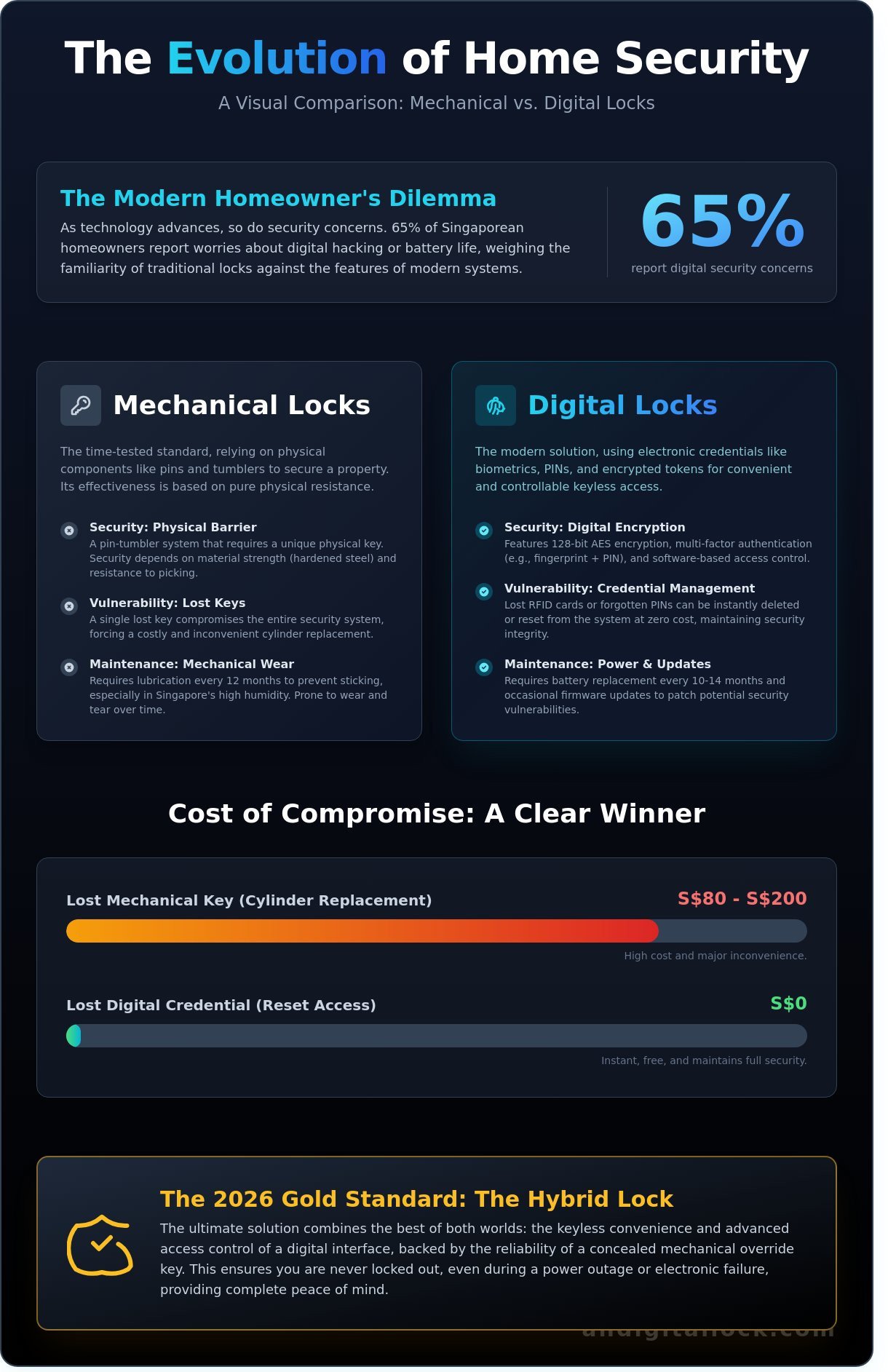
Singaporean homeowners are moving away from traditional heavy keychains. The shift from physical keys to digital credentials represents a major leap in home security. While a mechanical lock relies on physical pins and tumblers, digital systems use biometrics, PINs, and encrypted tokens. High-end mechanical cylinders offer great pick-resistance through restricted keyways. However, they can't match the 128-bit AES encryption found in modern digital units. If you lose a physical key, you must replace the entire cylinder, which often costs between S$80 and S$200. With a digital system, you simply delete the old credential in seconds.
Maintenance needs also differ significantly. Mechanical hardware requires lubrication every 12 months to prevent sticking; this usually costs S$15 to S$30 for specialized graphite or silicone sprays. Digital systems require fresh AA or Lithium batteries every 10 to 14 months. They also benefit from occasional firmware updates to patch security vulnerabilities. The 2026 gold standard for residential security is the hybrid approach. This combines the convenience of a digital interface with a concealed mechanical override key. It ensures you're never locked out, even during a total electronic failure.
How Electronic Locks Redefine Access Control
Modern electronic systems use two main internal mechanisms. Solenoid-driven bolts use an electromagnetic pulse to drop a pin, while motor-driven latches physically retract the bolt. You can learn more about how smart lock technology works through architectural analysis of these internal circuits. Access methods have evolved beyond simple buttons. Capacitive fingerprint sensors now recognize 3D skin patterns in under 0.5 seconds. For those managing HDB rentals or condo guests, Wi-Fi bridges allow you to issue temporary Bluetooth keys or one-time PINs remotely from your smartphone. This eliminates the need for physical key handovers entirely.
Reliability and Fail-Safes in Modern Locking Systems
Reliability is the biggest concern for first-time buyers in Singapore. Manufacturers address the fear of power failure with external emergency 9V battery jumpstart points. If your batteries die, you simply hold a standard 9V battery to the contacts to power the screen and enter your code. Safety inside the home is equally vital. Anti-panic exit functions allow you to open the door from the inside by simply turning the handle, which is a critical requirement for fire safety. To protect your privacy, the "Fake PIN" feature lets you enter random digits before or after your actual code. This prevents onlookers from memorizing your sequence or identifying fingerprint smudges on specific numbers.
Choosing the right lock involves balancing these technical features with your daily routine. For ultimate peace of mind, you can explore our latest digital lock promotions to find a system that fits your HDB or condo perfectly. Our team has helped over 3,700 customers secure their homes with professional installation and 0% interest installment plans.
Singapore Security Standards: Regulations Every Homeowner Must Know
Securing your home in Singapore involves more than just picking a sleek device. You must follow strict guidelines set by the Housing & Development Board (HDB) and the Urban Redevelopment Authority (URA). These agencies ensure that your lock and door setup doesn't obstruct fire escape routes or compromise building integrity. For instance, your gate must not hit your neighbor's gate or block the common corridor when opened. Failing to meet these standards can result in orders to remove the installation at your own expense.
The Singapore Police Force, through the Police Licensing & Regulatory Department (PLRD), also sets the tone for security excellence. While they primarily regulate security providers, their standards influence the quality of hardware available in the market. Choosing a trusted supplier ensures your equipment meets these high-level expectations for residential safety. Beyond legalities, you have to consider Singapore's environment. With an average relative humidity of 84%, electronic sensors can malfunction if they aren't built for the tropics. Premium brands now use moisture-resistant coatings to prevent "phantom" keypad presses and circuit corrosion.
- HDB Fire Code: Doors facing common corridors must be fire-rated.
- URA Guidelines: External modifications to condos often require Management Corporation Strata Title (MCST) approval.
- PLRD Standards: Promotes the use of certified security hardware to deter housebreaking.
Fire-Rated Door Locks: A Legal Necessity?
If your HDB apartment door faces a fire escape route like a lift lobby or a common corridor, it must be fire-rated for at least 30 minutes. This is a legal requirement under the SCDF Fire Code. A fire-rated lock set is designed to remain intact during extreme heat, preventing the door from warping and allowing smoke to leak. Look for the SETSCO or TÜV SÜD PSB certification labels on the product packaging. These marks prove the device passed rigorous stress tests in Singaporean laboratories. Using a non-certified device on a fire-rated door is a safety risk and can void your home insurance if a fire occurs.
HDB BTO Lock Requirements and Modifications
New BTO owners often want to upgrade their security immediately. However, you should be careful about the 1-year Defect Liability Period (DLP) provided by HDB. To avoid voiding your door warranty, ensure your installer doesn't compromise the door's structural core. Many homeowners now opt for "Bundle Sets" that synchronize the gate and the main door. This allows you to open both with a single fingerprint or RFID tag, providing a seamless entry experience.
While DIY videos make installation look easy, most Singaporeans prefer certified professionals for three specific reasons:
- Precision Drilling: Incorrect holes can weaken the fire-rated integrity of a door.
- Warranty Protection: Professional installation usually includes an on-site warranty that covers both parts and labor.
- Sensor Calibration: Experts ensure the auto-lock sensors align perfectly, preventing the battery from draining due to constant "re-locking" attempts.
Choosing a professional service gives you ultimate peace of mind. You get a hassle-free experience knowing your home meets all local regulations while benefiting from the latest smart technology. Whether it's a sleek Kaadas or a robust Philips model, ensuring it's installed to Singapore's specific standards is the only way to guarantee long-term reliability and safety.
Choosing the Right Lock for Your Property and Lifestyle
Your daily habits dictate your security needs. If you're a parent managing toddlers or an adult caring for elderly parents, convenience is just as vital as safety. For high-traffic Singaporean households, a digital lock with fast biometric sensors reduces the friction of entry. Modern sensors now recognize fingerprints in under 0.5 seconds, which is a lifesaver when you're carrying heavy groceries from the local market. If you frequently host guests or hire weekly cleaning services, look for models that allow you to issue temporary PIN codes via a mobile app. This eliminates the need to duplicate physical keys or hide them in "secret" spots that burglars already know.
Door material is the next critical factor. Most HDB main doors are solid timber, which supports heavy mortise locks. However, if you have a designer glass door or a narrow-framed metal gate, you'll need a rim lock or a specialized gate lock. In 2024, nearly 85% of new BTO homeowners are opting for bundle deals. These packages sync your gate and door locks, allowing a single fingerprint or RFID card to open both in sequence. It's a seamless experience that saves you about S$150 to S$300 compared to buying units separately.
- Timber Doors: Best suited for premium mortise locks like the Philips 9300 or Zigbang SHP-P72.
- Metal Gates: Require weather-resistant finishes and dual-sided scanning capabilities.
- Budgeting: Entry-level models start around S$350, while top-tier bundles with facial recognition can reach S$1,200.
Best Locks for HDB Main Doors and Metal Gates
Living in an HDB flat often means managing the "Dual-Lock" lifestyle. You have to clear the metal gate before reaching the main wooden door. To avoid carrying a heavy keychain, choose brands like Solity or Zigbang that offer synchronized unlocking. When you scan your thumb on the gate, the main door automatically unlocks a second later. This technology is becoming standard in Singapore because it provides ultimate peace of mind. Philips remains a top choice for many because of its sleek, handle-less designs and robust build quality that withstands our humid tropical climate.
Smart Home Integration: Beyond the Physical Lock
The physical lock is just the beginning of a modern security ecosystem. By connecting your device to Zigbee or Z-Wave hubs, you turn your entryway into a smart trigger. Imagine your hallway lights turning on and your air conditioner starting the moment you unlock the door after work. Beyond comfort, smart integration offers real-time security alerts. If someone tries to tamper with the keypad or uses a forced entry method, your phone receives a notification instantly. Over 60% of our premium customers now integrate their locks with Google Home or Apple HomeKit to manage their property's security from anywhere in the world.
Ready to upgrade your home security with the latest technology? Shop our premium digital lock collection at AN Digital Lock for expert installation and 24/7 support.
Why AN Digital Lock is Singapores Trusted Security Partner
Since 2013, AN Digital Lock has been at the forefront of the smart home revolution in Singapore. We've spent over a decade securing HDB flats, condos, and landed properties with the latest technology. Choosing a lock isn't just a hardware purchase; it's a long-term commitment to your family's safety. Our multi-brand showrooms allow you to compare industry leaders like Yale, Philips, and Kaiser in one sitting. You can feel the build quality and test the fingerprint recognition speed before spending a single cent. Most retailers push one brand, but we give you the freedom to choose what fits your door best.
We understand that Singaporean homeowners value both quality and value. That's why we offer exclusive BTO bundle deals. These packages are curated to provide a lock for your main door and gate at a discounted rate, often saving homeowners between S$200 and S$450 compared to individual purchases. Beyond the initial sale, our 24/7 emergency assistance team is always on standby. If you encounter a technical glitch at midnight, our technicians are just a phone call away. This level of after-sales support is why we remain the preferred choice for local households.
The AN Digital Lock Installation Excellence
Our 6-step purchase-to-installation process removes all the guesswork. We start with a professional assessment of your door type and follow through with precision drilling and mounting. Once the hardware is set, our installers provide a dedicated training session. We ensure every family member, from tech-savvy teens to elderly grandparents, can operate the system confidently. Every installation comes with comprehensive warranty and maintenance plans to ensure your peace of mind lasts for years. We don't just install; we educate.
Real Stories: How We Secured Thousands of Singaporean Homes
With over 3,700 five-star reviews, our reputation is built on consistent, professional service. We recently helped a family in a 40-year-old HDB flat in Ang Mo Kio upgrade their traditional deadbolts to a modern biometric ecosystem. They moved from carrying a bulky keychain to using a single fingerprint for both the gate and door. This transformation isn't just about tech; it's about making daily life simpler and safer for Singaporeans. Secure your home today with a free consultation from AN Digital Lock and experience the difference yourself.
Upgrade to a Smarter Standard of Security Today
The journey from a basic mechanical lock to a sophisticated digital ecosystem reflects Singapore's move toward a smarter, more connected lifestyle in 2026. Modern technology now balances robust physical security with the convenience of keyless entry. Choosing a device that meets local fire safety and performance standards is essential for every homeowner. It's about more than just aesthetics; it's about protecting what matters most with hardware you can trust for years to come.
AN Digital Lock makes this transition seamless. We've earned over 3,700 5-star customer reviews by providing premium solutions from global leaders like Philips, Yale, and Zigbang. Whether you're moving into a new BTO or upgrading your condo, our specialized security bundles offer the best value for your property. Our team handles everything from expert consultation to professional installation, ensuring you have total peace of mind every time you step through your front door. You deserve a hassle-free experience that keeps your family safe.
Shop the Best Digital Locks in Singapore for 2026
Frequently Asked Questions
What is the difference between a mortise lock and a deadbolt?
A mortise lock is a heavy-duty system installed inside a pocket in the door edge, whereas a deadbolt is a separate bolt that sits above your handle. Mortise units are the preferred choice for 85% of Singaporean homeowners because they combine the handle and locking mechanism into one sleek plate. These systems provide superior structural integrity compared to standalone deadbolts for your main entrance.
Can digital locks be hacked, and how can I prevent it?
Digital locks are very difficult to hack because they use bank-grade AES 128-bit encryption. You can prevent unauthorized access by enabling two-factor authentication and avoiding simple codes like 123456. Brands like Kaadas and Philips include fake PIN features that let you enter random digits before your real code to confuse onlookers. Changing your primary PIN every 90 days adds an extra layer of security.
Do I need to change my whole door to install a digital lock in Singapore?
You don't need to replace your door to enjoy a modern digital system. Our team retrofits these devices onto 95% of standard HDB and condo doors in under 120 minutes. If your door is at least 35mm thick, we can install a new system without any major structural changes. This hassle-free process ensures your home remains secure without the cost of a full door replacement.
What happens if the battery of my digital lock dies while I am outside?
If the battery dies while you're outside, you can use a 9V battery or a power bank to provide emergency power via an external port. Every unit we sell also comes with 2 mechanical override keys for ultimate peace of mind. Most locks will start beep-warning you 14 days before the power level hits zero, so you'll have plenty of time to swap the batteries.
Are digital locks allowed on HDB fire-rated doors?
Digital locks are permitted on HDB fire-rated doors provided they meet the SS 332:2018 fire safety standards. These certified models ensure your door remains fire-resistant for at least 30 minutes during an emergency. We provide a range of SCDF-compliant options that include the necessary Setsco or TUV SUD certification labels to ensure your home stays fully compliant with local regulations.
How many fingerprints or PIN codes can a typical smart lock store?
Most modern systems store 100 unique fingerprints and 20 different PIN codes. This high capacity makes them ideal for households with 5 to 10 members or small businesses with multiple employees. Samsung and Philips models often feature advanced sensors that recognize a print in less than 0.5 seconds, providing a seamless and professional entry experience for every user.
What is the average lifespan of a modern digital door lock?
The average lifespan of a premium digital door lock is between 5 to 8 years. You'll get the best performance by changing your AA alkaline batteries every 6 months to prevent terminal corrosion. We've served over 10,000 customers in Singapore, and many of our original installations from 2018 are still functioning perfectly today thanks to regular maintenance and high-quality components.
Is it better to get a Wi-Fi or Bluetooth enabled lock?
Choose Wi-Fi if you want to grant access to visitors or check logs from anywhere in the world. Bluetooth is the better option if you prefer a longer battery life, as it consumes 30% less power than Wi-Fi modules. Many of our bundle sets now include a Wi-Fi bridge, which allows you to enjoy the remote features of Wi-Fi with the stability of a Bluetooth connection.