


What if the best way to secure a jumbo HDB flat isn’t to put the same lock on every door, but to plan each entrance as part of one system? If you’re securing a jumbo hdb flat with multiple entrances, start by identifying which doors and gates are separate access points, then decide how to keep each one simple for everyone at home.
That uncertainty is understandable. A clear plan starts with knowing where each entrance leads, how often it’s used, and what kind of door or gate it is. The right arrangement can support security without turning everyday arrivals and departures into a puzzle.
This guide shows you how to map and assess every entrance, compare suitable lock arrangements for a main door and metal gate, and set a household access routine. You’ll also learn what to consider when choosing digital locks for different entrance types, and why fire-safety requirements matter when planning changes to an HDB flat’s doors or openings. With each access point accounted for, you can make choices with greater confidence and keep entry straightforward for the whole household.
Key Takeaways
- For securing a jumbo hdb flat with multiple entrances, map every external door and gate first, since layouts can vary.
- Treat the main door, metal gate, and any additional external door as distinct access points when planning your lock setup.
- Compare lock options by entrance type, existing arrangement, and who uses each entrance every day.
- Use a five-step review to list, inspect, match, assign users, and revisit each entrance’s normal use.
- Explore separate digital lock categories, including the SOLITY GD-60BK for gates and SOLITY GP-6000BK for digital door locks.
Securing a jumbo HDB flat with multiple entrances starts with an entrance map
Before comparing digital locks or changing household habits, identify every point where someone can enter the home from a shared area. Jumbo-flat layouts can differ, so don’t assume the home’s size or history tells you how many external entrances it has. Focus on doors and gates that connect the home to a corridor, landing, or other shared space, not openings that simply join one room to another.
A security plan begins with a list of every entrance used to enter the home. That inventory gives your household a reliable starting point and helps prevent a less-used door from being overlooked while attention stays on the main entrance.
How to identify every access point in your flat
Walk through the home and inspect each door and gate that opens to a shared area. Record its location and type, then note whether it’s used daily, occasionally, or rarely. A simple sketch is enough. Label each point clearly, such as “main door,” “metal gate,” or “rear external door,” if your layout has one.
Next, note who normally uses each entrance. Household members may use one route, while guests or deliveries arrive at another. This helps distinguish an entrance that’s part of the everyday routine from one that still needs attention despite being used less often.
- List each door or gate that leads from the home to a shared area.
- Record its type, current lock arrangement, and usual users.
- Mark rarely used entrances for regular checks rather than leaving them off the plan.
Shared spaces aren’t private entrances to your flat. For context on communal areas in HDB estates, see Void deck spaces. Keep your map focused on the actual boundary between your home and shared areas.
Why a jumbo-flat layout needs a tailored plan
A larger floor plan doesn’t automatically mean more external entrances. Two adjoining living areas may be connected by an internal opening, for example, but that opening doesn’t lead out of the home and shouldn’t be counted as an entrance. By contrast, include a door that opens to a shared corridor, even if the household rarely uses it.
This distinction keeps the plan practical. Count each external access point once, then consider its door or gate type and how it fits into daily use. Don’t treat every doorway as a separate security boundary, and don’t overlook a real entrance just because it isn’t the main route in.
For main-door considerations in Singapore, the HDB main door guide offers useful context. If you’re considering alterations to doors, gates, or openings, check current HDB requirements before proceeding. With an accurate entrance map, securing a jumbo hdb flat with multiple entrances becomes more manageable: you can plan around the home’s actual access points instead of assumptions based on its size.
Build a coordinated security plan for every jumbo HDB entrance
Once you’ve mapped the access points, give each one a clear role in your household’s routine. Treat the main door, metal gate, and any additional external door as separate points to secure. Their lock arrangements may differ, so assess each entrance on its own rather than assuming one choice will suit every door or gate.
Every external entrance needs a defined lock, user, and closing routine. The goal is a consistent habit, not a complicated system. Whenever the home is unoccupied, close and secure each entrance on your map. Include less-used doors, even if they aren’t part of the usual route in or out.
Match each entrance to its everyday role
Identify which entrance household members use most often and which serves as a backup. Then consider the people and activities connected to each one. A route used frequently by residents should be straightforward for everyone who uses it. An occasional entrance still needs a clear way to secure and check it.
Keep the plan practical. Note who needs routine access and whether anyone has difficulty using a particular entry method. When comparing lock arrangements for a main door and metal gate, remember that these are distinct categories. Choose for the actual door or gate and its everyday role, rather than selecting locks simply because they look similar.
Keep access simple for everyone at home
Agree on who needs access and which method each person can use comfortably. Depending on the lock, options may include a fingerprint, PIN, or RFID credential. These methods aren’t universal across digital locks, so base the household plan on the functions of the specific lock at each entrance. Keep the arrangement understandable for regular users, including family members who may not use the door every day.
Make leaving the home a shared habit. A simple check can follow the same order each time: close the main door, secure the metal gate, then check any additional external door. Adapt the order to your layout and say it aloud while everyone is learning. The same routine can apply before bed, with each person knowing which entrance they’re responsible for checking.
- Assign each entrance a primary user or household role.
- Agree on a comfortable access method for each regular user.
- Include every external entrance in the leaving and nighttime check.
- Follow the individual lock’s instructions for backup access arrangements.
Consistency matters more than adding steps. Avoid a routine that relies on one person remembering an unusual exception, such as a rarely used door that gets left unsecured. Instead, use the same entrance check whenever the home is empty, and review it if household members or daily patterns change.
A coordinated plan makes securing a jumbo hdb flat with multiple entrances easier to manage without requiring every access point to use the same lock. AN Digital Lock offers separate digital lock categories for different entrance types. Browse digital locks for HDB entrances and build your household routine around the setup you choose.
Compare main-door and metal-gate lock options before choosing
Choosing locks for a jumbo HDB flat means assessing each entrance on its own. A main-door lock and a metal-gate lock are separate product categories for different entrance components. Start with the door or gate type, note the existing lock arrangement, then consider how residents use that entrance each day. This avoids choosing based on appearance alone or assuming one model suits every point of entry.
Use this comparison to organise your selection. Access methods vary by lock, so compare the stated features of each product rather than assuming every option offers the same functions.
Choosing a lock for the main door
Begin by identifying the main door’s construction and the lock arrangement already in place. Then compare the access methods stated for each digital door lock with your household’s preferences. For example, consider whether regular users would find a PIN, fingerprint, or RFID method easy to use, where the lock supports that method. Review the model’s specifications rather than assuming it will fit every door.
In Singapore, the main door may also have fire-safety considerations. Check current HDB requirements before changing the door or its fittings, and take the door’s role into account when selecting a lock.
Choosing a lock for a metal gate
Treat the gate as its own entrance component, with a gate-lock category and a fit assessment based on the gate’s construction and current locking arrangement. Consider the whole arrival routine: will residents secure the gate and main door as separate steps, and is that sequence comfortable for everyone who uses the entrance?
Separate locks can still form a straightforward system if each has a clear purpose and the household follows a consistent routine. Compare the gate and door options side by side, then note which access methods each supports and who will use them. For broader criteria on comparing digital locks, consult this digital lock buying guide. A careful comparison makes securing a jumbo hdb flat with multiple entrances less about matching hardware and more about choosing suitable arrangements for each actual entrance.
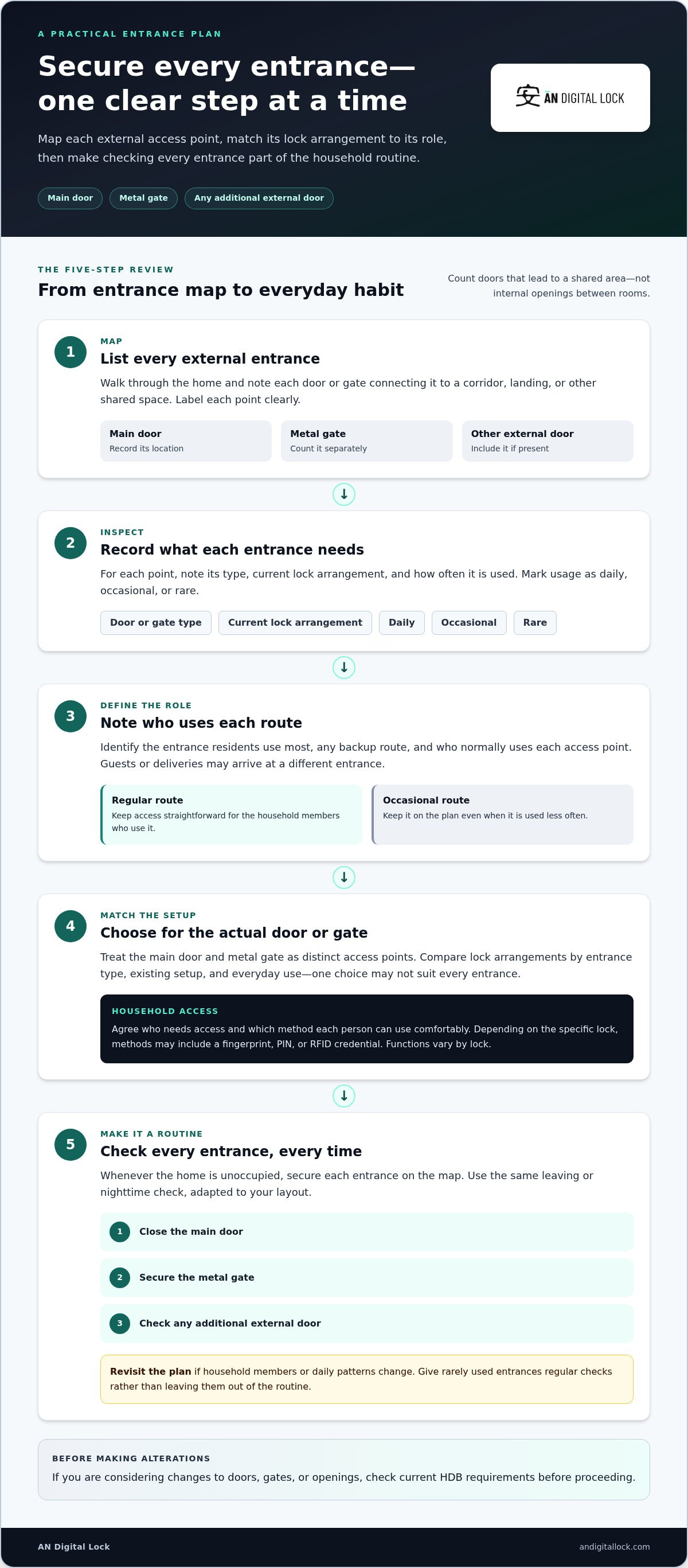
Use this step-by-step checklist to review multiple entrances
Turn your entrance map into a working household checklist. For each external door or gate, record its type, current lock category, everyday users, and normal use. Include secondary and rarely used access points. This makes it easier to spot missing information, unclear responsibilities, or a lock arrangement that doesn’t suit the entrance.
A written entrance checklist helps households follow the same routine every day. Keep it somewhere residents can refer to, and update it when a lock, household member, or daily access pattern changes.
Complete a practical entrance-by-entrance audit
Follow these five steps in order. Keep observations factual. If a door or gate behaves unusually, record what you notice without trying to diagnose a structural problem. For example, note that it feels difficult to close or that the locking arrangement is unclear. This gives you a specific item to review before deciding what to do next.
- List: Write down every external door and gate, including secondary entrances and those rarely used.
- Inspect: Note each entrance’s type and existing lock category. Record visible concerns, such as difficulty closing or uncertainty about how the lock engages.
- Match: Compare the entrance type and existing arrangement with the lock category intended for it. Flag any mismatch or unclear fit for further attention.
- Assign users: Record who needs everyday access and how each person normally uses that entrance.
- Review: Check the list with the household. Prioritise unclear access arrangements and any lock that appears unsuitable for its entrance.
A simple record might read: “Metal gate, gate lock, used daily by household members, secured before leaving.” For an infrequently used external door, note that it’s rarely used and include it in the regular check. The aim isn’t to create a technical report. It’s to give every entrance a clear place in the household plan.
Create a household access and closing routine
Use the audit to decide who takes responsibility for each entrance when the home is empty. You might assign one person to check the main door and another to check the gate, or agree that the last person leaving checks every point. Choose a routine that suits your household and doesn’t depend on remembering an exception.
Agree on a similar check before sleeping. Follow the same sequence each night, and make sure everyone knows which doors and gates are included. If a resident’s needs change, someone new joins the household, or the way an entrance is used shifts, revisit the assignments and access plan.
This practical review turns securing a jumbo hdb flat with multiple entrances into manageable actions: document each access point, resolve unclear arrangements, and give every user a role. AN Digital Lock offers digital locks for doors and gates. Browse digital locks for doors and gates to compare options against your entrance checklist.
Explore AN Digital Lock options for a coordinated HDB entrance setup
Once you’ve identified each entrance and considered who uses it, compare lock options by entrance type. AN Digital Lock specialises in digital door locks and has done so since 2013. Its digital locks for main doors and metal gates are separate categories, giving you a clear starting point for matching a product category to your entrance plan.
Two examples illustrate the distinction: the SOLITY GP-6000BK is a digital door lock, while the SOLITY GD-60BK is a metal gate lock. These models belong to different entrance categories. Don’t assume that a model is suitable for every door or gate. Consider the entrance’s construction, current locking arrangement, and the product’s stated specifications as you compare options.
Explore lock categories for different entrance types
Keep your shortlist organised by access point. For a main door, explore digital door locks such as the SOLITY GP-6000BK. For a metal gate, consider gate-lock options such as the SOLITY GD-60BK. These examples help distinguish the categories, but they don’t establish that either model fits every entrance. The door or gate and its existing arrangement remain part of the selection decision.
As you review a product, record its category alongside the entrance it’s being considered for. Then compare the product information with your household’s preferred access methods and everyday routine. For broader guidance on choosing a lock for a Singapore home, the main-door and lock guide provides related selection context.
Take the next step with a clear entrance plan
Bring your entrance list into the selection process. For each point, note whether it’s a main door, metal gate, or another external door; the existing lock category; who needs access; and how the entrance is used. This keeps the comparison grounded in your home’s actual needs instead of assumptions about jumbo-flat layouts.
It also gives you a practical way to compare options without treating the locks as interchangeable. Review main-door and gate categories separately, note any questions about the stated specifications, and consider whether the access steps make sense for regular household users. Keep product claims tied to the details provided for each model, and check current HDB requirements before making alterations to doors, gates, or openings.
A coordinated approach to securing a jumbo hdb flat with multiple entrances starts with a clear list and continues with suitable options for each access point. Explore digital locks and entrance options from AN Digital Lock, then use your entrance plan to guide your comparison.
Make your entrance plan work for everyday life
A useful security setup should feel clear to the people who live with it. As household routines change, revisit who uses each entrance and whether the access arrangement still feels straightforward. A small adjustment to responsibilities or the household checklist can help keep the plan practical without adding unnecessary steps.
Use your entrance notes as a guide while comparing digital locks for main doors and metal gates, along with related doors and home-security products. AN Digital Lock offers these distinct categories so you can explore options with your home’s layout and household needs in mind.
Ready to take the next step? Explore digital locks and entrance products from AN Digital Lock and make your plan for securing a jumbo hdb flat with multiple entrances part of a clear daily routine.
Frequently Asked Questions
Are all jumbo HDB flats configured with two main entrances?
No. A jumbo flat’s entrance layout depends on the individual home, so don’t assume it has two main entrances. For securing a jumbo hdb flat with multiple entrances, count the doors that lead into the home from shared areas, not internal openings between living spaces. For example, a doorway joining two former living areas isn’t an external entrance. Label each actual entry point on a simple sketch before comparing lock options.
Can one digital lock secure both a metal gate and a main door?
Don’t assume one digital lock can secure both a metal gate and a main door. They’re separate entrance components, and a lock suited to one may not suit the other. Compare each component’s construction and the lock’s stated specifications. For example, if your household unlocks the gate and door in sequence, consider whether those separate steps are easy for everyone to follow as they enter or leave.
Can every household member use fingerprint access?
That depends on the lock’s supported access methods and each person’s needs. Digital locks may offer methods such as fingerprint, PIN, or RFID, but features differ by model. Consider a resident who finds a PIN easier than fingerprint access, or a child who needs a method the household can manage consistently. Decide who needs routine access, and explain the chosen method and any backup process to each user.
Will a digital lock work during a power failure?
Power arrangements and backup access options vary by model, so don’t assume every digital lock responds the same way during a power failure. Check the specific lock’s instructions for its power source, warnings, and emergency access procedure. Make sure regular users know where to find that guidance and what steps to follow. This preparation is more reliable than assuming a particular backup feature is included with every lock.
Can a digital lock be fitted to a fire-rated main door?
Compatibility depends on the particular door and lock combination. Review the specifications for both, and don’t assume a lock is suitable simply because it is marketed for a main door. If the door is fire-rated, consider how a proposed change relates to its stated rating and applicable requirements. Before choosing, compare product information and check current HDB requirements for any planned alteration to the door or its fittings.
Do I need to replace both the main door and metal gate to improve entrance security?
Not necessarily. Start by assessing each component separately, including its condition and existing lock arrangement. Your household may decide to update a lock, a door, a gate, or more than one item, depending on its needs. For example, a satisfactory door may not need replacement just because you’re reviewing the gate lock. Match any selected product to its intended entrance, and don’t treat replacement as a guarantee of protection.