


A gate can look secure and still leave an opening your pet could squeeze through or get stuck in. Choosing a pet-friendly HDB gate with small gaps means checking more than appearance: the openings must suit your pet’s size and behaviour, and the gate must fit your entrance and work smoothly in daily use.
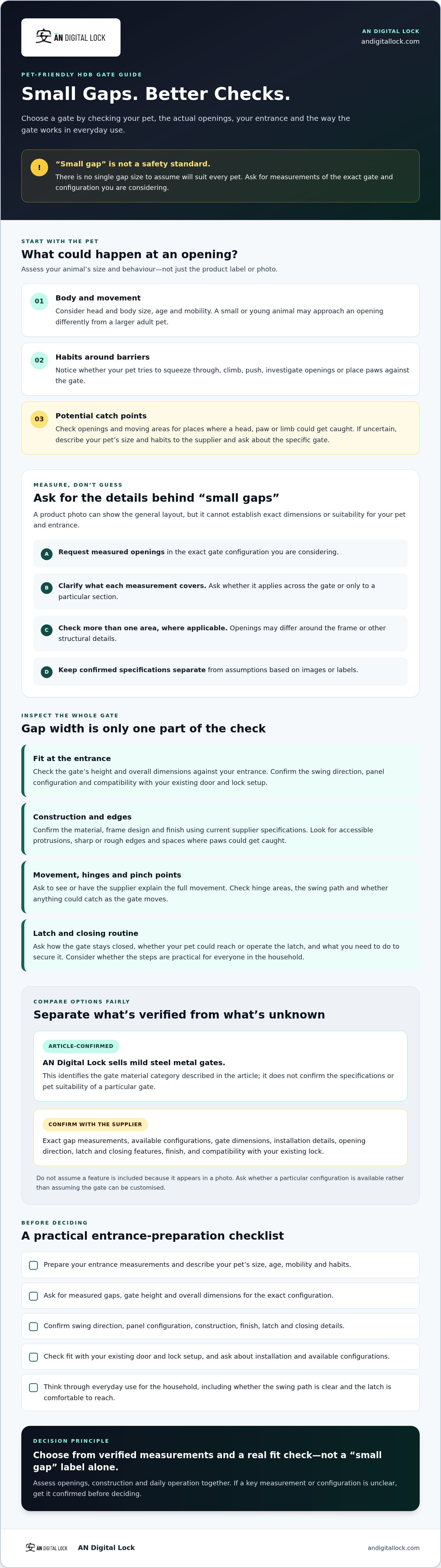
“Small gaps” can mean different things from one gate to another, so don’t rely on a label alone. Ask for the actual gap measurements and check for openings where paws, heads or limbs could catch. Also confirm the gate’s dimensions, swing direction, panel configuration and compatibility with your existing door and lock setup.
This guide explains how to assess gaps for your pet, compare metal gate options and confirm product details before buying. AN Digital Lock sells mild steel metal gates. Ask the company to confirm the specifications and available configurations for the gate you’re considering, so you can compare fit, safety and everyday convenience.
Key Takeaways
- Choose gate gaps based on your pet’s size and behaviour; a “small gap” label alone can’t confirm safety.
- Check the gate’s height, construction, opening direction and potential pinch points before deciding.
- Compare verified measurements and features separately from details you still need to confirm with a supplier.
- Prepare entrance measurements and ask about gate fit, available configurations, installation and compatibility with your existing lock.
What makes an HDB gate pet-friendly, and why do small gaps matter?
A pet-friendly HDB gate is one chosen for your animal, your entrance and the way your household uses the doorway. HDB stands for the Housing & Development Board, which is responsible for public housing in Singapore. In this context, “pet-friendly” should describe a considered fit, not a guarantee that one design is safe for every pet.
Assess the openings, construction and movement of the gate, as well as your pet’s size and behaviour. A narrow-looking gap in a product photo may be different in person, and even a measured opening is only one part of the safety check. Treat images as a visual reference, not proof that a gate will suit your pet or entrance.
How a pet’s size and behaviour affect gate-gap checks
Look beyond your pet’s weight or breed. Consider head and body size, age, mobility, and whether your pet tends to climb, push or investigate openings. A small or young animal may approach a gap differently from a larger adult pet. One may try to squeeze through, while another may place its paws against the gate. The same opening can present different concerns for different animals.
Ask the supplier for precise measurements of the actual openings in the gate you’re considering. Don’t judge clearance from a product photo. If you’re unsure whether an opening could trap a head, paw or limb, explain your pet’s size and habits and ask about that specific gate.
What buyers mean by a small-gap HDB gate
“Small gaps” is a buyer requirement, not a universal safety standard. There is no single gap size to assume will suit every pet. Ask for the measured width of openings in the exact gate configuration you’re considering. Clear photos can help you understand the layout, but use measurements to compare options.
Check whether the measurement applies across the whole gate or only to a particular section. Openings may differ around the frame or other structural details, so ask which areas have been measured. Keep confirmed specifications separate from assumptions: a product photo can show the general design, but it cannot establish exact dimensions, suitability for your pet or how the gate will operate at your entrance.
Use your pet’s needs alongside the supplier’s verified details. Consider the openings, construction and everyday operation together. If a key measurement or configuration is unclear, get it confirmed before deciding.
Which HDB gate details should pet owners inspect before deciding?
Once you’ve considered your pet’s needs, compare the gate specifications with the conditions at your entrance. Gap width is only one detail. Height, frame construction, edges and moving parts matter too. Check the opening direction: a gate that swings into a busy area may be awkward to use or obstruct your household’s routine.
Look for accessible protrusions, sharp or rough edges, pinch points around hinges and spaces where paws could get caught as the gate moves. Ask how it is secured when closed and whether your pet could reach or operate the latch. Don’t assume a feature is included just because it appears in a photograph.
Questions to ask about gate gaps and construction
Ask for measurements of openings at multiple points, where applicable, and clarify what each measurement refers to. Confirm the material, frame design and finish using the supplier’s current specifications. If you need a particular configuration, ask whether it is available rather than assuming the gate can be customised. Close-up photos can help explain the design, but they don’t replace confirmed measurements.
Check the gate’s height and overall dimensions against your entrance, and ask which way it opens. These details help you assess containment and everyday access. When comparing options, record confirmed specifications separately from details that still need to be verified.
Gate movement, latches and everyday pet safety
Ask to see, or have the supplier explain, the gate’s full movement. Check whether the swing path is clear, whether household members can reach the latch comfortably and whether your pet could nose or paw at it. Ask how the gate stays closed and what you need to do to secure it. Consider whether those steps are practical every time someone enters or leaves.
Think about how everyone in the household will use the gate. Children, older residents and anyone carrying bags may need to open and close it differently. Make sure they can do so without rushing or leaving it unsecured. Repeated daily use is a better test of usability than a quick look at the design.
Ask sellers for: measured gaps, gate height and dimensions, material and finish, opening direction, latch and closing details, and confirmation of the exact configuration offered. AN Digital Lock sells mild steel metal gates, but pet-specific options and specifications should be confirmed directly. Review its mild steel metal gates as a starting point for your questions.
How do small-gap metal gates compare with other HDB gate options?
Compare gates by what can be verified, not by how compact or secure they look in a catalogue. Metal gates can differ in spacing, frame construction, visibility and operation. A design that appears to have tighter spacing isn’t automatically safer for every pet. Check the openings, edges and moving parts against your animal’s needs and your entrance.
AN Digital Lock offers mild steel metal gates, but the available configurations and pet-specific specifications should be confirmed directly. Use the comparison below as a checklist for supplier questions, not as a claim that a particular design is available.
| Option to ask about | What to compare | What needs supplier confirmation |
|---|---|---|
| Metal gate with open sections | Measured spacing, frame layout, visibility and how the gate swings | Gap measurements at relevant points, dimensions, finish and available configuration |
| Metal gate with closer-spaced sections | Whether the openings suit your pet and whether the frame creates catch points | Exact opening widths, construction details and whether this configuration is offered |
| Gate with infill or mesh sections | Visibility, potential paw or claw contact, cleaning access and everyday operation | Material, opening details, compatibility with your entrance and availability |
Compare metal-gate designs by the needs of your household
Start with your pet’s size and habits, then consider visibility and household routines. A pet that reacts to activity outside may have different needs from one that stays calm at the entrance. Check whether everyone at home can operate the latch and move through the doorway comfortably. Give appearance less weight than confirmed measurements, entrance fit and practical operation.
When a small-gap requirement needs extra verification
Ask for precise, product-specific measurements if your pet is small, young, elderly or prone to squeezing into openings. Request written confirmation of the offered configuration and any limitations, especially if gaps vary across the frame. Photos can help you understand the layout, but they cannot establish dimensions or suitability. If your pet has unusual mobility or behaviour needs, consult an appropriate pet-care professional as well as checking the gate specifications.
For a useful comparison, ask each supplier about measured gaps, construction, opening direction, latch operation and fit with your existing entrance. Separate confirmed details from anything still awaiting verification. That makes it easier to compare options on safety and usability instead of relying on a “small-gap” label.
How to measure and prepare for a pet-friendly HDB gate purchase
Preparing before you enquire helps you compare options for fit, pet safety and daily use. Measurements can vary depending on where and how they’re taken, so follow the supplier’s instructions rather than estimating from a photograph. Record what you know, note any uncertainties and ask the supplier to verify the details before treating them as final.
A practical sequence for measuring the gate opening
- Ask how to measure. Confirm which points to measure and whether the supplier needs dimensions for the opening, existing frame or both.
- Record the entrance details. Measure width, height and relevant clearances using the requested method. Note frames, uneven surfaces, nearby walls and other obstructions that could affect fit or movement.
- Document the site. Take clear photographs from more than one angle and identify features that may affect installation. Use photos to explain the entrance, not to estimate dimensions.
- Send the information for review. Ask the supplier to check the measurements and identify any further checks needed before confirming the gate size.
Also check the gate’s opening clearance. Consider where it will swing and whether its path could meet a wall, door or another obstruction. For more context on choosing the paired entrance, see this HDB main door selection guide.
Confirming installation, access and lock compatibility
Before buying, clarify who handles measurement, delivery and installation, and which of these are included. Don’t assume they’re part of the purchase. Ask whether the installer needs access to the entrance or specific site information, and explain how the existing gate or door setup may affect the work.
If you’re keeping or adding a digital lock, confirm that it is compatible with the gate configuration and can be operated as intended. Check the lock’s position, clearance and operation with the gate fully closed. For broader selection considerations, consult this HDB door lock buying guidance.
Before placing an order, get the confirmed gate dimensions, gap specifications, opening direction, lock compatibility and installation responsibilities in writing. AN Digital Lock offers mild steel metal gates, but measurement, delivery and installation inclusions should be checked directly. Ask AN Digital Lock about its metal gate options and share your measurements, entrance photos and pet-related requirements for a more specific discussion.
Choosing an AN Digital Lock metal gate: what to confirm before enquiring
AN Digital Lock offers metal gates, including mild steel options. Whether a current gate can be supplied with small gaps or a pet-specific configuration needs to be confirmed directly. Treat an enquiry as a way to check available specifications, not as confirmation that a particular design is offered or will suit your pet.
Make your enquiry specific by including the details that affect safety and fit. Describe your pet’s size and behaviour, the gap requirement you have in mind and the entrance measurements taken using the supplier’s instructions. Mention any concerns, such as a pet that pushes at the gate or tries to squeeze through openings. Then ask which current options can be assessed against those needs.
What to include in a gate enquiry
- Pet needs: Describe your pet’s approximate size, mobility and habits around the entrance.
- Gap requirement: Explain the opening measurements you need and ask for the actual gap dimensions of the available configuration.
- Entrance fit: Provide the measurements and site details requested by the supplier. Ask how the fit will be verified before an order is confirmed.
- Product and installation details: Request current specifications, including material, dimensions and finish. Confirm who handles measurement, delivery and installation, and ask which product terms apply.
Get important details in writing. If a specification is unclear, ask for clarification instead of relying on a product image or a general description such as “pet-friendly.” A confirmed answer gives you a firmer basis for comparing the gate with your household’s requirements.
Pairing a gate purchase with entrance security
Consider how the gate works with the main door and your usual entry routine. If you’re keeping or choosing a digital lock, ask whether it’s compatible with the specific gate configuration and confirm the relevant product specifications. Don’t assume a lock will fit or operate as expected simply because it is intended for a gate.
For help weighing up lock features, refer to this digital lock buying guide. Check gate fit, pet-safety details and lock compatibility separately, so one confirmed detail doesn’t stand in for another.
Ready to check what’s currently available? Ask AN Digital Lock about metal gate options, and include your pet’s needs, measured gaps and entrance details to support a focused discussion.
Choose a gate with confidence
A suitable pet-friendly gate starts with your pet’s needs, not a “small gap” label. Compare measured openings, construction and gate movement, then confirm the dimensions and fit for your entrance. Photos can help you understand a design, but they can’t replace verified specifications.
Before deciding, ask which configurations are currently available, whether the gate suits your pet and household routine, and what measurement or installation details apply. AN Digital Lock offers mild steel metal gates alongside other home entrance products. Confirm pet-specific configurations and product details directly with the company.
To explore your options, ask AN Digital Lock about available metal gates and share your pet’s needs and entrance measurements. Clear questions and confirmed details will help you assess whether an option suits your home.
Frequently Asked Questions
What should I check when choosing a pet-friendly HDB gate with small gaps?
Check the actual gap measurements, gate height, construction and opening direction, then compare them with your pet’s size and behaviour. Look for protrusions, pinch points and places where paws could get trapped. Confirm the gate fits your entrance and that household members can open, close and secure it comfortably. Ask the supplier for current product specifications; photos and a “small gap” label aren’t enough to establish fit or suitability.
Are small gaps in an HDB gate safe for every pet?
No. A gap that suits one animal may still pose a risk to another. Consider your pet’s head and body size, age, mobility, and tendency to climb, push or squeeze through openings. Ask for measurements of the specific gate and check them against your pet’s needs. If your animal has unusual mobility or behaviour concerns, seek advice from an appropriate pet-care professional as well as confirming the gate details.
How do I measure an HDB gate opening before buying?
First, ask the supplier how and where to measure, since the required points may depend on the gate and existing frame. Record the entrance width, height and relevant clearances using those instructions. Note obstructions and take clear photos to show the site, but don’t estimate dimensions from images. Send your measurements to the supplier and ask them to verify the fit before treating the figures as final or placing an order.
Can I get a metal gate with smaller gaps for my pet?
Possibly, but don’t assume a supplier offers a particular gap size or pet-specific configuration. Ask which current metal-gate options are available and request measured opening widths for the exact configuration. Check other details too, including construction, height, opening direction and entrance compatibility. AN Digital Lock sells mild steel metal gates, but whether a pet-specific option or smaller-gap configuration is available must be confirmed directly with the supplier.
What happens if my pet can reach or operate the gate latch?
If your pet can reach or manipulate the latch, the gate may not stay secured as intended. Ask how the latch works and check whether your pet can nose, paw or push it during ordinary use. Consider the gate’s closing method and make sure household members can secure it consistently. If you’re unsure about the risk, discuss your pet’s behaviour with the supplier and consider advice from an appropriate pet-care professional.
Does AN Digital Lock sell pet-friendly HDB gates?
AN Digital Lock sells metal gates, including mild steel options, but its supplied product information doesn’t confirm specific pet-friendly models or small-gap configurations. Contact the company to ask what options are currently available and request verified gap measurements, gate dimensions and construction details. Also confirm entrance fit and whether measurement, delivery, installation or warranty is included. Treat those points as questions to verify, not as assumed product features.