


What if the easiest way to let your cleaner in is also the hardest access to take back? A shared key or household PIN may be convenient, but it can leave you wondering who can still enter if your cleaning arrangement changes. Managing access for part-time cleaner in my condo starts with choosing a credential you can manage, rather than relying on a key that could be misplaced or copied.
A useful arrangement should work for both your cleaner and your household, especially when you’re not home. Match the entry method to the cleaning schedule, and agree on clear arrival and departure steps before the first visit.
This guide compares physical keys with digital-lock options, including PIN, RFID, fingerprint and Wi-Fi access. Features vary by lock model, so you’ll also learn what to confirm before choosing a lock, how to set up recurring entry, and what to review or remove when the arrangement ends. The goal is to make visits straightforward without giving up control of access.
Key Takeaways
- Build a clear entry routine around the cleaning schedule, including agreed arrival and exit expectations.
- Compare a spare key, shared PIN and digital-lock access by how easily you can manage each credential if arrangements change.
- For managing access for part-time cleaner in my condo, choose a credential that fits your household routine and can be reviewed or removed when needed.
- Use a before, during and after checklist to prepare for the first visit and keep access arrangements clear over time.
- Compare PIN, RFID, fingerprint and Wi-Fi options carefully. Supported features vary by lock model.
Managing access for a part-time cleaner in your condo starts with a clear routine
A cleaner needs a dependable way to enter, but access without clear limits can feel uncomfortable. The aim isn’t to make every visit complicated. It’s to agree who may enter, when they may enter, and what should happen before the door is left unattended.
Recurring cleaner access is different from general household access. Someone invited for a scheduled cleaning visit doesn’t automatically need access at other times or for other purposes. Think of entry credentials as one part of your home-security routine: the Home Security Systems and Practices overview also highlights the role of both security hardware and personal habits. Choose an arrangement that reflects your household routine, your level of trust and the controls your lock actually supports.
There isn’t one right setup for every condo. A cleaner who visits on a regular day may need a different arrangement from someone you book occasionally. Consider whether you’ll be home, whether household members will use the entrance during the visit, and how you’ll handle changes to the schedule. A digital door lock can make recurring entry simpler, but its functions vary by model. Keep the plan practical, and don’t assume a lock can enforce limits it doesn’t support.
Agree on the cleaner’s arrival and departure routine
Before the first visit, agree on an arrival window and which entrance to use. Decide who the cleaner should contact if plans change and which household member will respond. Explain whether the cleaner should lock the door on departure, and whether anyone else may be at home. A short message confirming a schedule change can prevent a missed visit or an unexpected arrival.
Keep the routine consistent across household members. If one person changes the appointment, make sure the others know. This avoids conflicting instructions or someone expecting the cleaner at the original time.
Decide what access the cleaner actually needs
Start with the visit pattern. Does the cleaner come regularly or only for occasional appointments? Will they need to enter while everyone is out, or can someone let them in? These answers help you choose a method for the actual arrangement, rather than sharing broader access than necessary.
- Set access for the agreed cleaning visit, not general household use.
- Decide who is responsible for arranging entry if the cleaner arrives early or late.
- Agree how you’ll handle a cancelled or rescheduled visit.
Clear limits make the routine easier for everyone. If no one will be home, provide only the entry method needed for the visit and explain the departure procedure. If a household member will be present, decide who will meet the cleaner and whether independent entry is needed. These details give you a practical starting point for comparing access methods.
Compare a spare key, shared PIN, and digital lock access
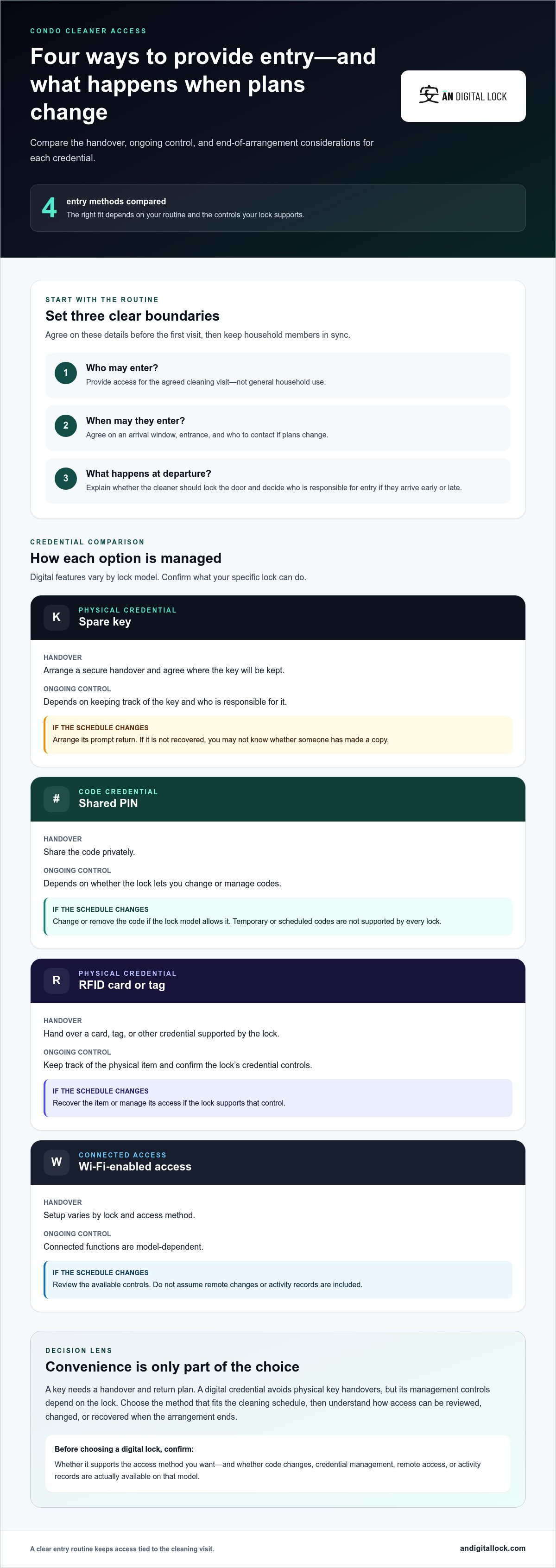
The best entry method is one you can manage comfortably throughout the arrangement, including when the cleaning schedule changes. A spare key is familiar, while a PIN or another digital credential can avoid physical handovers. Digital access is useful only when the specific lock supports the controls your plan requires.
| Method | Handover effort | Ongoing control | After a schedule change |
|---|---|---|---|
| Spare key | Arrange a secure handover | Depends on keeping track of the key | Arrange its prompt return; consider who may still have access if it isn’t recovered |
| Shared PIN | Share the code privately | Depends on whether the lock lets you change or manage codes | Change or remove the code if the model allows it |
| RFID credential | Hand over a card, tag or other supported credential | Keep track of the physical item and the lock’s credential controls | Recover the item or manage its access if supported |
| Wi-Fi-enabled access | Setup varies by lock and access method | Connected functions are model-dependent | Review available controls; don’t assume remote changes or logs are included |
These are practical distinctions, not a guarantee that any method prevents unauthorised entry. The Department of Homeland Security’s Physical Access Control Systems (PACS) Guidelines address managed entry in government facilities, not condo rules. They provide context for thinking about controlled credentials and entry points.
When a physical key may fit the arrangement
A spare key can suit a trusted cleaner with a consistent schedule if you’re comfortable arranging the handover. Agree where the key will be kept, who is responsible for it, and when it must be returned if visits stop. Avoid leaving it somewhere obvious. If the arrangement changes and the key isn’t returned, recovering it may be inconvenient, and you may not know whether someone has made a copy.
When PIN, RFID, or connected access may help
A PIN avoids passing a physical key back and forth, but not every lock supports individual codes, temporary codes or scheduled access. Check the specific model’s functions. RFID is another option, though a card or tag still needs a clear handover and return plan. Wi-Fi features also vary: remote access, code management and activity records aren’t universal.
For managing access for part-time cleaner in my condo, weigh convenience against what you can control when plans change. If you’re considering a digital door lock, explore digital lock options with your household’s entry routine in mind. Choose a credential that fits the arrangement, then understand how it can be changed or recovered when the schedule ends.
Is sharing a cleaner’s access code safe? Reduce the main risks
Sharing an access code can make a cleaning visit easier to arrange, but a digital lock isn’t automatically safer just because it replaces a key. Its usefulness depends on whether the lock’s features fit your access plan and whether you manage the credential carefully. A code that remains active after the cleaning arrangement ends may leave you with less control than you expected.
Keep credential management separate from broader home-security guarantees. A digital lock manages entry at the door; it doesn’t remove every risk inside a home or replace careful household routines. Before relying on a feature, read the specific lock’s instructions to learn how codes or credentials are added, changed and removed. Don’t assume a lock includes activity history, remote access or remote revocation unless those functions are supported by that model.
For managing access for part-time cleaner in my condo, plan for the end of the arrangement before the first visit. Decide what needs to be returned or changed and who will handle it. This makes access changes less stressful and helps prevent reliance on memory or assumptions.
Protect PINs, keys, and RFID credentials
Keep the cleaner’s access details separate from credentials used by household members. Don’t reuse a household PIN that has already been shared with visitors or other service providers. Share the cleaner’s details directly rather than posting them in a group chat where people who no longer need access may still see them. Treat an RFID card or tag like a key: hand it over deliberately and keep track of its return.
Avoid hiding spare keys or credentials in obvious places near the condo entrance. If someone may have seen the PIN, follow the lock’s instructions for changing it, if that option is available.
Plan for schedule changes and a lost credential
Agree on a simple way to report a missed visit, a changed appointment or an unexpected arrival. If a key or RFID credential goes missing, decide who needs to know and how you’ll recover it or manage its access. If a PIN may have been exposed, check whether the lock lets you change or remove it. A physical key needs a different response because the key itself can’t be deactivated.
- Before visits: Keep the agreed schedule and contact person clear.
- If plans change: Tell the cleaner which visit is affected and confirm the revised arrangement.
- If a credential is lost: Identify what can be recovered, changed or removed using the lock’s supported controls.
- When visits end: Collect keys or RFID items and review any PIN or connected access settings.
These steps don’t guarantee risk-free entry, but they clarify responsibilities and help you respond when circumstances change. Choose a method only after you understand its actual controls. If removing access would be difficult, factor that into your plan before sharing the credential.
Set up cleaner access with a simple before, during, and after checklist
A short checklist turns your access plan into a routine everyone can follow. Think through four stages: prepare before the first visit, confirm the process during that visit, review access when circumstances change, and close access properly when the arrangement ends. Tailor the steps to the credential you use and the functions your lock supports.
Before the cleaner arrives, confirm the entry method and arrival window. Explain which entrance to use, how to contact you if entry doesn’t work, and what to do before leaving. After the first visit, check that the cleaner and household members understand the locking routine. A brief follow-up can catch confusion early, such as whether the unit door or an agreed gate should be secured on departure.
- Prepare: Confirm the visit time, entry instructions, contact method and departure routine.
- First visit: Make sure the agreed entrance and locking steps are clear.
- Review: Revisit access if the schedule, cleaner or household routine changes.
- End: Recover physical credentials and remove or change digital access where the lock allows.
Prepare the home and explain entry instructions
Keep instructions concise and specific. Name the correct entrance, the areas included in the cleaning and whether the cleaner should lock the door on departure. Put valuables and private documents away as you normally would before a visitor enters your home. Choose one reliable communication channel for arrival updates or access problems, so messages don’t get lost across different chats or household members.
If more than one person at home coordinates visits, make sure everyone knows who is handling schedule changes. This prevents one person from expecting the cleaner while another has changed the appointment. For managing access for part-time cleaner in my condo, consistency matters as much as the credential: everyone should know the same entry and exit steps.
Review and remove access when arrangements change
Use a change in visit frequency, cleaner or household routine as a prompt to review access. If visits stop, collect any key, RFID card or tag, then update a PIN or connected setting if the lock supports that action. Don’t assume access can be removed remotely or that the lock records entry history. Check the model’s functions and instructions, and plan another practical step if a feature you need isn’t available.
For example, if a regular cleaner is replaced, recover the physical credential and review any shared codes before the next appointment. If the cleaner is away temporarily, decide whether access should remain active or be paused, based on the lock’s controls and your household’s preference.
If you’re comparing access features for a recurring household routine, the digital lock buying guide can help you consider the options. Choose a digital door lock around the credentials and controls you’ll actually use, then explore digital door lock options for your condo’s access plan.
Choose a digital door lock that fits recurring cleaner access
The right digital door lock should support the routine you’ve agreed on, not just offer a long feature list. Start with three questions: Which credential will the cleaner use? How easily can household members manage it? What access controls does the lock actually provide? A method that’s convenient for one household may feel awkward for another, especially when several people use the same entrance.
PIN, RFID, fingerprint and Wi-Fi access meet different needs. A PIN avoids handing over a physical item, but individual, temporary or scheduled codes depend on the model. RFID uses a card or tag that must be handed over and recovered. Fingerprint entry relies on biometric registration, so consider whether it fits your household’s preferences for recurring cleaner access. Wi-Fi indicates connectivity, but doesn’t confirm that remote code changes, activity records or other specific controls are included.
For managing access for part-time cleaner in my condo, turn the cleaning schedule into a short feature shortlist. If visits are regular, choose an entry method the cleaner and household can use confidently. If appointments shift, look for credential-management functions that suit those changes. Don’t assume a lock supports time-limited access unless its specifications say so.
Match access features to the cleaning schedule
For a fixed routine, ease of use may matter more than advanced settings. A cleaner who visits on the same agreed schedule may need a straightforward credential and clear entry instructions. For changing or occasional visits, consider how the lock handles adding, changing or removing access. Read the exact model’s instructions before relying on temporary codes or scheduled entry, as those features aren’t universal.
Compare lock options with the rest of the entrance
Consider the whole entrance, not only the main door. Some condo homes have a gate as well as a door, and your plan should account for which entrance the cleaner is expected to use. Consider the existing door and lock setup, who uses each entrance, and whether the routine stays simple for household members. Credential features help only if they suit the entrance where access is needed.
As you compare suitable options, use this checklist:
- Credential: Decide whether PIN, RFID, fingerprint or the model’s supported Wi-Fi functions suit the routine.
- Control: Check how access can be updated or removed when arrangements change.
- Ease of use: Consider what the cleaner and household members can use consistently.
- Entrance fit: Account for the door, any gate and the intended entry route.
The digital lock comparison guide can help you evaluate options against these needs. Shortlist the features that matter, then compare digital locks that suit your entrance and household routine. Explore digital door locks to find an option aligned with your access plan.
Make your cleaner access plan work for the long term
Your household routine may change, so choose an access setup you can revisit without turning every cleaning appointment into a new task. Keep a simple note of who has access, which credential they use and what you’ll review if the schedule or household changes. This makes managing access for part-time cleaner in my condo more practical as your needs shift.
AN Digital Lock has been established since 2013 and stocks brands including Zigbang, Philips, Solity and Hafele. Its digital door lock range includes PIN, RFID, fingerprint and Wi-Fi access methods, with functions varying by model. Use your shortlist to focus on the credentials and controls that suit your household, rather than choosing features you may not need.
Ready to compare options for your entrance and routine? Explore digital door locks for your home and take the next step toward convenient, controlled cleaner access. A clear plan and a suitable lock can make each visit easier to manage.
Frequently Asked Questions
Can I give my part-time cleaner a separate PIN for my condo?
Yes, if your digital lock supports creating a separate PIN for another user. Check whether you can manage that code separately from the household’s main code, so you can change or remove the cleaner’s access without affecting other users. For managing access for part-time cleaner in my condo, a separate credential can make responsibilities clearer. Don’t assume every lock supports multiple PINs or individual code controls; read the specific model’s instructions.
Is it safe to leave a key for a cleaner?
It can work if you’re comfortable with the handover and can keep track of the key. Avoid leaving it in an obvious spot near the entrance, and don’t label it with your unit details. Agree on how and when it will be returned if visits stop. If you can’t recover the key, remember that getting it back may not tell you whether a copy exists.
How do I remove a cleaner’s access when they stop coming?
Start by collecting any key, RFID card or tag, then review the access settings for your specific lock. If it supports separate PINs, remove or change the cleaner’s code. If access is linked to an app, follow the model’s instructions for removing that user or credential. If a shared code can’t be managed separately, changing it may affect other household members, so plan how you’ll update them too.
Can a cleaner enter my condo if I am not home?
Yes, if you’ve agreed on independent entry and provided a working method for the scheduled visit. Make sure the cleaner knows which entrance to use and what to do if the credential fails. Decide how you’ll confirm a changed appointment as well. If you prefer not to grant access while you’re away, arrange for a household member to be present instead.
Do digital locks work without Wi-Fi?
Some digital locks can operate with local methods such as a PIN, fingerprint or RFID credential without an active Wi-Fi connection, but this depends on the model. Wi-Fi may be needed for connected functions, such as app-based controls, while basic entry may work separately. Check the lock’s specifications and instructions to understand what continues to work during an internet outage, and don’t rely on remote features unless the model supports them.
Should I change the access code after every cleaning visit?
Not necessarily. If the cleaner has a dedicated code, it hasn’t been shared beyond the agreed arrangement, and you can remove it when visits end, changing it after every appointment may add unnecessary steps. Consider changing it if you believe someone else has learned it or if the access plan changes. Your lock’s code-management options matter, so choose a routine you can follow consistently.