


What if the lock that makes your home feel secure is still easy for a curious toddler to operate? If you’re wondering how to prevent my toddler from unlocking the main door, look beyond a single latch or lock. Toddlers learn by exploring, and a handle or release within reach may quickly become familiar.
The goal is to reduce unsupervised access without making it difficult for adults to use the door or leave quickly in an emergency. Combine practical safeguards with household routines, then review them as your child grows.
This guide covers ways to make the main door harder for a toddler to open, from adjusting access and supervising door routines to considering a different lock as one possible layer. It also explains how to weigh added security against adult access and safe exit. A thoughtful, layered approach is more useful than relying on one device to do everything.
Key Takeaways
- Learn how to prevent my toddler from unlocking the main door with a practical plan that combines supervision, safer routines, and carefully chosen safeguards.
- Compare barriers, door alerts, and lock changes by what each can do. An alert can notify adults, but it won’t physically stop the door from opening.
- Use an entrance checklist to spot reachable controls and household habits that could give your toddler access.
- Consider adult operation and a safe exit before adding a barrier or changing door hardware.
- A digital door lock may fit into a broader safety plan, but access methods vary across models.
Why toddlers can open the main door, and what to do first
It can be unsettling to realise your toddler can reach or operate the main door. Curiosity and imitation are normal parts of learning, so start by observing what happens rather than blaming or panicking. A child may copy the way an adult unlocks the door, reach a handle or thumb-turn, or take advantage of a moment when everyone assumes someone else is watching.
If you’re asking how to prevent my toddler from unlocking the main door, begin by staying close whenever your child is near the entrance. This gives you time to understand what’s happening and choose suitable safeguards. No single lock or device replaces active supervision and a household safety plan. A useful overview of childproofing measures also covers physical ways to restrict access around the home.
Spot how your toddler is reaching or operating the door
Observe from a safe distance while keeping your child within reach. Notice which controls they touch, whether they copy an adult’s actions, and whether they approach the door during arrivals, departures, or other busy transitions. Identify the access route without testing whether your toddler can open the door unsupervised.
- Check the handle, thumb-turn, latch, access card reader, or other controls your child can reach.
- Look for bags, shoes, furniture, or stored items that could provide a step up.
- Notice when attention tends to shift away from the entrance, such as while carrying groceries or greeting visitors.
These observations help you address the actual opening routine instead of adding a device that may not solve the problem.
Take immediate steps while you assess the entrance
Set a simple rule for now: your toddler waits with an adult and doesn’t approach or operate the main door alone. Use the same clear wording each time, and ask every caregiver to follow it. Consistent reminders make the routine easier to understand, but they don’t replace adult supervision.
- Keep your toddler within sight and reach whenever you’re near the entrance or opening the door.
- Store keys and access cards out of reach. Keep PIN entry information private and avoid saying it aloud where your child can learn it.
- Before opening the door, guide your child to a safe spot beside you, away from the moving door and its controls.
Make the routine practical for everyone who uses the entrance, including other caregivers. Keep the area around the door clear, and agree on who is watching your toddler during busy arrivals and departures. Once you understand how your child is reaching the controls, you can consider longer-term changes without relying on a single measure.
How to prevent your toddler from unlocking the main door safely
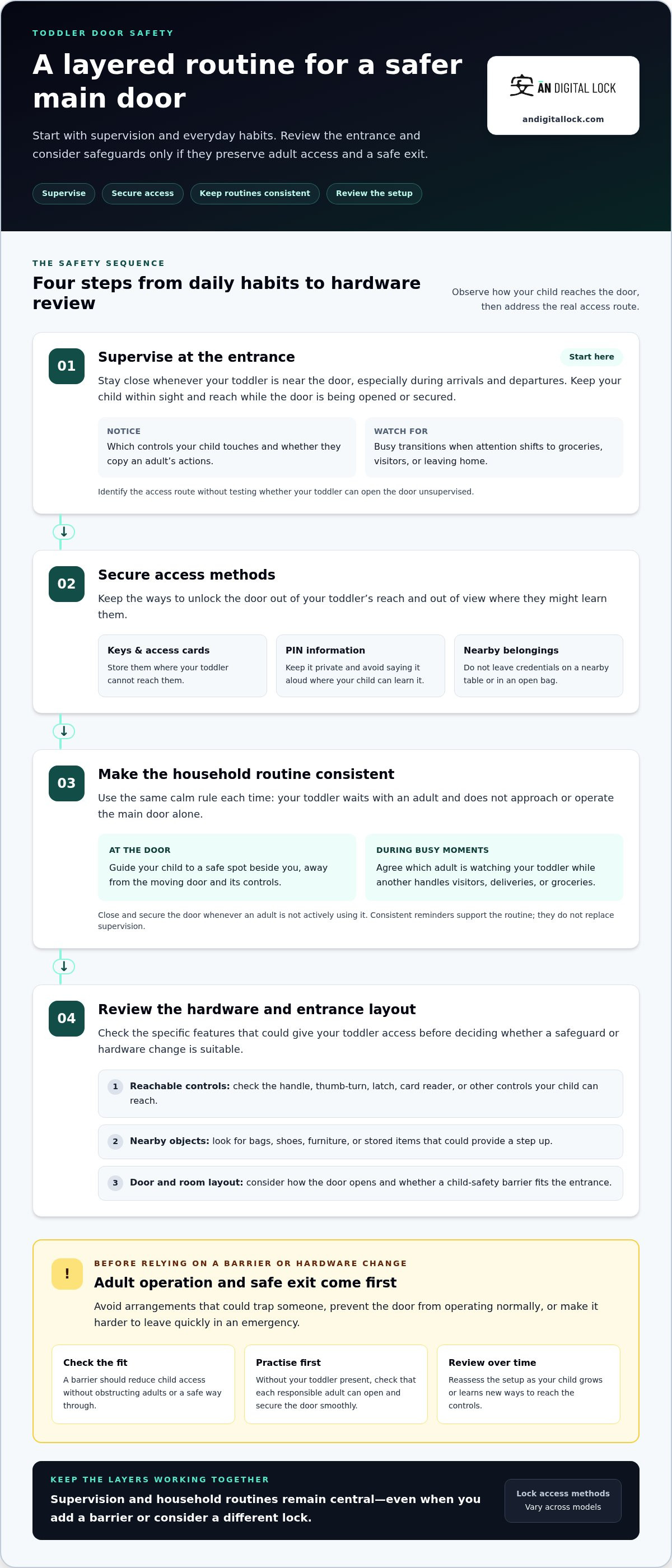
A reliable plan uses layers, starting with adult supervision and everyday habits before you decide whether hardware needs to change. If you’re considering how to prevent my toddler from unlocking the main door, follow these steps and adapt them to your entrance, your child’s reach, and your household’s routine.
- Supervise at the entrance. Stay close whenever your toddler is near the door, especially during arrivals and departures. Keep your attention on your child while the door is being opened or secured.
- Secure access methods. Put loose keys and access cards where your toddler can’t reach them. Keep PIN information private, and avoid leaving credentials on a nearby table or in an open bag.
- Make the routine consistent. Close and secure the door whenever an adult isn’t actively using it. Decide which adult is responsible for watching your toddler during busy transitions instead of assuming someone else has taken over.
- Review the hardware and layout. Consider reachable handles and controls, nearby furniture or objects, and how the door opens. These details affect which safeguards may be suitable.
Physical barriers should reduce a child’s access without obstructing adults or a safe exit. General American Academy of Pediatrics home safety tips can help you think through home hazards as part of a wider safety plan. Avoid improvised arrangements that could trap someone, prevent the door from operating normally, or make it harder to leave quickly in an emergency.
Build a safer routine around the entrance
Use a short, calm phrase your toddler can understand, such as “Wait with me while I open the door.” Repeat it each time, and guide your child to a nearby spot beside you. For visitors, deliveries, or groceries, assign one adult to supervise while another handles the door. A predictable routine reduces confusion, but it doesn’t replace supervision.
Choose barriers and safeguards carefully
A child-safety barrier may be an option if it suits the entrance and leaves adults a clear, safe way through. Door designs and household layouts vary, so assess whether a barrier fits your home. Keep keys and credentials inaccessible to your toddler while ensuring adults can still access and operate the door when needed.
Before relying on an added barrier or hardware change, practise using it without your toddler present. Check that each responsible adult can open and secure the door smoothly, including while carrying everyday items, and that the safeguard doesn’t obstruct an urgent exit. Review the setup as your child grows or learns new ways to reach controls.
If reviewing the entrance leads you to consider a different lock, explore digital door locks for main doors as one possible part of a broader plan. Choose a setup that works for the adults who use it and suits your household’s safety needs.
Door alarms, barriers, or a different lock: compare the options
The right option depends on what’s giving your toddler access and what your household needs at the entrance. Supervision and routine changes help manage everyday behaviour. A barrier changes access to the doorway, while an alert helps adults notice that the door has opened. A lock review may make sense if your child can reach or operate its controls. These measures serve different purposes, so don’t treat them as interchangeable or rely on one device alone.
| Option | Benefit | Limitation | Suitable household use |
|---|---|---|---|
| Routine changes and supervision | Build consistent adult oversight around arrivals and departures. | Depends on caregivers following the routine. | Useful in every household, especially during busy transitions. |
| Door alert | Can notify an adult when the door opens. | Raises awareness but doesn’t physically prevent opening or ensure a response. | May suit a home where adults can act on an alert. |
| Barrier | Can create an additional physical boundary. | Must suit the entrance and allow adults to pass safely. | Consider only if the layout allows clear adult access and exit. |
| Lock change | May address controls a toddler can reach or operate. | Doesn’t replace supervision and must remain usable by adults. | Consider after reviewing the child’s behaviour and household access needs. |
When a door alert or barrier may help
A door alert is an awareness aid, not a physical restriction. It may prompt caregivers to check the entrance, but it can’t stop the door from opening, and adults still need to be able to respond. A barrier may add a boundary, but its suitability depends on the doorway, surrounding space, and how adults need to move through it.
Before using a barrier, consider whether it could obstruct normal adult access or a safe exit. Avoid setups that make it difficult to leave quickly or could trap someone. Choose an option that fits your entrance and supports, rather than replaces, supervision.
When to consider changing the main door lock
Review the lock if your toddler can reach its controls, has learned how they work, or can copy an adult’s unlocking routine. Consider your child’s observed behaviour alongside the access methods adults use and how easily each caregiver can operate the door. A digital door lock may be one layer in a broader safety plan, but no lock should be treated as a childproof guarantee. Access methods vary across models and can include PIN, fingerprint, RFID, and Wi-Fi.
For wider context on comparing lock features and household needs, explore this digital lock buying guide. Practise adult access without your toddler present and make sure the setup preserves a safe exit. This balanced approach can help clarify how to prevent my toddler from unlocking the main door without choosing a safeguard that creates another problem.
A practical checklist for toddler-proofing your main door
Use this checklist to review the entrance, nearby storage, and walking area. Start with changes you can make today, then decide whether the hardware needs attention. The aim is to reduce easy opportunities and make your household routine clearer, not to assume any checklist can remove every risk.
Check the door area and household access habits
Walk through the entrance at your toddler’s height and consider the route they take to reach the door. Look for climbable items, reachable controls, and places where keys or cards are usually left. Then review busy moments, such as visitors arriving or the household leaving together. A clear plan helps prevent supervision from becoming an unspoken assumption.
- Door and controls: Notice handles, thumb-turns, and other controls your child can reach or watch adults use.
- Floor and nearby space: Move stools, bags, shoes, and other climbable objects away from the door.
- Storage spots: Keep keys and access cards in a consistent place that’s out of your toddler’s reach. Keep PIN details private.
- Household routine: Decide which adult supervises during deliveries, visitor arrivals, and other busy transitions.
- Door use: Make sure the door is closed and secured whenever an adult isn’t actively using it.
These immediate steps don’t require a hardware change. They can also show you what’s most important to address when working out how to prevent my toddler from unlocking the main door.
Test the plan from an adult’s point of view
If you’re considering a barrier or lock change, assess the entrance before settling on a solution. Door design, available space, and household routines all affect what may be suitable. Prioritise adult access and a clear exit. A safeguard that makes the entrance difficult to use can create a new problem instead of improving the plan.
- Adult operation: Have each caregiver use the door as they normally would, without relying on a toddler to move or cooperate.
- Safe passage: Check that any added measure doesn’t obstruct normal movement or make it harder to exit quickly.
- Child access: Observe whether controls remain within reach or become easier to operate as your child learns.
- Nearby hazards: Make sure a barrier or changed routine doesn’t create a trip hazard or block the usual path through the entrance.
Revisit the setup as your toddler grows, gains reach, or becomes more dexterous. If the review points to a lock change, explore digital door lock options for your main door as one possible layer in a broader safety plan. Keep supervision and household routines in place alongside any hardware decision.
When a digital door lock may fit into your safety plan
A digital door lock may be worth considering if your current lock’s controls are within your toddler’s reach or your child has learned how to operate them. Treat it as one possible entrance-security choice, not a childproof guarantee. Look for a setup that works for the adults in your household and takes your child’s current abilities into account.
Digital lock models vary in their access methods. Across the range, these can include PIN, fingerprint, RFID, and Wi-Fi. Each option gives adults a different way to access the door, but the method alone doesn’t determine whether a toddler can reach or operate the controls. Review how the specific door is used and where its controls are positioned before deciding what suits your household.
What to consider when a child can reach lock controls
Start with what you’ve observed. Can your toddler reach the controls, copy an adult’s actions, or access a card or PIN? Consider those habits alongside how each adult normally enters and exits. A lock that feels convenient for one caregiver may be less straightforward for another, so include everyone who regularly uses the entrance in your decision.
Don’t assume every digital lock has a child-specific feature or setting. Focus instead on the controls and access methods available on the model, how adults will use them, and whether the arrangement fits your door-area routine. No lock should replace supervision or a clear household safety plan.
Explore a lock option without relying on hardware alone
Hardware is only one part of the picture. Keep the entrance routine consistent, supervise your toddler near the door, and maintain a clear area around the controls. If you’re comparing options as part of working out how to prevent my toddler from unlocking the main door, weigh a lock’s adult usability alongside your child’s reach and learned habits.
For a broader framework, use this guide to choosing the right door lock to think through your household’s needs. Consider how any lock choice will fit with supervision, routines, and safe adult access, rather than expecting hardware alone to solve the issue.
AN Digital Lock has specialised in digital door locks since 2013, with options for main doors across multiple brands. If a digital lock feels like a suitable layer for your household, you can explore digital door locks and consider which access method best fits adult use and your wider safety plan.
Make your next safety step a practical one
Choose one small action to put in place today, such as clearing the area around the entrance or agreeing who will supervise during busy arrivals. Then observe how your child responds and review the setup as their reach and abilities change. A plan that works for your household should help adults use the door smoothly while keeping supervision at the centre.
If you’re still considering how to prevent my toddler from unlocking the main door, treat a lock as one possible part of a broader approach, not a standalone solution. Compare how the controls suit adult access and your child’s behaviour, and keep routines and safe exit in mind as you decide what comes next.
AN Digital Lock offers digital door locks for main doors. Explore digital door locks to consider an option for your household’s needs. Small, thoughtful changes can make your entrance routine more manageable, one step at a time.
Frequently Asked Questions
Can a toddler really unlock a digital door lock?
Yes, a toddler may operate a digital lock if they can reach and work its controls. For example, a child might copy an adult entering a PIN, touch an accessible fingerprint reader, or handle an RFID card left within reach. Access methods vary by model, so assess the specific lock and your child’s behaviour. Don’t assume a digital lock has a child-specific setting or prevents a child from opening the door.
What should I do if my toddler has already opened the main door?
Bring your child back inside, close the door, and make sure they’re safe before reviewing how it happened. Check whether they reached a control, used a credential, or found the door unsecured during a busy moment. Then adjust the immediate routine, such as having an adult stay beside the child during departures. If you can’t locate your child or they may be hurt, seek urgent help.
Is it safe to install a childproof lock high on the main door?
Not automatically. A high-mounted device may be beyond a toddler’s reach, but it must still be usable by adults and mustn’t obstruct a quick exit. Consider the door’s construction, the device’s operation, and the needs of everyone at home, including anyone who may have difficulty reaching it. Test adult access in ordinary conditions before relying on the setup, and avoid a device that could trap occupants.
Do door alarms stop toddlers from opening the door?
No. A door alarm can alert an adult that the door has opened, but it doesn’t physically stop a toddler from turning a handle or operating a lock. Its usefulness depends on an adult noticing and responding to the alert. For example, an alarm may add awareness while an adult is elsewhere in the home, but it shouldn’t replace supervision or a physical safeguard that still permits safe adult access.
Should I replace my main door lock if my toddler can open it?
Not necessarily. First identify exactly how your toddler operates the existing lock and whether a change in routine or access storage addresses that route. Consider replacement if the child can repeatedly reach and use the controls despite those changes. Compare adult access needs with your child’s current abilities, and test any new arrangement with the adults who regularly use the door. No replacement lock guarantees a toddler cannot open it.
How can I keep the main door safe while still allowing adults to exit quickly?
Keep the path to the door clear and avoid adding a device that requires complicated steps or blocks normal operation. Make sure adults can access any needed key, card, or PIN without leaving it where a toddler can reach it. Practise opening the door with the safeguards in place, including during a realistic departure routine. If an adult struggles to use the setup smoothly, reassess it before relying on it.