


What if a gate that looks secure and works smoothly still creates a corridor safety issue? If you’re wondering what to do if my HDB gate fails the corridor clearance rule, treat it as a compliance and fit problem, not a cosmetic defect. The specific concern matters: a gate beside a common corridor and one next to a staircase are assessed differently.
A failed check can raise concerns about replacement, deadlines or enforcement. Before acting, clarify what was measured and who issued the assessment. HDB’s gate requirements address clearance and how the gate opens, while SCDF’s corridor guidance focuses on keeping an escape passage clear.
This guide explains how to review a notice, identify the clearance issue and decide on practical next steps. Depending on the finding, those steps might include moving an obstruction, assessing an adjustment or considering a replacement. The aim is an entrance that meets the applicable requirements while remaining safe and usable.
Key Takeaways
- An HDB gate clearance finding concerns shared access and safety, not simply appearance.
- To work out what to do if my HDB gate fails the corridor clearance rule, review the notice and clarify the specific issue first.
- Possible next steps include moving nearby obstructions, adjusting the gate or considering replacement. The right fix depends on the finding.
- Keep the common corridor and access route clear while documenting the issue and following up.
- When considering a replacement, assess clearance, swing direction, daily access and entrance security together.
HDB gate fails the corridor clearance rule: what the finding means
A failed clearance check doesn’t automatically mean your gate must be replaced. Start by identifying what the finding describes: a measured obstruction, a gate that swings into a restricted area, or a general reminder to keep the shared corridor clear. Each points to a different issue and may need a different response.
Corridor clearance is the unobstructed space that must remain available for people to move along a shared corridor and reach an exit safely. The Housing & Development Board (HDB) manages Singapore’s public housing. When interpreting a gate-related finding, use the current HDB guidance that applies to your flat and layout.
What does corridor clearance mean for an HDB gate?
Consider the route a neighbour would use to walk past your entrance, not just how the corridor looks with the gate closed. The gate leaf is the moving panel, and its swing path is the space it occupies as it opens. Handles, hinges and other hardware can also project into that space. Nearby belongings, such as a shoe rack, are separate obstructions, even if they further narrow the walking route.
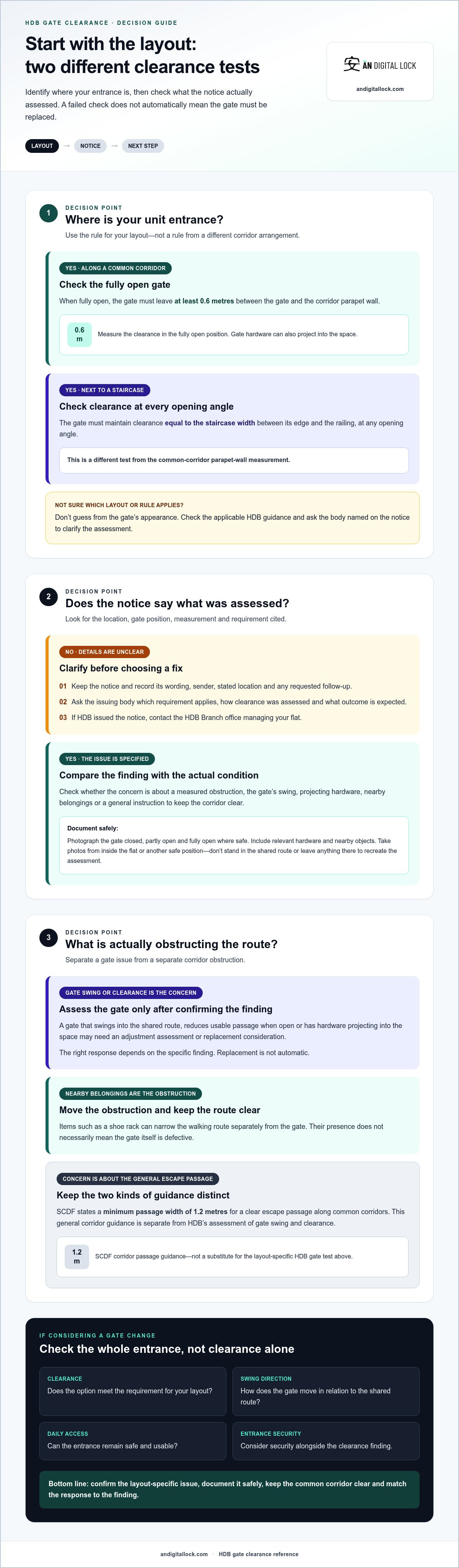
HDB’s guidance dated August 20, 2026 states that, for a unit along a common corridor, the fully open gate must leave at least 0.6 metres between the gate and the corridor parapet wall. For a unit next to a staircase, the gate must maintain clearance equal to the staircase width between its edge and the railing, at any opening angle. These are different situations, so don’t apply one rule to every layout.
Why might a gate fail a clearance check?
A gate may open into the shared route, reduce the usable passage when open or have hardware that projects beyond the gate leaf. Nearby belongings can also obstruct the corridor, though that does not necessarily mean the gate itself is defective. A general safety warning may not identify a measured gate failure, so check for the specific location, gate position and requirement cited.
HDB’s gate-swing guidance is separate from SCDF’s general requirement to maintain a clear escape passage along common corridors. SCDF states a minimum passage width of 1.2 metres. That guidance concerns corridor obstructions generally and should not be confused with HDB’s assessment of a gate’s swing and clearance.
Where possible, ask for the reason in writing, especially if the notice doesn’t say what was measured, where the gate was positioned or which rule applies. Record whether the gate was fully open or at another angle, and note any nearby objects. This information helps you decide what to do if my HDB gate fails the corridor clearance rule. A loose hinge or removable obstruction may be relevant, but don’t assume either is the cause or that replacement is inevitable. Check current official guidance and clarify the finding before choosing a fix.
How to verify an HDB corridor-clearance notice before acting
A notice can feel urgent, but a documented review helps you understand what needs attention before choosing a fix. Follow these steps and keep the corridor clear while gathering information.
Read the notice, identify the concern, document the gate and surrounding area, then seek clarification from the issuing authority.
- Read the notice carefully. Note the date, sender, wording, location of the stated issue and any requested follow-up. Keep the original notice and its envelope or message details. If it mentions a deadline or action, record the wording accurately rather than relying on memory.
- Pin down what was assessed. Check whether the concern refers to the gate’s position, its swing, a measurement, nearby items or a general instruction to keep the corridor clear. A general warning is not proof that the gate failed a specific measurement.
- Document the entrance safely. Take clear photographs with the gate closed, partly open and fully open, where safe to do so. Include the gate edge, hardware, nearby fittings and any objects mentioned in the notice. Take photos from inside the flat or another safe position. Don’t stand in the shared route or leave anything there to recreate the assessment.
- Ask for case-specific clarification. Contact the body named on the notice and describe the issue using its wording. If HDB issued it, contact the HDB Branch office managing your flat. Ask which requirement applies, how clearance was assessed and what outcome is expected. Keep a record of the reply and any reference details.
What details should you record after a failed check?
Keep the notice, photographs and follow-up in one place. Note the gate position shown in each image, the date the photos were taken, and whether nearby objects or fittings could affect the passage. Avoid editing images in ways that change the scene. Clear documentation helps distinguish a gate issue from a separate corridor obstruction.
Who can clarify the requirement for your case?
Start with the sender instead of guessing which rule applies. If a Town Council or another body raised the concern, ask it to identify the basis for its notice and whether HDB needs to address the gate-specific question. For a fire-safety point, consult current Singapore Civil Defence Force guidance. For an HDB gate requirement, seek clarification through the relevant HDB channel.
If you’re asking what to do if my HDB gate fails the corridor clearance rule, use the written clarification to compare the finding with the conditions at your entrance. Don’t alter or replace the gate based on assumptions. Once the issue is clear, consider entrance options, including metal gate options, while keeping the assessment and safety requirements central to your decision.
Compare possible fixes for an HDB gate that fails clearance
The right response depends on what caused the finding. A shoe rack blocking the route is different from a gate leaf that takes up too much space when open. Use the comparison below to consider options after clarifying the assessment. The right-hand column covers trade-offs and checks, because no option is a guaranteed fix.
| Option | When it may suit | Trade-offs and checks |
|---|---|---|
| Remove or relocate nearby items | The concern appears to involve belongings or a separate obstruction in the corridor. | This is usually the least disruptive option and won’t change the gate’s appearance or security. Keep the shared route clear, then check whether the stated concern remains. Moving an item won’t resolve a gate-swing issue. |
| Adjust or repair the existing gate | The finding may relate to gate position, loose fittings, sagging or hardware affecting its movement. | This could preserve the current appearance and security, but suitability depends on the cause and gate condition. Work may cause temporary disruption. Any alteration must meet applicable HDB requirements. Clarify whether approval is required before proceeding. |
| Replace the gate | The existing gate’s configuration may not provide the required clearance, even after relevant obstructions are addressed. | Replacement gives you a chance to reconsider everyday access, security and entrance appearance, but involves installation disruption and a new purchase. The replacement must follow HDB requirements. Don’t assume a new gate will pass simply because it is new. |
When might an adjustment or obstruction removal be relevant?
Start with the specific cause recorded in the assessment. If an object is narrowing the walking route, relocating it may address that obstruction. If the gate is sagging or not sitting correctly, a suitable repair or adjustment may be worth assessing. Neither step guarantees a pass. The result depends on the applicable rule, the gate’s position and the measured clearance. Confirm requirements before changing the gate.
When should you consider replacing the gate?
Replacement may be worth considering if the existing gate cannot achieve the required clearance in its current configuration. HDB’s guidance states that the replacement’s width, number of panels and swing direction must match those originally provided. A like-for-like replacement that follows HDB guidelines does not require a renovation permit, but renovation work must be carried out by a contractor listed in HDB’s Directory of Renovation Contractors. Confirm current requirements for your flat before arranging work.
Compare more than appearance. Consider whether the gate opens comfortably, provides the entrance security you want and works with the main door. Installation may temporarily affect access to your entrance, so plan around the work. AN Digital Lock sells metal gates, including mild-steel options, for homeowners considering replacement. The product itself does not establish that a gate meets a clearance requirement. For what to do if my HDB gate fails the corridor clearance rule, let the verified cause guide your decision, and explore metal gate options as one part of the process.
Steps to resolve the clearance issue while keeping the corridor safe
Keep residents’ access and safety in view as you work through the finding. The immediate priority is a clear route. Choose a longer-term remedy based on the authority’s clarification, not guesswork. These steps help organise the process and create a useful record.
- Clear the shared passage. Move belongings, loose items and anything else you control out of the common corridor. Don’t leave tools, packaging or materials outside your flat, even temporarily. Keep the route clear while the gate issue is being assessed.
- Preserve the original information. Save the notice, photographs and any measurements or details you recorded. Keep copies of messages or letters from the issuing authority, along with dates and reference details. This helps you compare the stated concern with any proposed change.
- Clarify what needs to change. If the required outcome is unclear, ask the issuing authority to explain it in writing. Identify the notice, describe what you understand the concern to be and ask what condition must be met. Don’t assume that moving an item, adjusting the gate or replacing it will resolve the finding.
- Check before altering the gate. Before arranging a repair or replacement, confirm which HDB requirements apply to your flat and whether approval is needed for the proposed work. Avoid structural changes or changes to the gate’s configuration until you’ve checked the applicable guidance. Keep the corridor clear during any work.
- Follow the stated next step. If the authority requests further information, an inspection or confirmation after a change, follow the process it gives you. Don’t assume that every case has the same inspection route or response deadline.
What should you do while waiting for clarification?
Keep your correspondence focused and factual. State what the notice says, explain what you’ve observed and ask a specific question about the required outcome. Keep the authority’s replies with the original notice. If the gate or an item presents an immediate obstruction, safely remove what you can without making an unverified alteration to the gate itself.
How should you document a completed change?
Once an agreed change is complete, take dated photographs showing the gate closed and open in the relevant positions, along with the clear passage beside it. Keep installation or alteration records with the notice and related correspondence. Send evidence or arrange a follow-up only as directed by the issuing authority. Photographs support your record but don’t replace any inspection or confirmation it requires.
If you’re deciding what to do if my HDB gate fails the corridor clearance rule, let the written requirement guide your next step and keep evidence of the outcome. If replacement is appropriate, explore metal gate options with your entrance needs in mind, while checking the applicable requirements separately.
Choose an HDB gate solution that supports clearance and entrance security
Choose a replacement only after you know the requirement for your flat and the cause of the clearance issue. HDB’s current guidance distinguishes between a unit along a common corridor and one beside a staircase. For a common corridor, the fully open gate must leave at least 0.6 metres between the gate and the parapet wall. Beside a staircase, the gate must maintain clearance equal to the staircase width between its edge and the railing at any opening angle. Use the measurement and layout that apply to your flat, rather than choosing by appearance alone.
What should you consider when selecting a replacement gate?
Start with how the gate moves in the available space. HDB guidance says the replacement gate’s width, number of panels and swing direction must match those originally provided. A change that looks more convenient could affect the shared route or a neighbour’s access, so don’t assume a different configuration is acceptable. Confirm the applicable requirement before choosing a design.
- Clear passage: Consider the gate’s fully open position, its swing path and the specific clearance assessment for your flat.
- Daily operation: Think about how easily household members can open and close the gate without encroaching on the corridor.
- Security and privacy: Choose a gate that suits your entrance needs. If a fully enclosed design obscures the flat number, HDB-related guidance says the number must remain visible from the corridor, either on the gate or adjacent wall.
- Material and appearance: Compare the look and feel of options such as mild-steel metal gates with the rest of your entrance. A design preference doesn’t establish compliance.
These checks help narrow your choices, but they don’t replace the authority’s stated requirement or confirm that a particular gate will pass an assessment.
How do gate and main-door decisions work together?
The gate and main door share the entrance area, so consider their movement and everyday use together. Check that opening one doesn’t make the other awkward to operate, and think about where a lock or handle sits in relation to the gate panels. Keep clearance as the priority, then weigh security, convenience and a coordinated appearance. For broader entrance planning, the HDB main door guide can help you consider how the door fits with the gate. For related locking decisions, see the Singapore door-lock selection guide.
If you’re working out what to do if my HDB gate fails the corridor clearance rule, let the verified requirement shape your selection before comparing styles. Explore metal gates and entrance products as you plan a secure, practical entrance.
Move forward with a safer, more usable entrance
Your next step doesn’t have to be a rushed replacement. Let the confirmed clearance requirement guide your decision, then choose an entrance setup that supports safe passage and works for everyday use. A clear understanding of the issue helps you weigh adjustments or replacement more confidently.
If you’re still asking what to do if my HDB gate fails the corridor clearance rule, resolve the specific finding before choosing a design. AN Digital Lock offers metal gates, doors and digital locks as part of its entrance product range. Product choice is one part of the decision. The applicable HDB requirement remains central.
When you’re ready to explore options, explore metal gates and entrance products for your home. Choose a practical entrance setup with safety and usability in mind.
Frequently Asked Questions
What should I do first if my HDB gate fails the corridor clearance rule?
Start by checking the notice for the sender and the exact concern. If you’re unsure what to do if my HDB gate fails the corridor clearance rule, don’t make a rushed change based on a brief or verbal comment. Take photos from inside your flat or another safe position, then ask the sender to explain the finding and required outcome. Keep the response with the notice so you can refer to the same instructions later.
Can I keep my existing HDB gate if it fails a clearance check?
Possibly, depending on what caused the finding and what the responsible authority requires. The concern might relate to an item beside the gate rather than the gate itself. In another case, the gate’s position or movement may be central. Ask the authority to state what condition must be corrected, then compare that with the gate’s operation before deciding whether an adjustment or replacement is appropriate.
Does an HDB gate have to open in a particular direction to meet corridor clearance?
The applicable gate requirements depend on your flat’s layout, so don’t assume a different swing direction will solve the issue. HDB’s August 2026 guidance says the replacement gate’s swing direction must match the one originally provided. It also sets different clearance checks for common-corridor units and flats beside staircases. Ask HDB which situation applies and how the gate’s movement was assessed in your case.
Who should I contact about an HDB gate clearance notice?
Contact the organisation identified on the notice first. If HDB issued it, direct your question to the HDB Branch office managing your flat. If it came from your Town Council, ask that office to clarify its finding and whether HDB needs to address a gate-specific requirement. For fire-safety guidance, consult the Singapore Civil Defence Force. Keep names, dates and written replies together so you can refer to the same information.
Can I modify my HDB gate myself to create more corridor clearance?
Don’t alter the gate until you’ve checked the requirements and whether approval is needed for the proposed work. A change to hinges, posts or gate positioning can affect movement and security as well as the passage outside your home. First establish whether the issue is the gate or a separate obstruction. If work is needed, follow HDB’s renovation guidance, including its contractor requirements, and retain records of the work.
Will a new metal gate automatically pass the HDB corridor clearance rule?
No. A replacement still needs to meet the requirements that apply to your flat. Choosing a new gate doesn’t establish that it will pass. HDB guidance says the replacement’s width, number of panels and swing direction must match those originally provided. Before selecting a design, compare its movement and position with the stated clearance concern, and clarify any required follow-up with the responsible authority.
Does a digital gate lock affect corridor clearance?
A digital lock doesn’t by itself resolve a corridor-clearance concern. Focus first on the gate’s position, movement and the specific finding. If you’re considering a lock change, include daily operation in your planning: check that the lock can be used comfortably without changing the gate’s required configuration or obstructing the shared route. Clarify the relevant requirements before combining lock or gate alterations into the same project.