


A fire resistance safe isn't actually meant to be "fireproof" in the way most people imagine; it's a strategic time-management tool designed to buy you a 60 to 120-minute window of survival for your legacy. You might feel overwhelmed by technical jargon or worry if your HDB floor can even support the weight of a high-security unit. It's common to fear that a safe labeled for fire won't actually protect your digital hard drives or that the ratings are just marketing fluff. We understand that choosing the right protection is about more than just steel; it's about the peace of mind that comes from knowing your birth certificates and family photos are secure.
In this guide, you'll learn how to decode the latest ANSI/CAN/UL 72:2026 standards and select a model that fits your specific living space perfectly. We'll simplify the differences between JIS and KS ratings so you can shop with total confidence. You'll also get clear answers on how to protect sensitive digital media from extreme heat and how to choose a size that won't compromise your home's structural integrity. This overview provides a clear roadmap to securing your most valuable assets against both heat and theft using the latest 2026 security innovations.
Key Takeaways
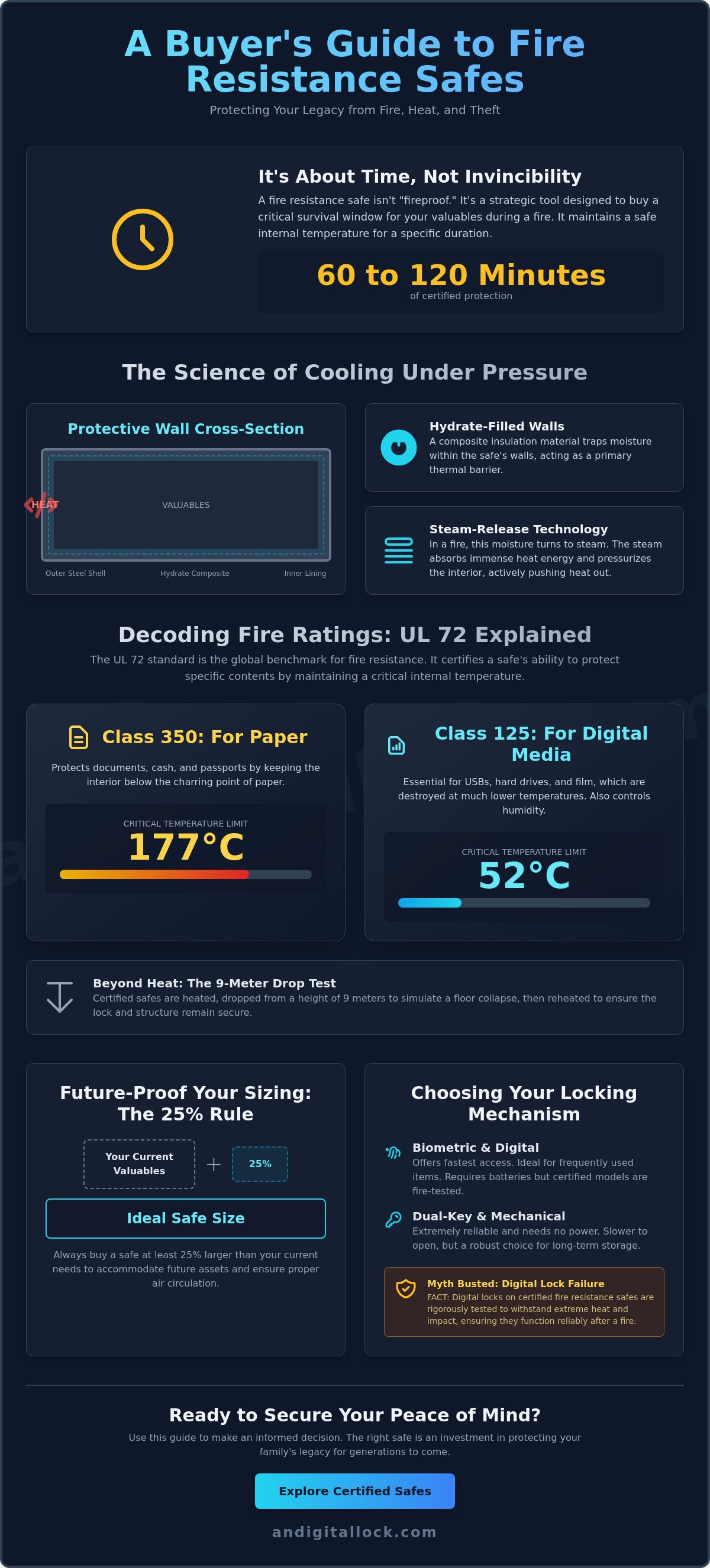
- Understand how hydrate-filled walls and steam-release technology create a cooling shield for your valuables during a fire.
- Learn to decode international standards like UL 72 and JIS to ensure your fire resistance safe provides the specific protection window your documents require.
- Use our volume calculation formula to find the perfect fit and discover why buying a unit 25% larger than your current needs is essential for future-proofing.
- Compare the speed and security of biometric and dual-key systems while debunking common myths about digital locks failing in high-heat scenarios.
- Get expert recommendations on the best entry-level and heavy-duty models tailored for Singaporean residential spaces like BTO flats.
What is a Fire Resistance Safe and How Does it Work?
A fire resistance safe is a specialized enclosure engineered to maintain a stable internal climate even when the world outside is engulfed in flames. Unlike standard security safes that focus solely on thick steel to prevent prying, these units use composite walls filled with hydrates. These materials act as a thermal barrier, slowing the transfer of heat from the exterior to your sensitive documents and heirlooms. It's a precision-engineered tool designed to buy you time when every second counts.
The core technology relies on a "steam-release" mechanism. When the safe is exposed to high temperatures, the moisture trapped within the wall insulation begins to evaporate. This process creates a layer of steam that absorbs heat energy and pressurizes the interior, effectively blocking external heat from entering. It's a clever use of physics that keeps your valuables cool under pressure. While these safe boxes provide excellent thermal protection, they are also designed with security in mind, often featuring drill-resistant plates and active locking bolts to deter theft.
The Science of Thermal Insulation
Fire Resistant vs. Fireproof: Clearing the Confusion
It is a common misconception that a safe can be entirely "fireproof." In reality, every safe has a specific fire-resistance rating that dictates how long it can withstand extreme heat before the internal temperature becomes dangerous. This rating is a measure of time, usually 60, 90, or 120 minutes. The industry uses the term "resistant" because no material can withstand intense heat indefinitely.
You should also distinguish between a basic fire box and a high-security fire safe. A fire box is often a lightweight container meant for portability and basic heat protection, whereas a high-security safe offers robust burglary resistance alongside thermal insulation. Many people assume that a heavy anti-theft safe will naturally protect against fire, but this is rarely true. Standard anti-theft safes often consist of a single layer of steel, which actually conducts heat directly to your valuables, turning the safe into an oven within minutes. Choosing a dedicated fire resistance safe ensures you have the necessary insulation to protect your legacy.
Decoding Fire Ratings: UL 72, JIS, and KS Standards
Understanding the technical certification on a fire resistance safe is the only way to guarantee your valuables survive a disaster. These ratings aren't just marketing labels. They represent brutal laboratory tests where safes are baked in industrial ovens at temperatures exceeding 1,000°C. In Singapore, you will primarily encounter three international standards: UL (USA), JIS (Japan), and KS (Korea). Each one tells you exactly how many minutes of protection you are buying and what specific items the safe can actually protect.
The testing process is rigorous. Beyond simple heat endurance, many certified safes undergo a "drop test" to simulate a floor collapsing in a multi-story building. This is particularly relevant for residents in high-rise HDB flats. After the safe is heated, it is dropped from a height of about 9 meters, then reheated to ensure the structure and the lock remain intact. Testing also accounts for the cooling period. Even after a fire is extinguished, the metal continues to conduct heat. A high-quality safe must keep its internal temperature stable long after the flames are gone.
UL 72 (Underwriters Laboratories) Explained
UL 72 is widely considered the global gold standard for thermal protection. It distinguishes between different types of contents through specific classes. Class 350 is designed for paper documents, keeping the internal temperature below 177°C. If you plan to store USB drives, hard drives, or old film negatives, you need a Class 125 rating. This stricter standard keeps the interior below 52°C and maintains low humidity levels. These rigorous requirements are why many experts, including those featured in Popular Mechanics' Best Fireproof Safes, prioritize UL certification for high-value protection.
JIS (Japan) and KS (Korea) Ratings
Many of the most popular brands in Singapore, such as Diplomat, carry JIS or KS ratings. These standards are highly reliable and often more common in the local market. A 1-hour JIS rating is generally comparable to a UL 1-hour rating for residential use. These tests also include an "Explosion Hazard Test," where a safe is placed into a pre-heated furnace to see if the rapid temperature spike causes the insulation to expand too quickly and rupture the safe's body. For a typical HDB flat, a 60-minute fire resistance safe is the "sweet spot," providing ample time for the Singapore Civil Defence Force (SCDF) to respond and extinguish a domestic fire.
Before you commit to a purchase, it's helpful to compare these technical specs against your specific home layout. You can browse our curated selection of Safe Boxes to find a model that balances these international standards with the right dimensions for your wardrobe or study.
How to Choose the Right Size and Placement for Your Safe
Selecting the right fire resistance safe requires a balance between your current inventory and your future needs. Most homeowners underestimate how quickly a safe fills up once they start protecting birth certificates, title deeds, and digital backups. To find your ideal size, stack your items and measure the total height, width, and depth. Always buy a unit that is at least 25% larger than your current stack. This future-proofing ensures you won't need to upgrade when you add more heirlooms or documents later.
Weight is a critical factor for Singaporean residential floors. While most HDB and Condo units can easily support standard home safes weighing between 30kg and 80kg, heavy-duty models exceeding 150kg require careful placement. Position heavier safes against load-bearing walls or in concrete corners to distribute the weight safely. These spots also offer the best protection during a fire, as they are less likely to collapse even if the floor's structural integrity is compromised.
Measuring Your Valuables
When browsing specifications, look closely at the internal dimensions rather than the exterior footprint. A fire resistance safe has significantly thicker walls than a standard security box because of the hydrate-filled insulation. An external width of 40cm might only offer 28cm of usable space inside. Consider these common internal requirements:
- A4 Documents: These require a minimum internal width of 210mm to lie flat without folding.
- Jewelry Boxes: These often need more internal depth than paper-only safes.
- Digital Media: Hard drives and USBs should be placed in fire-resistant pouches for an extra layer of thermal shielding.
- Cash: Stacks of currency are best kept in the center of the safe, away from the walls.
Safe Placement Strategy in Singapore Homes
The master bedroom wardrobe is the most common choice for convenience, but it's often the first place a burglar looks. Your choice of lock also dictates where you can hide the unit. A traditional dial lock requires good lighting to operate, while a modern biometric safe box can be opened instantly in a dark corner. If you choose to bolt your safe to the floor, be aware that the mounting hole can technically act as a heat conductor. High-quality manufacturers mitigate this with specialized gaskets, but placement on a concrete floor is always preferred over wooden laminate.
Ensure your delivery path is clear, especially when maneuvering through your HDB main door. Measuring your doorways and hallways beforehand prevents logistical headaches on installation day. Strategic placement near the entrance can make professional installation faster and easier, especially for heavier models that require specialized trolleys.
Digital vs. Mechanical: Selecting the Best Locking Mechanism
Choosing the right interface for your fire resistance safe is a decision that balances daily convenience with long-term reliability. In 2026, the technology has advanced significantly, offering several ways to secure your legacy. You aren't just choosing a lock; you're choosing how you interact with your security during both calm and crisis. Most homeowners prefer the speed of digital systems, but mechanical locks still hold a specific appeal for those seeking a "set and forget" solution.
The speed of access varies greatly between systems:
- Biometric: Provides near-instant entry, usually in under one second.
- PIN Code: Takes roughly 3 to 5 seconds to input a secure code.
- Dual-Key: Requires both a physical key and a code, offering the highest level of security at the cost of speed.
- Mechanical Dial: The slowest option, often taking 15 to 30 seconds of precise turning.
A common fear is that a digital lock will melt during a fire and trap your valuables forever. While the external plastic keypad may indeed deform in extreme heat, the internal locking bolt and the fire-resistant core protect the actual mechanism. High-quality safes include an emergency override key. This allows you to manually retract the bolts once the safe has cooled down. For home offices, many digital models now include audit trails. This feature lets you track exactly when the safe was opened, which adds a layer of accountability in shared households.
The Rise of Biometric Fire Safes
Biometric technology is no longer a futuristic luxury. Modern sensors are designed to handle aged or slightly wet fingerprints with high accuracy. This convenience is perfect for daily-use items like cash or passports. If you're interested in the latest home security trends, consulting a digital lock singapore expert can help you find a safe that matches the ease of use you expect from your front door security. These systems eliminate the need to memorize complex codes or hide physical keys.
Traditional Dial and Key Locks
Mechanical dial locks remain the gold standard for reliability. They don't require batteries, making them ideal for safes that you only open once or twice a year. While they require more maintenance to keep the internal tumblers moving smoothly, they're immune to electronic failure or hacking. Some high-end fire safes now use hybrid systems. These combine a digital keypad for daily ease with a physical key for secondary verification, giving you the best of both worlds.
Explore our curated range of safe boxes to find the locking mechanism that best fits your lifestyle and security needs.
Top Fire Resistance Safes for Singaporean Homes in 2026
Selecting a fire resistance safe is the final step in securing your home's most vital assets. In 2026, the options range from compact document boxes to massive, high-security vaults. It's vital to purchase from a trusted local supplier who provides professional delivery and after-sales support. This ensures your safe is installed correctly, especially when dealing with the weight limits of high-rise residential floors. Professional installers also ensure that bolting is done without compromising the fire-resistant seals of the unit.
For many residents, a digital-first model is the ideal solution. These units feature advanced biometric sensors and backlit PIN pads, making them easy to use even in low-light conditions. They offer the perfect blend of modern convenience and traditional thermal protection. You can set up multiple users, which is perfect for families who need to access shared documents like insurance policies or passports quickly. These systems often include low-battery alerts, so you're never locked out at a critical moment.
Standout Models for Documents and Cash
Entry-level models are specifically designed for BTO homeowners who need to protect essential paperwork. These safes typically offer a 60-minute JIS fire rating, ensuring your deeds and certificates remain intact during a typical domestic fire. Most models include adjustable shelving and internal drawers, allowing you to customize the interior layout for cash stacks or jewelry. This flexibility is essential as your collection of valuables grows over time. You can view our full fire resistance safe collection to compare the latest features and dimensions for your specific space.
The Premium Choice: High-Security Fire Safes
Secure Your Legacy with the Right Protection
Protecting your most valuable documents and heirlooms requires more than just a metal box; it's a strategic investment in time. You've now learned how to decode complex international ratings and why choosing a fire resistance safe with a 60 to 120-minute window is the ideal choice for most Singaporean homes. By calculating your internal volume needs and selecting a placement that respects your floor's structural limits, you've already taken the hardest steps toward total peace of mind.
As an authorized distributor of global brands like Diplomat and SentrySafe, we bring over 10 years of home security experience in Singapore to every installation. Our team provides expert bolting services to ensure your unit is both fire-ready and theft-deterrent. Don't leave your legacy to chance when professional protection is just a click away. Secure Your Legacy: Browse Our Full Fire Resistance Safe Collection today. Your birth certificates, property deeds, and family memories deserve a sanctuary that stands the test of time and heat. Start building your secure home today.
Frequently Asked Questions
Can a fire-resistant safe protect my USB drives and external hard drives?
Most standard fire safes only protect paper documents and won't save your digital media. To protect USB drives and hard drives, you need a unit specifically rated as UL Class 125, which keeps internal temperatures below 52°C. Standard paper-rated models allow internal heat to reach 177°C. This is enough to melt sensitive electronic components and destroy your data forever.
How do I bolt down a fire safe without compromising its fire rating?
You should only use the manufacturer's pre-drilled mounting holes to secure your unit. These holes are engineered with specialized fire-resistant gaskets that expand when exposed to heat, sealing the opening. Never drill your own holes into a fire resistance safe. Doing so punctures the hydrate-filled insulation layer and creates a direct path for heat to enter, which effectively voids the fire certification.
Is a 30-minute fire rating enough for a typical home fire?
A 30-minute rating is usually insufficient for a typical residential fire. House fires often burn at high temperatures for over an hour before the Singapore Civil Defence Force can fully extinguish the blaze. We recommend a minimum 60-minute rating for HDB flats and condos. This provides a safer buffer to account for the cooling period when the safe remains hot after the flames are out.
Do fire safes protect against water damage from fire sprinklers?
Fire resistance doesn't automatically guarantee protection against water from sprinklers or fire hoses. While the steam-release mechanism creates internal pressure that helps keep water out, only safes with a dedicated waterproof seal can fully protect against submersion or high-pressure sprays. Check the product specifications for an ETL water protection rating if you're worried about flooding or liquid damage during a fire.
How often do I need to change the batteries in a digital fire safe?
You should replace the batteries in your digital safe every 12 to 18 months. Always use high-quality, brand-name alkaline batteries rather than rechargeable or cheap zinc-carbon versions. Digital locks require a consistent high-voltage output to move the motorized bolts. Regular maintenance prevents battery leakage from damaging the sensitive electronic keypad and ensures you don't face an unexpected lockout during an emergency.
What happens if the digital keypad of my safe is damaged in a fire?
If your keypad melts or fails during a fire, you can still access your items using the emergency override key provided at purchase. Premium fire safes are designed so that the internal locking bolts remain secure even if the external electronics are destroyed. Keep your override keys in a separate, secure location outside the safe so you can retrieve your valuables once the unit has cooled down completely.
Are fire-resistant safes also burglar-proof?
Not every fire resistance safe is built to withstand a burglary attempt. Some models focus purely on thermal insulation and use thinner steel that a determined thief could easily puncture. For total protection, look for a dual-rated safe that offers both fire certification and a burglary rating like RSC. These units feature thicker steel, active locking bolts, and drill-resistant plates to deter forced entry.
Why is there moisture or a 'musty' smell inside my fire safe?
The musty smell is caused by the moisture-rich insulation materials used in the safe's walls. Because these safes are airtight to keep out heat, humidity can build up inside and affect paper or jewelry. You should open your safe for at least 20 minutes every two weeks to allow for air circulation. Placing a silica gel desiccant pack inside will also help absorb excess moisture and prevent mold growth.