


What if the biggest privacy risk in your corner unit isn’t the main door, but a window or corridor sightline you haven’t considered? Choosing corner unit hdb privacy and security solutions starts with identifying what’s actually exposed, rather than assuming every entrance needs an upgrade.
It’s understandable to want more privacy and peace of mind, especially when your home is beside a shared corridor or another flat’s window. But a digital lock manages access; it won’t screen views into your home or resolve every entrance concern.
This 2026 buying guide explains how to assess your unit’s exposure, compare practical options such as wooden doors, metal gates, digital door locks, digital viewers and doorbells, and prioritise improvements that suit your home. You’ll also learn what to check for product compatibility, installation requirements and applicable HDB rules before buying or arranging changes. Start with the sightlines and entrance conditions you can observe, then match each improvement to a specific need.
Key Takeaways
- Audit sightlines, entrance exposure, household routines and existing access controls before deciding what needs attention.
- Compare wooden doors, metal gates and digital locks by their different roles, compatibility needs and practical considerations.
- Consider whether PIN, fingerprint, RFID or Wi-Fi access suits your household, then verify the functions of each lock model.
- Use the corner unit hdb privacy and security solutions checklist to record your door and gate materials, current lock and intended users before shortlisting options.
- Match your setup to the concern you’ve observed, and check applicable HDB requirements and product compatibility before arranging changes.
Corner Unit HDB Privacy and Security: Assess What Actually Needs Attention
A corner flat doesn’t automatically have more security risks. The layout, nearby shared spaces, window placement and entrance position all affect what needs attention. Before comparing corner unit hdb privacy and security solutions, assess the conditions around your own home. A concern about people seeing into a room differs from a concern about who can enter, and each calls for a different response.
An entrance-security assessment is a simple review of observable sightlines, entrance conditions, household access needs and existing controls. It helps you identify what to address before buying or changing anything.
Which corner-unit privacy concerns are worth checking?
Check whether someone using a shared corridor or another commonly used space can see your entrance or private areas. Walk through the rooms you use and note what’s visible from the doorway, then repeat the check at different times. Lighting, open doors and everyday household activity can change what’s exposed, so one quick glance may not tell the whole story.
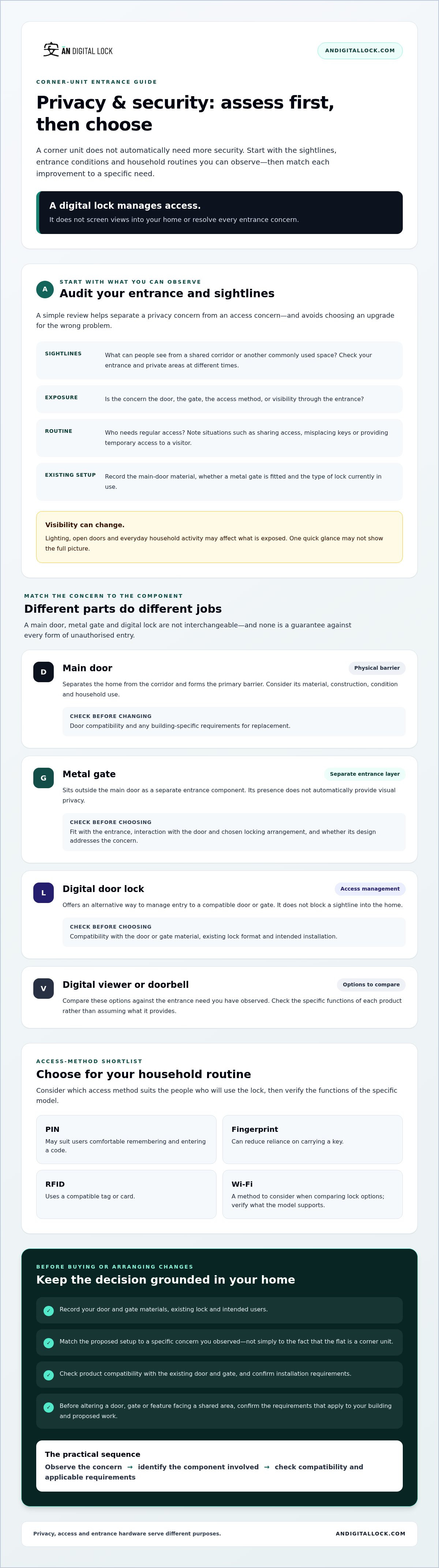
Keep privacy and entry concerns separate. A door lock manages access; it doesn’t block a sightline into your home. For a foundation in the hardware and ideas involved in door security principles, consider how locks, door construction and viewing features serve different purposes. First identify the problem you want to solve.
How to map entrance-security priorities before shopping
Make a short record of your current setup. Note the main-door material, whether there’s a metal gate, the existing lock type and who needs regular access. Then list the situations that matter to your household, such as sharing access, misplacing keys or providing temporary access to a visitor.
Use this quick audit to turn observations into a shortlist:
- Sightlines: What can people see from shared spaces, and at what times?
- Entrance exposure: Is the concern about the door, gate, access method or visibility through the entrance?
- Household routine: Who needs access, and what access problems come up in daily use?
- Existing controls: What door, gate and lock are already fitted?
Before altering a door, gate or feature facing a shared area, confirm the requirements that apply to your building and proposed work. Check the specific product’s compatibility with your existing door and gate, too. A clear assessment helps you compare options against an observed need, rather than buying an upgrade that addresses the wrong concern.
Compare HDB Main Doors, Metal Gates, and Digital Locks for Corner Units
Each entrance component has a different role. A main door forms the primary barrier to the home, while a metal gate provides a separate layer at the entrance. A digital lock changes how access is managed. None should be treated as a guarantee against every form of unauthorised entry, and a gate doesn’t automatically provide visual privacy.
The right option depends on your door, gate and household access needs, not simply on being in a corner unit. Use this comparison to shortlist what to check:
| Option | Purpose | Compatibility questions | Considerations |
|---|---|---|---|
| Main door | Creates the main physical barrier and separates the home from the corridor. | What material and construction does your existing door have? Are there building-specific requirements to confirm before replacement? | Consider door condition, household use and whether the concern is entry, privacy or both. |
| Metal gate | Provides a separate entrance component outside the main door. | Will it fit the existing entrance and work with the door and chosen locking arrangement? | Check how it opens and whether its design addresses your actual concern. A gate isn’t automatically a privacy screen. |
| Digital door lock | Offers an alternative way to manage entry to a compatible door or gate. | Does the lock suit the door or gate material, existing lock format and intended installation? | Choose an access method household members can use reliably, and verify model-specific functions. |
When a digital lock may suit an HDB main door
Access methods suit different routines. A fingerprint reader can reduce reliance on carrying a key, while a PIN may suit users comfortable remembering and entering a code. RFID access uses a compatible tag or card, which may feel familiar to some households. Wi-Fi features vary by model, so check what a specific lock supports rather than assuming every lock offers the same remote functions.
Before choosing, identify the door construction, current lock format and intended users. Ask the installer to confirm compatibility with that exact door. For a closer look at digital door lock options, explore available digital door locks.
When to consider a metal gate or coordinated entrance
Assess the gate separately from the main door. It may be part of a coordinated entrance, but its appearance and construction don’t necessarily block sightlines. If you’re changing both components, confirm that they fit together and that the proposed locks are compatible with each door or gate. For the best corner unit hdb privacy and security solutions, match each product to the exposure or access need you observed, then verify installation requirements before proceeding.
Does a Digital Lock Solve Corner Unit Privacy and Security Concerns?
No. A digital lock can change how household members access the home, but it can’t solve every concern associated with a corner unit. It won’t block a view into a room or address exposure through a window. Treat access management and visual privacy as separate needs, then choose an improvement for the issue you’ve identified.
Which access method fits your household?
Start with who needs regular access and what feels manageable in daily use. Fingerprint access may suit household members who prefer not to carry a key. A PIN avoids a physical key or tag, but users need to remember and enter the code. RFID access relies on a compatible tag or card, which may be familiar to some users. Wi-Fi functions vary by model, so confirm whether the features you want are supported and what setup they require. For a wider comparison, consult a 2026 digital-lock buying guide.
Before shortlisting a model, check:
- Household use: Can everyone who needs access comfortably use the chosen method?
- Product instructions: What setup, operation and care steps does the manufacturer specify?
- Fit: Is the lock compatible with your door or gate construction and existing lock format?
- Wi-Fi requirements: Which functions are available on that model, and what do they depend on?
What a digital lock cannot do on its own
A lock controls access at a particular entrance. It doesn’t screen sightlines from a shared corridor, cover window exposure or determine whether the door and gate themselves suit your needs. If your concern is that someone can see into a private area, changing the lock alone won’t address it.
Check the door, gate and proposed installation as a complete arrangement. Compatibility can depend on the specific combination, so have the details confirmed rather than assuming a lock will fit because it’s described for a main door or gate. Follow the product’s instructions, too.
For corner unit hdb privacy and security solutions, keep the decision focused: choose a digital lock if access management is the need, and assess visibility or other entrance concerns separately. A lock is one possible part of a considered setup, not a guarantee of a particular security outcome.
A Practical HDB Checklist Before Buying or Installing Entrance Upgrades
A little preparation can prevent a mismatch between the product you choose and the entrance you have. Before shortlisting a door, metal gate or digital lock, gather the details below and verify current HDB requirements for the exact change you’re planning.
- Write down the concern. Identify whether you’re addressing access, privacy, a worn entrance component or a household routine. Be specific about the improvement you want.
- Record your existing setup. Note the main-door and gate materials, current lock type, and whether the lock is fitted to the door or gate. Take clear photos and share relevant measurements or product details with the seller or installer.
- List the intended users. Consider who needs regular access and whether PIN, fingerprint, RFID or another supported method fits their routine. Ask about model-specific functions rather than relying on general feature descriptions.
- Confirm compatibility. Check that the proposed lock suits the actual door or gate configuration, and that a door-and-gate combination fits and works together as intended.
- Check applicable HDB requirements. Confirm current rules before replacing a door, changing a gate or altering a feature facing shared spaces. As of October 2026, a fire-rated main door is required for a unit within 3 metres of a lift lobby or staircase; replacement requires an HDB permit. For a corner-unit gate, check that it won’t hit a neighbouring flat’s window or obstruct an escape route. Verify all requirements that apply to your flat before arranging work.
- Plan installation and support. Ask what compatibility checks and installation steps are included, what after-sales support is available, and what building-related requirements you need to meet. Request written confirmation of product specifications and any agreed installation details.
Confirm the details before purchase
Confirm compatibility with your actual door and gate before you buy. Photos and descriptions help start the assessment, but don’t assume that a lock advertised for a main door will suit every door or gate. Ask the seller or installer to confirm the specific combination and installation requirements in writing.
Use this checklist to compare suitable digital door locks, wooden doors and metal gates against your needs, rather than selecting on features alone. A clear record of your existing entrance and intended users makes the next decision easier.
Choose a Corner Unit HDB Entrance Setup That Fits Your Home
The right setup starts with the concern you observed, not the fact that your flat is a corner unit. Match the entrance upgrade to your current door and gate, the way your household uses them, and confirmed product compatibility. A digital lock may make access more convenient, but it won’t resolve a sightline into your home.
Match the solution to your household’s priority
- For simpler keyless access: Compare suitable digital door locks and their available access methods. Consider who will use the lock and what feels practical for their routine, then confirm that the chosen model fits your specific door or gate.
- For a broader entrance refresh: Assess the main door, metal gate and locks as a coordinated setup. Check that each component suits the existing entrance and that the products work together as intended.
- For sightline concerns: Identify what can be seen, and from where, before selecting an entrance product. A digital lock manages access; it doesn’t block views through windows or from shared spaces.
These paths can overlap, but keep the priority clear. If your main concern is managing access for household members, focus on lock functions and daily use. If the entrance itself needs attention, assess the door and gate together. If privacy is the issue, locate the source of the exposure before choosing a product, so you don’t end up solving a different problem. For properties requiring dedicated monitoring and surveillance cameras, professional specialists such as StaySafe365 show how tailored placement and expert installation protect vulnerable sightlines.
Explore compatible entrance products before deciding
AN Digital Lock offers digital door locks, wooden doors, metal gates, digital door viewers and doorbells, alongside other entrance products. These categories may suit different needs, but none should be treated as a guaranteed fix for every corner-unit concern. Shortlist options by matching their purpose to your observed issue and existing entrance.
Before buying or arranging installation, ask for confirmation that the specific product suits your door, gate and lock configuration. Check current HDB requirements for the proposed change, especially if you’re replacing a door or altering a feature facing a shared area. Confirm product functions and installation details rather than relying on a general description.
For corner unit hdb privacy and security solutions that fit your home, explore AN Digital Lock’s entrance products and confirm compatibility before you decide. A considered match can make everyday access simpler while keeping the improvement focused on your actual priority.
Make Your Next Entrance Upgrade a Confident One
The right corner unit hdb privacy and security solutions start with what you’ve observed in your own home. Separate sightline concerns from access concerns, then choose a door, gate or lock that addresses the specific priority. A digital lock can make access more convenient, but it won’t solve every privacy issue.
Before buying or arranging installation, confirm that the product suits your actual door-and-gate setup and check the HDB requirements that apply to your planned changes. A careful compatibility check helps you make a practical choice with greater confidence.
AN Digital Lock is a Singapore-based company established in 2013, offering digital locks, wooden doors, metal gates and related entrance products. Explore digital locks, doors, and entrance products, then confirm product compatibility before deciding. With a clear priority and the right checks, you can choose an entrance setup that better suits your household.
Frequently Asked Questions
Are HDB corner units less private or less secure?
Not necessarily. Corner-unit layouts differ, so exposure depends on factors such as window placement, entrance position and nearby shared spaces. Check what can be seen from the corridor or neighbouring windows, and consider who can access your home and how the entrance is currently secured. A corner location alone doesn’t prove that a flat has a privacy or security problem; assess the conditions around your own unit first.
How can I improve privacy in a corner unit HDB flat?
Start by identifying the exact sightline, such as a view from a shared corridor into the entrance or a room. Check at different times, then consider an appropriate interior measure, such as curtains, blinds, or switchable frosted window films; you can learn more about Fågg AS to see how switchable glass solutions provide on-demand privacy. A digital lock manages entry, but won’t block a view. Before changing features that face shared spaces, check the requirements that apply to your flat and proposed work.
Can I install a digital lock on an HDB main door and metal gate?
It may be possible, but compatibility depends on the specific lock, door or gate construction, existing lock format and installation requirements. Don’t assume that a model suitable for a main door will also fit a metal gate, or vice versa. Identify the material and current hardware, then ask the seller or installer to confirm the exact configuration before you buy or arrange installation.
Does a digital lock make a corner unit HDB flat more secure?
A digital lock can change how household members manage access, but it doesn’t guarantee that a home is secure or prevent every unauthorised entry. It also won’t address window exposure or people being able to see into private areas. Consider the lock alongside the condition and compatibility of the door and gate, and choose access functions that suit the people who will use them.
Do I need HDB approval to change my main door or gate?
Requirements depend on the proposed change, so check current HDB rules before proceeding. For example, replacing a fire-rated main door requires an HDB permit. A fire-rated door is required if the unit is within 3 metres of a lift lobby or staircase, and it must provide at least 30 minutes of fire resistance with a self-closing device. Confirm which requirements apply to your flat and planned work.
What should I check before choosing a corner unit HDB security solution?
Record your door and gate materials, existing lock type, access needs and the concern you want to address. Compare product functions with your household routine, then confirm compatibility for the actual door and gate. Check current HDB requirements and ask what installation steps apply. These checks help you choose corner unit hdb privacy and security solutions that address an observed need, rather than relying on a product to solve unrelated concerns.