


Did you know that many Singapore homeowners only realize their brand-new safe can't even fit a standard A4 birth certificate after they've already bolted it to the floor? With 1,500 "theft in dwelling" cases reported in 2025, the drive for better home security is stronger than ever. However, it's a common struggle to find a unit that's heavy enough to deter intruders but light enough to stay within HDB's 150 kg per square meter floor load limit.
We understand that you want a secure solution that fits into your built-in wardrobe without compromising your home's structural integrity. Choosing the right size safe box doesn't have to be a guessing game. This 2026 guide gives you the exact framework to master your selection. You'll learn the vital difference between internal and external dimensions, how to plan for future storage needs, and how to ensure your new safe meets all local residential regulations perfectly.
Key Takeaways
- Understand the "fireproof wall factor" and why your usable internal volume is always smaller than the safe's external footprint.
- Ensure your home remains structurally sound by navigating the 150kg/m2 HDB floor load regulations for heavy safe boxes.
- Master the art of choosing the right size safe box by accounting for "collection creep" and future-proofing your storage by 25%.
- Learn how to measure your built-in wardrobe correctly so your safe fits perfectly and allows for a full door swing.
- Discover the lifestyle benefits of biometric and digital safes that match the convenience of your modern smart home security.
Internal vs. External Dimensions: The Fireproof Wall Factor
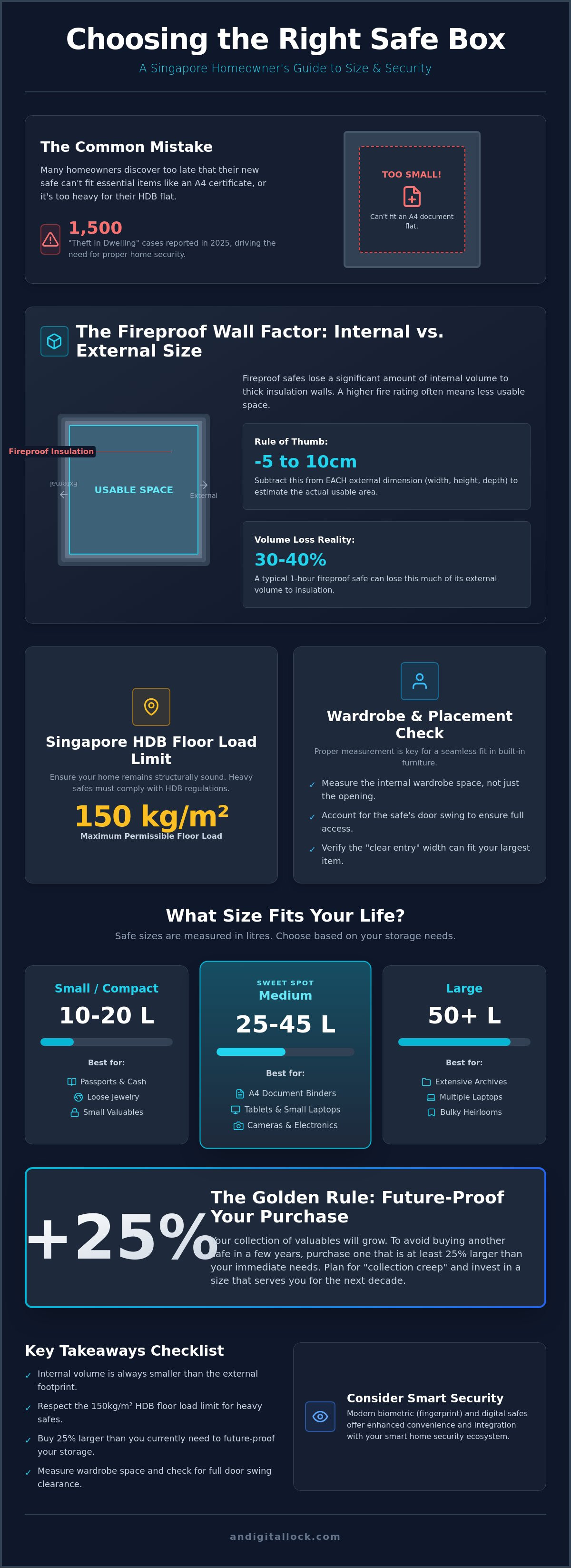
Many homeowners assume that a safe box measuring 40cm wide on the outside provides 40cm of storage space inside. This is a costly mistake that leads to frustration during installation. When you are choosing the right size safe box, you must account for the "Fireproof Wall Penalty." Unlike thin-walled security cabinets, fireproof safes use thick layers of insulation to protect your valuables from extreme heat. You can learn more about safe construction and security ratings to see how these barriers function against both fire and theft.
The trade-off is simple but brutal. A higher fire rating usually means thicker walls and less internal storage for the same external footprint. If you choose a safe with a 2-hour fire rating, expect the internal capacity to be significantly smaller than a 1-hour model of identical exterior size. You aren't just buying a box; you're buying a thermal shield that occupies physical space.
The "Usable Space" Reality Check
Fireproof safes are built with specialized insulation materials like perlite or concrete composites. These materials are heavy and bulky. For most fireproof models, you should subtract at least 5 to 10cm from every external dimension to estimate the actual usable area. It's also vital to consider internal components. Built-in drawers, jewelry trays, and adjustable shelves are helpful for organization, but they also eat into your total volume. If you have one large, bulky item to protect, you might need to remove these accessories entirely to make it fit.
Measuring Your "Must-Protect" Items
Start your selection process by measuring the largest single item you plan to store. If you intend to keep A4 documents flat, your safe needs an internal width of at least 310mm. Anything less will force you to curl your birth certificates or property deeds, which can cause permanent damage over time. For those storing electronics, measure your laptop's width and depth, including any protruding battery packs or cables. A standard fireproof home safe with a 1-hour rating typically loses 30-40% of its total exterior volume to insulation. This fact highlights why choosing the right size safe box requires looking past the product's outer shell.
Finally, always verify the "clear entry" width. The door hinges and the thickness of the door itself often block a portion of the opening. Even if the internal cabinet is technically wide enough for your 15-inch laptop, the door frame might be too narrow to slide it in horizontally. Use this checklist before you buy:
- External Dimensions: Does it fit in your wardrobe or on your floor?
- Internal Dimensions: Is there enough volume for your entire collection?
- Clear Entry: Can your largest item pass through the open door?
- Shelf Clearance: Will the internal drawers block your tall items?
Assessing Your Storage Needs: What Size Fits Your Life?
Before you commit to a purchase, take a physical inventory of what you intend to protect. Most homeowners make the mistake of buying for today rather than for the next decade. Choosing the right size safe box is about more than just matching a volume number on a spec sheet; it's about the physical dimensions and shapes of your most prized possessions. Following home security best practices means creating a final line of defense that is actually practical for daily use.
Safe sizes in Singapore are generally categorized by their internal capacity in litres. Use these tiers to narrow your search:
- Small/Compact (10-20 Litres): These are the most common choice for HDB residents. They are perfect for passports, spare cash, and loose jewelry. They fit easily into most wardrobe shelves but rarely accommodate standard document folders.
- Medium (25-45 Litres): This is the "sweet spot" for most families. These units typically fit A4 document binders and small electronics like tablets or mirrorless cameras.
- Large (50+ Litres): Choose this size if you maintain extensive physical archives, multiple laptops, or bulky family heirlooms. These units are heavy and require careful placement according to floor load limits.
The Laptop and Electronics Test
Don't rely on the "15-inch" screen size label when measuring for a safe. That number is a diagonal measurement. You need the actual width and depth of the device. If you plan to store your laptop while it's connected to an external hard drive or a charging cable, add at least 5cm to the required depth. For tech-heavy households, we recommend a medium-sized safe with internal felt lining to prevent scratches on your hardware. If you're upgrading your home's tech, consider how a new safe complements a modern digital lock singapore system for a fully integrated security experience.
Document Storage: Beyond the Envelope
A few loose papers in an envelope will fit almost anywhere. However, property deeds, birth certificates, and insurance policies often live in thick lever-arch files or plastic organizers. These binders require significant vertical clearance. If you plan to use internal dividers to keep your documents organized, measure the height of the dividers themselves. Many safes offer enough width for A4 paper but fail the height test once you add a binder. Choosing the right size safe box means ensuring your documents can sit flat or stand upright without the edges curling against the fireproof lining.
If you're unsure which model fits your specific HDB layout, our team is ready to help. You can browse our curated selection of safe boxes designed specifically for Singaporean homes.
Singapore Home Constraints: Wardrobes, HDB Loads, and BTOs
Space is a premium in Singapore. Beyond just what goes inside the unit, you must consider the physical constraints of your HDB flat or BTO unit. Choosing the right size safe box requires a careful look at your floor’s structural limits and your furniture’s internal depth. You don't want to buy a high-security safe only to realize it's too heavy for your floor or too deep for your closet doors to shut.
The Housing & Development Board (HDB) enforces a permissible imposed load of 150 kg per square meter (1.5 kN/m²) for residential floors. This regulation is vital for maintaining the structural integrity of your block. While most residential safes weigh between 30kg and 80kg, they are well within these limits. However, the problem arises with weight concentration. A very heavy, narrow safe puts a lot of pressure on a tiny footprint, which is why understanding the distribution of that weight is key.
The 150kg/m2 Rule for HDB Flats
If you're looking at professional-grade safes that exceed 150kg, you must exercise caution. For most homeowners, a safe in the 40kg to 70kg range is the perfect balance of security and safety. If you do choose a model heavier than 150kg, you might need a steel base plate to spread the load across a larger surface area. It's also a legal requirement to seek HDB approval for exceptionally heavy loads. Regardless of the weight, always bolt your safe to the concrete floor. New BTO flats feature reinforced concrete floors that are ideal for secure bolting. This prevents "carry-away" theft, which remains a primary concern for property crimes in Singapore.
Fitting a Safe into Modern Wardrobes
Most BTO built-in wardrobes have a standard external depth of 600mm. Once you account for the thickness of the wardrobe doors and the back panel, your usable internal depth is often closer to 530mm or 550mm. Choosing the right size safe box means selecting a model that leaves enough room for the wardrobe doors to glide or swing shut without hitting the safe's handle or keypad.
Don't overlook the "swing space" for the safe door itself. Most safe doors need to open at least 90 degrees for you to pull out internal drawers or access the battery compartment. If the wardrobe frame is too narrow, the safe door will catch on the wood, preventing you from fully opening it. Ensure there's also a small gap for ventilation. Electronic motherboards in digital safes can be sensitive to the high humidity levels found in Singapore if they're trapped in a completely airtight space. For a total security overhaul, you can pair your internal safe with a reinforced entrance by following our hdb main door guide.
Future-Proofing: Why You Should Buy 25% Larger
One of the most frequent regrets homeowners share after a year of ownership is that they bought a safe that was just "big enough" for their current needs. Over a ten-year period, families naturally accumulate more valuables. We call this "Collection Creep." From heirloom jewelry and luxury watches to updated property titles and insurance policies, your storage requirements will only grow. Choosing the right size safe box today means anticipating who you will be five or ten years from now.
As you invest in high-quality items, you may also want to check out GoldStandard Amsterdam for insights on luxury materials and premium accessories that deserve such secure storage.
Adopting the "25% Rule" is the most cost-effective strategy for long-term security. Always select a model that offers at least 25% more internal volume than your current inventory requires. It's far more economical to invest in one medium-sized unit now than to pay for a second safe and a second professional installation later when your first one overflows. A larger interior also allows you to organize your items properly. When a safe is too cramped, you risk scratching delicate jewelry or damaging the edges of important legal documents as you move things around.
Security Benefits of Larger, Heavier Safes
Size isn't just about storage; it's a fundamental part of your security strategy. Larger safes are inherently heavier, which serves as a powerful deterrent against "carry-away" theft. While any safe should be bolted down, a 60kg unit is significantly harder for an intruder to manipulate than a 15kg compact model. Larger models also frequently come equipped with more advanced security technology. Because they have more door surface area, they can accommodate dual-verification systems that require both a biometric fingerprint and a PIN code. Many of our larger premium models even feature "hidden compartments" or secondary inner safes for an extra layer of protection for your most sensitive items.
Organisational Accessories
If you plan to use organizational tools, you must account for their bulk. Premium accessories like automatic watch winders or multi-tier jewelry trays consume a surprising amount of internal space. Adjustable shelving is a critical feature to look for in larger models. It allows you to customize the interior layout as your collection evolves. Internal cubic capacity refers to the total volume of the safe's interior, which dictates how high or low you can position adjustable shelves to accommodate specific items. If you're ready to secure your future, explore our range of high-capacity safe boxes to find the perfect fit for your growing collection.
By planning for growth, you ensure that your investment remains useful for decades. Don't let a lack of space compromise your organization or your peace of mind. A little extra room today prevents a major headache tomorrow.
Smart Security: Integrating Your Safe with AN Digital Lock
Modern home security is about creating a seamless, keyless ecosystem. If you've already upgraded your home with a smart door lock, your safe box shouldn't be the only thing requiring a physical key. Choosing the right size safe box is the first step, but selecting the right interface ensures you actually use it. We recommend digital safes that mirror the convenience of your entrance locks, allowing you to secure your valuables with the same ease you enter your home.
At AN Digital Lock, we curate specific safe brands that meet the rigorous demands of Singaporean households. These models are selected for their reliable electronics, robust fire ratings, and compact footprints that fit perfectly into HDB and BTO floor plans. By integrating your safe into a broader best digital lock singapore bundle, you create a unified defense for your property and your most precious items.
Biometric vs. Keypad Safes
Fingerprint access is the definitive choice for homeowners in 2026. Biometric sensors eliminate the need to memorize complex PIN codes or hide physical keys. Modern sensors are highly advanced and perform reliably even in Singapore’s high humidity. For those who prefer traditional methods, keypad safes remain a sturdy alternative. When selecting a digital model, always look for emergency bypass options. This usually includes a master override key or an external battery port. These features ensure you're never locked out of your valuables if the internal batteries fail or if a family member forgets the code.
BTO Security Bundles
Moving into a new BTO is the ideal time to consolidate your security needs. You can often save significantly by bundling your digital door lock, metal gate lock, and safe box into a single purchase. This approach ensures aesthetic consistency across your home hardware and simplifies your maintenance schedule. Professional installation is a core part of our service. Our experts don't just deliver the unit; they perform the essential anchoring and bolting required to meet SPF safety recommendations. We ensure your safe is positioned for maximum security while respecting HDB floor load regulations.
Ready to complete your home security setup? Browse our range of digital safe boxes at AN Digital Lock to find a model that fits your space and your lifestyle perfectly. Our team is here to help you navigate the technical specs so you can make an informed, confident decision for your family's protection.
Secure Your Assets with Confidence
Choosing the right size safe box is a strategic decision that balances your current inventory with future growth and Singapore's specific residential regulations. You now understand that internal volume is the only metric that truly matters for your A4 folders and electronics. By respecting the 150kg/m2 HDB floor load limit and planning for 25% more space than you currently need, you're making an investment that will last for decades.
Since 2013, AN Digital Lock has been trusted by thousands of HDB and BTO homeowners for contemporary security solutions. Our expertise has been featured in major Singaporean media, and we take pride in providing professional installation by our dedicated in-house experts. We ensure your safe is anchored correctly for maximum deterrence against theft.
Secure your valuables with the perfect digital safe from AN Digital Lock today. Your peace of mind is our priority, and we're ready to help you finalize a security setup that fits your lifestyle perfectly.
Frequently Asked Questions
What size safe box is best for a standard HDB wardrobe?
A safe with an external depth of 450mm to 500mm is the most practical choice for standard HDB wardrobes. This depth ensures that your wardrobe doors shut properly without hitting the safe’s handle or keypad. You should also leave at least 10cm of side clearance. This allows the safe door to swing open fully so you can access internal drawers or battery compartments without obstruction.
Can I place a 200kg safe in my HDB flat without approval?
No, you should seek HDB approval for any safe that exceeds the 150kg weight limit. The HDB Building Control Act mandates an imposed load limit of 150kg per square meter. A 200kg safe concentrates significant weight on a small footprint, which can stress the structural slab. For heavy models, our team often recommends using a steel base plate to distribute the load safely across the floor.
Will an A4 folder fit in a compact 15-litre safe?
Most compact 15-litre safes are too narrow to hold a standard A4 document binder flat. While the paper itself might fit, the binder’s spine usually requires an internal width of at least 310mm. When choosing the right size safe box, always prioritize the internal "clear entry" width over the total litre capacity. We recommend moving up to a 25-litre model if you have thick property deeds or insurance files.
How much extra space should I allow for a fireproof safe wall?
You should subtract between 5cm and 10cm from every external dimension to estimate your actual storage space. Fireproof safes use thick composite insulation to protect contents from extreme heat. This means a safe that looks large on the outside often has 30% to 40% less usable volume than a non-fireproof security cabinet. Always verify the internal dimensions before finalizing your purchase to avoid storage disappointment.
Is it better to have a tall, slim safe or a short, wide one for a condo?
A short, wide safe is generally the superior choice for most Singapore condos and HDBs. Wide safes allow you to store A4 documents and laptops flat, which prevents damage to the items. They also distribute weight more effectively across the floor. Tall, slim safes are often harder to fit into standard wardrobe shelving and can be more difficult to anchor securely to the ground.
Do I need a larger safe if I want to store a 15-inch laptop?
Yes, you typically need a medium-sized safe with a capacity of at least 35 to 45 litres. A 15-inch laptop is a diagonal measurement, so the actual width is usually around 360mm. Most compact safes won't accommodate this width. Choosing the right size safe box for electronics also requires extra depth. This ensures you have space for charging cables or external hard drives without bending the ports.
How much does the weight of the safe affect floor load calculations in Singapore?
Weight is the primary factor in determining if a safe is legally compliant with HDB regulations. The 150kg/m² limit is a strict structural requirement. While most residential safes weigh between 40kg and 80kg and are perfectly safe, professional-grade models can quickly exceed the limit once filled with heavy gold or coins. Always calculate the "loaded weight" of the safe to ensure it stays within residential safety margins.
Why do digital safes require slightly more external clearance than key-lock safes?
Digital safe keypads and biometric sensors usually protrude 3cm to 5cm from the face of the door. Key-lock safes often have a flatter profile with recessed handles. If you are installing your safe behind a sliding wardrobe door, you must include the keypad's depth in your measurements. Failing to account for this protrusion is a common reason why wardrobe doors fail to close after a safe installation.