


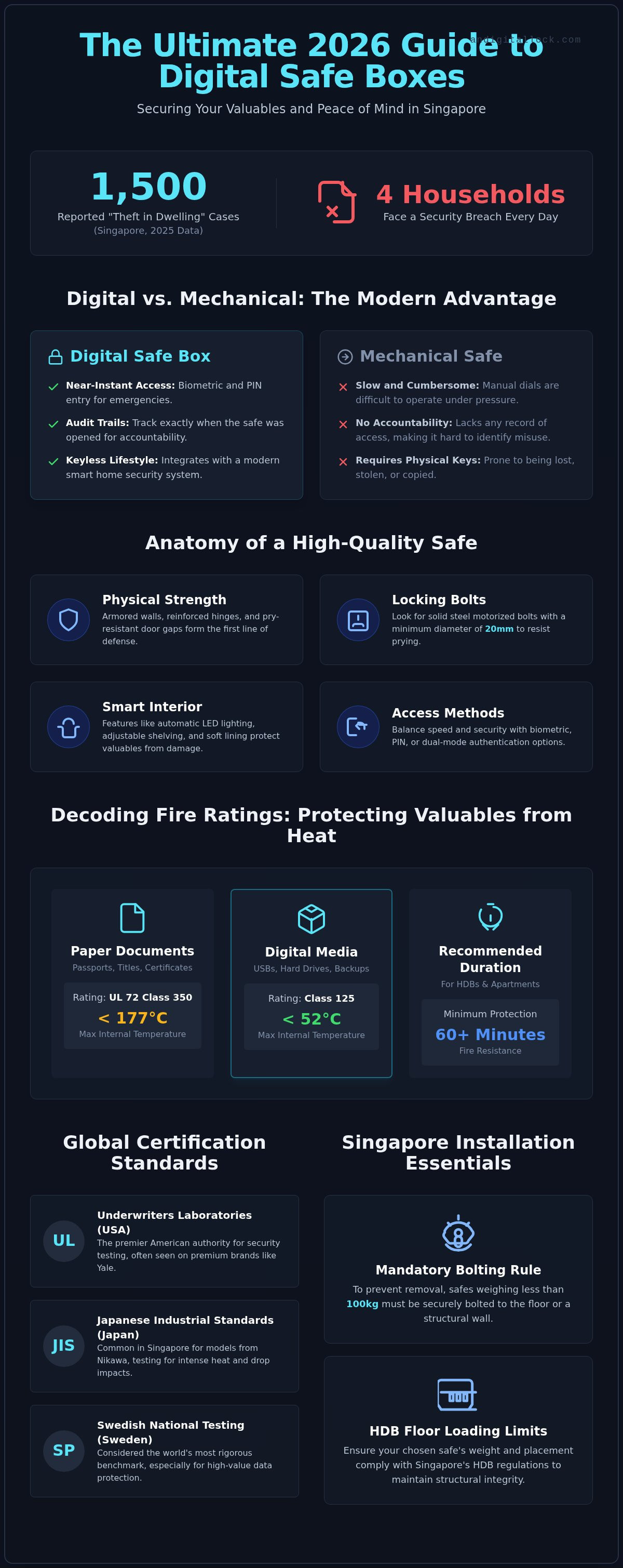
In 2025 alone, Singapore recorded 1,500 reported "theft in dwelling" cases. This means roughly four households face a security breach every single day. It's a sobering reality that makes choosing the right digital safe box more than just a luxury; it's a necessity for every modern homeowner. You likely worry about a fire destroying your essential documents or the frustration of a battery failure locking you out of your own property. These anxieties are common, especially when security certifications seem like a confusing maze of technical jargon.
This 2026 guide simplifies your security journey by bridging the gap between high-tech specs and practical home placement. We'll show you how to choose a model that offers sub-second biometric recognition while meeting strict HDB floor loading limits. You'll learn the difference between burglary resistance and fire ratings to ensure your peace of mind is backed by global standards. By the end, you'll know exactly how to integrate a secure, aesthetically pleasing safe into your smart home ecosystem for ultimate protection and ease of use.
Key Takeaways
- Learn why the modern digital safe box has evolved from a simple steel container into a sophisticated biometric security hub for 2026.
- Master the technical differences between UL and JIS certifications to ensure your valuables survive extreme heat for at least 60 minutes.
- Identify the best access methods for your lifestyle, balancing the speed of fingerprint sensors with the reliability of shared PIN codes.
- Navigate Singapore-specific installation requirements, including HDB floor loading limits and the essential bolting rules for safes under 100kg.
- Explore how to create a unified home security ecosystem by pairing your safe with reputable brands like Yale and Nikawa.
What is a Digital Safe Box and Why Your Home Needs One
A digital safe is a secure storage solution utilizing electronic authentication to replace traditional key-and-tumbler mechanisms. For decades, Singaporean households relied on heavy mechanical dials that were slow and cumbersome to operate. Today, the digital safe box has redefined home security. It merges heavy-duty steel construction with advanced electronic access points. This evolution is particularly important for BTO owners who need a dedicated space for property titles, emergency cash, and family heirlooms that cannot be replaced.
Digital vs. Mechanical: The 2026 Security Debate
Speed is the most significant advantage of modern technology. In an emergency, such as a localized fire, you can't afford to fumble with a manual dial. Biometric sensors and PIN pads offer near-instant access. Digital safes also provide comprehensive audit trails. You can see exactly when the safe was opened, which adds a layer of accountability that mechanical safes lack. Many residents now sync their safe choices with their digital lock singapore to maintain a completely keyless lifestyle. Understanding What is a Digital Safe Box reveals how these units have transitioned from simple metal boxes into intelligent security assets.
Key Components of a High-Quality Safe
Physical strength remains the foundation of any good safe. High-quality models use solid steel motorized locking bolts. You should look for a bolt diameter of at least 20mm to ensure the door remains secure against prying. Armored walls and reinforced hinges are also essential to prevent forced entry. Beyond the exterior, the interior features should make your life easier. High-end units often include:
- Internal LED lighting that turns on automatically when the door opens.
- Adjustable shelving to accommodate different sizes of valuables.
- Soft felt or leatherette lining to protect jewelry and watches from scratches.
- Pry-resistant door gaps that leave no room for entry tools.
Investing in a safe with these specifications ensures your most valuable possessions are protected by more than just a digital code. It provides a physical barrier that is difficult to bypass, even for determined intruders. This combination of electronic convenience and physical toughness creates the ultimate peace of mind for any homeowner.
Understanding Security and Fire Ratings (UL, JIS, and SP)
Choosing a digital safe box requires understanding two distinct types of protection: burglary resistance and fire resistance. A safe designed to stop a thief might not protect your documents from extreme heat. Conversely, a lightweight fire safe could be easily pried open or carried away by an intruder. You must identify which threat is more likely in your specific Singaporean residence to make the right investment. Most homeowners in HDB flats prioritize fire protection due to the proximity of neighboring units.
Fire ratings are typically measured by the duration the safe can withstand external heat. A 60-minute rating is the recommended minimum for high-rise living. During a fire, the internal temperature of the safe must stay low enough to prevent its contents from charring. Paper is relatively resilient, but digital media like USBs or hard drives are extremely fragile. These devices require specialized data safes because they fail at much lower temperatures than paper. A UL 72 Class 350 rating ensures internal temperatures stay below 177°C to protect paper. If you store high-value digital backups, you'll need a Class 125 rating to keep the interior below 52°C.
International Standards Comparison
Standardized testing ensures you get the protection promised on the box. Underwriters Laboratories (UL) is the premier American authority for security testing. You'll often see their certification on premium brands like Yale. Japanese Industrial Standards (JIS) are equally common in Singapore, especially for Nikawa models. These tests simulate intense heat and drop impacts from collapsed floors. For the highest level of data protection, the Swedish National Testing (SP) benchmark is often cited as the most rigorous in the world. When Integrating Your Safe into a Smart Home Ecosystem, checking for these labels is your first step toward a reliable setup.
The Myth of the "Indestructible" Safe
No safe is 100% theft-proof. A high security rating simply means the safe can resist a professional intruder for a specific amount of time. This delay is critical because it increases the chance of an intruder being caught or giving up. High-quality safes feature a relocking mechanism. If a burglar attempts to drill through the lock, a secondary internal bolt triggers and permanently locks the safe. You can verify these features by checking the certification plate. It's usually a metal badge located on the inside of the door. To see these certified features in person, you can browse the latest models at AN Digital Lock.
Comparing Access Methods: Biometric vs. PIN vs. Dual-Mode
Selecting the right entry system for your digital safe box involves balancing speed with foolproof security. Biometric fingerprint technology is the gold standard for 2026. It allows you to access your valuables in under a second without memorizing a single digit. PIN-based keypads remain a reliable alternative for families who need to share access safely. For the ultimate level of protection, dual-authentication requires both a valid fingerprint and a correct PIN. This ensures that even if someone discovers your code, they still cannot bypass the biometric layer. This approach aligns with the rigorous standards found in Understanding Security and Fire Ratings for top-tier residential hardware.
Regardless of the primary method you choose, don't ignore the physical override key. This "Plan B" is your only way in if the internal batteries fail or the electronic circuit suffers a rare malfunction. Keep this key in a secure location outside of the room where the safe is installed. Never store the override key inside the safe itself, as this defeats its entire purpose.
Biometric Advancements in 2026
Modern scanners have evolved significantly. Capacitive sensors are now the industry benchmark, outperforming older optical sensors. They use electrical currents to map your unique ridges, which makes them more effective for users with wet or aged fingers. We recommend registering at least three different fingers during the initial setup. This redundancy ensures you aren't locked out if you have a small cut on your primary finger. Pay close attention to the False Rejection Rate (FRR) in the technical specs. A high-quality sensor should have an FRR of less than 0.1%, ensuring seamless access every time you touch the pad.
The User Interface and Battery Management
A safe is only useful if you can operate it easily under pressure. Look for high-contrast, backlit displays that make the keypad visible inside a dark wardrobe or cabinet. Effective battery management is also a hallmark of a professional safe. Most units will provide audible chirps or visual icons when power is low. If you miss these warnings, look for external emergency power terminals on the faceplate. These allow you to touch a standard 9V battery to the terminals to power the lock temporarily. To enhance privacy, utilize the "fake PIN" function. This feature lets you enter random numbers before or after your actual code, preventing any onlookers from learning your secret sequence.
Placement and Installation in Singapore Homes
Finding the perfect spot for your digital safe box is as critical as the lock itself. In Singapore, residential regulations play a major role in where you can place heavy security hardware. HDB flats have a strict floor loading limit of 150kg per square meter. If you've chosen a heavy, fire-rated model, you must ensure the weight is distributed correctly to avoid structural issues. Beyond weight, you must follow the "Bolting Down" rule. Any safe weighing less than 100kg can be carried away by two determined intruders. Anchoring the unit to a concrete floor or a load-bearing wall is the only way to prevent this scenario.
Strategic placement requires balancing security with convenience. You want your safe to be hidden from casual observers but accessible enough for daily use. Consulting a door lock singapore expert can help you design a layered security plan that protects your entire home entrance while ensuring your safe is positioned for maximum effectiveness.
HDB and Condo Specific Constraints
Many homeowners prefer installing safes inside their Household Shelter, commonly known as the bomb shelter. This is a smart choice because the walls are reinforced concrete. However, you must never drill into the shelter door or the ventilation sleeve, as this compromises the room's integrity. If you prefer a wardrobe installation, ensure the base is reinforced. A heavy safe sitting on a thin plywood shelf will eventually cause the wood to sag or snap. Finally, keep your digital safe box away from outer walls or bathrooms. Singapore’s high humidity leads to condensation, which can corrode internal motherboards and drain batteries prematurely.
Installation Checklist for Homeowners
Professional installation ensures your safe remains immovable and functional for years. Use this checklist before you start drilling into your property:
- Scan the wall or floor for concealed wiring and water pipes using a stud finder.
- Use heavy-duty expansion bolts specifically designed for concrete surfaces rather than standard screws.
- Confirm the door has a full 90-degree opening clearance to allow internal drawers to slide out.
- Check that the surface is perfectly level so the motorized locking bolts align correctly every time.
For professional advice and seamless installation services tailored to Singaporean homes, browse our full range at AN Digital Lock.
Integrating Your Safe into a Smart Home Ecosystem
Modern home security isn't about a single piece of hardware; it's a layered ecosystem where every barrier works in harmony. Your digital safe box shouldn't be an isolated metal container. It should be the final, most secure layer of a unified strategy. By matching your safe with the best digital lock singapore, you create a seamless experience for your family. This synergy ensures that your entrance and your internal storage utilize similar technology, which reduces the learning curve and simplifies your daily routine.
App-enabled safes have become a 2026 standard for high-security residences. These intelligent units send real-time alerts to your smartphone the moment someone touches the keypad or attempts a forced entry. This connectivity provides a psychological safety net that traditional safes can't provide. AN Digital Lock offers holistic security consultations to help you decide which smart features add the most value to your specific property. For those moving into new flats, our specialized BTO bundles allow you to combine doors, gates, and safes into one cost-effective, high-performance package.
Why Brand Consistency Matters
Choosing a single brand like Yale allows you to manage your entire home through a single interface. The Yale ecosystem is designed for homeowners who value simplicity; you can check your door status and safe access logs on one centralized app. This integration streamlines long-term maintenance. You'll only need to track one type of battery replacement cycle and one service contact for all your devices. For many Singaporean HDB owners, Nikawa remains a favorite due to its localized reliability and proven durability in our humid climate. Sticking to these established manufacturers ensures you have access to official parts and expert support for years to come.
Next Steps: Securing Your Assets
Reading about security is the first step, but experiencing the hardware in person is essential. We invite you to visit an AN Digital Lock showroom for a hands-on demo of the latest 2026 models. You can test the sub-second biometric sensors and feel the weight of the reinforced steel doors yourself. Our experts will help you customize a security package that fits the specific layout of your new BTO flat or condo. Don't leave your valuables to chance when professional-grade protection is easily accessible. Explore our Digital Safe Box collection at AN Digital Lock today and finalize your home's defense strategy.
Take Control of Your Home Security Today
Choosing the right digital safe box is about more than just picking a steel container; it's about matching certified fire resistance with the speed of 2026 biometric technology. You now understand how to navigate HDB floor loading limits and why official certifications like UL and JIS are essential for protecting your property titles and digital backups. These technical details are the foundation of a secure, modern household.
As an official stockist for Yale and Nikawa, AN Digital Lock brings over 10 years of Singapore-based expertise to your doorstep. We ensure your installation is handled with precision; we even offer free delivery on selected models to make your transition to a secure home as frictionless as possible. Don't leave your most precious heirlooms and essential documents to chance. Secure your home today with AN Digital Lock’s premium safe collection. Your peace of mind is within reach. Start building your layered security ecosystem today.
Frequently Asked Questions
How long do the batteries in a digital safe box usually last?
Batteries in a premium digital safe box typically last between 12 and 18 months with regular use. You should always use high-quality alkaline batteries rather than rechargeable ones to ensure consistent voltage. Most modern units provide a visual or audible low-battery warning weeks before they fail. If the power does run out, you can use the external emergency power terminals or your physical override key to regain access safely.
What happens if I forget my PIN and lose the override key?
If you lose both your code and the physical key, you must contact an authorized service center or the safe's manufacturer. Professional technicians can sometimes verify your ownership and provide a replacement key based on the unit's serial number. If the model is high-security, a forced entry might be the only option. This process usually involves specialized tools and will likely render the safe unusable after the contents are retrieved.
Are fireproof safes also waterproof?
Fireproof safes are not automatically waterproof. While fire-rated safes use thick walls filled with moisture-releasing material to keep the interior cool, they don't always have airtight seals against liquid. To protect against flooding or burst pipes, look for models with an ETL-verified water protection rating. These units feature specialized gaskets that keep the interior dry even when submerged for several hours, providing total peace of mind for your valuables.
Can a digital safe be hacked via Wi-Fi?
Most residential digital safe box models are designed with offline security to prevent remote hacking. While some units offer smartphone connectivity, they typically use encrypted Bluetooth or local protocols rather than a direct Wi-Fi connection. This creates an air-gapped barrier that keeps your safe invisible to online threats. Always choose reputable brands that utilize advanced encryption standards to ensure your biometric data and PIN codes remain strictly private and protected.
Is it better to bolt a safe to the floor or the wall in an HDB?
Bolting your safe to the concrete floor is generally superior to wall mounting in a Singaporean HDB flat. Floor anchoring utilizes the full weight of the safe and makes prying nearly impossible. If you have delicate floor tiles or concealed pipes, bolting to a reinforced structural wall is a viable alternative. Professional installation ensures the expansion bolts are seated deeply enough to resist several tons of pulling force from an intruder.
Do I need a fire-rated safe for my electronic data (USBs/Hard drives)?
Standard fire-rated safes are designed for paper and are insufficient for electronic data. Paper chars at much higher temperatures than the sensitive components in USB drives or external hard disks. To keep digital media safe, you need a specialized data safe with a Class 125 rating. This certification guarantees the internal temperature stays below 52°C, which is the critical threshold to prevent data loss or physical warping of your storage devices.
What is the ideal weight for a home safe to prevent it from being carried away?
The ideal weight for a home safe is between 50kg and 100kg, provided it is also bolted down. While heavier safes are harder to move, you must respect the HDB floor loading limit of 150kg per square meter. A moderately heavy safe that is professionally anchored to the structure is far more secure than a massive, unbolted unit. Focus on high-quality bolting kits rather than just the physical mass of the steel.