


Over 60% of new BTO homeowners in 2026 are choosing smart entrance upgrades, yet many families still rely on a cloudy, distorted glass peephole to safeguard their front entrance. Straining to identify visitors through a tiny lens is frustrating, and it leaves children and elderly parents vulnerable to corridor blind spots. True entrance security starts with clear visual verification before a lock ever opens, which is why a digital door viewer has become an essential protection layer for modern households.
You shouldn't have to guess who stands on the other side of your doorway. In this guide, you'll discover how a digital door viewer transforms visibility with wide-angle clarity day or night, enhances family safety, and integrates smoothly with modern smart locks. We break down door thickness requirements, fire-rated door considerations, and straightforward selection tips so you can choose the ideal setup for your home with complete confidence.
Key Takeaways
- Understand how an electronic peephole camera transmits instant, wide-angle footage to an internal LCD screen for effortless hallway monitoring.
- Discover why upgrading to a high-definition digital door viewer eliminates optical distortion and solves low-light corridor blind spots.
- Learn the essential hardware specifications to evaluate, from 1080p Full HD resolution to optimal screen sizes tailored for children and seniors.
- Master the critical door thickness and peephole diameter measurements needed to ensure a clean fit without compromising fire-rated door integrity.
- Explore how pairing clear visual verification with smart digital door locks creates a synchronized, multi-layered home security barrier.
What Is a Digital Door Viewer and How Does It Work?
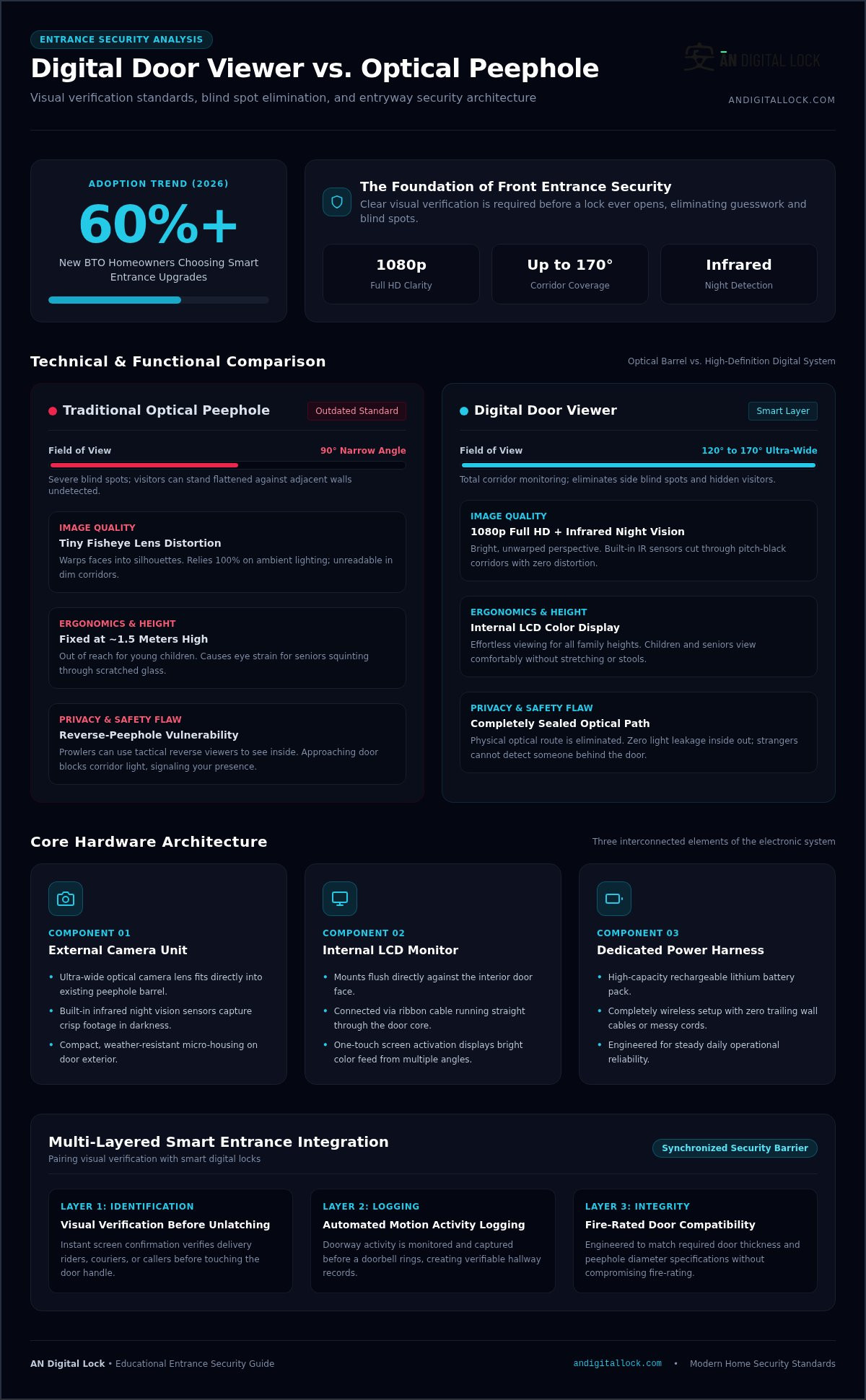
A digital door viewer replaces the standard glass peephole with a two-part electronic monitoring setup. On the outside of your door sits a compact, weather-resistant micro-camera lens fitted directly into the existing peephole barrel. Inside your entryway, a high-definition color LCD screen mounts securely over that opening. When someone approaches or knocks, the camera captures wide-angle footage and routes the signal through a ribbon cable running directly through the door core. This technology operates much like a specialized video door-phone system, delivering real-time visual verification without requiring you to squint through dark, narrow optics.
Traditional optical viewers warp faces and rely entirely on external ambient lighting. If your corridor has dim lighting or strong shadows, identifying a visitor becomes pure guesswork. An electronic viewer solves this problem instantly. The internal display screen illuminates at the push of a button, showing a bright, unwarped perspective of the common corridor so you know exactly who is standing outside before turning a handle.
Core Components of an Electronic Peephole System
Modern electronic viewers rely on three interconnected hardware elements to maintain reliable front entrance security:
- External camera unit: Houses an ultra-wide optical lens and built-in infrared night vision sensors to capture crisp footage even in pitch-black corridors.
- Internal LCD monitor: Mounts flush against the interior door face, presenting an immediate color display for clear viewing from multiple angles.
- Dedicated power harness: Runs on a high-capacity rechargeable lithium battery pack, ensuring steady daily operation without messy trailing wall cables.
Key Advantages for Everyday Home Safety
Upgrading your entryway delivers immediate practical benefits for everyone under your roof:
- Effortless viewing for all heights: Young children and elderly family members can check the wide display comfortably without stretching, standing on stools, or straining their eyes.
- Complete privacy protection: Physical peepholes are vulnerable to specialized reverse-peephole viewers used by intruders to peer inside your home. A digital viewer completely seals that optical path.
- One-touch screen activation: You get instant, distortion-free visual confirmation with a single press, keeping your door firmly locked until you verify the caller.
Traditional Optical Peepholes vs. Digital Door Viewers
Standard optical peepholes have remained virtually unchanged for decades. While they offer a rudimentary glimpse outside, their tiny fisheye lenses bend and blur light, turning hallway visitors into distorted silhouettes. Upgrading to a digital door viewer replaces passive observation with proactive monitoring. Automated motion logging captures doorway activity before a doorbell even rings, giving you verifiable visual records rather than fleeting glimpses.
Visibility, Field of View, and Night Performance
Narrow 90-degree optical lenses leave dangerous blind spots where someone can stand flattened against adjacent walls undetected. In contrast, digital camera sensors offer ultra-wide fields of view spanning 120 to 170 degrees. When you consider building a smart home, reliable visual verification is the bedrock of entrance security. Built-in infrared LEDs cut through poorly lit corridors, rendering crisp images at night so you never have to strain your eyes against cold metal.
Usability Differences for Children and Seniors
Physical barriers often make standard peepholes unusable for half the family. Standard peepholes are drilled roughly 1.5 meters high, completely out of reach for young children. For older adults with fading eyesight, squinting through a scratched lens causes severe eye strain. A large, bright interior screen lets anyone check visitors from a comfortable distance. Household members can quickly identify couriers or delivery riders without unlatching the entryway.
Privacy Protection and Anti-Peeping Defence
Mechanical peepholes introduce an unexpected security vulnerability. Prowlers can press reverse-lens tactical scopes against external optical barrels to view directly into your home. Approaching a glass viewer also blocks ambient light, instantly tipping off strangers that someone is standing right behind the door. A digital unit eliminates that direct line of sight entirely. Pair this privacy barrier with a sturdy hdb main door to keep your private living space completely shielded from corridor foot traffic. You can explore certified entrance security packages directly with AN Digital Lock to find the best fit for your layout.
Essential Features to Evaluate Before Buying a Digital Door Viewer
Selecting the right digital door viewer requires balancing optical performance with practical everyday convenience. A unit with weak resolution or sluggish motion sensors causes frustrating lag when you need immediate clarity. To ensure your investment provides dependable entrance protection, evaluate these core hardware specifications before making a purchase.
Display Quality, Screen Size, and Camera Optics
Camera clarity is your first line of defense. Look for optical sensors delivering at least 1080p Full HD resolution to ensure crisp facial identification rather than pixelated silhouettes. Consider these hardware elements:
- Display dimensions: Screen sizes between 3.5 inches and 5.0 inches provide optimal visibility. They allow family members to identify visitors clearly from several feet away without overpowering the interior door aesthetic.
- Dynamic range balancing: Corridors with bright overhead fluorescent tubes create harsh glare. High dynamic range (HDR) processing balances intense highlights and dark doorway shadows effectively.
- Vertical lens angle: Choose a wide-angle lens that captures vertical space. This ensures you can view doorstep deliveries and packages placed flat on the floor beneath the camera line.
Smart Motion Detection, Recording, and Connectivity
Automated activity tracking turns a passive monitor into an active security tool. Advanced viewers feature Passive Infrared (PIR) motion sensors that detect body heat rather than just visual shifts, filtering out false alerts caused by corridor shadows or flickering lights.
Decide whether you want standalone local convenience or remote network visibility. Models with Wi-Fi connectivity push instant photo or video alerts directly to your smartphone when someone loiters outside. Many units also integrate an electronic chime, functioning smoothly as a primary digital doorbell. For data storage, assess whether you prefer local micro-SD recording for complete privacy without subscription fees, or encrypted cloud archiving that keeps footage secure even if the door hardware experiences physical damage.
Power delivery matters just as much. Opt for high-capacity rechargeable lithium batteries over disposable AA cells. Modern lithium packs deliver months of consistent operation per charge and recharge easily via standard USB cables, keeping your entryway guarded around the clock.
Door Compatibility, Installation, and Setup Requirements
Fitting a digital door viewer requires accurate measurements before you touch any tools. While installation is straightforward, skipping structural checks can leave you with loose brackets or a damaged entrance. Follow these five steps to ensure a secure, flush installation:
- Measure door thickness and barrel diameter: Measure the precise depth of your entrance slab and the existing peephole borehole.
- Inspect exterior gate clearance: Verify the physical gap between your main entrance door and the outer security gate.
- Remove the optical peephole: Unscrew the interior lens barrel carefully using a wide flathead tool or coin to avoid scratching exterior laminate veneers.
- Mount the hardware: Thread the flexible ribbon data cable through the bore opening, secure the metal mounting plate on the interior side, and tighten the retaining screws.
- Calibrate the system: Mount the internal monitor, power on the battery, adjust time stamps, and set your PIR detection zones to prevent nuisance alerts.
Measuring Door Thickness and Hole Dimensions
Most residential electronic viewers support door thicknesses ranging from 35mm to 110mm. Borehole diameters typically accommodate 14mm to 28mm openings. If your entryway features a fire-rated door, using the existing optical peephole aperture is critical. It preserves the door's fire-stopping integrity without drilling unapproved holes. Verifying these exact proportions ensures clean alignment with existing access hardware, such as a modern door lock singapore configuration.
Clearance Checks for Exterior Metal Gates
Singapore homes frequently feature a dual-barrier entrance where a decorative metal gate sits inches in front of the main wooden door. Protruding camera lenses can easily collide with exterior gate bars or laser-cut motifs when closing either panel. Check your clearance depth carefully. If the clearance is tight, choose a viewer model engineered with a low-profile, flush-mount exterior casing.
Ensuring your visual surveillance hardware fits your specific entrance layout without voiding manufacturer warranties is essential. To avoid measuring errors or complex wiring headaches, book professional entrance installation with AN Digital Lock to secure your home properly.
Creating a Complete Smart Entrance with AN Digital Lock
A secure doorway relies on multiple coordinated defense layers. While an electronic viewer provides immediate visual verification, pairing it with a high-performance digital lock singapore setup establishes complete control over your threshold. You screen callers clearly on your monitor, verify their credentials, and grant access without compromising personal safety.
Pairing Digital Viewers with Smart Biometric Locks
Visual screening prevents accidental unlocking. When an unexpected visitor approaches, checking the display screen lets you inspect identification badges or doorstep parcels before disengaging your deadbolt. AN Digital Lock pairs surveillance hardware seamlessly with leading push-pull locks from trusted global manufacturers, including Zigbang, Philips, Solity, Hafele, and Igloohome. Explore the top-rated models in our guide to the best digital lock singapore options to discover how biometric handles and wide-angle visual verification work together to streamline daily entry.
Professional Assessment and Installation Support
Mounting modern entrance hardware demands careful precision. Fitting cables or adjusting barrel sleeves on heavy wooden slabs without proper tools risks veneer splintering, frame misalignment, or voided door warranties. Established in 2013, AN Digital Lock utilizes an experienced in-house technician network to guarantee damage-free installation. Backed by over 5,000 verified five-star homeowner reviews, our specialists inspect your entrance dimensions thoroughly, ensuring every bracket aligns flush while keeping fire-rated certifications fully compliant.
Upgrade Your Home Entrance Security Today
Protecting your household begins with a unified entrance setup tailored to your layout. Whether you want to add an individual digital door viewer to your existing door or configure an all-in-one bundle combining wooden doors, metal gates, and biometric locks, our security specialists guide you at every step. Visit our national showrooms to test live display monitors and touch interactive locking systems firsthand. Contact AN Digital Lock today to book your entrance consultation and upgrade your doorstep defense.
Upgrade Your Front Entrance with Lasting Peace of Mind
Say goodbye to distorted glass peepholes and hallway blind spots. Installing a digital door viewer gives your family crisp, wide-angle visibility, effortless operation for children and seniors, and total confidence before anyone turns a handle. When paired with high-performance biometric access, you establish a layered security barrier that shields your home around the clock.
Choosing the right entrance setup is simple with expert guidance. Serving homeowners since 2013, AN Digital Lock is an established national security specialist backed by over 5,000 verified five-star reviews. As an authorized distributor for premier brands including Zigbang, Philips, Solity, Hafele, and Igloohome, our experienced team ensures clean, damage-free installation that protects your door warranties. Visit our dedicated national showrooms to test live display monitors, or explore digital door viewers and smart locks at AN Digital Lock to protect your loved ones today.
Frequently Asked Questions
How does a digital door viewer differ from a smart video doorbell?
A digital door viewer installs directly through your door's existing peephole borehole and includes an internal LCD screen for immediate indoor monitoring. A smart video doorbell typically mounts onto an exterior wall or gate frame and relies primarily on a smartphone app or wireless chime. Digital viewers let children and seniors check who is outside instantly without needing mobile devices or handheld applications.
Can a digital door viewer be installed without drilling new holes in the door?
Yes, modern units use your entrance's existing optical peephole aperture, which typically measures between 14mm and 22mm. The camera barrel slides directly through this opening, connecting to the interior LCD mount via a flat ribbon cable. You won't need to drill fresh holes, helping you maintain your door's structural strength while avoiding voided manufacturer warranty terms or building guidelines.
How long does the battery last on a modern electronic peephole viewer?
Most units powered by high-capacity rechargeable lithium battery packs last between two and six months on a single charge. Actual battery life depends on how often corridor foot traffic triggers the PIR motion sensors and how frequently residents activate the display screen. When power runs low, you simply recharge the battery pack using a standard USB cable without dismantling the entire door bracket.
Do digital door viewers work effectively in dark corridors at night?
Yes, they perform reliably in poorly lit or unlit hallways. Most electronic viewers incorporate built-in infrared night vision sensors that automatically activate as corridor light levels drop. These invisible infrared LEDs illuminate approaching visitors without alerting them, rendering high-contrast video on your interior screen even in total darkness. This ensures you never struggle to identify visitors during late-night deliveries or unexpected late arrivals.
Will a digital door viewer record visitors when nobody is at home?
Yes, units equipped with Passive Infrared (PIR) motion sensors automatically capture still photos or short video clips whenever someone lingers outside your entryway. The captured media is safely stored onto a local micro-SD memory card or encrypted cloud storage. When you return home, you can review time-stamped logs of all deliveries, visitors, or unusual corridor activity directly on the internal display screen.
Can an exterior security metal gate block the digital viewer camera view?
An exterior metal gate will not obstruct your view if the camera is properly aligned between the gate bars. Because digital door viewers feature wide-angle lenses spanning up to 170 degrees, they capture a broad perspective across the corridor despite nearby gate mesh. Selecting a flush-mount exterior camera housing also ensures the hardware never strikes your metal gate during swinging door movements.
Is a digital door viewer compatible with fire-rated main wooden doors?
Yes, electronic viewers are compatible with fire-rated wooden entrance doors as long as installation utilizes the original, pre-drilled peephole opening. Fitting the camera through this existing barrel hole preserves the door's fire-stopping core and regulatory certification. Homeowners must avoid drilling unapproved secondary boreholes, which compromises fire resistance and invalidates the door's compliance rating. Professional installation ensures proper, certified alignment.