


Are Digital Locks Safe? A Complete Security Analysis (2025)
Thinking of upgrading your HDB or condo door to a sleek, keyless digital lock? The convenience is undeniable, but the questions can be unsettling. What if it gets hacked? What happens if the batteries die? This leads to the most important question for any Singaporean homeowner: is a digital lock safe enough to protect my family and home? It's a valid concern, and getting a clear, trusted answer is essential for your peace of mind.
This complete 2025 security analysis is here to provide that clarity. We cut through the complex technical jargon to give you an evidence-based look at the true security of modern digital locks. We’ll explore everything from their physical strength against brute force attacks to their resilience against sophisticated hacking attempts. You'll also learn about critical features like power failure backups and encryption types, empowering you to make a confident and informed decision. Get ready to discover if a digital lock is not just convenient, but truly the superior choice for your home's security.
Key Takeaways
- True home security rests on three pillars: physical strength, digital encryption, and access control. Learn how modern digital locks stack up against traditional ones in each area.
- To answer is digital lock safe from hacking, you must look at its specific encryption standards and anti-tampering features-not all models offer the same level of protection.
- Never worry about being locked out. Discover the built-in failsafes, from emergency power options to physical key overrides, that keep you secure even during a power failure.
- Feel confident in your purchase with our buyer's checklist, designed to help you choose a genuinely secure digital lock for your Singapore home and achieve ultimate peace of mind.
Digital vs. Traditional Locks: A Head-to-Head Security Comparison
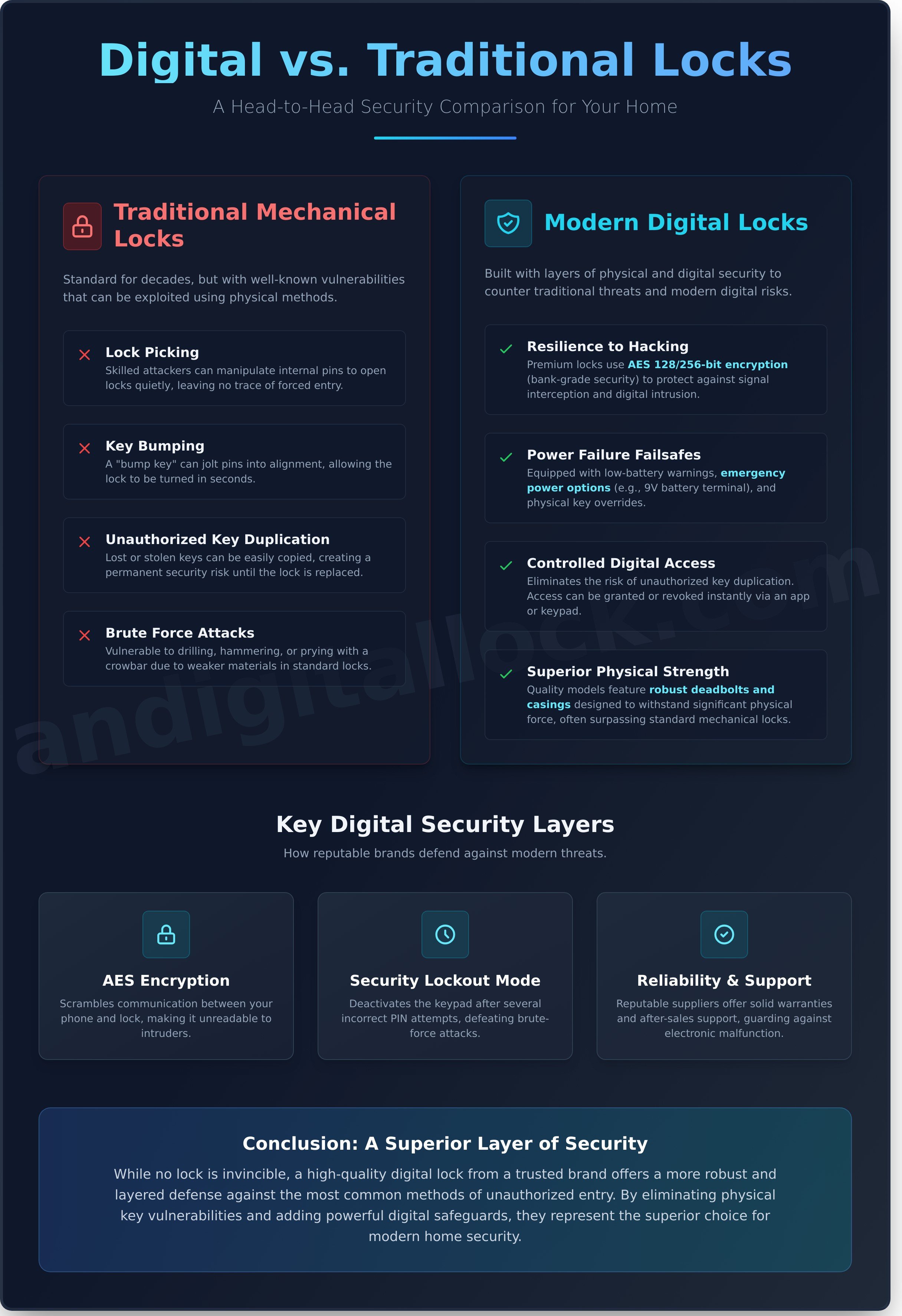
When securing your HDB flat or condo in Singapore, the choice often comes down to a familiar metal key versus a sleek, modern digital lock. It’s a classic battle of old-school reliability against new-age convenience. Many homeowners ask, is digital lock safe compared to its traditional counterpart? The truth is that no lock is completely unbreakable. True security comes from creating layers of deterrence that make unauthorized entry difficult and time-consuming. To understand which is right for your home, let's compare the most common vulnerabilities of each.
Vulnerabilities of Traditional Mechanical Locks
For decades, mechanical locks have been the standard, but they come with well-known weaknesses that criminals can exploit. These outdated methods are precisely what modern security solutions aim to prevent.
- Lock Picking: Skilled individuals can manipulate the internal pins and tumblers to open the lock quietly. With professional tools becoming more accessible, this is a significant vulnerability of older locks; click here to see examples of the equipment used.
- Key Bumping: Using a specially cut "bump key," an intruder can jolt the lock pins into alignment, allowing the lock to be turned in seconds.
- Unauthorized Key Duplication: A lost, stolen, or even a temporarily borrowed key can be easily copied without your knowledge, creating a permanent security risk until the entire lock is replaced.
- Physical Force: Many standard-issue locks are vulnerable to brute force attacks like drilling, hammering, or prying the door open with a crowbar.
Potential Vulnerabilities of Digital Locks
Digital locks offer outstanding convenience and advanced control, but their security relies on both digital and physical integrity. Understanding what a smart lock is helps clarify its potential weak points and how premium models address them.
- Hacking: Any device connected via Wi-Fi or Bluetooth has a theoretical risk of being hacked. That's why trusted brands like Philips, Samsung, and Kaadas invest heavily in advanced encryption to protect against digital intrusion.
- Power Failure: A common worry is a dead battery locking you out. Fortunately, all quality digital locks provide clear low-battery warnings and feature backup power options, such as an external 9V battery terminal or a physical key override for ultimate peace of mind.
- Electronic Malfunction: Like any electronic device, components can fail over time. This is why choosing a reputable supplier with a solid warranty and dedicated after-sales support in Singapore is crucial.
- Physical Strength: The "smart" features are only one part of the equation. Ultimately, the answer to is digital lock safe depends just as much on its physical build-the deadbolt material and casing construction must be robust enough to withstand a physical attack.
Can Digital Locks Be Hacked? Unpacking the Cybersecurity Myth
This is the number one question we hear from homeowners in Singapore: can my digital lock be hacked? It's a valid concern, and the honest answer is that not all digital locks are created equal. While cheap, unbranded models from unverified sellers might pose a risk, premium digital locks from trusted brands like Samsung, Philips, and Kaadas are built with multiple layers of advanced security to prevent digital intrusion.
Understanding these security features is key to feeling confident. The question of is digital lock safe depends far more on the technology inside than the threat from the outside. Let's break down the digital shield that protects your home.
Understanding Encryption: The Digital Shield
At the core of every premium smart lock is AES 128-bit or 256-bit encryption. This is the same level of security used by banks and governments worldwide to protect sensitive data. In simple terms, it scrambles the communication between your smartphone and the lock into an unreadable code. Whether you're using Bluetooth or Wi-Fi, this ensures that no one can intercept the signal to gain unauthorised access, giving you ultimate peace of mind.
Common Hacking Methods and How Quality Locks Defend Against Them
Reputable digital locks are designed to defeat common attack methods. Here’s how they provide a seamless and secure experience:
- Brute-Force Attacks: This is when a person tries to guess your PIN code repeatedly. Our locks feature a security lockout mode, which temporarily deactivates the keypad after several incorrect attempts, making this method ineffective.
- Signal Interception: Hackers may try to capture the signal sent from your phone. Modern locks use rolling codes and encrypted protocols, meaning the "key" changes with every use. A captured signal is useless because it cannot be replayed to open the door.
- Social Engineering: The most common security risk is human error. Always protect your PIN and smartphone access as you would your bank details. Never share your master code with anyone.
The Risk of Networked vs. Non-Networked Locks
Standalone digital locks (using only a keypad, fingerprint, or card) have no connection to the internet, which means they have zero remote attack surface. While these models eliminate digital threats, their physical security is paramount. Top brands undergo rigorous physical strength and reliability tests to ensure they resist forced entry. Networked locks (Wi-Fi or Bluetooth) offer incredible convenience, like remote unlocking for guests, but they connect to your home network. Therefore, securing your home Wi-Fi with a strong, unique password is a critical step in ensuring your smart lock's security is uncompromised.
What if the Power Fails? Backup Systems and Failsafes
One of the most common questions we hear from homeowners in Singapore is, "What happens if my digital lock runs out of battery?" It's a valid concern, but we're here to provide complete peace of mind. Premium digital lock manufacturers have engineered multiple layers of failsafes to ensure you are never permanently locked out. This layered approach to security, from digital access to physical overrides, is a core principle in modern security design. It ensures every potential failure point is addressed-a philosophy that also extends to digital security, with authorities establishing comprehensive standards like the NIST Digital Identity Guidelines to protect digital credentials. A dead battery is a minor inconvenience, not a security crisis.
Low Battery Warnings: Your First Line of Defense
Your digital lock is designed to give you plenty of advance notice before the batteries run out. For weeks, you will receive clear, unmissable alerts, ensuring you have ample time to act. These include:
- Visual Alerts: A red battery icon or a specific LED light will flash on the keypad.
- Audible Alerts: The lock will play a distinct melody or a series of beeps every time you use it.
- App Notifications: For smart locks, you'll receive push notifications directly on your smartphone, reminding you to replace the batteries.
Ignoring these repeated warnings is the only way to end up with a completely dead battery.
Emergency Power Options When the Battery is Dead
Even if you miss all the warnings, you still won't be locked out. Manufacturers have included simple emergency power solutions. Most locks feature an external 9V battery terminal. Simply touch a standard 9V battery to these contact points to provide enough temporary power to enter your PIN or use your fingerprint. Newer models from brands like Philips and Kaadas often include a USB-C port for the same purpose, allowing you to use a common power bank. This gives you immediate access to get inside and replace the batteries.
The Ultimate Backup: The Mechanical Key Override
For absolute certainty, most high-quality digital locks come with a physical key override. This traditional keyhole is often discreetly hidden under a small cover to maintain the lock’s sleek appearance. This mechanical key bypasses all electronics, guaranteeing entry during a complete electronic failure. We advise storing this emergency key securely outside your home-perhaps with a trusted family member or neighbour. These robust physical failsafes are a critical reason why the answer to the question 'is digital lock safe' is a resounding yes, as they cover every possible contingency.
Beyond Code: Assessing the Physical Strength of Digital Locks
While digital encryption and smart features are impressive, a lock is still a physical barrier. A hacker-proof digital lock is useless if an intruder can simply kick the door in or smash the lock open. When considering if a digital lock is safe, it's crucial to look beyond the code and evaluate its physical toughness. True security comes from combining smart technology with robust mechanical construction.
Let's break down the components that give a premium digital lock its strength and provide you with ultimate peace of mind.
The Deadbolt Mechanism: The Heart of the Lock
The deadbolt is your door's primary defence against forced entry. High-quality digital locks from trusted brands like Kaadas and Philips feature deadbolts that are just as strong-if not stronger-than traditional high-security locks. They are crafted from hardened steel to resist sawing and drilling. For proven security, look for locks with a high ANSI/BHMA grade, which certifies they have passed rigorous tests against brute force attacks. A secure fit into a reinforced door frame is equally critical for the deadbolt to be effective.
Casing and Material Construction
The body of the lock must protect its internal electronics and mechanics from both tampering and the environment. Leading digital locks are built with tough, durable materials to withstand attack. Key materials include:
- Zinc Alloy: Offers an excellent balance of strength, durability, and corrosion resistance.
- Stainless Steel: Provides premium resistance to impact, drilling, and weathering.
For outdoor gate locks in Singapore's humid climate, an IP (Ingress Protection) rating like IP65 is essential to ensure protection from rain and dust. Many models also include a built-in tamper alarm that blares a loud siren if it detects a physical attack, effectively scaring off intruders.
The Role of Professional Installation
Even the most advanced, physically robust digital lock can be compromised by poor installation. An improperly fitted lock can have gaps, misaligned bolts, or be loosely anchored, creating weak points a burglar can exploit. A professional ensures every component is perfectly aligned and securely fastened to your HDB or condo door, maximising its defensive capability. This guarantees the deadbolt fully extends and the lock can withstand significant force.
Our experts ensure your lock is installed for maximum security. Learn about our process.
How to Choose a Genuinely Secure Digital Lock: A Buyer's Checklist
After breaking down the technology and potential vulnerabilities, the final question is how to make a smart purchase. The answer to is digital lock safe ultimately depends on the quality of the lock you choose and where you buy it from. This practical checklist is designed to empower you to select a premium digital lock that delivers both convenience and genuine peace of mind for your Singapore home.
Essential Security Features to Look For
Not all digital locks are created equal. Prioritize models that include these non-negotiable security features to protect your HDB flat or condo effectively:
- AES 128-bit or Higher Encryption: For any smart lock that connects to your phone via Bluetooth or Wi-Fi, this is the gold standard. It scrambles the data, making it virtually impossible for hackers to intercept your digital key or PIN code.
- Automatic Lockout Mode: A critical defence against brute-force attacks. The lock should automatically disable itself for a few minutes after multiple incorrect entry attempts, deterring anyone trying to guess your code.
- Physical Key Override or Emergency Power: Technology isn't foolproof. A secure lock must have a reliable backup plan. Ensure it comes with a concealed mechanical keyhole or an external 9V battery terminal so you are never locked out.
- Built-in Tamper Alarm: This acts as an immediate deterrent. If a potential intruder tries to pry, drill, or force the lock, a loud, high-decibel alarm will sound, scaring them off and alerting you and your neighbours to the threat.
Choosing a Reputable Brand and Supplier
The hardware you choose is only half the battle; who you buy it from is just as important. Your goal is a seamless, secure experience from purchase to long-term use.
Always stick with well-known, established brands that have a strong presence in Singapore, such as Philips, Solity, Kaadas, and Zigbang. These manufacturers invest heavily in security research and product reliability. Most importantly, purchase exclusively from an authorized dealer. This guarantees your product is 100% authentic and covered by a local warranty, protecting you from counterfeit products and voided claims. Before making a final decision, read recent customer reviews and confirm the availability of local after-sales service and support.
As an authorized dealer for Singapore's leading brands, we guarantee genuine products, professional installation, and outstanding support. Shop our trusted brands and invest in your security with confidence.
The Final Verdict: Your Key to Modern, Trusted Security
So, after weighing the evidence, is digital lock safe? The answer is a resounding yes-when you choose a high-quality, professionally installed model. A premium digital lock surpasses traditional keys by offering superior encryption, robust physical construction, and reliable battery failsafes. It's not just about convenience; it's about a smarter, more controlled layer of security for your Singapore home.
At AN Digital Lock, we make that choice simple. As an authorised dealer for leading brands like Philips, Solity, and Zigbang, your security is our priority. Our promise of a hassle-free experience is backed by over 3,700 5-Star Customer Reviews and includes professional installation with every purchase, giving you complete confidence in your new lock.
Take the next step towards effortless protection. Secure your home with ultimate peace of mind. Explore our range of trusted digital locks.
Frequently Asked Questions
Is a fingerprint digital lock safer than a PIN code one?
Both options offer robust security for your home. A fingerprint lock provides unique biometric security that cannot be easily copied, shared, or observed by others. This eliminates the risk of "shoulder surfing." However, premium PIN code locks from trusted brands like Kaadas include features like random security codes to prevent guessing. The best choice often comes down to your personal preference for convenience versus specific security protocols, as both provide outstanding protection.
What happens if I forget my digital lock's master PIN code?
Rest assured, you will not be locked out. All our digital locks come with a physical override key for emergency access. We always recommend storing this key securely outside your home, perhaps with a trusted relative. Some models also allow for a factory reset, though this will erase all user data. Our professional after-sales support team is always on standby to provide a hassle-free solution and guide you through the process for complete peace of mind.
Are digital locks waterproof and suitable for Singapore's weather?
Most digital locks are weather-resistant, designed to handle Singapore's high humidity, making them perfect for sheltered HDB and condo main doors. While not fully waterproof, many models carry an IP rating (e.g., IP54) that protects against dust and water splashes. For gates directly exposed to heavy rain, we offer specific outdoor-rated models built to withstand the elements, ensuring your lock remains reliable and secure year-round.
Can a digital lock be bypassed with a magnet?
This is a common myth concerning older, low-quality locks. Modern digital locks from leading brands like Philips and Samsung are engineered to be completely immune to magnets. They are built with non-ferrous materials and advanced solenoid mechanisms that cannot be manipulated by strong magnetic fields. You can be confident that our premium, trusted digital locks are designed to prevent such bypass methods and keep your home secure.
How long do the batteries in a digital lock typically last?
On average, the batteries in a digital lock last between 6 to 12 months, depending heavily on usage. Your lock is designed to give you plenty of warning before the power runs out, usually with a flashing LED light, a specific tune, or a voice alert. In the unlikely event the batteries die completely, you can use a standard 9V battery to temporarily power the lock from the outside for seamless entry.
Is professional installation for a digital lock really necessary?
Yes, we strongly recommend professional installation to guarantee security and functionality. The answer to "is digital lock safe" often depends on correct installation. Our trained technicians ensure perfect alignment with your door and frame, preventing operational issues and potential security gaps. A DIY installation can damage the lock, compromise its integrity, and may even void your warranty. Investing in our expert service ensures a seamless setup and your ultimate peace of mind.